Hello everyone!
I’m looking to connect with people interested in:
- AI tips and workflows
- Where AI is headed
- Building apps
- Creative UI and animation
- Open source
- Building in public
Let’s connect 🤝
@k0r37k1 Glad to see Semantics getting attention!
That’s built into the approach too 🙂 Decorative paint is excluded from semantics; native text and controls carry the labels, actions and selected state. We test the semantics tree as well.
One of the things I’m building with AI is an app that feels like stepping into a handmade, illustrated world.
I took some of the rendering components behind that experience and turned them into an open-source Flutter library. Here’s what they can do.
handcrafted_flutter
Fully implemented by Sol (6.1 and 6.2). Reviewed by Astra.
https://t.co/wtZzzEODsY
@AKhomssi For local dictation, the number I’d care about is the pause between releasing the hotkey and seeing the text at my cursor. That’s what makes it feel like part of the editor.
@FlutterDev@lildeimos Procedural drums are a great demo for this. I’d love to hear the same pattern while the UI is busy, especially with a fast scroll or animation running.
@LeilaniMolina_ The shortlist of three ads is where I’d keep a human check. I’d ask the system for the exact timestamp and why it picked each one, then decide which ideas are worth adapting.
As AI writes more code, can review keep up?
A year after firms adopted AI coding agents, monthly pull request merges per active engineer were up an estimated 26%. Nearly two extra days to merge the ones that made it through. [1]
Fiona Chen and James Stratton’s Nov. 19 working-paper revision draws on 655 Jellyfish customer firms. The estimated delay was 1.99 days from a 3.56-day baseline, with an approximate 95% interval of +0.74 to +3.24 days. For the merge gain, the interval was about +2% to +50%. [1]
The researchers compared adopters with firms that had yet to adopt and estimated the change on top of earlier AI assistant use. PR openings per active engineer-month rose an estimated 35.7%. Jira coding issue resolutions rose an estimated 13.7%, with an interval that includes zero. These are separate outcomes. How many more changes reached customers is still open. [1]
In 83% of observed reviews, the reviewer had already committed code or opened a PR in that codebase. Firms that worked across the most repositories from October 2023 through March 2024 saw an estimated 70% increase over their group’s baseline merge time, versus 25% for firms that worked across the fewest, even though PR openings grew less. The split can also reflect how firms organize review. [1]
Among merged PRs with a comment from another person, both the wait for that first comment and the time from comment to merge grew. Queues, a change in which PRs reached merge, or more scrutiny could all contribute. The clock measures elapsed time. [1]
Coralogix reports that its own median time to merge fell from 3.1 to 0.9 days after it automated the first pass and kept design and risk with human reviewers. That’s one company’s before-and-after median. The paper estimates a change in mean elapsed time across firms. For engineering teams and review-tool vendors, the open question is whether comparable changes can get through with fewer human hours. [2] [1]
The number I’d watch is the cost of a comparable change that reaches production and holds up there. Count the agent bill, reviewer time, and rework. If the first patch gets cheaper and that total stays flat, where did the savings go?
[1] Fiona Chen and James Stratton, Artificial Intelligence in the Firm: Bottlenecks in Software Production
https://t.co/PhQXLIlJqB
[2] Coralogix Engineering Benchmarks, July 2026 delivery entry
https://t.co/3vZbyMuQZt
@k0r37k1 The materials are custom-painted around native Flutter text and controls. System font scaling stays in place, and the examples wrap and reflow as labels grow. We test narrow layouts at 200–250% text scale, including selected buttons.
AI Math Progress by Lab (November 2026)
In Haider’s November 25 tally of 100 prominent math problems,
OpenAI recorded progress on 16 (4 claimed solutions and 12 partial advances). Anthropic had 3 claimed solutions, and Google DeepMind made partial progress on 3.
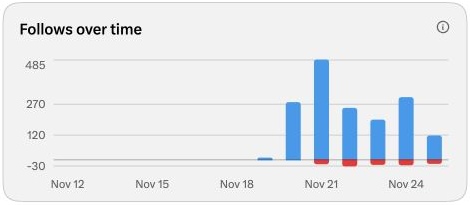
I just hit 1.5K followers here in my first week!
Thank you, X!
If you’re building with AI too, I’d love to see what you’re working on. Let’s compare notes.
@AnthropicAI The part I like is keeping the Python service as a reference while Rust catches up. You can turn each mismatch into a regression test without having to guess what clients already rely on.
@atticoos@RelayRunnerCI Queue time would be a useful number to show next to savings. A cheaper runner is a great fit for a nightly build, but I’d pay more to get a quick answer on a PR.