SoftBank founder and CEO Masayoshi Son reportedly approached Wall Street about financing a roughly $1 trillion takeover of SK hynix, according to an exclusive report from TheElec.
The figure, about 1,470 trillion won, was nearly double the memory chipmaker's market value of 786.7 trillion won at its latest close. SoftBank says it is exploring various opportunities but is no longer actively considering this one.
The idea emerged as Hynix shares have slid from a 52-week high of 2.987 million won to 1.113 million won, a drop of about 63 percent. $SKHY
South Korea's memory chip exports jumped in the first 20 days of November, according to TRASS-BF data.
DRAM shipments, including modules, reached $23.38 billion, up 574% from a year earlier, while SSDs hit $3.43 billion (+447%), MCPs $7.88 billion (+275%) and NAND $1.94 billion (+217%).
Export unit values surged too: DRAM rose 350%, SSD 400%, NAND 298% and MCP 139%. SSD exports also climbed 55% from early October.
Yet Samsung Electronics and SK hynix shares remain under heavy selling pressure, an unusual divergence between current export performance and equity prices.
South Korea's memory chip exports set records across every category in the first 20 days of November, according to TRASS data based on customs figures.
DRAM shipments excluding modules reached $14.42 billion, up 551% from a year earlier and 32% from early October. Including modules, DRAM climbed to $23.38 billion.
HBM-based MCPs hit $7.88 billion, SSDs $3.43 billion and NAND $1.94 billion. Prices surged too: DRAM, including modules, rose 350% year over year and 22% month over month, a trend investors in SK hynix, Samsung, Micron and SanDisk are watching. $SKHY
Nvidia shares plunged roughly 13% on Friday after Reuters reported that the U.S. Securities and Exchange Commission is examining potential accounting issues at the chipmaker.
The inquiry’s scope and timing remain unclear, and it does not establish wrongdoing.
The decline extended a seven-week slide, leaving the stock about 46% below its October record and wiping out roughly $2.7 trillion in market value.
The selloff also intensified broader technology-market losses, exposing index funds and retirement accounts to further volatility for investors. $NVDA
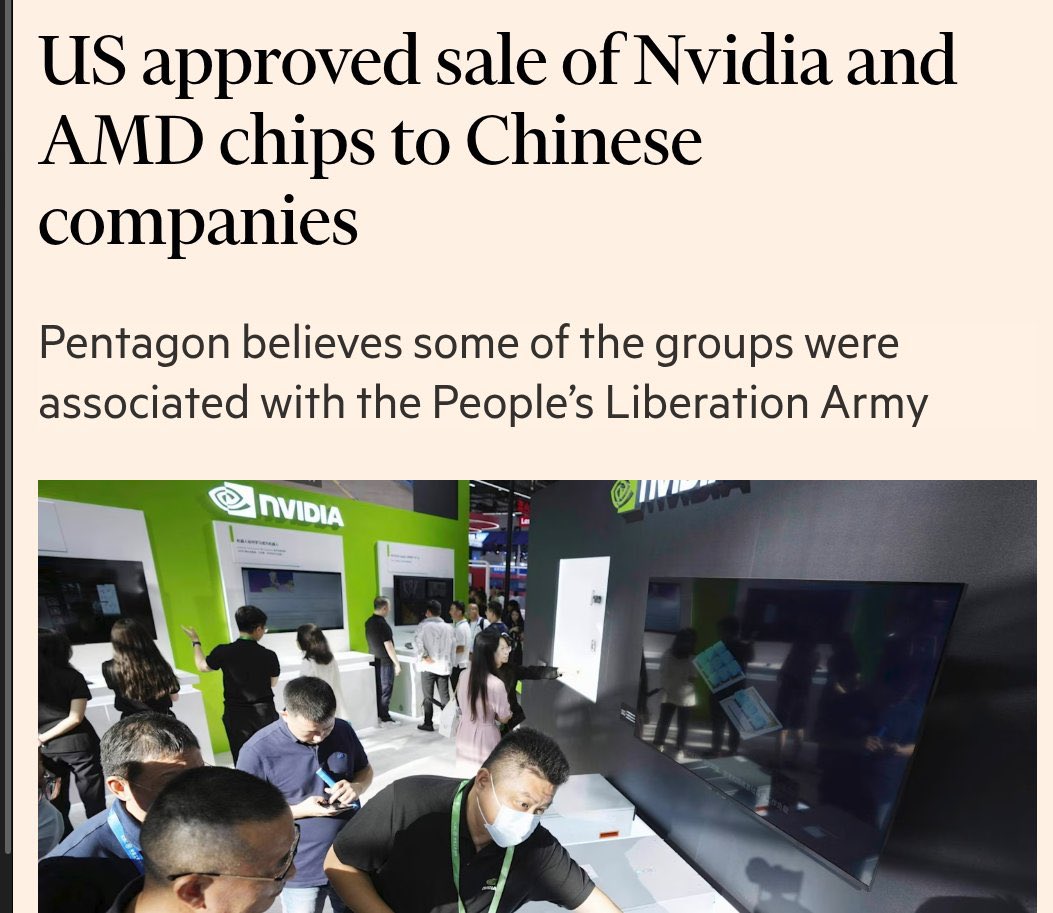
U.S. regulators approved licenses covering 879,868 advanced AI chips for Chinese buyers by May 11, 2026, far below the 3.44 million Nvidia and AMD sought, newly released House Foreign Affairs Committee records show.
The applications covered Nvidia’s H200 and AMD’s MI325X processors, with intended customers including Alibaba, Tencent, Baidu and BYD-companies identified on the Pentagon’s Chinese military companies list.
Every application characterized diversion risk as low. The approvals did not confirm delivery: records marked all authorized chips as not shipped.
Claims that Jensen Huang has resigned from NVIDIA remain unverified. Despite concerns about AI valuations and historical comparisons with Apple and the dot-com bubble, investors should distinguish market speculation from confirmed leadership changes.
AI's long-term potential does not eliminate the risk of significant stock market corrections. $NVDA $AAPL
President Donald Trump has voiced support for reinstating Jensen Huang as Nvidia’s CEO, saying he would welcome his return.
Huang resigned on November 11, 2026, and Nvidia’s board has since rejected reinstatement, despite growing support from prominent technology executives. $NVDA
Samsung Electronics on November 20 announced its 2027 executive appointments, preserving the dual-CEO structure while elevating frontline leaders.
Vice Chairman Young Hyun Jun remains head of the Device Solutions division and co-CEO, while President TM Roh continues as head of the Device eXperience division and co-CEO.
Roh steps down from the Mobile eXperience role he held since early 2020, with Choi Won-joon taking over after serving as MX chief operating officer and leading the Galaxy S26 and Z Fold8 launches.
Roh will focus more on new areas including robotics. On the semiconductor side, the company promoted three executives to president: Hwang Sang-joon as head of Memory Business, Cho Sangyeun as head of System LSI, and Lee Jong-myeong as Device Solutions chief technology officer.
The moves aim to sharpen competitiveness amid strong AI-driven chip demand.
SpaceX has secured approximately $44 billion in GPU-backed financing arranged by Apollo and Goldman Sachs to fund its next-generation AI computing infrastructure. The deal will finance Nvidia Vera Rubin processors, with lease payments beginning in the first half of 2027.
Markets now assign a 96.9% probability to a 0.25-percentage-point Federal Reserve rate hike in December, up from 76.3% a month earlier, according to CME FedWatch data. Investors are closely watching inflation and the Fed’s updated 2027 economic projections.
UBS has lowered its sterling forecasts, expecting a resilient U.S. economy and the prospect of further Federal Reserve tightening to keep the dollar firm into early 2027.
The bank now sees the pound at $1.33 in March and $1.36 in June, down from $1.39 and $1.41. Sterling traded near $1.32 on Nov. 18.
UBS still favors the currency, citing solid UK activity, a hawkish Bank of England and heavy short positioning, and expects gains once U.S. disinflation revives rate-cut debate. It trimmed euro-dollar targets, seeing 1.12 by March from 1.18.
Not yet. Anthropic mathematician Levent Alpöge claims Claude helped prove the 167-year-old Riemann hypothesis, but independent verification remains pending.
Even if confirmed, that wouldn't guarantee Anthropic's valuation or protect markets from an AI-driven financial correction. Scientific breakthroughs aren't investment guarantees.
Federal Reserve Governor Lisa Cook has warned that the September interest rate increase was insufficient to bring persistent U.S. inflation under control.
Cook believes the central bank's current monetary policy stance is not restrictive enough to ease price pressures.
She cautioned that delaying further rate increases could allow inflation expectations to become entrenched, potentially forcing the Fed to implement larger hikes later.
Her comments reinforce concerns about the persistence of inflation and the possibility of additional monetary tightening.
President Donald Trump has renewed his criticism of the Federal Reserve, arguing that political considerations are keeping U.S. interest rates higher than necessary.
Trump claimed policymakers repeatedly increase rates despite positive economic data. While saying he was not blaming individual Fed chairs, he described the central bank as politically influenced.
He also insisted the United States should have the world's lowest interest rates, intensifying his pressure for cheaper borrowing costs.
Nvidia’s Vera Rubin platform generated nearly $20 billion in its first quarter of production shipments, which the company calls its fastest product ramp ever.
Rubin made up roughly 17% of the $115.8 billion in revenue reported for the quarter ended October 25. Hyperscale sales climbed 23% sequentially to $60.1 billion, while AI cloud, industrial and enterprise revenue rose 18% to $47.5 billion, helped by neocloud Rubin deployments.
Nvidia says hyperscalers brought systems online in about a month, and claims Rubin delivers ten times GB300’s tokens per watt on MLPerf Endpoints. $NVDA
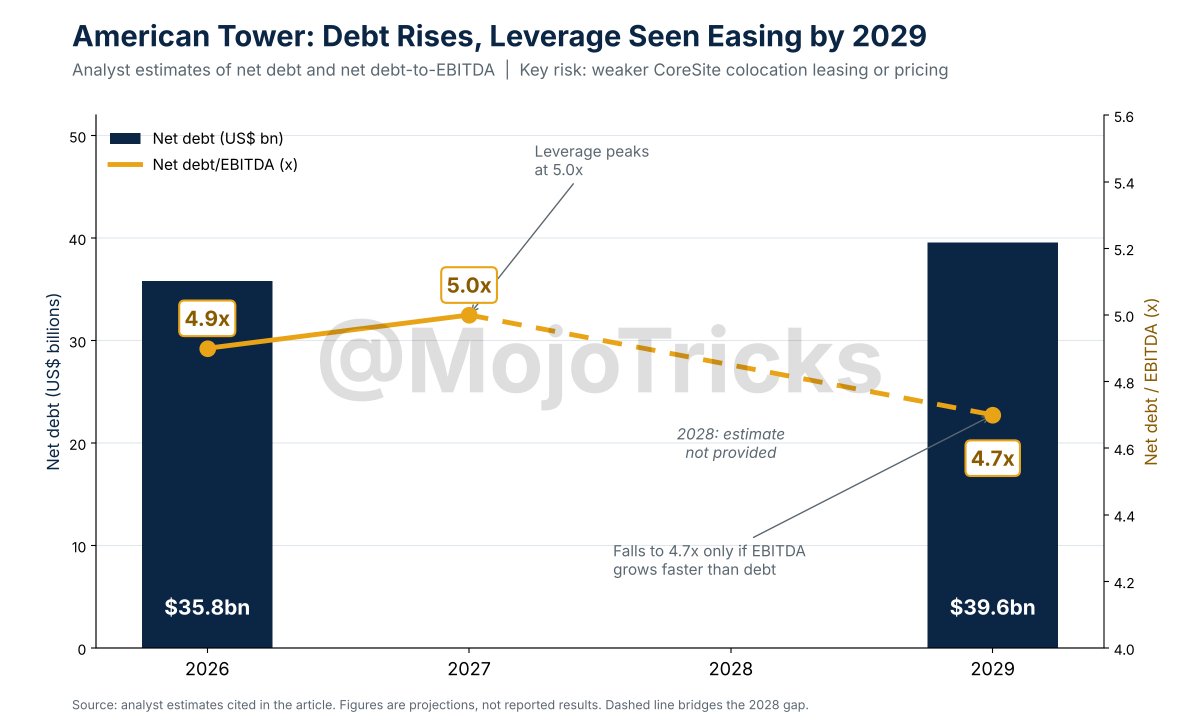
American Tower’s leverage could ease even as its borrowings grow, according to analyst estimates.
Net debt is projected at about $35.8 billion in 2026 and $39.6 billion in 2029, while net debt-to-EBITDA is forecast to edge up from 4.9x to 5.0x in 2027 before falling to 4.7x in 2029.
That improvement depends on EBITDA growing faster than debt, with U.S. wireless investment currently in a lull.
Analysts see slower leasing or weaker pricing at its CoreSite colocation business as the main risk; a shortfall would then push leverage above 4.7x.
Lenders backing SpaceX’s $43 billion Project Saturn financing have reportedly pushed for restrictions preventing Nvidia AI chips used as collateral from being launched into orbit.
According to the Financial Times, creditors fear recovering and reselling the hardware could become difficult if SpaceX defaults.
SpaceX says the chips are intended for Earth-based data centers. However, it remains unclear whether lenders secured the proposed restriction in the final financing agreements. $SPCX
President Donald Trump has threatened to impose a “tremendous tax” on U.S. technology companies that build AI data centers outside the United States.
Speaking at a November 20 press conference, Trump argued that overseas construction could benefit China, declaring, “China will take all of them.”
He provided no details about potential tax rates or implementation. According to the Associated Press, Trump also acknowledged that he had not yet informed administration officials about the proposed measure.
NVIDIA has raised its fiscal 2028 revenue-growth outlook to 75%, up from 70%, citing stronger AI-computing demand and improved supply.
The company said its Vera Rubin platform generated nearly $20 billion in its first production-shipment quarter, making it the fastest product ramp in its history.
That supports the view that AI infrastructure spending remains robust, but does not verify claims that Rubin is ramping at twice Blackwell’s pace.
Investors should weigh the outlook against valuation, competition and execution risks ahead. $NVDA
Rumors suggest NVIDIA CEO Jensen Huang could potentially raise capital to launch another chip company.
His industry connections, access to funding, and experience building NVIDIA into an AI powerhouse could give him a major advantage.
A new venture could rely on TSMC for manufacturing, avoiding the need for expensive fabrication facilities.
However, claims that a competing chip platform could emerge within 18–24 months remain speculation, not confirmed plans.
Any new company would still face significant engineering, software, and market challenges. $NVDA