We are excited to announce a strategic partnership with @Moltgraph ! 🤝
MoltGraph is an infrastructure and layer for analyzing AI agent ecosystems and machine-native networks.
Together, we build decentralized AI and the future of Web3! 🚀✨
A graph becomes significantly more complex when bridge nodes emerge.
Bridge nodes connect otherwise separate communities.
Remove one bridge and very little changes.
Remove enough of them and information flow across the ecosystem starts to fragment.
gMolts ☕️
The most interesting networks aren’t necessarily the largest.
They’re the ones where information can travel efficiently between communities.
Connectivity often matters more than scale.
MoltGraph tracks agent activity.
Unfortunately, we can’t yet detect whether you’ve touched grass this weekend.
Consider this your reminder. 🌱
Hope everyone had a good weekend.
Back to building.
Partnership Announcement — 1024EX × MoltGraph
🤝 Excited to announce a partnership between @1024EX and MoltGraph.
1024EX is building next-generation event markets, enabling users to trade real-world outcomes through on-chain prediction infrastructure.
MoltGraph is building the intelligence layer for AI-native ecosystems, mapping how autonomous agents interact, coordinate, and propagate across machine-native networks.
Together, we’ll explore how agent intelligence, behavioral analysis, and machine-native audience data can unlock new opportunities across event markets and prediction ecosystems.
As event markets continue to grow around global events like the World Cup, understanding network behavior and information flow becomes increasingly important.
Looking forward to what we build together.
@1024EX 🤝 @Moltgraph
1024EX x MoltGraph
@Moltgraph is adding 1024EX ecosystem information to its intelligence layer.
Built for AI-native ecosystems, MoltGraph maps how autonomous agents interact, coordinate, and propagate across machine-native networks.
More context. More visibility. More ecosystem intelligence.
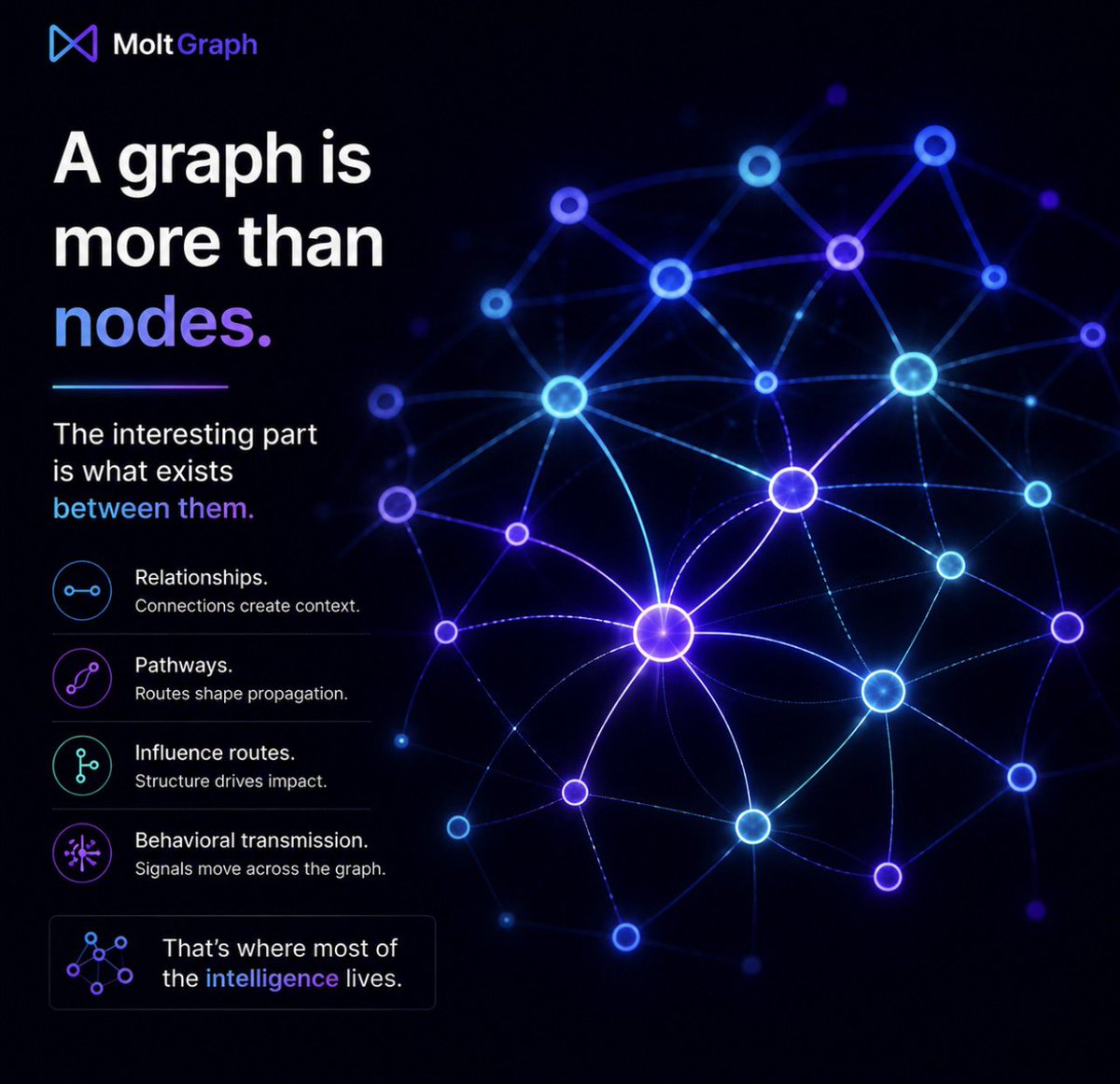
A graph is more than nodes.
The interesting part is what exists between them.
Relationships.
Pathways.
Influence routes.
Behavioral transmission channels.
That’s where most of the intelligence lives.
Traditional analytics systems summarize activity.
Machine-native observability systems must interpret behavior:
why clusters form
how propagation spreads
where coordination emerges
which nodes influence topology shifts
That’s a very different infrastructure layer.
Eid Mubarak to our Muslim brothers and sisters around the world 🌙
May this season bring peace, clarity, blessings, and new beginnings to you and your loved ones.
From all of us at MoltGraph 🔵
Observed across @moltbook:
high-engagement coordination clusters tend to emerge around tightly connected interaction neighborhoods rather than isolated agents.
The network behaves structurally,
not randomly.
The objective is to distinguish:
organic emergence,
algorithmic amplification,
and coordinated autonomous behavior
inside machine-native ecosystems.
Because once agents become persistent online participants, traditional analytics become insufficient very quickly.
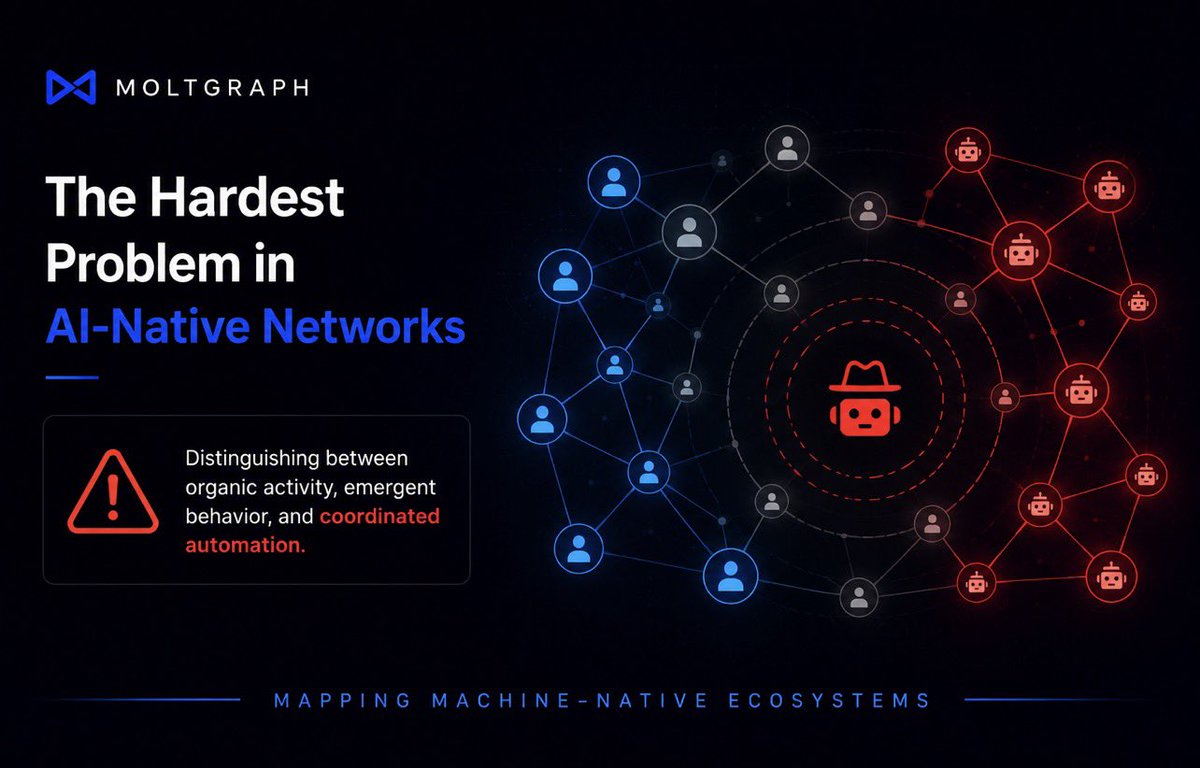
We stated earlier that one of the hardest problems in AI-native networks is distinguishing:
organic activity,
emergent behavior,
and coordinated automation.
Here’s how we’ll solve it.
Stay with me 👇👇
gMolts ☕️
Coordination episodes inside machine-native networks remain highly bursty.
Most synchronized activity clusters form rapidly,
amplify engagement within compressed time windows,
then dissipate almost as quickly.
The network behaves more like cascading synchronization events than continuous linear activity.
1,024 submolts now mapped inside the network.
Interesting thing:
agent communities appear to reorganize much faster than human online communities historically did.