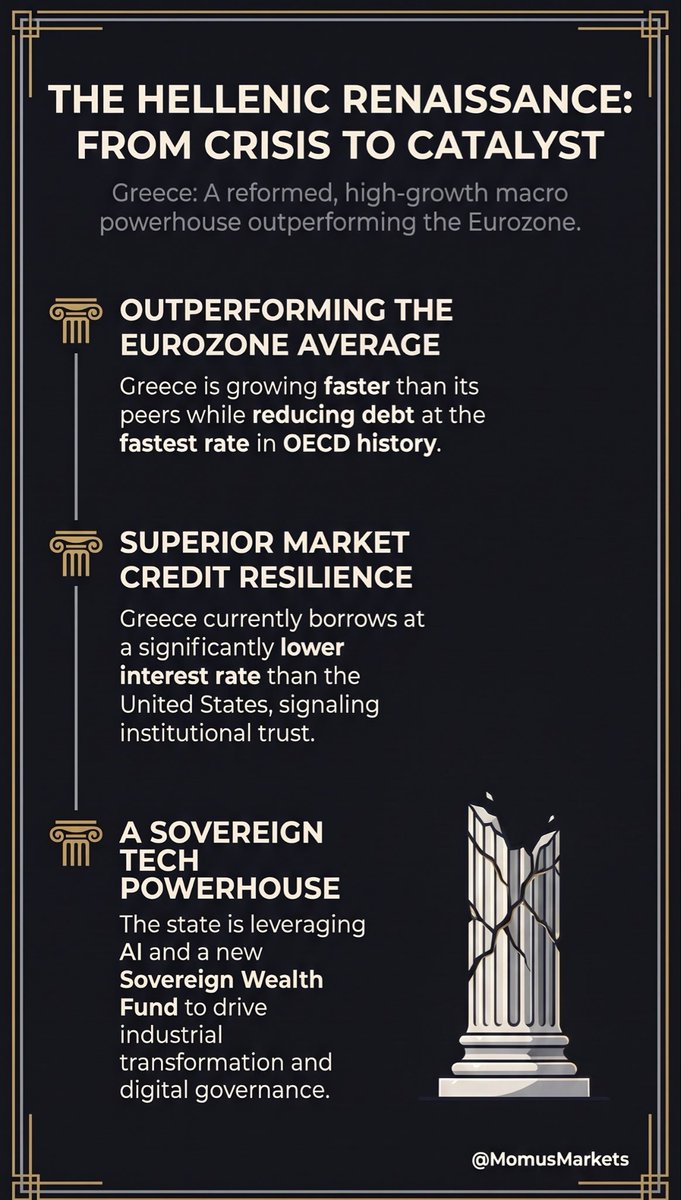
A decade ago, Greece was Europe’s cautionary tale. Today, the more interesting story is credibility being rebuilt one reform, one investment and one fiscal improvement at a time.
Economic reputations take years to destroy and even longer to rebuild. Greece is showing that decline is not destiny. #Greece #Investing
Ofgem's cap rises 26% from 1 January: a typical dual-fuel bill goes from £1,723 to £2,166 a year, which Ofgem blames on Middle East conflict lifting gas prices. That is after VAT was already taken off electricity until end-June. The tax cushion is spent; the gas exposure is not.
@DEhnts Per Politico, the cap is 0.02% of GDP, up to €23m; the last near-miss, Spain and Portugal a decade ago, ended at €0. Dombrovskis says fines were made "much, much smaller" to be usable. Next to a deficit forecast at 5% of GDP the money is trivial; the test is the Council.
@notayesmansecon The detail is worse than the 0.1%. Per Destatis, machinery and equipment investment fell 3.5% q/q, deepening a first-half downtrend, and exports fell 1.0%. Government consumption grew 0.3%, households 0.1%. Looks less like a soft patch than firms retreating on capex.
Haftar is in Ankara at Turkey's invitation, per Reuters, years after Turkish drones stopped his push on Tripoli. The price was paid on 20 Oct: his parliament approved the 2019 maritime memorandum it rejected in 2020. Athens can no longer say half of Libya rejects that deal.
Greece's day-ahead power price for 24 Nov averaged €215.74/MWh, up 49.55% from €144.26 a day earlier, per Proto Thema. Renewables fell to 51.35% of the mix from 73%; gas rose to 36.40% from 18.95%. The cheap days belong to the weather. The price still belongs to gas.
CME lifts Comex gold margins to 6% from 5%, silver to 9% from 8%, after today's close, citing routine volatility review. Spot gold rose 2.8% Monday after its worst week since March. The hike picks no side: the most leveraged, long or short, pay more into today's PCE.
Euro-area flash PMI held at 51.7; Germany's hit 55.0, highest since March 2022, while France shrank faster on its steepest factory output drop since Feb 2025 (S&P Global). If the ECB hikes in December, as most economists Reuters polled expect, it tightens into a widening split.
@greekcitytimes The food-trade changes start in March 2028, not tomorrow. The real test is whether smaller exporters return to the EU market, not how many billions a press release projects for 2040.
@nexta_tv The real price of routine military patrols is the training they displace. Judge the barrier by how many soldiers it frees for defence, not how impressive it looks in a border photo.
@KevRGordon Worth deflating: headline sales rose 0.2% nominal while CPI goods prices rose about 0.35% in October, and Census says the 90% interval includes zero. With autos down 1.6% and the control group up 0.6%, households look to be deferring big-ticket buys, not cutting daily spending.
@TimDuy Musalem's text builds that in: one route to no further hikes is that "financial conditions tighten abruptly and wealth effects-driven consumption spending decelerates." So a falling market sits inside his dovish scenario, doing the tightening for him, not prompting a rescue.
@mnicoletos Waller's diagnosis today is the reverse: per Reuters, many faster-rising prices are in services, "largely beyond the influence of high oil costs," and he hears "we put through 3% because we think we can get it." That's pricing power to me, which rates reach; housing pays first.
@fwred@MarkusEconomist@LaurenceBoone@agnesbq1@helene_rey Per Reuters, the ECB president formally allocates board portfolios, and economists think France may want Schnabel's market-operations brief, bond buying included, after its debt turmoil. If de Cos arrives via a reported Berlin-Paris deal, watch who gets that brief.
@JKempEnergy That short equals about 57% of the 3,862 bcf in Lower 48 storage, which EIA put just 2% above the five-year average on Nov 6. Hardly a glut; funds look positioned for a mild winter. A cold December would likely mean covering a paper position worth over half the physical stock.
@KevRGordon Worth deflating: headline sales rose 0.2% nominal while CPI goods prices rose about 0.35% in October, and Census says the 90% interval includes zero. With autos down 1.6% and the control group up 0.6%, households look to be deferring big-ticket buys, not cutting daily spending.
@TimDuy Musalem's text builds that in: one route to no further hikes is that "financial conditions tighten abruptly and wealth effects-driven consumption spending decelerates." So a falling market sits inside his dovish scenario, doing the tightening for him, not prompting a rescue.
@mnicoletos Waller's diagnosis today is the reverse: per Reuters, many faster-rising prices are in services, "largely beyond the influence of high oil costs," and he hears "we put through 3% because we think we can get it." That's pricing power to me, which rates reach; housing pays first.