@JasonBourne1986 Nobody mentioning just how bad Fatawa was and all his errors led to problems, hate having a winger who only cuts inside, one trick pony
@Callum_Boyle_ Dead right, defenders know he will cut in every time he gets the ball so easy to defend.
We don't have wingers who cross the ball early and from the byline it's why the strikers stop making runs, oh to have an Albrighton or Guppy
@StringerSport We have wingers that always cut inside, easy to defend and impossible for any striker to make a run. They never cross the ball.
They have killed our attacking game and where are the coaches?
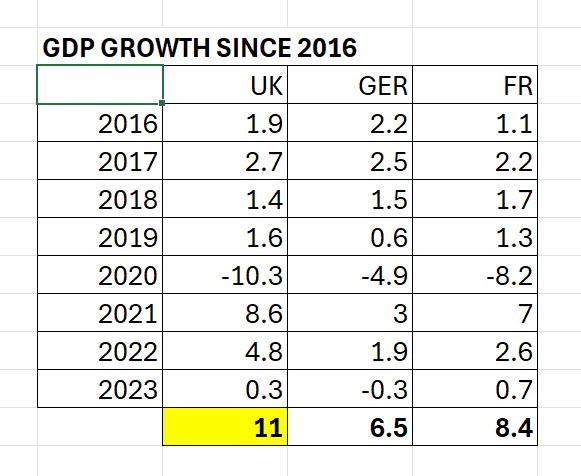
The UK/EU reset has reignited the claim in much of the media that Britain’s GDP is 4% lower than it would have been but for Brexit, citing the Office for Budget Responsibility (OBR). It was just cited yet again on @GMB Good Morning Britain, as it has all over the place.
But it is not what the OBR said. Since March 2020 the OBR has argued that Brexit will reduce the UK’s long-run potential productivity by approximately 4%. It is not an estimate of an immediate or annual GDP loss — much less one that has already happened — but a long-term reduction in the economy’s productive capacity which will take OVER 15 YEARS to materialize fully.
The OBR argues this on the well-founded economic basis that free trade boosts productivity and trade barriers reduce it over time. Hence the potential long-term hit to GDP because, even with the EU/UK free trade agreement there will be more trade barriers than before.
At no stage does the OBR claim Brexit is a direct 4% annual GDP loss — as the media so often repeats — but a lower growth trajectory over time i/e GDP could be 4% lower than otherwise by 2035.
The OBR projection is based on an assumption of a 15% reduction in trade intensity (exports plus imports as a share of GDP) over time. If that proves pessimistic, the 4% projection will be too high. If optimistic, too low