Have you demanded disclosure labels for all the other technologies that have produced "slop" over the last 30 years?
IntelliSense Slop™
Normal Map Slop™
SpeedTree Slop™
Visual Scripting Slop™
PBR Material Slop™
Substance Painter Slop™
Megascans Slop™
Mixamo Auto-Rigging Slop™
Motion Capture Slop™
Humanoid Retargeting Slop™
Procedural Generation Slop™
Blueprint Slop™
Modular Asset Slop™
LOD Slop™
Let's be real. You had no fucking idea what tools or workflows went into making half the games you've loved and played.
But now you've heard of AI, you've decided it's scary, and suddenly you want warning labels slapped on everything it touches.
You never cared how the sausage was made. You just found a new reason to be outraged.
Enemy Types 💀
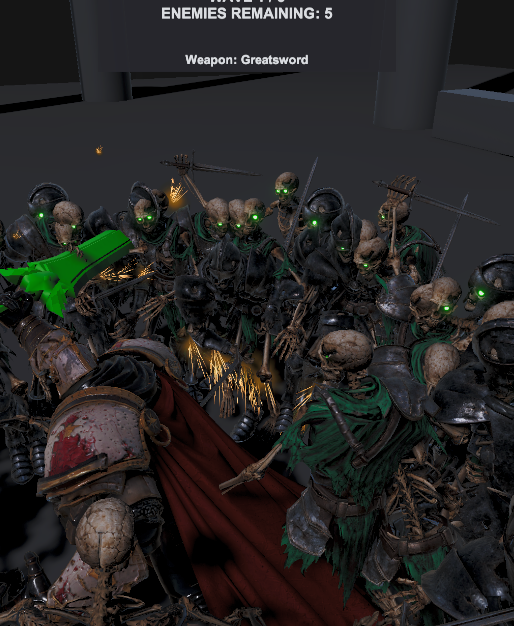
Starting to get more enemy variety in, and a new weapon appears! Bow to my Untextured Claymore of Involuntary Baptism +1.
Knocking these skeleton chumps around with a giant sword is going to feel reeeeeally good.
I'm also starting to think more about classes / abilities.
Right now I'm liking the idea that the Crusader should want to be in the middle of the horde; the more surrounded he is, the stronger he gets.
Still early, though. For now I'm mostly focused on building weapons, enemies, and skills that are just fun as hell to use.
Then I'll figure out how they all map together into class fantasy and balance.
ENEMIES! 💀
Got the first unholy enemies spawning, chasing players, and taking damage.
-Server-authoritative enemy spawning
-Basic navigation and player targeting
-Health, damage, and death
-First pass at enemy hit reactions
-Stress testing with larger groups
Watching a swarm of these fuckers get absolutely shredded is ridiculously satisfying.
Next up: different enemy types to smite and proper wave spawning!
Shooting & ADS ⚔️
Moving from locomotion into shooting mechanics.
Hip-fire and right-click ADS
Camera and aiming transitions
Recoil and weapon spread
Vertical camera smoothing to reduce animation-driven bounce while moving
Tuning movement and aiming together so neither feels compromised
One of the bigger challenges has been keeping the weight of the character's movement without transferring every little vertical motion into the camera.
Still tweaking, but the shooting is starting to feel good.
Oh, and you can also see a sloppy first pass at texturing my boy, plus a sneak peek at his weapon design. 👀
Locomotion 🏃
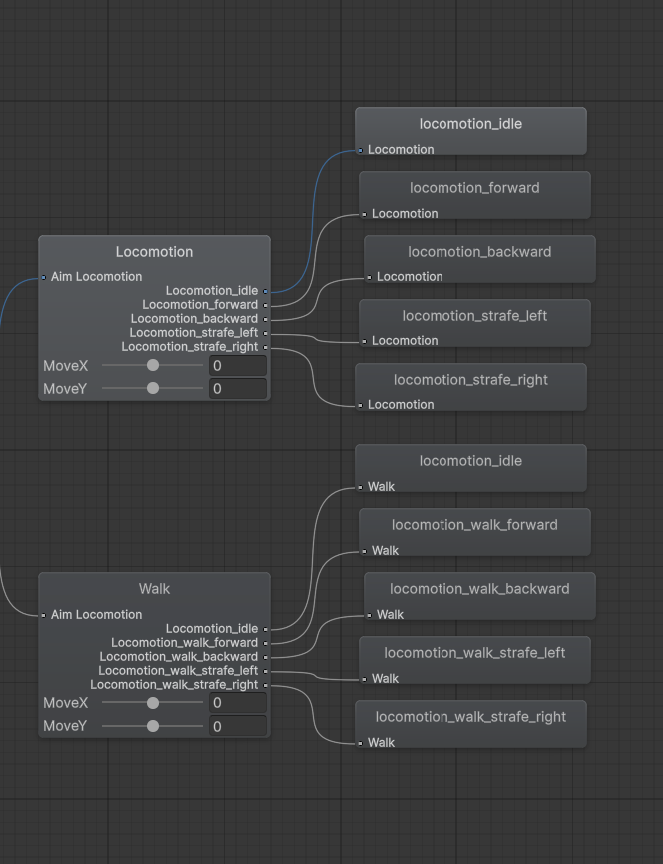
Been dialing in the third-person locomotion system.
Directional movement with strafing and backpedaling
Camera-driven facing, independent of movement
Upper/lower body animation masking
Separate walk/run blends
Idle and ADS transitions
AI has been a huge accelerator for implementation, but the architecture, system design, and feel are driven by me.
Knowing what to build, how the systems should work together, and recognizing when something feels wrong is where game development experience really matters.
AI helps me build faster. It doesn't make those decisions for me.
Still polishing, really should get a turn animation on those legs next 😬, but it's coming together!
Couldn't agree more, Tim.
I've been making games professionally since 2007. I've seen this cycle countless times. Every new tool gets called a shortcut until it becomes standard practice.
AI has supercharged workflows I've spent decades refining, and I think we're barely scratching the surface of what it can do for game development.
It's not just typing "MAKE GAME" into a prompt.
Right now, everyone's focused on the flood of AI-generated clones. Another Diablo clone, another generic survival game, another barely functional prototype.
Meanwhile, experienced developers are quietly integrating AI into established workflows, building ambitious games from the ground up.
They're not replacing their creative process. They're removing bottlenecks, iterating faster, and spending more time pushing their ideas beyond what was previously practical.
I think the next 6–12 months are going to surprise a lot of people when these projects start hitting the market.
And the best part? Players won't even know AI was involved.
Just like they don't know which environments use SpeedTree, which textures were made in Substance, or which characters were auto-rigged with Mixamo.
They'll just see a fucking great game.
AI-Assisted Game Development 🪜
I've been making games professionally since 2007, and AI has been an absolute supercharger for workflows I've spent years learning and refining.
I've watched plenty of technologies come along that were supposedly going to replace us. Every few years there was another "they took eer jerbs!"
Remember when...
- Unreal / Unity: "Real developers build their own engines! Now anyone can make a game!"
- ZBrush: "You're not a real 3D artist if you can't box model!"
- Wacom tablets: "That's not real drawing! Try doing it with a pencil!"
- PBR: "The shaders do all the work now! Artists don't even have to know how to texture!"
- Substance / Quixel: "You're just dragging sliders around and using premade materials!"
- Modular character creators: "You're not modeling anything! You're just playing dress-up with someone else's assets!"
- Mixamo auto-rigging: "Rigging takes actual skill! Now any idiot can rig a character with one click!"
- Motion capture: "That's not animation! You're just recording someone moving instead of actually animating!"
And the list goes on. It was all "slop", until it wasn't anymore.
Ever notice how some of the loudest gatekeepers are still circulating the same tired portfolios on LinkedIn, looking for increasingly narrow roles built around workflows they refuse to move beyond?
You can call it "adapting" if you want, as though progress is something being forced upon you.
But I've never looked at it that way.
Imagine spending your entire career painting in black and white, and someone hands you color. That's what these technologies represent to me.
Not shortcuts. Opportunities.
Opportunities to realize your vision faster, get closer to what you actually imagined, optimize the tedious parts of production, and spend that reclaimed time pushing your work further than you originally thought possible.
AI isn't a replacement for experience, creativity, or technical knowledge. It's a force multiplier for all three.
And as an indie developer trying to bring an ambitious vision to life, that's a hell of an advantage.
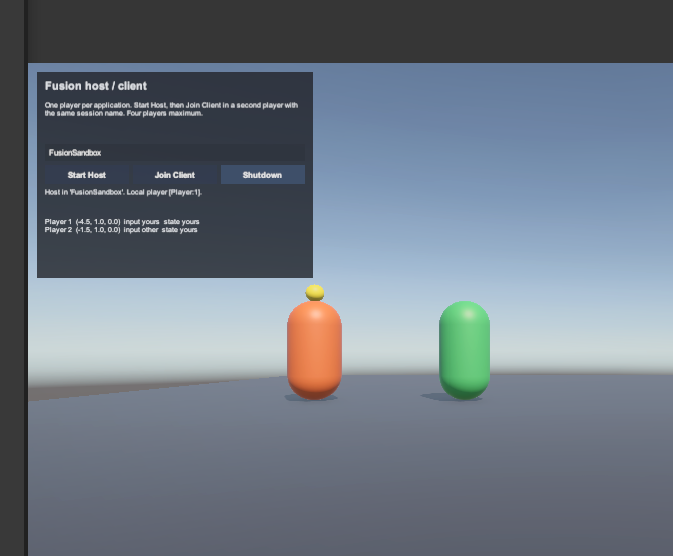
Leaning toward Fusion 2 Host Mode for launch. It’s looking promising, though I still need to test real-world latency and heavier combat loads.
Host advantage, connection quality, and handling host disconnects are tradeoffs, but they seem reasonable for a co-op PvE horde shooter.
Dedicated servers are still on the table if testing gives me a compelling reason to take on the hosting costs and operational overhead. Still learning and keeping my options open. 🤔
Multiplayer Foundations
If I'm going to build a coop horde shooter, multiplayer needs to be at the foundation, not something bolted on later.
I started with Unity's Netcode for GameObjects (NGO). Got the basics working: hosting, client connections, spawning, server-authoritative movement, and synchronization.
But as I started dialing in the movement, I wasn't happy with how it felt. The host was responsive, but remote clients still had that slight snapshot/interpolation feel.
For a third person action game, responsiveness is non-negotiable.
So I decided to evaluate Photon Fusion 2.
Rather than immediately ripping everything apart, I spun up a separate Unity sandbox to test Fusion's Host Mode and establish a clean multiplayer foundation.
It's still early, and Fusion isn't a magic fix for latency or synchronization. But I'd rather challenge my networking architecture now than discover its limitations after building an entire combat system on top of it.
Sometimes progress means throwing away working code.
Next up: getting the actual combat loop running. ⚔️
Character Design ⚔️
With multiplayer foundations underway, I've started establishing the visual identity of our playable characters.
I'm leaning heavily into Gothic architecture, medieval craftsmanship, and the imposing silhouettes of heavily armored crusaders.
Oversized pauldrons, exaggerated proportions, religious iconography, and just enough fantasy to push things beyond historical realism.
I already know those giant pauldrons are going to come back to haunt me when I start animating, but honestly, I think they're worth the headache.
Here's the initial character turnaround alongside the first untextured 3D mesh. I'm pretty happy with how much of the original silhouette carried over.
Next up: materials, textures, and rigging.
I've been making games professionally since 2007. But I've been playing, modding, and learning how to make them for as long as I can remember.
Layoffs pushed me out. Watching hiring priorities shift away from the experience and passion that built this industry made me question whether I even wanted back in.
But I never stopped building. And I've watched an industry I love become something I barely recognize.
I miss when loving games was practically a prerequisite for making them. Somewhere along the way, we became obsessed with making games for everyone. Sanding down the edges, chasing audiences that were never interested, and forgetting the players who loved these games in the first place.
Some games were never meant to be for everyone. And that's exactly what made them special.
Gears of War was one of those games for me.
I hoped E-Day would remind me why I fell in love with the franchise.
Instead, I walked away wanting to make my own.