The battle for Nordic power market liquidity is far from over. ⚡
Exchange-traded Nordic power futures volumes have recovered, but they remain well below historical levels.
At our Swedish Energy Day last Thursday, Suvi Paaso, Managing Director at Power-Deriva, highlighted how competition between exchanges is helping to rebuild liquidity in the Nordic financial power market.
Before the energy crisis, exchange-traded volumes were around 800 TWh. Today, that figure is closer to 500 TWh, leaving a significant gap still to be recovered.
The big question now is: where will liquidity ultimately concentrate, and who will win the race to attract market participants?
Suvi joined Staffan Friberg (Nord Pool), Andreas Gillheim (NAET), and Arne Haugland (EEX) for a panel discussion on the future of the Nordic financial power market.
🎥 Watch the full panel from our Swedish Energy Day for free: https://t.co/omArF5bVhP
Algo fests” blamed for “pumping” TTF volatility amid Iran war
🔎 Montel News investigates
Are regulators keeping pace with the rise of algorithmic trading in Europe's gas markets?
As the war in Iran has increased volatility across energy markets, traders and experts told Montel that headline-reading algorithms are playing a growing role in driving short-term price movements on the Dutch TTF gas hub: https://t.co/2bfzsmUntp
🇫🇮 Join us at Finnish Energy Day 2026
A full day of conversations exploring the forces shaping today’s energy markets.
From power prices and demand growth to flexibility, energy security, renewables, policy and long-term market outlooks, Finnish Energy Day brings together industry experts and market participants to unpack the trends driving change across the Nordic and European energy landscape.
The energy system is evolving rapidly.
Understanding the shifts behind that evolution has never been more important.
Join us for a day of insight, discussion, and market intelligence with leading voices from across the sector.
👉 Sign up here: https://t.co/StzCVpNxXM
Tomorrow: A deep dive into France's rapidly evolving balancing markets 🇫🇷
France's integration into the European balancing platforms PICASSO and MARI is already changing how balancing prices are formed, creating new opportunities and new risks for market participants.
Join Clément Bouilloux for a free French-language webinar exploring the early market impacts, the latest activation data, and what traders should be watching for through the rest of 2026.
Topics include:
🔹 The impact of PICASSO and MARI on French balancing prices
🔹 Early lessons from the first MARI activations
🔹 How imbalance price formation is evolving
🔹 Key signals and indicators for traders and market participants
📅 3 June 2026
🕑 14:00 CET
🎙️ Webinar conducted in French
🎟️ Free registration: https://t.co/lJT4wkwfBo
⚡ What a great day at Swedish Energy Day 2026 last Thursday in Stockholm!
A big thank you to our speakers, partners, delegates, and of course the Montel team who made the event such a success.
Across the day, we explored some of the key questions shaping the Swedish energy market, with discussions focused on:
🔹 The macroeconomic outlook, carbon markets, and geopolitics
🔹 Swedish energy policy and what the next four years could bring
🔹 Growing electricity demand and where consumption growth is expected to emerge
🔹 New investments and the development of a new financial marketplace for power trading
The conversations, insights, and networking throughout the day made it a valuable gathering for the Swedish energy community.
🤝 It was great to see so many familiar faces alongside new participants joining the discussion.
📍 Next stop on the Energy Day calendar: Finnish Energy Day on 11 June in Helsinki.
👉 Link to register: https://t.co/StzCVpNxXM
French balancing: 5 quarters above 1 000€/MWh. And everything worked perfectly.
Yes, that was sarcastic. The scheme worked. But 1 000€/MWh is not cheap.
Two events. Same afternoon.
First: a brief peak at 3.4 GW of aFRR upward from 13.00 to 13.15. 100% covered by imports via Picasso. 3.4 GW in a single quarter. This is exactly what Picasso was designed for. Grid stability, cross-border sharing, instant response at a cheap 39€/MWh.
Second: from 15.15 to 18.00, France requested more than 1 GW of aFRR upward. The root cause: excess downward RR activation via nuclear units from 12.00. Look closer and there is potentially congestion management behind it.
1.4 GW of nuclear stopped in a balanced grid. Counter-activation needed. aFRR answered. France imported everything available from 15.00 to 18.00, between 200 and 700 MW on the 16.45 to 17.00 quarter, to maintain grid stability and security of supply.
PICASSO's initial purpose is simple: share resources when a country needs them. It worked.
The price is merely the consequence of that need. The thermometer. You don't break the thermometer because you dislike the temperature, regardless of the economic rationale behind a bid at 3 000€/MWh or above.
Could France avoid these spikes?
Yes. Contract more aFRR capacity via auction. The volumes are small compared to the demand and aFRR capacity costs are already among the most expensive in Europe.
The result: global balancing costs would explode. It is a risk transfer from traders who position poorly to consumers who pay regardless.
Extreme imbalance prices are the new French reality.
👀💰 Protect yourself and lose ground. Embrace it and make money. 👍
^CB
PS: MARI is coming upward and prices are fine: 110€/MWh. So far.
PS: Oil turned out to be cheap in the end...
Want to understand what's driving these balancing market dynamics? Join our free webinars on Trading French Balancing Markets on 3 and 4 June. Register for free: https://t.co/c6QnhM76Cm
How are PICASSO and MARI changing French balancing markets in practice?
The answer is already starting to appear in the data.
Recent MARI activations have highlighted significant differences between cross-border mFRR pricing and France's domestic balancing mechanism, creating new signals, risks, and opportunities for market participants.
On 4 June, join Clément Bouilloux for a free webinar exploring what these developments mean for balancing and intraday trading in France and across Europe.
We'll cover:
⚡ The impact of PICASSO and MARI on French balancing prices
⚡ Early lessons from the first MARI activations
⚡ How imbalance price formation is evolving
⚡ Key indicators to watch through the rest of 2026
📅 English webinar: 4 June | 14:00 CET
Prefer French? We are also hosting a dedicated French-language webinar on 3 June, where Clement will cover the same market developments for French-speaking participants.
🎟️ Register for the English webinar: https://t.co/c6QnhM76Cm
Register here for the French-language webinar: https://t.co/DYpgisObXO
For Europe's gas market, one question matters more than any other right now: When will the Strait of Hormuz reopen? ⛽
"The key thing to most people's forecasting is when will the Strait of Hormuz open? That's the big uncertainty."
At our Swedish Energy Day yesterday, Wayne Bryan, Director, European Gas Research at LSEG, explored how uncertainty around the Strait of Hormuz continues to shape gas market expectations.
While markets are focused on the timing of a reopening, there are still major unknowns. How will the route operate afterwards? Will there be restrictions, tolls, or new geopolitical controls?
Wayne also highlighted the growing challenge facing Europe’s gas storage refill efforts, with competition from Asia for LNG supplies adding further pressure as the disruption continues.
As winter preparation ramps up, how much longer can Europe afford uncertainty around one of the world's most important energy chokepoints?
🎥 Watch Wayne Bryan’s full session, "Gas market update", for free: https://t.co/LniTJcYh2I
Is the carbon market losing confidence in Europe’s climate ambitions? 📉
“The actual price drop that we've seen recently in the carbon market is not due to actual fundamentals, but more due to market participants questioning whether the EU will be able to maintain these ambitions.”
Earlier today at our Swedish Energy Day, Mia Bodin, Independent Market Expert, explored why recent weakness in the carbon market may be more linked to sentiment and political confidence than underlying market fundamentals.
Her view? If confidence in Europe’s long-term climate ambitions and future scarcity returns, carbon prices could recover again over the coming years.
As Europe balances decarbonisation with industrial competitiveness, how much of the carbon market is now being driven by policy trust rather than supply and demand alone?
🎥 Watch Mia Bodin’s full session, “Carbon market update. When will we see higher prices?”, for free: https://t.co/KftdEv5EI1
Europe’s energy crisis is no longer just about prices. It’s becoming a political test for the EU itself. ⚡🇪🇺
“Right now we see European countries maybe closing down their exports to save their own markets and lower their own prices. But that comes with a real spillover risk.”
Earlier today at our Swedish Energy Day, Jakob Dreyer explored how growing pressure on national energy systems could challenge European cohesion, increase tensions between member states, and reshape Nordic power markets in an era of hybrid warfare.
As governments prioritise domestic energy security, could Europe risk undermining the cooperation its power markets were built on?
🎥 Watch Jakob’s full session, “European Energy Security in an Age of Hybrid Warfare: Implications for Nordic Power Markets”, for free: https://t.co/hFxxd5DgFz
European gas markets don't move in isolation. 🌍
Storage levels, LNG inflows, cross-border flows, infrastructure constraints, and geopolitical developments increasingly interact across the entire region.
And in many cases, the challenge is no longer access to data.
It’s understanding changing market conditions fast enough to make informed decisions. 📊
The European gas market reacts to:
• global LNG dynamics 🌐
• shifting import dependencies 🔄
• weather-driven demand swings 🌦️
• geopolitical disruption 🌍
• evolving storage behaviour 🏗️
As markets become more interconnected, operational visibility becomes increasingly important and that not only for gas participants, but also for power market stakeholders exposed to gas-driven pricing dynamics.
Register your interest for our Montel Gas Analysis to see how we are approaching European gas market visibility within our new platform: https://t.co/LhuEC6l9qy
🇸🇪 Swedish Energy Day is about to get underway in Stockholm ⚡
We’re looking forward to a full day of discussions on the topics shaping the Nordic and European energy markets right now, from gas and carbon to flexibility, demand growth and geopolitics.
We’re kicking things off with:
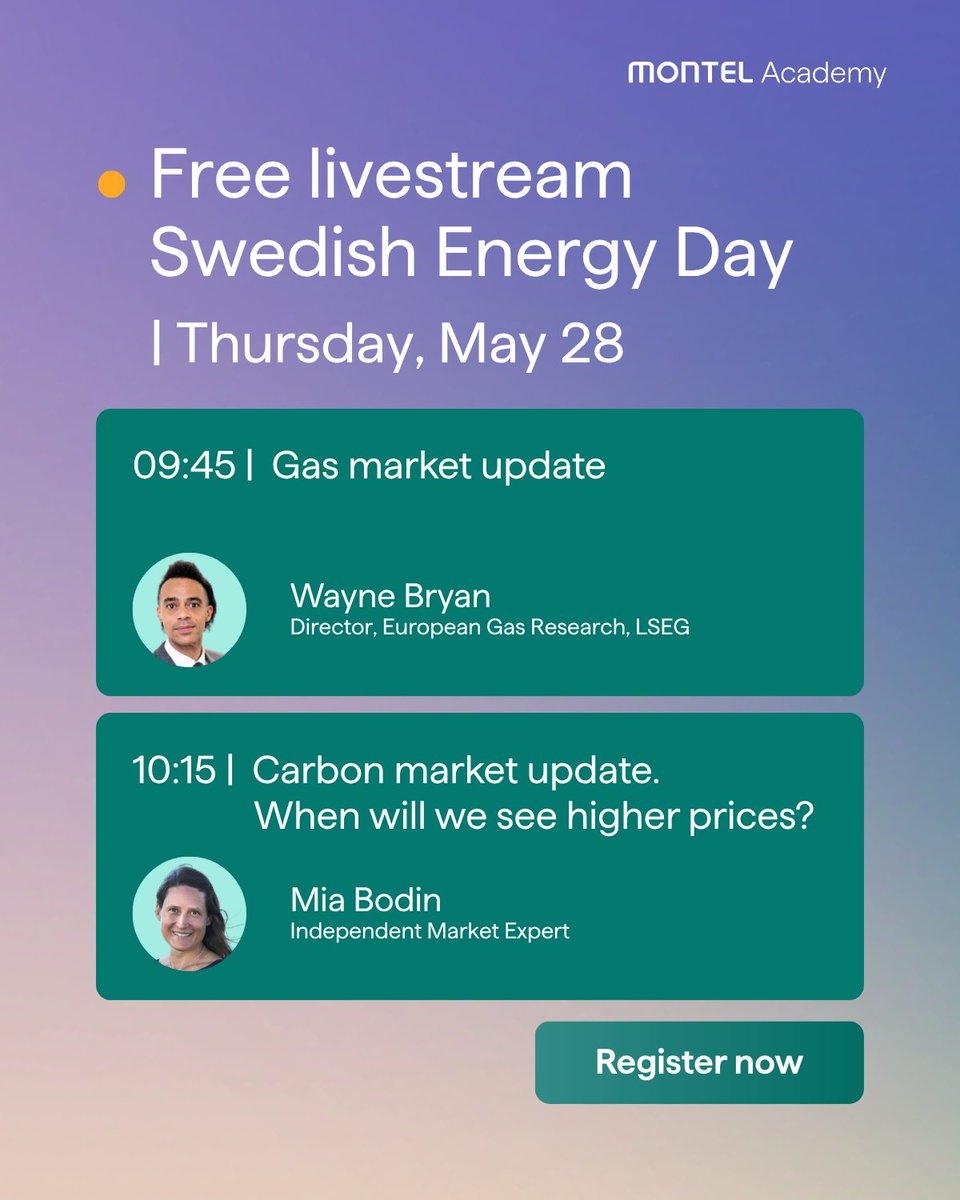
🟢 Gas market update
Wayne Bryan, Director, European Gas Research, LSEG
🟢 Carbon market update. When will we see higher prices?
Mia Bodin, Independent Market Expert
Both opening sessions will be live streamed for free.
If you’d like to join us online, there’s still time to register and watch live: https://t.co/op01qJf61L
Follow us throughout the day for insights, speaker takeaways and updates direct from Swedish Energy Day 👀
MARI à tout prix.
France connected to MARI mid-April. And it is not cheap.
The expectation was simple: neighbouring countries have high activation prices, so MARI would rarely be used. We were wrong.
MARI activated almost every day since April 14th. Price: around –300€/MWh. More extreme than usual mFRR specific activations.
MARI set the marginal price.
In the example I chose, you could argue many volumes were already activated downward and MARI was simply the last flexibility remaining. Maybe. Probably.
These volumes would have been activated under the Mécanisme d'Ajustement and classified as mFRR specific. Sure.
But the impact on imbalance price would have been drastically different. All MARI volumes settle at the marginal price. mFRR specific settles at VWAP. Quite different.
Same volumes. Very different settlement. That is the game now.
There is more to explore on MARI: its asymmetry, the positioning of volumes, the structural impact on imbalance prices. And when it's not MARI, it's PICASSO. We will cover all of it during next week's webinar.
Link to the webinar: https://t.co/c6QnhM76Cm
👀💰 Now you know. MARI every day at –300€/MWh. 👍
^CB
⚡ Where is flexibility creating the most value in Nordic power markets right now?
As ancillary service markets evolve and trading strategies increasingly shift towards intraday and balancing markets, understanding where value is emerging is becoming more important for market participants.
Join Priyanka Shinde, at Energy Deep Dives Sweden as she explores:
🔋 How BESS participation is changing market dynamics
📈 Why ancillary service markets are evolving
⚡ Where flexibility is increasingly being valued across markets
📊 How balancing market insights can support intraday trading strategies
🎥 Can't join us in person? This session will be live streamed for free.
Register to join live: https://t.co/RNtESTCtH4
Two key sessions from Swedish Energy Day will now be live streamed for free.
📍 Gas market update: Wayne Bryan, Director, European Gas Research, @LSEGplc
📍 Carbon market update: When will we see higher prices? Mia Bodin, Independent Market Expert
European energy markets continue to face pressure from shifting gas fundamentals, storage dynamics, geopolitical uncertainty, and evolving carbon market expectations.
In these live-streamed sessions, Wayne Bryan will provide an update on the latest developments across European gas markets, while Mia Bodin will explore the outlook for carbon prices and the factors that could influence EUA market direction in the months ahead.
If you can’t join us in Stockholm, you can still follow the discussions live online and hear directly from two leading market experts.
Register to watch the free live stream here: https://t.co/op01qJf61L
Three days. The exact same 30-minute window. The exact same market signal.
From Friday to Sunday, Romanian imbalance prices collapsed between -778 and -1248 EUR/MWh, each time between 16:00–16:30 EET.
Coincidence? Or the beginning of a repeatable regional oversupply pattern?
Here’s what happened:
On the demand side, Romanian consumption followed a familiar weekend trend, dropping by around 2 GW during late morning and early afternoon hours.
On the supply side:
☀️ Strong solar generation
💨 Elevated wind output
⚫ Lignite generation reduced to roughly 25% of normal weekday levels
The result was significant solar curtailment and growing oversupply pressure across the system.
The balancing market reinforced the same story:
📉 Deep negative imbalance prices
📉 Downward aFRR activation pushing deep into the downward ladder
But the more interesting signal may be the regional flow dynamic behind it.
Romania was exporting to Bulgaria, which in recent weeks has been one of RO’s key support markets following nuclear outages, supplied through the GR → BG → RO corridor.
During these oversupply moments, Bulgaria’s battery fleet absorbed excess energy, while Romania simultaneously continued importing from Hungary, a market heavily supported by solar generation.
The regional chain increasingly looks like this:
HU oversupplied → exports to Romania → Romania oversupplied → exports to Bulgaria → Bulgaria batteries charging
And this is where things get interesting.
The question is no longer whether oversupply events will return. They will.
The real question is whether these synchronized late-afternoon imbalance price spikes start appearing like clockwork across the region.
⚡ Georgios Merachtsakis previously analyzed Romania's net flows during nuclear plant outages and Bulgaria’s battery response during these oversupply events. Link to the post here: https://t.co/Bkojs4NZub
Can Italy avoid another gas price shock this winter? 🇮🇹⛽
Storage levels, LNG supply, geopolitics, and renewable growth are all reshaping the outlook for the Italian gas and power markets.
Today at 14:00 CET, join our free webinar:
“Gas o non gas? L’Italia in bilico tra sicurezza e prezzi shock”
Our speakers will explore:
• Gas supply and storage dynamics
• Potential price scenarios and volatility risks 📉
• The evolving role of gas in Italy’s energy system
• Government measures and market implications
• How analytics can support trading, hedging, and procurement decisions
Featuring insights from:
• Davide Tasinato, Axpo Italia
• Daniela Miccoli, Energy Aspects
• Matteo Melotti, Fedabo S.p.A. SB
• Enza Tedesco, Montel News
🇮🇹 The webinar will take place entirely in Italian.
🎟️ Register here: https://t.co/SSjjA0xHs9
🇸🇪 Swedish energy policy is entering a critical period.
With debates around nuclear, wind power, electrification, and market reform continuing to intensify, the decisions made over the next few years could reshape the direction of the Swedish energy market for decades to come.
⚡ At Swedish Energy Day 2026, representatives from four major political parties will take part in a live energy politics debate discussing where Swedish policy is heading next:
• Linus Lakso, Miljöpartiet
• Rickard Nordin, Centerpartiet
• Tobias Andersson, Sverigedemokraterna
• Jesper Skalberg Karlsson, Moderatern
Moderated by Anton Tigerstedt, Montel News.
If you want to hear how political priorities could impact power markets, investment, grid development, and energy security in Sweden, this is a discussion you do not want to miss.
📍 Hilton Stockholm Slussen 📅 28 May 2026
Register here: https://t.co/op01qJf61L
🇸🇪 One of the biggest questions facing the Nordic energy market today is whether the widely discussed wave of electricity demand growth will actually materialise and how quickly.
We’re pleased to welcome our next speaker at Swedish Energy Day 2026:🎤
Executive Vice President, Corporate Customers and Markets, @Fortum
Simon-Erik Ollus will present:
⚡ Will there even be a Nordic demand growth race? And if so, when?
As electrification, industrial expansion, data centres, and hydrogen projects continue to dominate discussions across the Nordic region, the pace and scale of future power demand remains one of the market’s biggest uncertainties.
⚡ There is still time to register and join leading experts and decision-makers from across the Swedish energy sector.
📍 Swedish Energy Day 2026
📅 28 May 2026
Register here: https://t.co/op01qJf61L