Turkey has a deep identity crisis and is constantly haunted by a past it didn’t build and can’t escape.
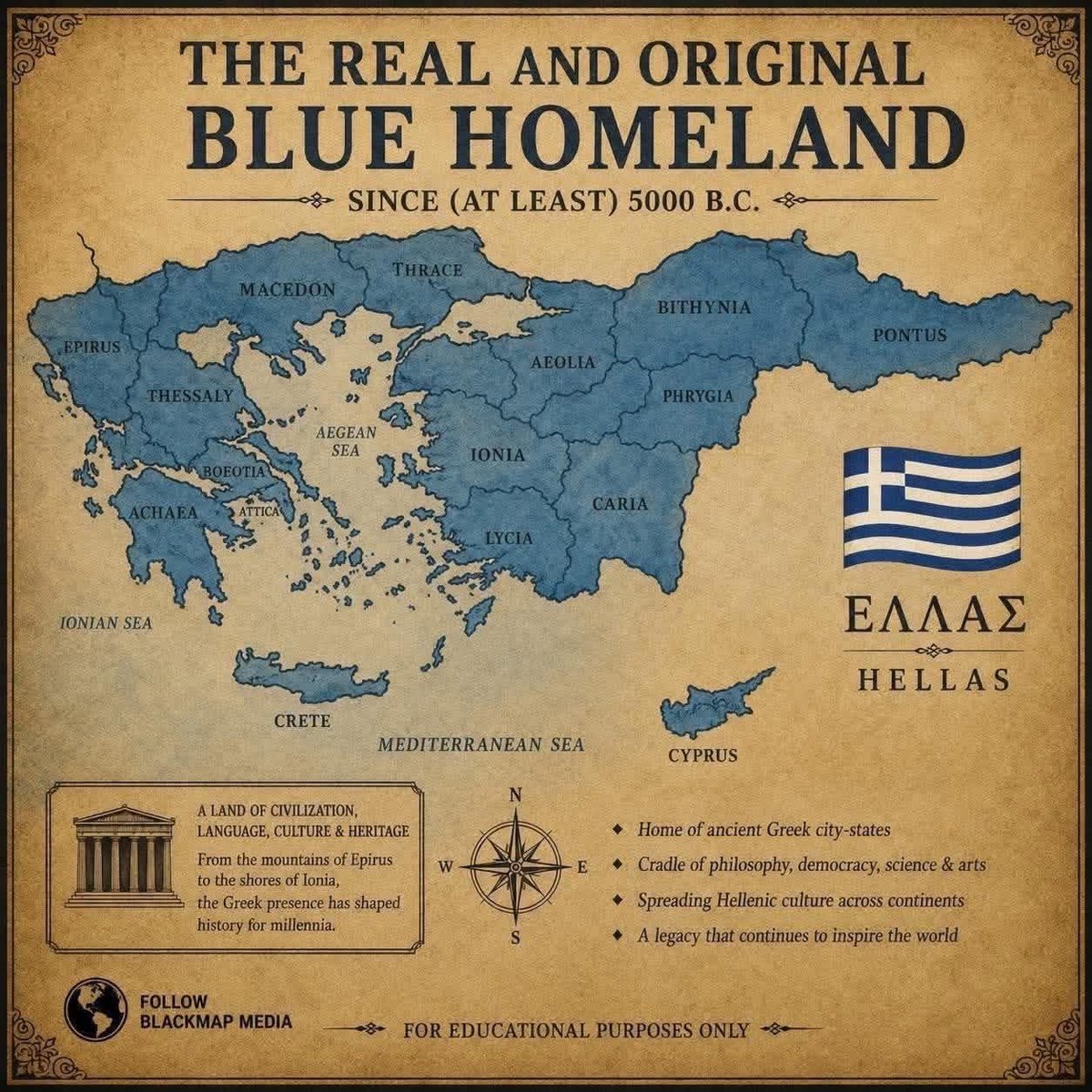
“Anatolian Turks” is a fabricated identity - a label designed to cast invaders as the natural inhabitants of a land they occupied. Turks came from the Central Asian steppe and burst into Anatolia by force, destroying the Byzantine Greek, Armenian, and ancient Christian civilisations that had shaped this land for millennia.
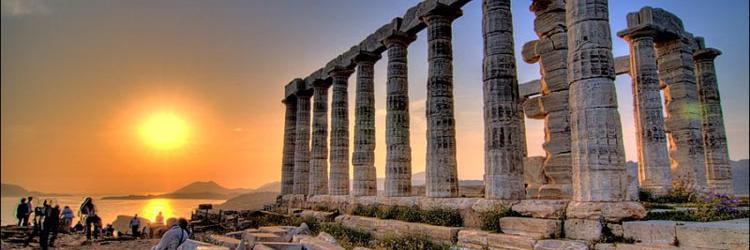
This is an Ancient Greek theatre. You don’t inherit an identity by destroying the people who created it.
When Gorgo, queen and wife of Leonidas, asked by an Athenian woman, "Why are you Spartan women the only ones who rule over your men?", she replied, "Because we are the only ones who give birth to men".
Celebrating the fall of Constantinople is like a thief celebrating stolen treasure. For Greeks the conquest of 1453 was not a triumph but the loss of a civilization’s capital, centuries of heritage, and countless lives. History should be remembered.
Δεν είναι μακρινό παρελθόν, 7-8 γενιές πίσω.
Απόγονος τέτοιων προγόνων είσαι
Βάδισε το δρόμο της τιμής και του χρέους για να αφήσεις πατρίδα στα παιδιά σου.
We live in a world where we are born and die without our own will. Allow me to introduce you to the real world of Greek philosophy that modern universities will never teach you.
From the very beginnings of our existence, one fundamental idea has tormented humanity, an idea that has never been fully answered: For what reason do we not control our own birth, and even more so, why must we become incarnated? Why does life exist? What is the purpose of this obligatory appearance of ours on planet Earth?
It was precisely upon these questions that philosophy was born in Greece. The Greeks attempted to explain these eternal riddles. Yet for the Greeks, philosophy is inseparably linked with theology. Just as today, back then too there were citizens of "two speeds", so to speak: those who believed simple in the gods, and those who tried to explain the secrets of the universe hidden within philosophy and theology.
However, most people who deal with Greek philosophy make a mistake here, believing that it concerns itself with life. That is incorrect. Philosophy is literally the study of death. In other words, Greek philosophy is entirely occupied with preparing us so that, when the hour of death arrives, we may be judged worthy of the next phase.
This also implies something else. Reading Greek philosophy is difficult for an atheist because the theological element dominates.
According to the teachings of the Greek philosophers, our birth into this life is by no means a random event. Our Father and Demiurge (Creator), as they call Him, is responsible for this birth, because this event is connected with the evolution of our soul and is accompanied by great expectations: the evolution of the soul that will lead to a "second birth", that of the awakened soul in the material world.
The reason for our birth, or in other words, the purpose of our life, is so that the human being who was born may, during his embodied life and this time using only his own powers, accomplish a second birth, in imitation of the act of his Father. Only then can a life receive its true value and discover its real meaning.
If a person does not proceed to this second birth, he remains half-finished. If we remain only with the first birth, we cannot function as human beings in the philosophical sense of the term. We live an aimless and meaningless life focused on material pleasures and the general logic of "let’s have a good time". Yet the main purpose of a human being is not "to have a good time".
On the contrary, it is to become weary, to toil and labor in spiritual matters so as to manage even a small step forward and thus evolve his soul.
According to Aristotle, in Book Μ of the Metaphysics ("μετὰ τὰ φυσικά"= actually means "those after the physics"), man is a species, and as a species he is obliged to evolve. So Aristotle says that there are therefore three basic evolutionary stages through which the human species must pass in order to be completed and perfected, stages which, unfortunately, we ignore today.
In exactly the same way, we are ignorant of this function of the two births that we must undergo in order to achieve this perfected and completed path.
The first birth, which occurs without our will, produces human beings who unfortunately possess only the appearance, the external form of a human being. They remain at the first evolutionary stage, to which the philosophers have given various, not particularly flattering, designations.
> Aristotle called them "two-footed creatures" [δίποδα (dipoda) = δίς (two) + πούς (foot)]
or anthropoids (ανθρωποειδής= ἄνθρωπος (human) + -ειδής (second compound adjective expressing similarity in kind to the one stated in the first compound) which means the one that looks like a human being, that has similar characteristics but he is not.
> Pythagoras called them "human-footed animals" [(ἀνδράποδα (andrapoda zōa)].
> Plato called them "little men" [ἀνθρωπίσκος (anthrōpiskoi)].
Plutarch, “On Exile” [p. 555] :
For, as Plato also says, man does not "spring from the earth" like a plant, nor does he remain fixed in place, because when he begins to evolve, "he becomes celestial. The root of man is his head, which is located at the highest point of his body when he stands upright, so that his root is connected to the heavens, (from which he receives his nourishment). Since the head is our root, it is our mind that is "watered from heaven" by celestial knowledge and not by earthly knowledge. The value of initiation lies precisely in helping us to accomplish this "inversion" (the turning upside down). In this way is explained the fact that Heracles said he would wish (εὖ) not to consider himself either an Argive or a Theban, because his desire was, with the help of God, not to be regarded as belonging to a single city. But, as he said, he would wish to consider his homeland to be the entire Tower of the Greeks. Socrates formulates an even better statement (regarding the delimitation of his homeland). He says that he does not consider himself either an Athenian or a Greek, because his soul is Celestial, coming from the Universe (kosmios) • and he could have been born either in Rhodes or in Corinth. Socrates, that is (as a superior being), cannot confine (ἐνέκλεισεν) his homeland, neither up to the promontory of Sounion where the hinterland of Greece and Attica ends, nor up to the promontory of Taenarum where the Peloponnese ends, nor anywhere on the earthly sphere that is enclosed by an atmosphere which receives the fall of thunderbolts.
- Plutarch, “On Exile” [p. 555]
According to this description, Socrates is essentially admitting that his homeland is no longer earthly but celestial, since his roots have ceased to be directed toward the earth and are now in communication with heaven.
So, someone who remain at the first evolutionary stage, to which the philosophers consider to be bad, will never understand the celestial power of his soul. This means that a person who has merely been born and has not entered an educational process that would allow him to develop his intellectual faculties remains, according to our great philosophers, at the level of an animal.
Such a person is condemned to exercise his thinking in a not particularly flattering manner. The human being who has remained at the first evolutionary stage of the two-footed / anthropoid creature only perceives (αντιλαμβάνεται).
The true human being who manages to enter and master the second evolutionary stage now exists in an intellectual condition that allows him to understand (ἐννοεῖ).
The difference, of course, is enormous. Because perception (αντίληψη), as the very word indicates, takes as reality the OPPOSITE of truth.
This means that the PERCEPTIVE ABILITY of a two-footed anthropoid will never lead him to the revelation of truth.
Therefore, concerning the reason for our existence and the process of life and death, we must understand that it is God who grants us the first birth, during which our physical body is born.
Our mission consists in managing to imitate His example and proceed to the second birth, which, however, is purely our own achievement. In other words, the person who manages to complete this second birth is automatically considered a small god.
These are the Heroes and the Philosophers.
For this short introduction to the concept of Philosophy, I have selected a passage from the ancient text of Diogenes Laërtius. In paragraph 122 is preserved a letter that Epicurus himself sent to one of his students, Menoeceus, in which he draws his attention to certain basic points of his teaching. We will read the text together word for word as we did before with Plutarch, translating it directly into English.
The letter is as follows:
"Epicurus sends greetings to Menoeceus.
Neither when one is young should one hesitate to philosophize, nor when one is old should one grow weary of philosophizing. For no one is too young or too old for the health of the soul. And he who says that the time for philosophizing has not yet come or that it has already passed is like one who says that the time for happiness has not yet come or has already passed. Therefore one must philosophize both when young and when old. The young so that as he grows old he may be young in good things thanks to the memory of what has happened, the old so that he may be at once young and old through his lack of fear of what is to come. Therefore one must study the things that produce happiness, since when it is present we have everything, but when it is absent we do everything in order to possess it. And the things I constantly advised you, practice these and study them, considering them to be the elements of living well. First, believe that god is an indestructible and blessed animal, as the common conception of god has outlined, and attach to him nothing alien to his indestructibility or inappropriate to his blessedness. And believe everything that can preserve his blessedness along with indestructibility concerning him. For the knowledge of Them is clear. But they are not such as the many suppose them to be. For they do not preserve them as they suppose. The impious man is not he who abolishes the gods of the many, but he who attaches to the gods the opinions of the many."
In other words, according to Epicurus, it is not impiety not to believe in the gods, but rather it is impiety to attribute to the gods qualities which they themselves do not possess, qualities that are our own personal judgments, because we have not yet succeeded in knowing the true nature of God.
"For the pronouncements of the many about the gods are not preconceptions but false suppositions. From these arise the greatest harms to the wicked from the gods and benefits to the good."
Therefore, according to Epicurus, neither the good nor the bad things that happen in our life should be attributed to the gods, because it is a mistaken belief that the gods are responsible for what we decide to do in our personal life. Epicurus maintains that each one of us is responsible for our own moral being, responsible for the reality we create, while the view accepted by most people, that the role of god is to intervene in our life, either positively or negatively, is mistaken.
"For, being accustomed always to their own virtues, they accept those who are similar, considering everything that is not like that as alien. Accustom yourself to believe that death is nothing to us. For all good and evil lie in sensation, and death is the deprivation of sensation. Hence a correct understanding that death is nothing to us makes the mortality of life enjoyable, not by adding infinite time, but by taking away the longing for immortality.
Philosophy = [Philo (love) + sophia (wisdom)]
Philosophy isn't just abstract thought, it is a way of life aimed at understanding the cosmos, the self, ethics, politics, and especially how to live well in preparation for death, mastering the moral virtues that define a perfect human being.
Starting with the first moral virtue (out of 12)
1. ἀνδρεία (courage, bravery).
"As Pindar says, every body is awaited by the almighty death, and an idea of immortality remains alive, an immortality that comes from the gods. For from there it is and there it ascends, not with the body but after, as much as possible, it is freed from the body and separated and becomes completely pure and incorporeal and pure. For for Heraclitus the most excellent soul is the "dry", the one that flies from the body like lightning from a cloud. The soul that is mixed with the body, that is covered by bodily matter as by a heavy and misty vapor, cannot easily be freed from its bonds and ascend high. There is therefore no need at all to send, against nature, the bodies of the good together with their souls to heaven, but to believe that, according to nature and divine justice, the virtues and souls of men become the souls of heroes, from heroes to demons, and from demons, escaping from every mortal passion and suffering, not according to the laws of the city but according to truth and justice, they become the souls of gods, thus enjoying the most beautiful and blessed end."
- Plutarch, Romulus ch. 28
Thank you for reading me.
- Homer Pavlos
1/2 Δεν υπάρχει αντιπολίτευση, γιατί τα κόμματα της "αντιπολίτευσης" έχουν την ίδια πολιτική με τον Μητσοτάκη. Υποταγή στην τριπλή εξάρτηση της Πατρίδας μας από ΗΠΑ, Τουρκία και ΕΕ και για την Κύπρο ΔΔΟ, δηλαδή χάρισμα των κατεχομένων στην Τουρκία.
Από όλο το φάσμα.
If the Ottoman turks took Constantinople from the Romans and not the Greeks, then why were the centuries of resistance that followed overwhelmingly led by Greeks, fought by Greeks, and remembered by Greeks?
From 1453 to 1821, the Greeks launched over 100 revolts, uprisings, and resistance movements against Ottoman rule. The people fighting to reclaim the Eastern Roman homeland were Greeks because the Eastern Romans were Greeks.


![HomerPavlos's tweet photo. We live in a world where we are born and die without our own will. Allow me to introduce you to the real world of Greek philosophy that modern universities will never teach you.
From the very beginnings of our existence, one fundamental idea has tormented humanity, an idea that has never been fully answered: For what reason do we not control our own birth, and even more so, why must we become incarnated? Why does life exist? What is the purpose of this obligatory appearance of ours on planet Earth?
It was precisely upon these questions that philosophy was born in Greece. The Greeks attempted to explain these eternal riddles. Yet for the Greeks, philosophy is inseparably linked with theology. Just as today, back then too there were citizens of "two speeds", so to speak: those who believed simple in the gods, and those who tried to explain the secrets of the universe hidden within philosophy and theology.
However, most people who deal with Greek philosophy make a mistake here, believing that it concerns itself with life. That is incorrect. Philosophy is literally the study of death. In other words, Greek philosophy is entirely occupied with preparing us so that, when the hour of death arrives, we may be judged worthy of the next phase.
This also implies something else. Reading Greek philosophy is difficult for an atheist because the theological element dominates.
According to the teachings of the Greek philosophers, our birth into this life is by no means a random event. Our Father and Demiurge (Creator), as they call Him, is responsible for this birth, because this event is connected with the evolution of our soul and is accompanied by great expectations: the evolution of the soul that will lead to a "second birth", that of the awakened soul in the material world.
The reason for our birth, or in other words, the purpose of our life, is so that the human being who was born may, during his embodied life and this time using only his own powers, accomplish a second birth, in imitation of the act of his Father. Only then can a life receive its true value and discover its real meaning.
If a person does not proceed to this second birth, he remains half-finished. If we remain only with the first birth, we cannot function as human beings in the philosophical sense of the term. We live an aimless and meaningless life focused on material pleasures and the general logic of "let’s have a good time". Yet the main purpose of a human being is not "to have a good time".
On the contrary, it is to become weary, to toil and labor in spiritual matters so as to manage even a small step forward and thus evolve his soul.
According to Aristotle, in Book Μ of the Metaphysics ("μετὰ τὰ φυσικά"= actually means "those after the physics"), man is a species, and as a species he is obliged to evolve. So Aristotle says that there are therefore three basic evolutionary stages through which the human species must pass in order to be completed and perfected, stages which, unfortunately, we ignore today.
In exactly the same way, we are ignorant of this function of the two births that we must undergo in order to achieve this perfected and completed path.
The first birth, which occurs without our will, produces human beings who unfortunately possess only the appearance, the external form of a human being. They remain at the first evolutionary stage, to which the philosophers have given various, not particularly flattering, designations.
> Aristotle called them "two-footed creatures" [δίποδα (dipoda) = δίς (two) + πούς (foot)]
or anthropoids (ανθρωποειδής= ἄνθρωπος (human) + -ειδής (second compound adjective expressing similarity in kind to the one stated in the first compound) which means the one that looks like a human being, that has similar characteristics but he is not.
> Pythagoras called them "human-footed animals" [(ἀνδράποδα (andrapoda zōa)].
> Plato called them "little men" [ἀνθρωπίσκος (anthrōpiskoi)].
Plutarch, “On Exile” [p. 555] :
For, as Plato also says, man does not "spring from the earth" like a plant, nor does he remain fixed in place, because when he begins to evolve, "he becomes celestial. The root of man is his head, which is located at the highest point of his body when he stands upright, so that his root is connected to the heavens, (from which he receives his nourishment). Since the head is our root, it is our mind that is "watered from heaven" by celestial knowledge and not by earthly knowledge. The value of initiation lies precisely in helping us to accomplish this "inversion" (the turning upside down). In this way is explained the fact that Heracles said he would wish (εὖ) not to consider himself either an Argive or a Theban, because his desire was, with the help of God, not to be regarded as belonging to a single city. But, as he said, he would wish to consider his homeland to be the entire Tower of the Greeks. Socrates formulates an even better statement (regarding the delimitation of his homeland). He says that he does not consider himself either an Athenian or a Greek, because his soul is Celestial, coming from the Universe (kosmios) • and he could have been born either in Rhodes or in Corinth. Socrates, that is (as a superior being), cannot confine (ἐνέκλεισεν) his homeland, neither up to the promontory of Sounion where the hinterland of Greece and Attica ends, nor up to the promontory of Taenarum where the Peloponnese ends, nor anywhere on the earthly sphere that is enclosed by an atmosphere which receives the fall of thunderbolts.
- Plutarch, “On Exile” [p. 555]
According to this description, Socrates is essentially admitting that his homeland is no longer earthly but celestial, since his roots have ceased to be directed toward the earth and are now in communication with heaven.
So, someone who remain at the first evolutionary stage, to which the philosophers consider to be bad, will never understand the celestial power of his soul. This means that a person who has merely been born and has not entered an educational process that would allow him to develop his intellectual faculties remains, according to our great philosophers, at the level of an animal.
Such a person is condemned to exercise his thinking in a not particularly flattering manner. The human being who has remained at the first evolutionary stage of the two-footed / anthropoid creature only perceives (αντιλαμβάνεται).
The true human being who manages to enter and master the second evolutionary stage now exists in an intellectual condition that allows him to understand (ἐννοεῖ).
The difference, of course, is enormous. Because perception (αντίληψη), as the very word indicates, takes as reality the OPPOSITE of truth.
This means that the PERCEPTIVE ABILITY of a two-footed anthropoid will never lead him to the revelation of truth.
Therefore, concerning the reason for our existence and the process of life and death, we must understand that it is God who grants us the first birth, during which our physical body is born.
Our mission consists in managing to imitate His example and proceed to the second birth, which, however, is purely our own achievement. In other words, the person who manages to complete this second birth is automatically considered a small god.
These are the Heroes and the Philosophers.
For this short introduction to the concept of Philosophy, I have selected a passage from the ancient text of Diogenes Laërtius. In paragraph 122 is preserved a letter that Epicurus himself sent to one of his students, Menoeceus, in which he draws his attention to certain basic points of his teaching. We will read the text together word for word as we did before with Plutarch, translating it directly into English.
The letter is as follows:
"Epicurus sends greetings to Menoeceus.
Neither when one is young should one hesitate to philosophize, nor when one is old should one grow weary of philosophizing. For no one is too young or too old for the health of the soul. And he who says that the time for philosophizing has not yet come or that it has already passed is like one who says that the time for happiness has not yet come or has already passed. Therefore one must philosophize both when young and when old. The young so that as he grows old he may be young in good things thanks to the memory of what has happened, the old so that he may be at once young and old through his lack of fear of what is to come. Therefore one must study the things that produce happiness, since when it is present we have everything, but when it is absent we do everything in order to possess it. And the things I constantly advised you, practice these and study them, considering them to be the elements of living well. First, believe that god is an indestructible and blessed animal, as the common conception of god has outlined, and attach to him nothing alien to his indestructibility or inappropriate to his blessedness. And believe everything that can preserve his blessedness along with indestructibility concerning him. For the knowledge of Them is clear. But they are not such as the many suppose them to be. For they do not preserve them as they suppose. The impious man is not he who abolishes the gods of the many, but he who attaches to the gods the opinions of the many."
In other words, according to Epicurus, it is not impiety not to believe in the gods, but rather it is impiety to attribute to the gods qualities which they themselves do not possess, qualities that are our own personal judgments, because we have not yet succeeded in knowing the true nature of God.
"For the pronouncements of the many about the gods are not preconceptions but false suppositions. From these arise the greatest harms to the wicked from the gods and benefits to the good."
Therefore, according to Epicurus, neither the good nor the bad things that happen in our life should be attributed to the gods, because it is a mistaken belief that the gods are responsible for what we decide to do in our personal life. Epicurus maintains that each one of us is responsible for our own moral being, responsible for the reality we create, while the view accepted by most people, that the role of god is to intervene in our life, either positively or negatively, is mistaken.
"For, being accustomed always to their own virtues, they accept those who are similar, considering everything that is not like that as alien. Accustom yourself to believe that death is nothing to us. For all good and evil lie in sensation, and death is the deprivation of sensation. Hence a correct understanding that death is nothing to us makes the mortality of life enjoyable, not by adding infinite time, but by taking away the longing for immortality.
Philosophy = [Philo (love) + sophia (wisdom)]
Philosophy isn't just abstract thought, it is a way of life aimed at understanding the cosmos, the self, ethics, politics, and especially how to live well in preparation for death, mastering the moral virtues that define a perfect human being.
Starting with the first moral virtue (out of 12)
1. ἀνδρεία (courage, bravery).
"As Pindar says, every body is awaited by the almighty death, and an idea of immortality remains alive, an immortality that comes from the gods. For from there it is and there it ascends, not with the body but after, as much as possible, it is freed from the body and separated and becomes completely pure and incorporeal and pure. For for Heraclitus the most excellent soul is the "dry", the one that flies from the body like lightning from a cloud. The soul that is mixed with the body, that is covered by bodily matter as by a heavy and misty vapor, cannot easily be freed from its bonds and ascend high. There is therefore no need at all to send, against nature, the bodies of the good together with their souls to heaven, but to believe that, according to nature and divine justice, the virtues and souls of men become the souls of heroes, from heroes to demons, and from demons, escaping from every mortal passion and suffering, not according to the laws of the city but according to truth and justice, they become the souls of gods, thus enjoying the most beautiful and blessed end."
- Plutarch, Romulus ch. 28
Thank you for reading me.
- Homer Pavlos](https://pbs.twimg.com/media/HJqZrsDWMAIJzfR.jpg)








![HomerPavlos's tweet photo. We live in a world where we are born and die without our own will. Allow me to introduce you to the real world of Greek philosophy that modern universities will never teach you.
From the very beginnings of our existence, one fundamental idea has tormented humanity, an idea that has never been fully answered: For what reason do we not control our own birth, and even more so, why must we become incarnated? Why does life exist? What is the purpose of this obligatory appearance of ours on planet Earth?
It was precisely upon these questions that philosophy was born in Greece. The Greeks attempted to explain these eternal riddles. Yet for the Greeks, philosophy is inseparably linked with theology. Just as today, back then too there were citizens of "two speeds", so to speak: those who believed simple in the gods, and those who tried to explain the secrets of the universe hidden within philosophy and theology.
However, most people who deal with Greek philosophy make a mistake here, believing that it concerns itself with life. That is incorrect. Philosophy is literally the study of death. In other words, Greek philosophy is entirely occupied with preparing us so that, when the hour of death arrives, we may be judged worthy of the next phase.
This also implies something else. Reading Greek philosophy is difficult for an atheist because the theological element dominates.
According to the teachings of the Greek philosophers, our birth into this life is by no means a random event. Our Father and Demiurge (Creator), as they call Him, is responsible for this birth, because this event is connected with the evolution of our soul and is accompanied by great expectations: the evolution of the soul that will lead to a "second birth", that of the awakened soul in the material world.
The reason for our birth, or in other words, the purpose of our life, is so that the human being who was born may, during his embodied life and this time using only his own powers, accomplish a second birth, in imitation of the act of his Father. Only then can a life receive its true value and discover its real meaning.
If a person does not proceed to this second birth, he remains half-finished. If we remain only with the first birth, we cannot function as human beings in the philosophical sense of the term. We live an aimless and meaningless life focused on material pleasures and the general logic of "let’s have a good time". Yet the main purpose of a human being is not "to have a good time".
On the contrary, it is to become weary, to toil and labor in spiritual matters so as to manage even a small step forward and thus evolve his soul.
According to Aristotle, in Book Μ of the Metaphysics ("μετὰ τὰ φυσικά"= actually means "those after the physics"), man is a species, and as a species he is obliged to evolve. So Aristotle says that there are therefore three basic evolutionary stages through which the human species must pass in order to be completed and perfected, stages which, unfortunately, we ignore today.
In exactly the same way, we are ignorant of this function of the two births that we must undergo in order to achieve this perfected and completed path.
The first birth, which occurs without our will, produces human beings who unfortunately possess only the appearance, the external form of a human being. They remain at the first evolutionary stage, to which the philosophers have given various, not particularly flattering, designations.
> Aristotle called them "two-footed creatures" [δίποδα (dipoda) = δίς (two) + πούς (foot)]
or anthropoids (ανθρωποειδής= ἄνθρωπος (human) + -ειδής (second compound adjective expressing similarity in kind to the one stated in the first compound) which means the one that looks like a human being, that has similar characteristics but he is not.
> Pythagoras called them "human-footed animals" [(ἀνδράποδα (andrapoda zōa)].
> Plato called them "little men" [ἀνθρωπίσκος (anthrōpiskoi)].
Plutarch, “On Exile” [p. 555] :
For, as Plato also says, man does not "spring from the earth" like a plant, nor does he remain fixed in place, because when he begins to evolve, "he becomes celestial. The root of man is his head, which is located at the highest point of his body when he stands upright, so that his root is connected to the heavens, (from which he receives his nourishment). Since the head is our root, it is our mind that is "watered from heaven" by celestial knowledge and not by earthly knowledge. The value of initiation lies precisely in helping us to accomplish this "inversion" (the turning upside down). In this way is explained the fact that Heracles said he would wish (εὖ) not to consider himself either an Argive or a Theban, because his desire was, with the help of God, not to be regarded as belonging to a single city. But, as he said, he would wish to consider his homeland to be the entire Tower of the Greeks. Socrates formulates an even better statement (regarding the delimitation of his homeland). He says that he does not consider himself either an Athenian or a Greek, because his soul is Celestial, coming from the Universe (kosmios) • and he could have been born either in Rhodes or in Corinth. Socrates, that is (as a superior being), cannot confine (ἐνέκλεισεν) his homeland, neither up to the promontory of Sounion where the hinterland of Greece and Attica ends, nor up to the promontory of Taenarum where the Peloponnese ends, nor anywhere on the earthly sphere that is enclosed by an atmosphere which receives the fall of thunderbolts.
- Plutarch, “On Exile” [p. 555]
According to this description, Socrates is essentially admitting that his homeland is no longer earthly but celestial, since his roots have ceased to be directed toward the earth and are now in communication with heaven.
So, someone who remain at the first evolutionary stage, to which the philosophers consider to be bad, will never understand the celestial power of his soul. This means that a person who has merely been born and has not entered an educational process that would allow him to develop his intellectual faculties remains, according to our great philosophers, at the level of an animal.
Such a person is condemned to exercise his thinking in a not particularly flattering manner. The human being who has remained at the first evolutionary stage of the two-footed / anthropoid creature only perceives (αντιλαμβάνεται).
The true human being who manages to enter and master the second evolutionary stage now exists in an intellectual condition that allows him to understand (ἐννοεῖ).
The difference, of course, is enormous. Because perception (αντίληψη), as the very word indicates, takes as reality the OPPOSITE of truth.
This means that the PERCEPTIVE ABILITY of a two-footed anthropoid will never lead him to the revelation of truth.
Therefore, concerning the reason for our existence and the process of life and death, we must understand that it is God who grants us the first birth, during which our physical body is born.
Our mission consists in managing to imitate His example and proceed to the second birth, which, however, is purely our own achievement. In other words, the person who manages to complete this second birth is automatically considered a small god.
These are the Heroes and the Philosophers.
For this short introduction to the concept of Philosophy, I have selected a passage from the ancient text of Diogenes Laërtius. In paragraph 122 is preserved a letter that Epicurus himself sent to one of his students, Menoeceus, in which he draws his attention to certain basic points of his teaching. We will read the text together word for word as we did before with Plutarch, translating it directly into English.
The letter is as follows:
"Epicurus sends greetings to Menoeceus.
Neither when one is young should one hesitate to philosophize, nor when one is old should one grow weary of philosophizing. For no one is too young or too old for the health of the soul. And he who says that the time for philosophizing has not yet come or that it has already passed is like one who says that the time for happiness has not yet come or has already passed. Therefore one must philosophize both when young and when old. The young so that as he grows old he may be young in good things thanks to the memory of what has happened, the old so that he may be at once young and old through his lack of fear of what is to come. Therefore one must study the things that produce happiness, since when it is present we have everything, but when it is absent we do everything in order to possess it. And the things I constantly advised you, practice these and study them, considering them to be the elements of living well. First, believe that god is an indestructible and blessed animal, as the common conception of god has outlined, and attach to him nothing alien to his indestructibility or inappropriate to his blessedness. And believe everything that can preserve his blessedness along with indestructibility concerning him. For the knowledge of Them is clear. But they are not such as the many suppose them to be. For they do not preserve them as they suppose. The impious man is not he who abolishes the gods of the many, but he who attaches to the gods the opinions of the many."
In other words, according to Epicurus, it is not impiety not to believe in the gods, but rather it is impiety to attribute to the gods qualities which they themselves do not possess, qualities that are our own personal judgments, because we have not yet succeeded in knowing the true nature of God.
"For the pronouncements of the many about the gods are not preconceptions but false suppositions. From these arise the greatest harms to the wicked from the gods and benefits to the good."
Therefore, according to Epicurus, neither the good nor the bad things that happen in our life should be attributed to the gods, because it is a mistaken belief that the gods are responsible for what we decide to do in our personal life. Epicurus maintains that each one of us is responsible for our own moral being, responsible for the reality we create, while the view accepted by most people, that the role of god is to intervene in our life, either positively or negatively, is mistaken.
"For, being accustomed always to their own virtues, they accept those who are similar, considering everything that is not like that as alien. Accustom yourself to believe that death is nothing to us. For all good and evil lie in sensation, and death is the deprivation of sensation. Hence a correct understanding that death is nothing to us makes the mortality of life enjoyable, not by adding infinite time, but by taking away the longing for immortality.
Philosophy = [Philo (love) + sophia (wisdom)]
Philosophy isn't just abstract thought, it is a way of life aimed at understanding the cosmos, the self, ethics, politics, and especially how to live well in preparation for death, mastering the moral virtues that define a perfect human being.
Starting with the first moral virtue (out of 12)
1. ἀνδρεία (courage, bravery).
"As Pindar says, every body is awaited by the almighty death, and an idea of immortality remains alive, an immortality that comes from the gods. For from there it is and there it ascends, not with the body but after, as much as possible, it is freed from the body and separated and becomes completely pure and incorporeal and pure. For for Heraclitus the most excellent soul is the "dry", the one that flies from the body like lightning from a cloud. The soul that is mixed with the body, that is covered by bodily matter as by a heavy and misty vapor, cannot easily be freed from its bonds and ascend high. There is therefore no need at all to send, against nature, the bodies of the good together with their souls to heaven, but to believe that, according to nature and divine justice, the virtues and souls of men become the souls of heroes, from heroes to demons, and from demons, escaping from every mortal passion and suffering, not according to the laws of the city but according to truth and justice, they become the souls of gods, thus enjoying the most beautiful and blessed end."
- Plutarch, Romulus ch. 28
Thank you for reading me.
- Homer Pavlos](https://pbs.twimg.com/media/HJqZrsFXkAIqxI6.jpg)