@Noahpinion Keynes predicted the same almost 100 yrs ago, and it didn't quite happen! Therefore we can expect it to not happen in the next 100 yrs either?
@kshaughnessy2 Sounds like low IQ comments -- makes no sense.
Antropic having a record revenue isn't a trigger for crash, it's a trigger for higher valuations and momentum.
@Noahpinion What if super intelligence is so alien that we won't even grok what it says? Kinda worrisome. Because much of "intelligence" is intution; implicit thoughts and reasoning. Once verbalized, it might lose its strength?
@joni_askola He's the ringleader of unfounded "west is stagnating [therefore we need crazy right wing authoritarian reform ]" movement , mentor of spineless JD Vance, and a big enabler of the extremely harmful DJT regime. Sad figure if you ask me. As sad as Elon musk if not more.
@WSJ Confederacy never ended. It continued as Nazi in Europe. And both of them continue as maga in USA. These are fundamentally the same mindsets and essentially the same people.
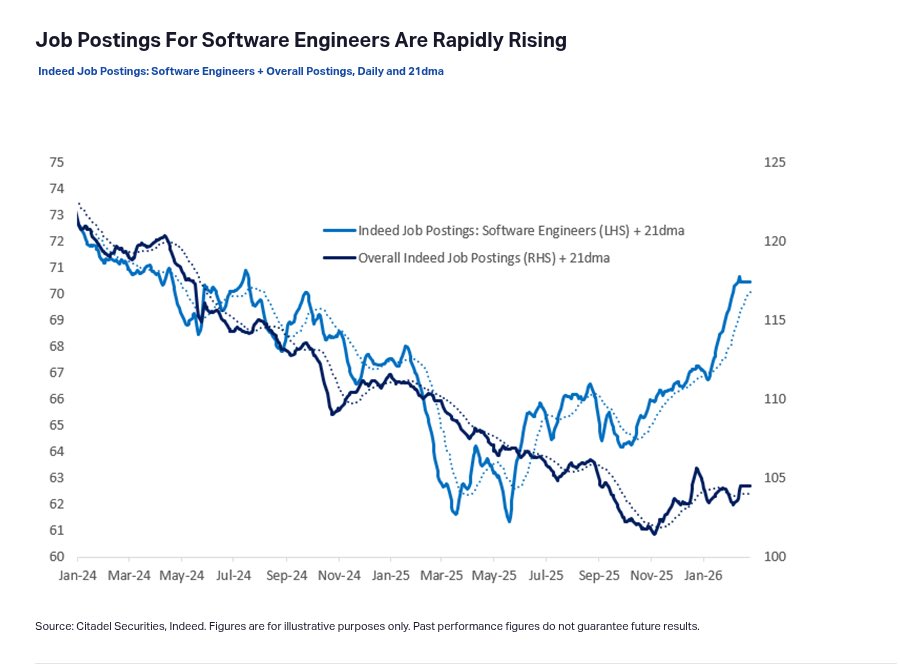
Q: How are job postings for software engineers rising rapidly despite AI agents automating coding?
A: Because there’s far more code to manage than ever before. We’re already seeing a 14x YoY increase in GitHub commits, and it’s accelerating.
AI has dramatically lowered the cost of writing code, so it’s now being used across far more businesses, applications, and use cases.
We’re at the beginning of a massive productivity boom driven by the proliferation of bespoke software throughout the entire economy.
Coding has been AI’s breakout use case this year. The fact that it’s increased demand for software engineers — rather than decreased it — should call into question the entire “AI will cause mass job loss” narrative.
Marc Andreessen: AI coding doesn’t eliminate programmers — it redefines them. The job is no longer typing code line by line, it’s orchestrating 10 coding bots in parallel, arguing with them, debugging their output, changing the spec, and pushing them toward the right result. But here’s the catch: if you don’t understand how to write code yourself, you can’t evaluate what the AI gives you.
The next layer of programming isn’t writing scripts — it’s supervising AI that writes them. Today’s best programmers spend their day jumping between terminals, managing multiple coding bots, fixing mistakes, and refining instructions. The irony? You still need deep fundamentals, because without them, you won’t know when the AI is wrong.
The job of the programmer has changed. Now it’s about arguing with coding bots, debugging AI-generated code, and understanding why something doesn’t work or isn’t fast enough. AI abstracts the work — but only people who truly understand code can tell if the abstraction is doing the right thing.
Programmers aren’t going away — they’re becoming 10x, 100x, even 1,000x more productive. Tasks are changing, the job is changing, but humans are still overseeing the process, evaluating results, fixing errors, and making judgment calls. AI changes how we code, not who is responsible.
The future programmer isn’t replaced by AI — they’re upgraded by it. You still need to learn how to write and understand code, because when the AI gets it wrong, humans are the ones who have to know why. That up-leveling of capability is the real revolution.