“Beware of your thoughts for they are heard in Heaven.”
- St. Augustine
St. Augustine of Hippo was a major theologian who wrote extensively about the inner life and the idea that nothing within the human mind is hidden from God.
The quote attributed to him reflects his belief that God knows every thought, even those never spoken aloud. In Confessions, Augustine explored this idea personally, describing God as being closer to him than he was to himself. From this perspective, thought is not truly private but part of an ongoing, silent relationship with the divine, encouraging believers to be as mindful of their inner lives as they are of their outward actions.
Field mice have been photographed curling up inside flowers, using the soft petals as a tiny natural bed.
The blossoms can provide a sheltered spot to rest while helping them stay hidden from predators. 🌸🐭
“Nature does not punish the evil, it punishes the weak.”
- Nietzsche
Friedrich Nietzsche argued that nature exists outside human concepts of morality. In his view, ideas such as good and evil are human constructions, not universal principles that govern reality. Nature does not recognize moral virtue, meaning it offers no guarantee of cosmic justice for those who do wrong.
Instead, forces such as disease, environmental change, and predation test an organism’s physical strength, resilience, and ability to adapt. Survival, in this sense, depends on an organism’s capacity to endure and adjust—not on whether it is morally good or bad.
An elderly Japanese man keeps taking his two cats to scenic spots for photos, he lines everything up. The second he tries to hold them still, they start fighting instead of posing
He just stands there smiling while they go at each other. Not their first rodeo 😂
Pluto place in the Solar System changed 20 years ago
On August 24, 2006, Pluto was officially reclassified as a dwarf planet, ending its 76 year run as the ninth planet in our Solar System
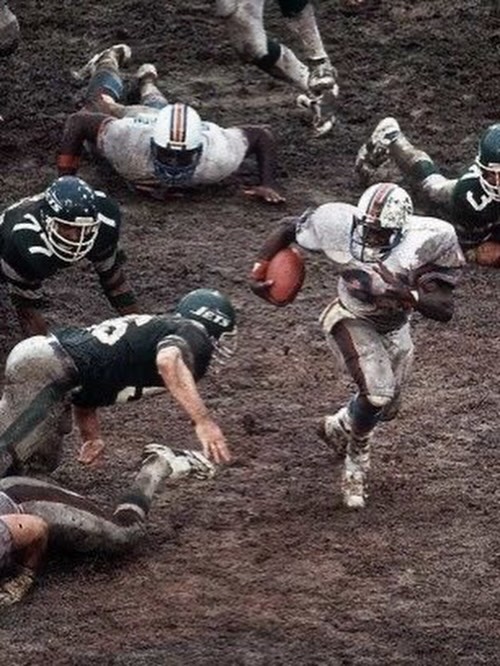
Before AstroTurf, domed stadiums, and modern drainage systems, rain could transform an NFL field into a muddy battlefield, making games look more like trench warfare than football.
When rain entered the equation, football fields could become nearly impossible to play on. Cleats were sometimes taped to players’ feet to prevent slipping, while gaining even a few yards became a monumental challenge.
Mud was the great equalizer. Speed and finesse meant little when players could barely find their footing. Games became tests of pure mental and physical toughness, with some teams even choosing not to cover their fields during rain when facing more talented opponents, hoping to win through endurance instead.
It’s a rare sight in the NFL today, where games can be paused when standing water creates unsafe conditions. Muddy fields are now a relic of football’s past, along with the rugged mindset of the era in which the game was played.