Hi Twitterverse, I'm looking for a candidate to apply for a MC fellowship
https://t.co/ny3S9LvA1q
Many new research lines to study major evolutionary transitions in both Archaea and Bacteria, involving phylogenomics, metagenomics, and experimental work. Deadline Sept 11, RT pliz
Absolutely true: giant viruses do NOT escape the central definition of a virus, which is an intracellular parasitic organism requiring host ribosomes for expression of its proteins.
The genomic underpinnings of eukaryotic virus taxonomy: creating a sequence-based framework for family-level virus classification https://t.co/41ZBA4p7P3
Our latest paper on NCLDV diversity in Loki's Castle marine sediments, great collaboration between @disavlynx and the Koonin-lab https://t.co/hwknC6f9d4
I started reading the #Tangletree. It nicely complement #Microbesfromhell. One focuses on north American scientists, the other on Europeans and some Japaneses, both discussing Woese history from different perspectives.
Why eucaryotes became so complex. The answer might be to look for in their unique viruses, absent (lost?) in Archaea and absent or very rare in Bacteria
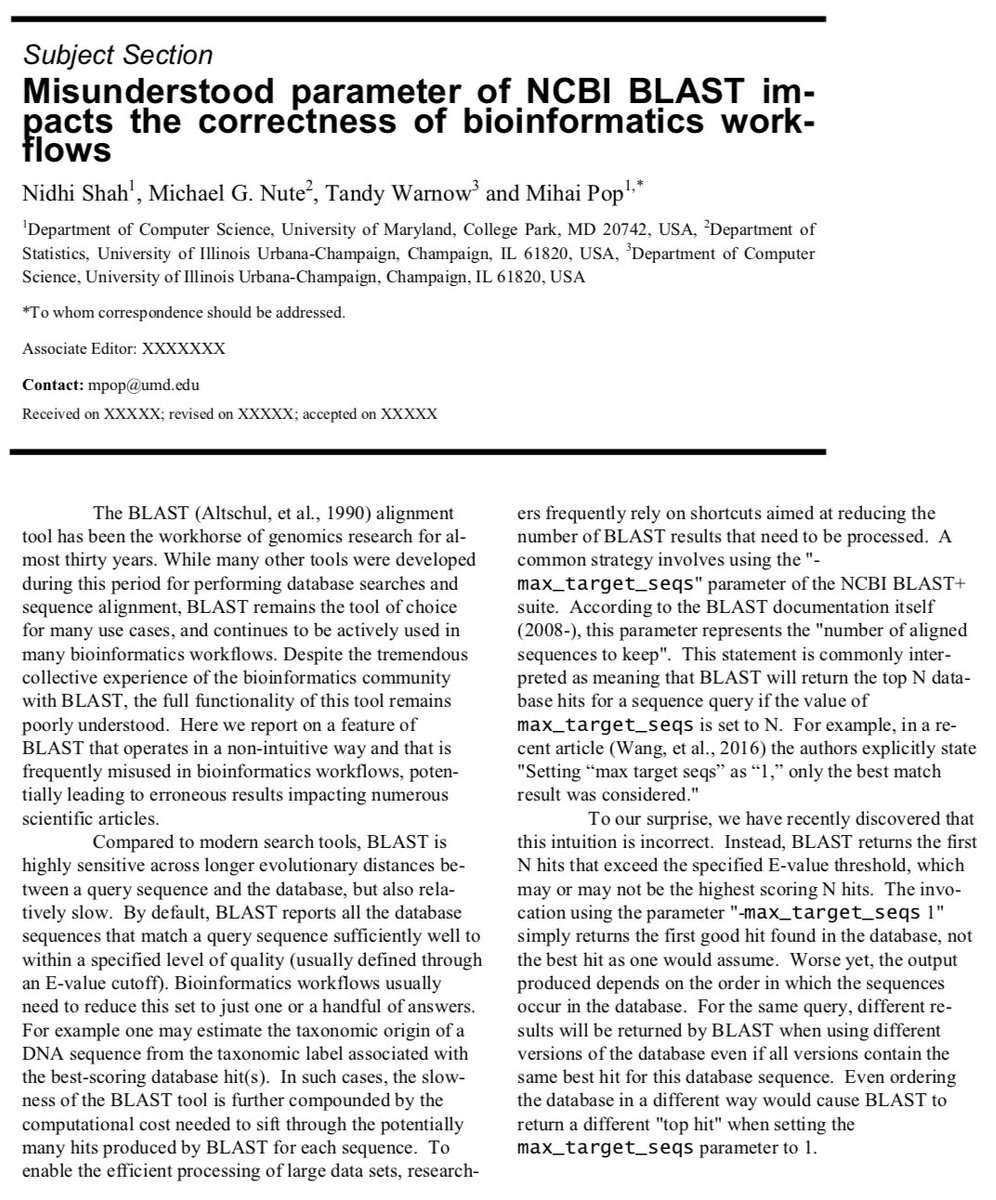
Misunderstood parameter of NCBI BLAST impacts the correctness of bioinformatics workflows https://t.co/gtbYgY5y4i Seems the importance of this can't be understated: 1/n
Debate about whether viruses are alive is heating up again on various timelines. Quite absurd to think than an entity that makes up 5-8% of our own genomes as humans should not be considered as part of life
It's not all about viruses! See this story on the mitochondrion-hijacking, protistolytic bacterium Chromulinavorax destructans led by @_viral_Chris @UBCMicroImmuno https://t.co/dQ0J7mluZE