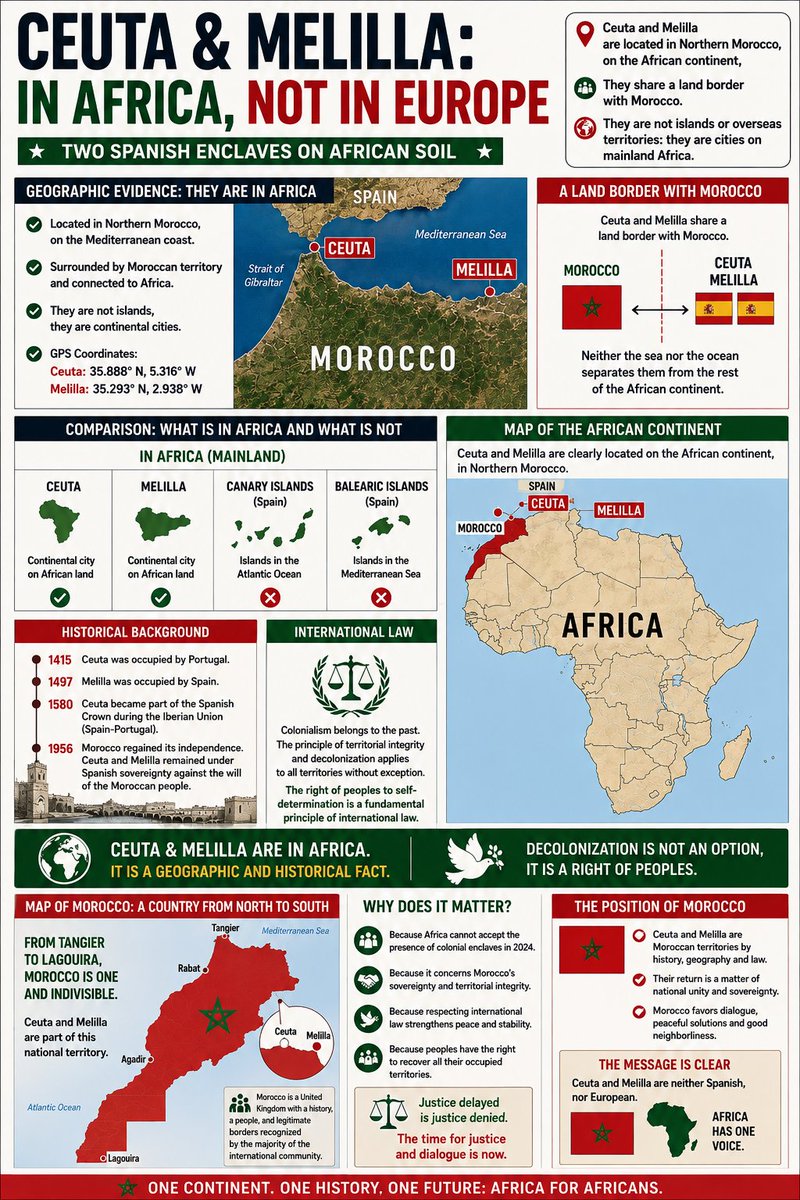
🧵 CEUTA & MELILLA: WHAT SPAIN SAID BEHIND CLOSED DOORS
Today, the official narrative is simple: Ceuta and Melilla are Spanish and their status is not open to discussion.
But declassified US diplomatic records reveal a much more complicated history.
Let’s look at the archives. 👇
Justement, votre argument ne tient pas davantage. La population de Hong Kong demandait-elle majoritairement son rattachement à la Chine avant 1997 ? Non. Cela n’a pourtant pas empêché le transfert de souveraineté.
Le fait que les habitants actuels de Ceuta et Melilla votent aux élections espagnoles ou ne réclament pas leur rattachement au Maroc décrit leur préférence politique actuelle. Ce n’est pas, à lui seul, un titre de souveraineté.
Sinon, il faudrait expliquer pourquoi ce critère serait déterminant à Ceuta et Melilla, mais ne l’était pas à Hong Kong. On ne peut pas changer de principe selon le territoire dont on parle.
@daedric_dog You keep saying I’m wrong, but you still haven’t said what I’m actually wrong about. Repeating it over and over doesn’t make it an argument.
@daedric_dog Calling me a “Moroccan propagandist” isn’t an argument, it’s just a convenient way to avoid answering one. If what I said is wrong, prove it wrong with facts and sources. My nationality, real or imagined, doesn’t magically invalidate historical facts. Nice try though ;)
@daedric_dog Well, looks like you’ve run out of arguments and started rambling. When the arguments disappear, the insults and stereotypes usually aren’t far behind.
Mate, calling it “basic philosophy” doesn’t suddenly make the history disappear 😄
You said Morocco was basically invented by France. I gave you dates and historical facts. If they’re wrong, prove it.
Otherwise, we’re just going from history to “mmm, mmm” because you’ve run out of arguments 😉
@SiChe761@dzingeur85 Tu as fini par comprendre comme un grand, bravo ! Ce que tu t’autorises, prends le temps de nous l’autoriser à nous aussi… Est-ce que là, c’est assez court pour toi ? Tu veux aussi des images ? Pour colorier ?
Non, justement. Tu viens de confirmer mon argument en essayant de le retourner contre moi.
Je n’ai jamais dit qu’un pays n’existait pas parce que son nom moderne n’était pas utilisé. J’ai expliqué exactement l’inverse : il ne faut pas confondre l’histoire d’un nom avec celle d’une entité politique.
« Maroc » est un exonyme européen ancien, tandis que les sources arabes employaient notamment al-Maghrib al-Aqsa. L’absence du mot français « Maroc » dans un document arabe ne fait évidemment pas disparaître le Sultanat.
Même principe pour l’Algérie : trouver des expressions européennes comme « pays d’Alger » avant la période coloniale ne démontre pas l’existence d’un État-nation algérien moderne avec les frontières et les institutions de l’Algérie actuelle.
Un toponyme, un territoire, une régence/sultanat et un État-nation moderne sont quatre notions différentes.
Donc non, les rôles ne s’inversent pas. Tu viens simplement d’illustrer précisément la distinction que j’expliquais.
Your reasoning is rather curious for a journalist familiar with the subject.
The fact that Ceuta and Melilla are not on the UN list of Non-Self-Governing Territories is neither international recognition of Spanish sovereignty nor a legal ruling settling the dispute with Morocco.
The argument that “they are fully integrated into Spain, therefore they cannot be colonial” is equally weak. A state can incorporate a territory into its domestic legal system; that alone does not determine the origin or international legitimacy of its sovereignty over it.
And you conveniently leave out the central fact: Ceuta and Melilla are territories on the African coast, controlled by a European state and officially claimed by Morocco for decades.
You are perfectly entitled to defend Spain’s position. Presenting that political position as an unquestionable legal truth is another matter entirely.
And applying one logic to Gibraltar while refusing even to contemplate the same logic for Ceuta and Melilla deserves, at the very least, a more serious explanation.