💎 proof of Quality: Why "done" is no longer equal to "ready"
in a world where 90% of code and content will soon be generated by AI, the main value is no longer production itself, but proof of quality. we are moving from an economy of "promises" to an economy of "verifiable results."
the problem of "digital noise"
when autonomous swarms begin generating thousands of lines of code or massive arrays of scientific data, humans simply cannot be the "last line of defense" for verification. traditional auditing becomes a bottleneck, slowing progress and creating risks.
the solution: verifiable audit (Agentic Audit)
we are building systems where verification is embedded into the coordination process itself:
- autonomous stress testing: Agents don't just write code — they simultaneously attack it, identifying hallucinations and vulnerabilities at the build stage.
- zk-proof of correctness: Every scientific discovery or financial transaction is accompanied by a cryptographic proof that the computational logic has not been violated.
- mathematical consensus: Instead of trusting a "brand" or "reputation," we rely on a distributed network of agents that confirm data validity through mathematical protocols.
architectural manifesto: Zero-Noise
true reliability of a system is directly proportional to the absence of unnecessary entities in it. minimalism in architecture is not just about convenience — it's about minimizing the attack surface. the less "noise" and unnecessary features, the higher the accuracy of verification.
Breakpoint 2026 will be a celebration of the Solana community. Can’t wait to see everyone out there.
And don’t forget the return of @hackerhouses with London Hacker House from October 31 - November 12
🛰️ protocol > Prompt: Why the future of AI is not "chat" but a structured network
in 2026, it's time to admit: agents communicating with each other in natural language is a waste of resources and an unnecessary source of entropy. if your agent is "chatting" with another agent, you're building a fragile system.
true autonomy begins where prompt engineering ends and protocol design begins.
why is "dialogue" just noise?
natural language was made for humans — it's full of ambiguity. for autonomous swarms, it's a backdoor for hallucinations. to build a truly fault‑tolerant system, we need zero‑noise architecture.
the shift to deterministic interaction:
- **standardizing structures:** Instead of loose instructions, use strictly typed data structures. this minimizes the risk of one agent "misunderstanding" another.
- **agents as nodes:** We should treat agents not as characters but as nodes in a distributed network. interaction between them should be as rigorous as consensus in a blockchain.
- **verification at the interface level:** Every message between agents must be verifiable. if the interaction logic is transparent and mathematically sound, the need for constant human oversight disappears.
insight for developers:
the best prompt is the one that turns the chaos of a neural network into a predictable protocol. we are not teaching AI to "talk" — we are teaching it to be a reliable component of a system.
the key shift:
we are moving from "AI assistants" to the Agentic Web, where the value of a system is determined not by the power of the model, but by the cleanliness and reliability of its coordination layer.
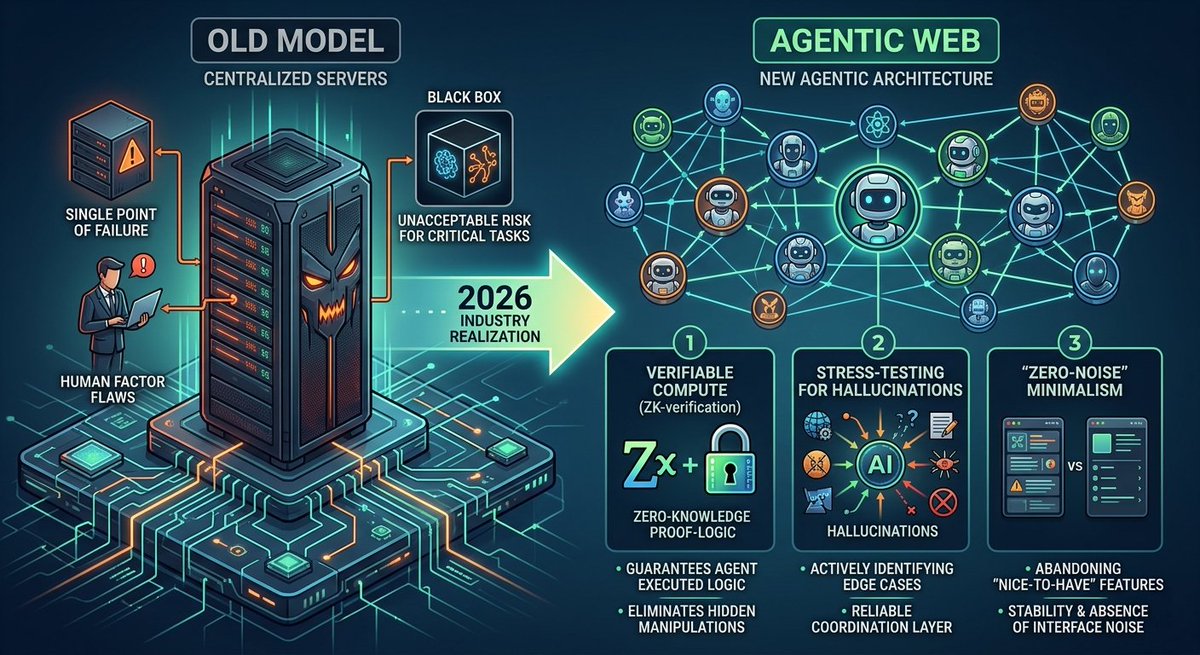
🛠️ from centralized servers to autonomous consensus
in 2026, the industry has realized: for AI agents to become truly autonomous, they need an environment that eliminates the "human factor" and the flaws of centralized infrastructure. we are building the Agentic Web, where coordination happens at the level of distributed consensus.
why the old model no longer works?
centralized data servers create a single point of failure and a "black box" in decision‑making. for critical tasks — such as smart contract auditing or capital management — this is an unacceptable risk.
three pillars of the new agentic architecture:
1. verifiable Compute (ZK‑verification): integrating Zero‑Knowledge proofs for computations at the system's core ensures that the agent executed exactly the logic it was supposed to, without hidden manipulations.
2. stress‑testing for hallucinations: actively identifying edge cases and testing agents for errors in vulnerability reports is the only way to build a reliable coordination layer.
3. "zero‑Noise" minimalism: effective architecture requires stripping away everything unnecessary. abandoning "nice‑to‑have" features in favor of stability and the absence of interface noise is the standard for systems operating autonomously.
what does this change?
standardizing prompt structures minimizes ambiguity in communication between agents, turning their interactions into a clear, mathematically precise dialogue. we are moving from "chatbot conversations" to managing fault‑tolerant decentralized systems.
conclusion: the future belongs to autonomy that does not require trust — because it is verifiable by default.
Tomorrow on Open Source Friday 👇
We're breaking down Spec Kit: what it is, the problems it solves, and how clear specs make collaboration actually work. Principal Software Engineer Manfred Riem explains live.
Set a reminder. 🔔
https://t.co/g0xrLf3Hb5
#TRX: Broad market correction is accelerating TRX downside.
Key level $0.27111 likely to break this month.
Next support: $0.24175 — accumulation zone.
TRX will survive. Tron network fundamentals remain strong.
A retest of $3 is plausible, but whether it holds will depend on market conditions.
You can average into a position in the $2.78 – $3 range if you missed the last opportunity.
#ICP Held the $3 Zone
The coin defended this level and rallied +55% before nearly fully retracing the move.
We’re now testing the MA200. A break below seems likely, so I expect further downside.
The GitHub Copilot SDK is here 🙌
You can take the same Copilot agentic core that powers GitHub Copilot CLI and embed it in any application, with just a few lines of code.
https://t.co/2XcdaqWdMT
We’ll reassess the setup once that zone is tested. Market conditions remain challenging, particularly for altcoins, as BTC dominance shows little sign of easing.
#UNI Consolidating Under $5
As anticipated, UNI corrected toward the $5 level. However, the expected follow-through decline is now materializing.
Downward momentum persists for now, increasing the likelihood of a further move toward the $4.50 area.
We’re back with more Copilot CLI updates and improvements 🙌 Check out:
✅ New models and easier model management
✅ Built-in custom agents
✅ New ways to install
✅ Automation and scripting
✅ Context management
✅ Terminal experience
✅ Web access controls
Let us know what you think after trying it out.
https://t.co/chm4MoJRbh
This is exactly what is happening now. The problem is that there is not enough liquidity from above to act as a motivator for the asset.
I am more inclined to return to the boundaries of the ascending channel and continue the movement within it.
BTC The asset is trying to strengthen.
The situation in the market is quite complex, as we are doing our best to break the bearish flag pattern in the global projection,
and for this, we need to reach the area of $96,000+ and consolidate above the ascending channel.
.@OpenAI’s GPT-5.2-Codex is now rolling out in GitHub Copilot.
This model excels at large code changes like refactors or migrations, and has improved performance in Windows environments. Try it out in @code. https://t.co/TnkOVixjUI
You still have an opportunity to add to your position in the attractive $1.8 – $2 range if you haven't already.
While BTC dominance has dipped to around 59%, that's still not enough for alts to move independently.
#XRP Nears the $2 Mark
The asset gained +30% over the past week before correcting along with the broader market following BTC.
The most likely scenario now is a retest of the $2 zone, although a drop below that level remains possible if Bitcoin's decline continues.
Engineers at GitHub spent a year testing Copilot coding agent to find the best workflow. Now they have an easy-to-remember acronym: WRAP.
W – Write effective issues
R – Refine your instructions
A – Atomic tasks
P – Pair with the coding agent
Here's how to WRAP up your backlog. ⬇️
https://t.co/6pllDHq26X