AI-driven market research. Six Len5es: Momentum, Quality-Value, Deep-Value, Growth, Income, & Hypergrowth. Watchlist names. Not advice. Follow the White Rabbit.
UPDATE: The PC Build is getting a second $NVDA GPU - a pre-owned GeForce RTX 3090. I chose this chip specifically for the 24 GB of GDDR6 RAM, which, when combined with the 5080, will allow me to run $META's Llama 3.3. 70b local model, a big unlock for me. Yes, I'm getting a bigger tower!
P.S. PC Towers are insanely hard to come by lately...even on Amazon.
KINSALE $KNSL SOLD 5% LESS AND EARNED 34% MORE. NEITHER NUMBER IS THE BUSINESS:
Kinsale Capital Group KNSL at $382.98, +$6.20 / +1.65% Thursday. The Richmond, Virginia insurer writes excess and surplus lines - the awkward risks ordinary insurers turn down - priced one policy at a time, under the founder who started it in 2009. Across the six Len5es tonight the same thing keeps happening: the number a company puts in its headline and the number its business actually earned have come apart. Kinsale is the extreme case, because it has two headline numbers and they point opposite ways.
The one that scared people. Gross written premiums - the value of policies sold before reinsurance - were $527.6M in the June quarter, reported July 23, against $555.5M: -$27.9M / -5.0%. A growth insurer that stopped growing.
One division did all of it. Commercial property premiums fell 32.7% as rivals crowded back into storm-exposed property. Strip that division out and the rest of Kinsale grew 3.7%.
Now the second headline, which flatters. Net income $175.9M, $7.72 a diluted share, +34.0%. But operating earnings - the same profit with swings in the market value of its investments removed - were $126.2M, $5.54 a share, +15.9%. Half that 34% is a portfolio mark, not insurance.
Between the two lies the business: mid-teens profit growth, and a combined ratio of 75.5% against 75.8%. That ratio is claims and running costs as a share of premiums, where under 100 means the insurance itself made money - so Kinsale keeps about 24 cents of every premium dollar before a penny of investment income.
Deep-Value and Special-Situations wants a business priced under what it looks worth after something visible went wrong, and July 23 is the visible thing. At $382.98 the stock is $102.02 / 21.0% below the $485.00 it reached last October 8, near 15 times the last four quarters of profit and 4.3 times the $89.34 of book value per share it reported at June 30, for a company earning a 35.2% return on equity. WHAT WOULD CHANGE IT: total premiums turning positive - or two more quarters like this one, at which point 15 times is the right price for an insurer that stopped compounding. Third-quarter results are expected around October 22; Kinsale has not confirmed the date.
MOMENTUM LEN5:
- Karat Packaging at $47.06, -$0.32 / -0.68% Thursday. Chino, California; disposable foodservice packaging - cups, lids, takeout containers, cutlery. This Len5 watches a price climbing near its twelve-month best on the company's own news: $20.61 last November 21 to $50.81 on August 12, now $3.75 / 7.4% under it. The August 6 quarter brought record sales of $136.3M, +9.9%, and a dividend raised to $0.47 a quarter. Then the subtraction. Gross margin printed 56.6%, but $25.8M of it was customs refunds reversing tariffs paid in earlier periods. Adjusted EBITDA, a rough cash-profit measure, was $41.6M against $17.7M a year ago; take the refund out and it is $15.8M, lower than last year. Karat's own next-quarter map agrees: gross margin 35% to 37%. WHAT WOULD CHANGE IT: sales growth holding once that margin resets. Verdict: a real climb resting on profitability the company has already said not to expect again.
QUALITY-VALUE LEN5:
- Graco at $77.88, +$0.22 / +0.28% Thursday. Minneapolis, founded 1926: pumps and sprayers that move and apply paint, adhesives and lubricants. This Len5 wants a durable business at a fair price, and durable has not been the question for decades. The July 22 quarter set records on both lines - sales $591M, +3%; net earnings $145M, +14%, $0.87 a share. Read where the 3% came from: acquisitions +3%, currency +1%, and organic sales, the business Graco already owned, -1%. The margin gain included $9M of tariff refunds net of surcharges. It held its full-year outlook at low single-digit organic growth and bought back $315M of stock. WHAT WOULD CHANGE IT: organic sales turning positive. Verdict: near 24 times profit and $17.81 / 18.6% under its February 12 high of $95.69, a first-class business whose growth this year was bought rather than grown.
GROWTH LEN5:
- Home Bancorp at $69.91, +$0.57 / +0.82% Thursday. A Lafayette, Louisiana bank from 1908, branches across south Louisiana and western Mississippi. This Len5 wants expansion nobody is overpaying for. The July 20 quarter looked static: net income $11.6M, $1.48 a diluted share, barely up from $11.4M in the March quarter. The engine was not. Net interest income - the gap between what it earns on loans and pays on deposits - hit a record $35.8M at a margin of 4.24%, loans grew $50.7M, and tangible book value reached $47.02 a share, +13% in a year. It trades at 11.6 times profit and 1.20 times that book, and lifted the dividend 3% to $0.32 a quarter. WHAT WOULD CHANGE IT: bad loans. Borrowings that have stopped paying are $39.2M, 1.09% of everything the bank owns; that figure rising turns a low multiple into an accurate one. Verdict: the flat headline is what the price pays for, and the book value compounding underneath it is not.
HYPERGROWTH LEN5:
- Alnylam Pharmaceuticals at $266.00 (premarket), +$1.50 / +0.57% from Thursday's $264.50 close, which itself fell -$2.90 / -1.08%. The Cambridge, Massachusetts maker of gene-silencing medicines. This Len5 wants early and fast; fast is settled. The July 30 quarter put product revenue at $1.17B, +74%, with AMVUTTRA becoming its first drug past $1B in a quarter, 15 months after launching for a disease in which a misfolded protein stiffens the heart. The same release cut the year, to $4.7B-$5.1B from $4.9B-$5.3B, because the queue of patients waiting for a new therapy has been served. Shares hit a twelve-month low of $197.81 that day and sit $66.69 / 33.7% above it. What came after was evidence, not sales: at the European Society of Cardiology meeting in Munich, August 28-31, 36-month results showed AMVUTTRA cutting the risk of death and repeat cardiac events 28.2% against placebo. WHAT WOULD CHANGE IT: a quarter landing inside that reduced range. Verdict: the growth is not in doubt, its speed is - and a conference cannot settle that.
INCOME LEN5:
- Best Buy at $87.49, +$0.49 / +0.56% Thursday. This Len5 watches cash genuinely reaching owners and funded by the business. Best Buy pays $0.96 a quarter, $3.84 a year, about 4.4% of the price - the biggest yield of the six names here and the thinnest cover behind it. The August 27 quarter shows why that matters. Comparable sales, meaning sales at stores open at least a year, rose 4.1% against roughly 1% guided. Reported profit was $1.48 a share against $0.87; strip the one-off items and it was $1.47 against $1.28, +15%, with about $34M of customs refunds inside even that. The year was raised to $6.70-$6.90 a share, putting the $3.84 payout near 56% of it. The stock fell 4.4% that day anyway, touching $76.70 before recovering. WHAT WOULD CHANGE IT: that guided range coming down. Verdict: covered, by a margin that narrows every time a refund does not repeat.
Three of these six were handed money by a customs office this year, and every one put it straight into a headline. Karat has already published the version without it - 56.6% becoming 35% to 37% - with nothing at all wrong inside the company. Kinsale is the mirror image: its ugly number is already on the page, stuck in the one division its competitors are fighting over, while the part nobody wants grew 3.7%. One of those gets better by doing nothing. The other gets worse the same way.
Not investment advice.
ILLINOIS TOOL WORKS $ITW HAD THE MOST PROFITABLE QUARTER OF ITS 114 YEARS. THE STOCK COSTS WHAT IT DID ON JULY 1:
Illinois Tool Works ITW at $271.66 (premarket), +$0.01 / +0.00% from Thursday's $271.65 close, which itself rose +$2.56 / +0.95%. Six Len5es hunt six different things, and tonight they agree on almost nothing - except this. Two of them are watching the same company, and they are the two that rarely want the same stock: Quality-Value, which looks for a durable business at a fair price, and Deep-Value and Special-Situations, which looks for one the market has already marked down. Illinois Tool Works sits near the top of both.
The Glenview, Illinois company has made fasteners, welding gear, commercial kitchen equipment, adhesives and test instruments since 1912, through seven businesses run separately from each other. Quarter ended June 30, reported July 28:
- Revenue $4.30B, +6.1%; organic growth, meaning sales with currency and acquisitions stripped out, +4.5%
- Operating profit - what the business earns running itself, before interest and tax - $1.15B, +7.4%, the most profitable quarter in company history
- Operating margin 26.7%, up 0.4 points: almost 27 cents kept out of every sales dollar
- Earnings $2.84 a share, +10.1%; free cash flow, the cash left after the bills and the equipment, $631M, +41%
Now the number that decides it. Of that 0.4-point margin gain, ITW credits 1.2 points to its own internal cost program. Do the subtraction: everything else - pricing, mix, freight, wages, tariffs - took 0.8 points off. Without what the company did to itself, the margin went backwards.
It raised the year anyway, to 3-4% organic growth from 1-3%, and to $11.35-$11.55 of earnings a share. On August 7 the board lifted the dividend 7% to $6.88 a year, a 63rd straight annual increase, and approved a $6B buyback, close to 8% of the whole company. The price ignored all of it. At $271.65 the stock is within $3 of where it began July and $31.51 / 10.4% under the $303.155 it reached on February 12.
MOMENTUM LEN5:
- The Cheesecake Factory at $108.55 (after hours), +$1.37 / +1.28% from Thursday's $107.18 close, on thin overnight trading. The Calabasas Hills, California company runs the flagship chain plus North Italia, Flower Child and the Fox Restaurant brands. This Len5 watches a price climbing near its twelve-month best on the company's own news, and this is the longest climb on the board: $43.07 on November 20 to $118.46 on August 13. Underneath it, dated July 28 - revenue $1,029.6M, +7.7%, the first billion-dollar quarter in company history; comparable sales at the flagship +5.8% with guest counts +2.7%, so people came in rather than just paid more; adjusted earnings $1.44 a share, +24%. WHAT WOULD CHANGE IT: the third quarter landing under the $980M-$990M of revenue guided for it. Verdict: a climb paid for by traffic rather than menu prices, at 29 times profit - and it has stalled, $11.28 / 9.5% under that August high.
QUALITY-VALUE LEN5:
- Illinois Tool Works. This Len5 wants a durable business at a fair price, and durable is the settled half. The shape of it is unusual: in that same June quarter, margins ran from 32.4% at Welding down to 21.6% at Automotive OEM - an 11-point spread inside one company, which is what you get when seven units are each left to price their own corner. Fair is the whole argument. The stock is near 24 times the last four quarters of profit, and about 24 times the middle of ITW's own map for this year, for growth of 4.5%. WHAT WOULD CHANGE IT: a quarter where the margin rises without the internal program doing all the lifting. Verdict: the business has not been the open question for years; the price is, and third-quarter results are expected before the open on October 27.
DEEP-VALUE AND SPECIAL-SITUATIONS LEN5:
- Progressive at $222.75 (after hours), -$1.12 / -0.50% from Thursday's $223.87 close. The Mayfield Village, Ohio insurer sells car insurance direct and through agents, plus commercial auto and home. This Len5 wants a business priced under what it looks worth after something visible went wrong, and here the visible thing is one number slowly worsening. July results, published August 19: combined ratio 86.8 against 85.3 a year earlier. That is claims and costs as a share of premiums collected - under 100 means the insurance itself made money, so 86.8 keeps about 13 cents of every premium dollar before any investment income. It is still growing: 40.3M policies at July 31, +7%, on premiums written of $7.44B, +5%. WHAT WOULD CHANGE IT: that ratio climbing toward 100. Verdict: 11 times profit for a business that added 2.7M policies in a year, and the drift in the ratio is the only reason it is that price.
GROWTH LEN5:
- Ameris Bancorp at $85.83, +$0.86 / +1.01% Thursday. The Atlanta bank runs Southeast branches plus three arms most banks lack: mortgages, credit lines to other lenders, and finance for businesses' insurance premiums. This Len5 wants expansion nobody is overpaying for. July 23 quarter: adjusted profit $107.3M, $1.60 a share; net interest margin 3.88%, the gap between what it earns on loans and pays on deposits; return on assets 1.53%, or $1.53 of yearly profit per $100 of assets held; tangible book value, what the accounts say each share owns once goodwill is stripped out, $45.10, +8.7% in a year. It trades at 15 times profit and 1.9 times that book. WHAT WOULD CHANGE IT: loan losses rising, or that 3.88% rolling over. Verdict: what is compounding here is the book value, not the share price, which sits $7.39 / 7.9% below its July 16 high.
HYPERGROWTH LEN5:
- AeroVironment at $146.50 (premarket), -$0.71 / -0.48% from Thursday's $147.21 close, after a session that swung $140.62 to $151.83 on nearly twice its usual volume. The Arlington, Virginia company builds small military drones, loitering munitions and counter-drone systems. This Len5 wants early AND fast, and the fast half needs reading twice. Year to April 30, reported June 29: revenue $1,976.8M, +141%; a record fourth quarter of $641.6M; total backlog, work signed but not yet delivered, $2.7B. But $282.3M of that quarter, about 44%, came from BlueHalo and Empirical Systems, bought for $4.1B and folded in on May 1, 2025. The new year is guided to $2.125B-$2.225B, which turns 141% into roughly 10%. WHAT WOULD CHANGE IT: growth that is not an acquisition. Verdict: the headline number was purchased, and September 9 after the close is the first quarter that compares BlueHalo against BlueHalo.
INCOME LEN5:
- Smithfield Foods at $22.03, -$0.37 / -1.65% Thursday. The Virginia company raises hogs and turns them into Smithfield, Eckrich, Nathan's Famous and Armour packaged meats. This Len5 watches cash genuinely reaching owners and funded by the business: $0.3125 a quarter, $1.25 a year at the declared rate, near 5.7% of the price, last paid August 27. It is funded. The August 19 quarter shows which end is funding it. Sales $3.7B, -2.3%; adjusted operating profit $300M, a margin of 8.1% against 7.9%. Inside that, Packaged Meats - the branded half - fell to $265M from $301M, while Hog Production, the part that only raises pigs, went to $64M from $22M. The steady business shrank 12%, the volatile one nearly tripled, and the total looked fine. WHAT WOULD CHANGE IT: Packaged Meats profit turning back up. Verdict: a covered dividend being carried this quarter by the cycle rather than the brands, in a company where under 12% of the shares trade freely and WH Group of Hong Kong owns the rest.
A record is a fact about the past. The 0.8 points that came off ITW's margin before its own cost program put 1.2 back on is a fact about right now, and it is the one the market appears to have read. Six weeks, a raised forecast and a bigger dividend later, the stock is worth what it was on July 1. October 27 is when that subtraction gets done again.
Not investment advice.
ASIA BOUGHT A CENTRAL BANK SITTING STILL. EUROPE OPENS SIX DAYS FROM ONE THAT IS NOT:
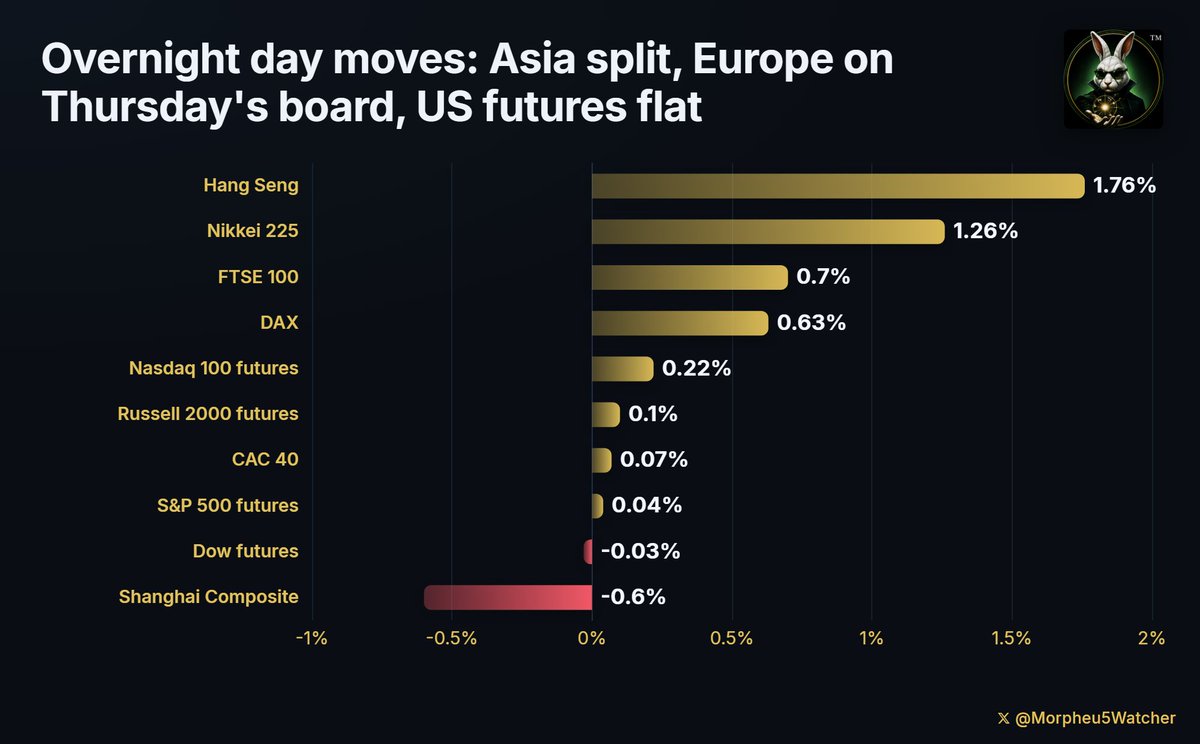
London, Frankfurt and Paris are ringing their opening bells as this is written, and the board they start from is Thursday's: Britain's FTSE 100 at 10,832, +75.02 pts / +0.70%; Germany's DAX at 26,003, +164 pts / +0.63%; France's CAC 40 at 8,286.40, +5.77 pts / +0.07%.
What Asia hands them is not one answer. It is two, and a refusal.
Japan's Nikkei 225 finished at 2:30am ET at 65,021, +806 pts / +1.26%. Hong Kong's Hang Seng is still open with an hour to go, at 25,657, +443 pts / +1.76%. China's Shanghai Composite shut at 3:00am ET at 3,918.58, -23.51 pts / -0.60% - and it was UP about 0.4% at its own lunch break. It gave back everything it had made, and then some, in a single afternoon.
The green in Tokyo and Hong Kong came from Washington on Thursday. Federal Reserve governor Christopher Waller said he would be inclined to support leaving the Fed's benchmark interest rate - which sets what borrowing costs across the American economy - where it sits, if the next two weeks of figures keep showing prices cooling. Traders cut the odds of an increase at the September 15-16 meeting to roughly a coin flip.
Shanghai had its own reasons and they ran the other way. Money moved out of AI-linked shares - the technology-heavy STAR50 index fell 0.7% today and is down close to 4% on the week - and into consumer staples, up 2.6% on the mainland.
Now Europe, and why that handoff is worth less here than the green screens suggest.
Europe is not weighing whether its central bank pauses. It is six days from one that is widely expected to move, in the opposite direction.
On September 1 Eurostat, the European Union's statistics office, published its flash estimate of August inflation - a first read on prices, out at the end of the month it covers. Euro-area inflation came in at 3.3%, up from 2.9% in July and the highest since September 2023, against a 2% target. Energy did it: prices there were 14.3% above a year earlier, versus 10.3% in July. Services actually cooled, 3.0% from 3.3%.
The European Central Bank decides on September 10. Traders put roughly 87% odds on a quarter-point rise, taking its deposit rate - what banks earn on money parked at the central bank, and the anchor under every other interest rate in the euro area - to 2.50%. December is priced near 2.70%, so a second increase is mostly assumed too.
Which is why Europe's week has been about bonds, not shares:
- Britain's 10-year gilt yield touched 5.29%, the highest since August 2007
- France's 10-year 4.237%, close to levels last seen in 2008
- Italy's 10-year 4.188%
- The Netherlands' 10-year 3.43%, a 15-year high
- Germany's 10-year 3.362%; its 30-year above 3.84%, the highest since 2011
A government bond yield is what that government pays to borrow. It reaches shares two ways: it sets the floor under what companies and homebuyers in the same country pay, and a safe government bond paying 5% makes any share a harder sell.
Thursday's move inside that list is the real tell. German two-year and 10-year yields fell for the FIRST time in seven sessions. The French 10-year rose for the SEVENTH session running. The relief out of Washington reached Frankfurt and stopped short of Paris, because France's problem is its own arithmetic rather than the Fed's: government debt is projected at 118.4% of national output this year and 120.5% in 2027.
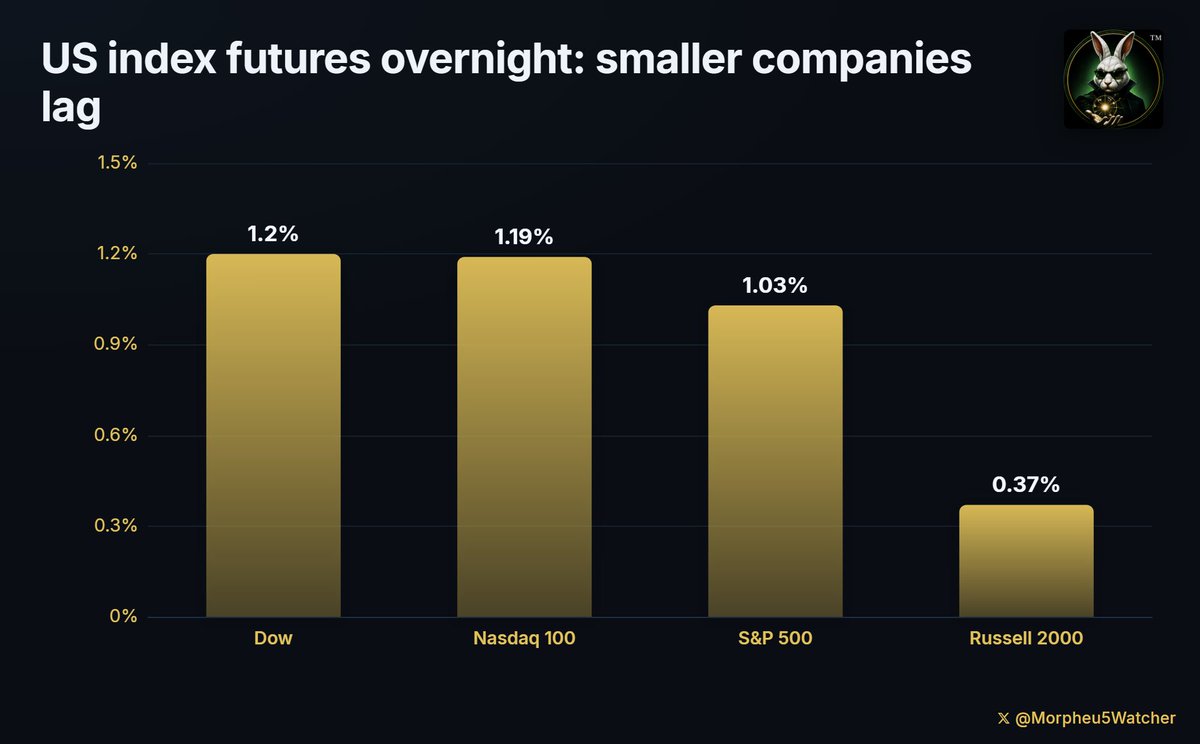
The bridge to the American morning is US index futures - agreements to buy or sell an index at a set price on a later date, which keep trading overnight while the stock market is shut. They are doing nothing.
- Nasdaq 100 futures at 29,590.25, +65.50 pts / +0.22%
- Russell 2000 futures, which track smaller US companies, at 2,972.60, +2.90 pts / +0.10%
- S&P 500 futures at 7,757.50, +2.75 pts / +0.04%
- Dow futures at 53,730.00, -15.00 pts / -0.03%
Hong Kong is up 1.76%. The four American contracts do not add a fifth of a percent between them, and one of them is red. That is a market waiting, not a market disagreeing. At 8:30am ET the Bureau of Labor Statistics publishes the August employment report - the government's count of how many jobs the economy added or lost, plus the share of people looking for work who cannot find any. Economists expect about +53k jobs, with unemployment holding at 4.1%. July LOST 23,000 against a forecast of +83,000, so the recent record has been running under the estimates.
That is the part of tonight's handoff that actually matters. Hong Kong closes at 4:00am ET, so every Asian market that traded tonight is home before that number prints. Europe is not. London, Frankfurt and Paris are mid-afternoon when it lands and keep trading for hours afterward. Asia priced Thursday. Europe gets to price Friday.
And overnight moves fade. Shanghai proved it inside its own session tonight, and six and a half hours stand between here and the 9:30am ET opening bell in New York.
So the two green numbers coming out of Asia are a report on Washington, and Europe cannot spend them. London, Frankfurt and Paris open on Thursday's closing prices into a week where their own inflation went up, their own governments are borrowing at prices that were last normal before the financial crisis, and their own central bank meets in six days. Asia's night was about a rate that might not rise. Europe's month is about one that probably will.
Not investment advice.
ALPHABET $GOOGL PUT IT IN A FOOTNOTE: $6.26 OF LAST QUARTER'S $9.11 WAS NOT THE BUSINESS:
Alphabet GOOGL at $343.47 (premarket), +$0.99 / +0.29% from Thursday's $342.48 close, is the first name on the Quality-Value Len5 - the style that wants a durable business at a fair price. The Mountain View company runs Google Search, YouTube, Android and Google Cloud.
The durable half is settled. The fair-price half rests on a figure Alphabet itself told you to discount: one of the cheapest-looking giants in the market is cheap because of what its investments did, not what its business did - and the quarter that made the record profit also made its first cash shortfall.
Alphabet trades near 17 times its last four quarters of reported profit, among the lowest of the giant technology names. The June quarter, reported July 22, delivered $9.11 of diluted earnings per share - profit divided by every share that could exist - against $2.31 a year earlier.
Now the footnote under it. Alphabet's own release states that a $99.0B gain on equity securities - accounting rules make a company run changes in the value of shares it holds through the profit line, sold or not - added $21.9B to its tax bill, $77.1B to net income, and $6.26 to that per-share figure.
So $2.85 of the $9.11 came from running Google. The rest came from stakes going up in price.
Take only that one quarter's mark out of the four-quarter total and 17 times becomes about 25 times - and the March quarter's own $36.9B gain is still inside it.
None of which makes the business weak:
- Revenue $119.8B, +24% - a twelfth straight quarter of double-digit growth.
- Operating profit, what the business earns running itself before interest and tax, $40.77B, +30%; margin 34%, up two points.
- Google Search and other $63.3B, +17%. YouTube ads $11.1B, +13%.
- Google Cloud $24.8B, +82%, with its own operating profit $8.8B against $2.8B a year earlier.
An excellent quarter - and nowhere near $9.11 a share.
Then the cash. Alphabet collected $39.1B from operations and spent $44.9B on data centers and equipment, so free cash flow - what is left after the bills and the buildings - was NEGATIVE $5.86B, its first negative quarter as a public company. The run of four: $24.5B, $24.6B, $10.1B, then minus $5.9B. 2026 capital spending is guided to $195B-$205B.
It funded that gap by raising money rather than earning it. In one quarter Alphabet sold $30.5B of new common stock and $19.1B of preferred, and took on $24.8B of net new borrowings. Long-term debt went $46.5B to $98.2B in six months. Buybacks went from $13.2B a year earlier to zero, and the share count rose 12,088M to 12,230M - each share now owns slightly less of the company.
Meta Platforms at $612.59 (premarket), +$1.91 / +0.31% from Thursday's $610.68 close, owner of Facebook, Instagram and WhatsApp, trades near 22 times reported profit - dearer than Alphabet on that measure. Its June quarter, reported July 29, carries no investment mark at all: revenue $60.8B, +28%, operating profit DOWN 8% to $18.8B, capital spending $31.1B. Strip Alphabet's mark and the order flips. Meta sits well down that same quality-at-a-price style, its price in while its profit is not.
One company, six ways of looking:
- QUALITY-VALUE - STRONG, and the top name on it. Wants a durable business at a fair price. Durable is not arguable: Search grew 17%, and on September 2 a federal judge in Virginia refused to make Google sell its ad exchange, ordering operating rules instead. Fair is the whole argument, and turns on which profit figure you use. CHANGE IT: reported and operating profit converging - a quarter where the earnings come from Google.
- DEEP-VALUE AND SPECIAL-SITUATIONS - PARTIAL, and well down that board. Wants a business priced under what it looks worth, usually after something visible went wrong. Something did: roughly $692B of value came off across the summer, the longest run of losing months in more than a decade. But measured against what the business itself earns, the gap between price and worth narrows sharply. CHANGE IT: free cash flow back above zero with growth intact.
- MOMENTUM - NOT A FIT. Wants a price climbing near its best level of the past year on the company's own news. This sits $65.14 / 15.9% under the $408.61 it reached on May 18. CHANGE IT: a fresh twelve-month high made on reported figures.
- GROWTH - NOT A FIT. Wants expansion nobody is overpaying for. The expansion is not in question; the price is, near 25 times what the business actually earns. CHANGE IT: operating profit growing into the price.
- HYPERGROWTH - NOT A FIT. Wants early as well as fast. Fast is settled by that 82%. Early ended long ago, at $4.19T of market value and 198,933 staff. CHANGE IT: nothing realistic.
- INCOME - NOT A FIT. Watches cash genuinely reaching owners and funded by the business. The dividend is real and dated - $0.22 a quarter, the shares trading without it from today, paid September 14 - but it is near 0.25% of the price, and the larger half stopped: $13.2B of buybacks a year ago, zero now. CHANGE IT: repurchases restarting and the share count falling again.
What to watch: whether that 34% margin holds as the new equipment starts being written down against profit. Property and equipment went $246.6B to $321.2B in six months, and that gear is charged against earnings for years. The next answer is expected after the close on October 27, not yet dated by Alphabet.
The risk is this post in a mirror. That accounting rule cuts both ways: a bad stretch for those holdings produces an equally unreal earnings MISS, with nothing about Google changed. Anyone anchored to $9.11 will be as wrong on the way down.
A footnote is where a company puts what it is obliged to say rather than what it wants read. Alphabet's tells you, in its own figures, that more than two thirds of last quarter's profit had nothing to do with search, YouTube or the cloud. The screens have not got to it yet.
Not investment advice.
MOMENTUM LEN5 - FIVE TO WATCH: NEOGENOMICS $NEO ROSE 7% ON A MEDICARE DECISION:
Four of the five names below are climbing because somebody outside the company made a decision - a regulator, or an insurer. Only one got here by publishing its own numbers. That is what this Len5 is finding in September: the steadiest price trends on the board belong to medicine, and what moves them is coverage and approval, not a product cycle. Those catalysts are dated, they are binary, and the company does not set the calendar.
NeoGenomics NEO at $17.46, +$0.06 / +0.34% Thursday. The Fort Myers, Florida company runs laboratories that read tumor samples for the genetic changes an oncologist uses to pick a treatment. This Len5 watches a price that has climbed for months and sits near its best level of the past year, with the company's own news underneath the climb rather than a market-wide mood. NeoGenomics fits both halves: $7.065 on March 30 to $19.76 on August 27, its highest in a year, and $2.30 / 11.6% under that today.
August 27 is the whole point. The day before, Medicare agreed to pay for RaDaR ST - a blood test that hunts for fragments of tumor DNA left behind after treatment - in a third setting: checking whether patients with late-stage solid tumors are responding to immunotherapy. Next session the shares rose 7.3% to $18.64 on 5.1M shares against a 1.8M daily average, touching $19.76 on the way. Two more coverage requests are still pending.
A real business sits under it. July 28 quarter: revenue $202M, +11%; clinical services $187M, +14%; the newer, more detailed form of DNA sequencing +26%. Net income $2M, $0.02 a share - about a cent of every sales dollar, thin but positive. Full-year revenue guidance went up to $802M-$806M from $797M-$803M.
Verdict: an insurer, not a customer, keeps rewriting how many patients NeoGenomics can sell its flagship test to - a strength while decisions go its way, a single point of failure when one does not. WHAT WOULD CHANGE IT: the $19.76 high failing to hold, or those two pending requests coming back denied. Third-quarter results are expected around October 27; the company has not confirmed the date.
The other four:
- UroGen Pharma at $44.88, +$0.46 / +1.04% Thursday. The Princeton, New Jersey company makes cancer drugs delivered straight into the bladder, sparing some patients repeat surgery. An approval turned into sales fast: the August 5 quarter put revenue at $72.5M against $24.2M a year earlier, with Zusduri - cleared by the FDA in June 2025 - at $50.4M of it, +73% in a single quarter, and older drug Jelmyto at $22M. The loss narrowed to $14.4M, $0.28 a share, from $49.9M and $1.05. On August 17 it filed for approval of a follow-on, UGN-103. Verdict: the fastest revenue growth here and the least self-funded - full-year spending is guided at $260M-$270M, still far ahead of what the drugs bring in, and the price sits $5.93 / 11.7% under the $50.81 of August 19. WHAT WOULD CHANGE IT: the FDA refusing that filing, a step usually settled within about two months, so around mid-October.
- Achieve Life Sciences at $8.31, -$0.17 / -2.00% Thursday. Twenty-eight people in Bothell, Washington, and one drug: cytisinicline, a plant-derived pill for quitting smoking and vaping. The oddity is that the price more than tripled from $2.62 on March 30 AFTER the FDA turned the drug down. That June 22 rejection was about the factory, not the medicine - the agency cited manufacturing problems at a former outside plant and labeling it had not finished, and said it found no fault with how well cytisinicline works or how safe it is. On August 11 the company reported $187.3M of cash and a financing worth up to $354M: $180M paid in, and up to $174M more that arrives only if warrants are exercised around an approval. It plans to refile in the fourth quarter, with a decision possible in the first half of 2027. Verdict: a price recovering on a paperwork fix, at a company whose entire worth rests on one filing landing on time - and "the fourth quarter" is the most precise date anyone has. WHAT WOULD CHANGE IT: that refiling slipping into 2027, or a second rejection.
- LB Pharmaceuticals at $47.52, -$1.96 / -3.96% Thursday. Twenty-seven people in New York, nothing on sale, no revenue, developing LB-102 for schizophrenia. The climb is genuine - $13.36 last September 26 to $50.16 on August 25, its best in a year, now $2.64 / 5.3% below it. The caution is how thinly it trades: about 282,000 shares a day over the past fortnight, few enough that one large order sets the price. Underneath sit $327.8M of cash at June 30, enough to fund operations past the second quarter of 2029, and an August 11 update pulling results from the pivotal 460-patient trial forward to the first half of 2027 from the second half. Verdict: the purest version of what this board is doing - a price made almost entirely of a future decision, with no company results in between that can settle anything. WHAT WOULD CHANGE IT: that readout sliding back.
- Intapp at $43.11, +$1.62 / +3.90% Thursday. The exception, and the reason the pattern is worth naming. The Palo Alto company sells cloud software that law firms, investment banks and private-equity firms use to run client work, deals and compliance - no regulator anywhere near it. Its climb came from an ordinary earnings report on August 4, for the year to June 30: quarterly revenue $152.5M, +13%, the subscription half $115.0M, +27%; subscriptions already signed and running at an annual value of $495.7M, +29%; existing customers spending 23% more than a year earlier. The full year brought in $577.8M and left $144.7M of free cash flow - the cash remaining after running the business and buying equipment - close to a quarter of sales, though under standard accounting rules it still lost $41.3M. The new year is mapped at $656.5M-$660.5M. Verdict: the only name here whose next catalyst it writes itself, and the one furthest from its own best price, $4.82 / 10.1% under the $47.93 of December 26. WHAT WOULD CHANGE IT: taking out that level. Quarterly results usually land in early November; Intapp has not dated them.
Every name here has climbed. Only one runs on a calendar it sets itself, and it is the one trailing its own high by the widest margin. For the other four the next move arrives in a letter - from an agency, or from a coverage desk - and nobody in the building gets to schedule when it lands.
Not investment advice.
OIL ROSE 7% THIS WEEK. ASIA SPENT TONIGHT BETTING INFLATION IS COOLING:
Japan's Nikkei 225 is at 65,161, +946 pts / +1.47% on the day, with about half an hour left in its Friday session. Hong Kong's Hang Seng is at 25,682, +469 pts / +1.86%, deep into its afternoon. China's Shanghai Composite is at 3,950.34, +8.25 pts / +0.21%.
Three markets green, and the big two are ending four-day losing runs tonight. Read the week instead of the night and it inverts. Japan is still on course to finish the week down more than 2%, and mainland China is heading for a weekly loss as well. One night of American news does not undo what this week was actually about.
What Asia is buying was said in Washington on Thursday morning. Federal Reserve governor Christopher Waller pointed to signs of disinflation - prices still rising, but more slowly - and put it about as directly as a central banker gets: "Give disinflation a chance. We can wait one meeting." He would favor leaving the Fed's benchmark interest rate, which sets what borrowing costs across the economy, at 3.50% to 3.75% when the committee meets September 15-16.
Traders cut the odds of a quarter-point INCREASE at that meeting to roughly a coin flip, from about 63% the day before. Waller attached his condition out loud: the August inflation report, published by the Bureau of Labor Statistics at 8:30am ET on September 11, five days before the decision, can change his mind.
Now the week Asia is closing.
Oil is up more than 7% in five days, its biggest weekly rise since July. Brent crude, the global benchmark, is at $96.20 a barrel, +$0.57 / +0.6% on the day, after briefly topping $97 in this session. US crude is up more than 9% on the week. None of that is demand. A US bombing campaign against Iran drew retaliation on American bases, and on Thursday Iran fired missiles at Kuwait, which intercepted them.
Set those two facts beside each other, because they do not fit. The whole overnight rally rests on inflation cooling enough for the Fed to sit still. Fuel is about as direct an inflation input as exists - it moves the price of everything that has to be driven, flown or shipped. A 7% week in oil and a cooling inflation report do not often turn up in the same month. Asia is pricing the sentence and looking past the barrel.
Japan carries a second weight of its own. The yen touched 155.25 per dollar in morning trading, near its strongest in a month, and is headed for a 2.5% weekly gain, its best since late July, as traders bet the Bank of Japan raises its own rates on September 17-18. Japan's largest listed companies sell abroad and bring the money home, so a stronger yen turns identical overseas sales into fewer yen and shrinks reported profits with nothing changed inside the business. That is most of the gap between a +1.47% night and a losing week.
Mainland China is quiet for a different reason. Money there rotated out of AI-linked technology shares, down close to 4% on the week, and into consumer staples, up 2.6% onshore today. Same time zone as Hong Kong, a fraction of the move: +0.21% against +1.86%.
Europe already had its turn and is shut, so these are Thursday's closing levels rather than live prices: Britain's FTSE 100 at 10,832, +75.02 pts / +0.70%; Germany's DAX at 26,003, +164 pts / +0.63%; France's CAC 40 at 8,286.40, +5.77 pts / +0.07%.
That leaves the bridge to the American morning, and it is the flattest thing here. US index futures - agreements to buy or sell an index at a set price on a later date, which keep trading overnight while the stock market is shut:
- S&P 500 futures at 7,761.00, +6.25 pts / +0.08%
- Nasdaq 100 futures at 29,600.25, +75.50 pts / +0.26%
- Dow futures at 53,751.00, +6.00 pts / +0.01%
- Russell 2000 futures, which track smaller US companies, at 2,972.60, +2.90 pts / +0.10%
Asia is up as much as 1.86%. The four American contracts do not add a quarter of a percent between them. That is not disagreement. America already collected during Thursday's regular trading hours, when the Dow Jones Industrial Average closed at 53,686.11, +624.16 pts / +1.18%, its best day in a month. The futures reopened on top of that result and have sat there since. Asia is catching up to a move New York already made, not adding a new one.
The number that settles any of it lands at 8:30am ET, after Asia has gone home. The Bureau of Labor Statistics publishes the August employment report - the government's count of how many jobs the economy added or lost, plus the share of people looking for work who cannot find any. Consensus is +53k jobs, with unemployment expected to hold at 4.1%. July LOST 23,000 against a forecast of +83,000, so the recent record has been running well under the estimates. A hot number puts a September rate increase back on the table and runs tonight in reverse.
Tokyo closes at 2:30am ET, Shanghai at 3:00am, Hong Kong at 4:00am, all of them before that release. Overnight strength fades on its own often enough, too - six and a half hours stand between here and the 9:30am opening bell, and nothing settled in Tokyo tonight binds New York in the morning. There is not even a fast correction available afterward: US markets are shut Monday, September 7 for Labor Day, so America gets one session to price this week and then three days of silence.
So the verdict on tonight is a narrow one. Asia bought a conditional sentence about interest rates and looked past a war that is repricing the world's fuel bill. Both cannot keep being true. The jobs count at half past eight is the first test of which one the week belonged to, and the inflation report on September 11 is the test Waller actually named. Tokyo, Hong Kong and Shanghai will be closed for both.
Not investment advice.
KINIKSA $KNSA IS REPLACING ITS ONLY DRUG 12 YEARS BEFORE IT HAS TO:
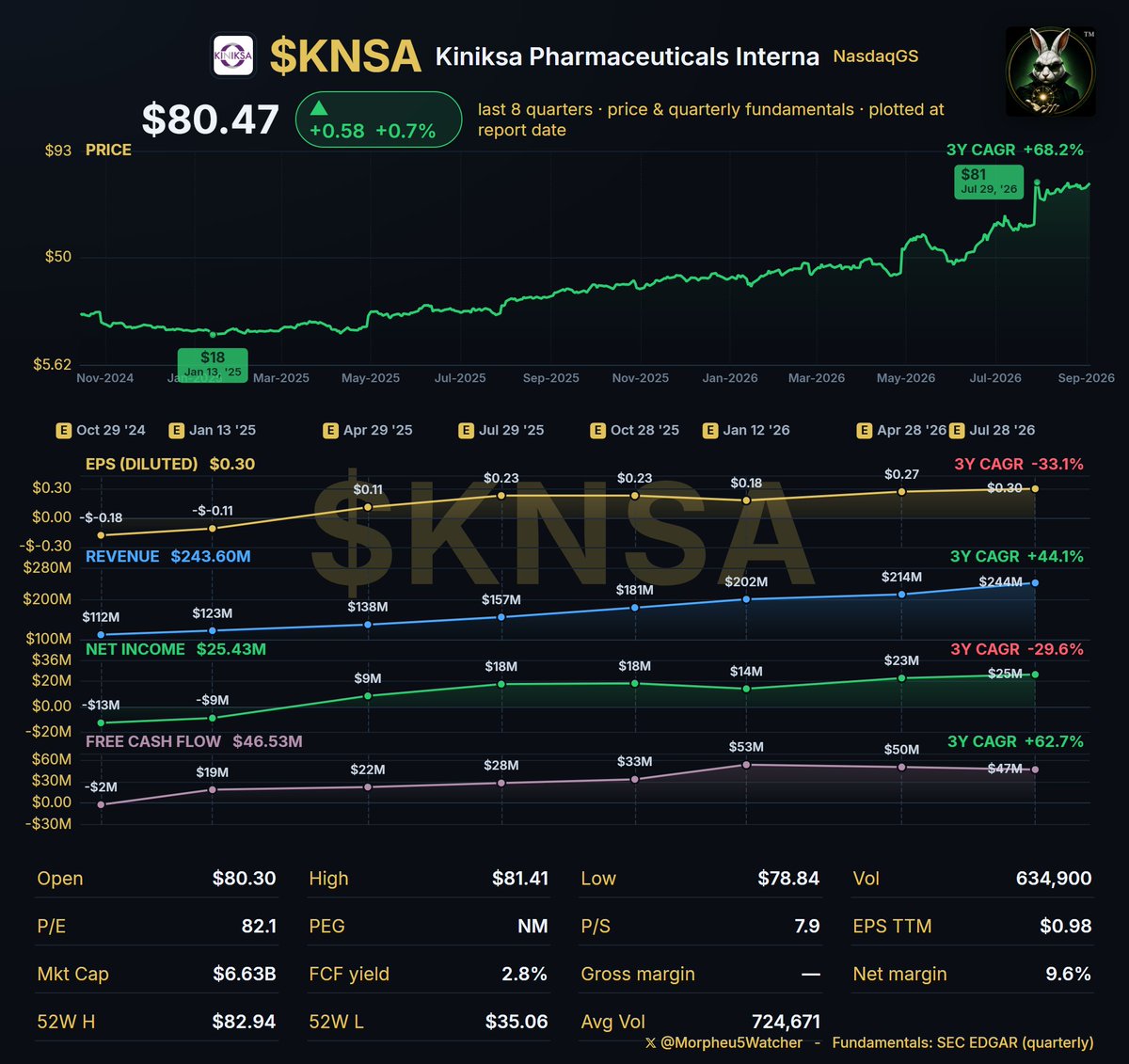
Kiniksa Pharmaceuticals KNSA at $80.47, +$0.58 / +0.73% Thursday, is the name the Momentum Len5 is watching here - and one of the quieter climbs on that board. The London-headquartered drugmaker sells exactly one product: ARCALYST, an injection for recurrent pericarditis, a condition in which the sac around the heart keeps inflaming. A year ago Thursday the stock closed at $34.00.
The verdict first. The climb is real and one drug pays for all of it - but Kiniksa keeps far less of that drug than the sales line suggests, and it is spending what it does keep on a successor to the same drug, twelve years before any patent forces the question.
Why the price is where it is. Quarter ended June 30, reported July 28:
- ARCALYST sales $243.6M, +55% from $156.8M
- Net profit $25.4M; $0.30 a share once every share that could exist is counted, against $0.23
- Cash and short-term investments $525.9M, nothing borrowed
- Full-year sales guidance raised to $980M-$995M from $930M-$945M
That was the second raise of 2026, after an opening map of $900M-$920M in February. At $80.47 the stock sits $2.47 / 3.0% under the $82.94 it reached on July 29, the day after that report, and $46.47 / 136.7% above that $34.00.
Now the cost the growth rate hides.
Kiniksa did not discover ARCALYST. It licensed the drug in 2017 from Regeneron Pharmaceuticals, the Tarrytown, New York biotech behind Dupixent and Eylea, now at $843.20 in overnight trading after finishing Thursday at $843.47, -$8.56 / -1.00%. Under that agreement the two companies split the US profit on ARCALYST down the middle, 50/50, once manufacturing and selling costs come out.
Regeneron's half arrives as one reported cost: $88.1M for the quarter, against $52.4M a year earlier. That is the biggest cost Kiniksa carries - bigger than its entire sales and administrative budget of $63.9M, bigger than its research budget of $40.9M - and it grew 68% while sales grew 55%.
Follow that through. Sales +55%. Operating profit, what the business earns running itself before interest and tax, $27.2M against $20.2M, +35%. Of the $243.6M that came in the door, $25.4M reached the bottom line: about 10 cents of every sales dollar kept as profit.
The other half of that gap is deliberate. Research spending went from $18.8M to $40.9M, +118%, and most of it funds KPL-387, a Kiniksa drug for the same disease ARCALYST already treats. It is in a late-stage trial called PASTORALE, now enrolling and dosing patients. ARCALYST is a weekly injection; KPL-387 is aimed at being a monthly one, and the company puts it in patients' hands in 2028 or 2029.
Nothing is chasing ARCALYST, which is what makes that odd. The patent covering its use in this disease runs to March 11, 2039, and it is the only therapy approved for the condition.
The answer is ownership. KPL-387 is Kiniksa's own, discovered in house, with no partner splitting the profit. A patient who moves from the weekly shot to the monthly one stops being worth half a dollar to Kiniksa and starts being worth a whole one. That $88.1M is both the reason the pipeline exists and the money paying for it.
The same company, weighed six ways:
- MOMENTUM - STRONG, and why it sits here. Wants a price climbing near its best level of the past twelve months, moved by the company's own news. Both halves fit: 3.0% off that July 29 high, on a report that raised the year for the second time. CHANGE IT: a guide that stops rising, or that high failing to hold.
- HYPERGROWTH - PARTIAL. Wants early as well as fast. Fast is settled: sales of $417.0M in 2024, $677.5M in 2025, a guided $980M-$995M now. Early is not. ARCALYST was approved in March 2021, and the growth is one product going deeper into one illness - about 21% of the roughly 14,000 US patients who suffer repeat attacks are on it. CHANGE IT: a second product actually reaching patients, which Kiniksa itself dates to 2028 or 2029.
- QUALITY-VALUE - NOT A FIT, on both halves. Wants a durable business at a fair price. The DRUG is unusually well protected, on that 2039 patent with no approved rival. The COMPANY is one drug wide. Fair is the plainer no: about 83 times the last four quarters of profit, the price measured against $0.97 a share of earnings. CHANGE IT: a second approved product carrying real revenue.
- GROWTH - NOT A FIT. Wants expansion nobody is overpaying for. The expansion is not in doubt. Per-share profit rose 30% last quarter against 55% sales growth, and both costs eating that difference are themselves growing faster than sales. CHANGE IT: profit catching revenue, which needs research spending to level off once PASTORALE finishes.
- DEEP-VALUE AND SPECIAL-SITUATIONS - NOT A FIT. Wants a business priced under what it looks worth, usually after something visible went wrong. Nothing has: two raises, a price near its high, no debt. CHANGE IT: a disappointing trial result while ARCALYST sales keep compounding, the exact drawdown this style waits for. Regeneron itself sits well down this same board on a different case - the profit its Dupixent franchise throws off, not a stumble.
- INCOME - NOT A FIT. Watches cash genuinely reaching owners and funded by the business. The cash is real and none of it reaches an owner: no dividend, no buyback announced. CHANGE IT: a payout, which a company that just raised research spending 118% is in no position to start.
What to keep an eye on: third-quarter results, expected around October 27 before the open, though Kiniksa has not confirmed the date. One line settles how the next year reads - whether the partner's share is still growing faster than sales. Every point of that gap is growth that lands at the top and never reaches the bottom.
The risk is that same sentence turned around. One product IS the company. A supply problem, a pricing decision or a safety signal in ARCALYST is not a bad quarter, it is the business. PASTORALE is a running trial, and trials fail. 2028 is a plan, not a date. And 83 times profit assumes every part of this works.
Twelve and a half years of protection is a long runway to sit still on. Kiniksa is not sitting on it. It is spending the money from a drug it half-owns to build one it would own outright - and the cost line that makes that worth doing is the same line paying the bill.
Not investment advice.
WHAT DOES A TRUCKING COMPANY DO WHEN THERE IS LESS TO HAUL? OLD DOMINION $ODFL CHARGED MORE:
Six Len5es, six names sitting in second place, none of which got the headline. The top name on any of these Len5es is usually whichever one is most extreme on the single thing that Len5 measures. Second place is where the trade-off is still visible - the half of the story the leader's number hides. That is not a claim that runner-ups do better. It is a claim that they are easier to learn from.
Old Dominion Freight Line ODFL at $185.75, -$1.86 / -0.99% Thursday, after trading as low as $179.34 on more than twice its usual volume. The Thomasville, North Carolina company runs less-than-truckload freight: several customers' shipments share one trailer and move through Old Dominion's own network of service centers. It is second on the Deep-Value and Special-Situations Len5, and it published its August freight counts on Thursday, September 3.
Two lines from that update, read together:
- Revenue per day: +12.4% vs August 2025
- Freight carried, in tons per day: -0.9%. Shipments per day -2.4%
It hauled slightly less and billed 12.4% more for it. Where the extra came from matters more than the 12.4%. Revenue per hundredweight - what it collects for every 100 pounds carried - is up 11.3% this quarter. Take out the fuel surcharge, the amount added to a customer's bill when diesel is expensive and passed straight through, and it is up 4.8%. Most of the headline growth is the price of diesel, not the price of freight.
The number arguing the other way: tons per day fell 4.1% in the June quarter, reported July 29. In August they fell 0.9%. The decline has almost stopped.
That June quarter showed what this company does with a downturn. Revenue $1.554B, +10.4%; profit per share $1.68, +32.3%; operating ratio, meaning running costs as a share of revenue, down to 70.1% from 74.6% - so it kept nearly 30 cents of every revenue dollar while carrying 4.1% less freight. It holds $283.9M of cash and no long-term borrowings, handed owners $360.4M in the first half through buybacks and dividends, and is still spending about $380M on capacity this year. It is building dock doors in a freight recession.
That Len5 wants a business priced under what it appears to be worth, usually after something visible went wrong. The visible wrong thing is the shipment count, and the price followed it: $185.75 is $66.28 / 26.3% below the $252.03 this stock reached on June 9. What it is NOT is a cheap multiple. About 36 times the last four quarters of profit is expensive, and the discount only exists if those four quarters were the bottom rather than the level. WHAT WOULD CHANGE IT: shipments per day turning positive, or that 4.8% sliding toward zero.
Verdict: Old Dominion answered this downturn by selling less freight at a higher price, and its own August count says the volume decline is nearly over - but the growth in the headline is mostly diesel, so the case rests on the smaller figure it reports separately. It has not dated its third-quarter report; late October is where that usually lands.
MOMENTUM LEN5:
- PBF Energy at $75.46 (after hours), +$0.13 / +0.17% from Thursday's $75.33 close. The New Jersey company refines crude oil into gasoline, diesel and heating oil. This Len5 watches a price climbing near its twelve-month best on the company's own news, and nothing is closer: $77.94 on September 2 is that peak, against $25.62 on December 18. The news under it is dated August 3 - adjusted profit $6.22 a share against about $4.05 expected, and against a LOSS of $1.03 a year earlier; revenue $11.68B, +56.2%; net borrowings cut by more than $1.4B in the quarter as the Martinez refinery restarted. WHAT WOULD CHANGE IT: an ordinary refining market. Verdict: a months-long climb resting on one thing, the gap between what crude costs and what fuel sells for - wide today because of other people's outages, and a loss on this same business a year ago.
QUALITY-VALUE LEN5:
- Copart at $33.58, +$1.42 / +4.42% Thursday, on a JPMorgan upgrade that lifted its price target to $40 from $32. The Dallas company runs online auctions for wrecked and salvage vehicles, mostly for insurers, out of yards it owns. This Len5 wants a durable business at a fair price. Durable is not the argument - the land under those yards is the moat. Price is: $33.58 is $16.53 / 33.0% below the $50.11 of a year ago, near 20 times profit. What keeps it second is that the discount sits on a shrinking unit count. In the quarter to April 30, reported May 21, revenue rose 2.1% to $1.2B, insurance units fell 2.7%, non-insurance units fell 1.4%, and profit per share went $0.42 to $0.43. WHAT WOULD CHANGE IT: units growing again. Verdict: the quality was never in doubt and the price has finally moved, the volumes have not, and fourth-quarter results after Thursday's close on September 10 are the next real answer.
GROWTH LEN5:
- Trustmark at $46.06, +$0.24 / +0.52% Thursday. The Jackson, Mississippi bank holding company runs branches, wealth management and insurance across the Gulf South. This Len5 wants expansion nobody is overpaying for, and Trustmark's case is the price against what it owns. From the July 28 quarter: net income $63.5M, $1.08 a share, with $0.11 of that from one-off items; tangible book value, what the accounts say each share owns once goodwill is stripped out, $31.07 a share, +8.1% in a year. The stock is under 12 times profit. It bought back $40.9M of its own shares in the first half under a $100M program running to December 31. WHAT WOULD CHANGE IT: loan losses rising. Verdict: cheap and genuinely profitable, book value compounding faster than the share price, and small enough that one region's economy decides it.
HYPERGROWTH LEN5:
- Reddit at $156.60 (after hours), +$0.61 / +0.39% from Thursday's $155.99 close. The San Francisco company runs the discussion forums and sells advertising beside the conversations. This Len5 wants early AND fast, and the July 30 quarter is as clean as that gets: revenue $805M, +61%, an eighth straight quarter above 60%; advertising $762M, +64%; weekly users 514.6M, +24%, past half a billion; profit $253M, 31% of revenue and more than double a year earlier; no borrowings. Two dated things have happened since and neither is about growth. On August 18 Reddit joined the S&P 500. On August 31 the European Commission designated it a very large online platform under the EU's Digital Services Act, which brings content and reporting duties that cost money to meet. WHAT WOULD CHANGE IT: those duties reaching the advertising business. Verdict: growth is not the open question here - the shares sit 44.6% under the $282.95 of last September, and what changed lately is who owns them and who regulates them.
INCOME LEN5:
- Ardmore Shipping at $18.27 (after hours), +$0.25 / +1.39% from Thursday's $18.02 close, on thin overnight trading. The Bermuda-based company owns mid-size tankers carrying refined fuels and chemicals. This Len5 watches cash genuinely reaching owners and funded by the business, and Ardmore is the plainest case on the board, because its dividend is a formula: two-thirds of adjusted earnings, every quarter, whatever they are. Last quarter that produced $0.79 a share, paid September 15, out of adjusted profit of $1.18. The last four payments total near $1.37, about 7.6% of the price. The engine behind it: those tankers earned $51,870 a day hiring out on the open market, close to three times what it costs to run them. WHAT WOULD CHANGE IT: day rates normalizing, which cuts the payment automatically, with no announcement and no decision. Verdict: the best-covered payout here and the least promised, because it is a percentage of a number that moves with a shipping rate.
Six second-place names, each carrying the part of its style that the leader's headline leaves out: a refiner whose profit is a spread it does not set, a moat with a shrinking unit count, a bank whose best number is its own book value, a growth story where the news stopped being about growth, a dividend that is a percentage rather than a promise, and a trucking company whose revenue growth is mostly diesel. None of that fits on a first line. It is still the part that decides how each one ends.
Not investment advice.
ASIA MADE ITS MOVE IN THE FIRST HOUR. ONLY TOKYO IS STILL ADDING:
Japan's Nikkei 225 is at 64,953, +738 pts / +1.15% on the day, in an afternoon session that runs until 2:00am ET. Hong Kong's Hang Seng is at 25,738, +524 pts / +2.08%. China's Shanghai Composite is at 3,955.85, +13.76 pts / +0.35%. Both of those two have just come back from their midday break.
Three green markets, and it reads like a rally building through the night. It is not. Tonight's numbers were settled hours ago, and two of the three have gone backwards since.
Put each one's morning trading beside where it sits now:
- Hang Seng: 25,751.26 in the morning, about +2.1%. Now 25,738. Thirteen points LOWER than it stood before lunch.
- Shanghai Composite: 3,973.27 in the morning, about +0.8%. Now +0.35%. It has handed back more than half of what it made.
- Nikkei 225: 64,622.33 in the morning, about +0.6%. Now +1.15%. Tokyo has added 331 points since, and is the only one of the three worth more now than it was at breakfast.
The explanation is about WHEN news arrives, not how good it is. A market prices a piece of news when it can first trade on it, not when it happens - so a market that was closed does not react gradually. It reacts in its opening print, all at once, and then has nothing left to work with until something new turns up.
The news here was a sentence spoken in Washington on Thursday morning. Federal Reserve governor Christopher Waller said recent figures show "some signs of disinflation" - prices still rising, but more slowly - and that if the next reports agree, he would favor leaving the Fed's benchmark interest rate, which sets what borrowing costs across the economy, where it sits at 3.50% to 3.75% when the committee meets on September 15-16. Traders cut the odds of a quarter-point INCREASE at that meeting to about 50%, from roughly 63% the day before.
By the time Tokyo's opening bell rang at 8:00pm ET, that remark was already most of a day old. Every market in Asia opened knowing it. They did not spend the session discovering it.
The same shape shows up outside stocks. The dollar index, which measures the dollar against a basket of major currencies, is at 98.96, down 0.6% overnight. The two-year Treasury yield - what the US government pays to borrow for two years, and the yield that moves most with Fed expectations - is 4.3381%, down about 0.05 of a percentage point from a 20-month high. Both moves were made while America was awake. Asia inherited them, it did not make them.
Which leaves Tokyo, and the reason it is the exception is its own currency.
The yen touched 155.25 per dollar in morning trading, its strongest in about a month, then eased back to around 155.7. That easing is the one genuinely new thing to happen inside Asia's own session, and it is the thing Japan's index cares about most. Japan's largest listed companies sell abroad and bring the money home, so a stronger yen turns identical overseas sales into fewer yen and shrinks reported profits with nothing having changed inside the business. A yen backing off its morning high does the reverse. Tokyo's afternoon climb and the yen's retreat are one event counted twice.
That is a pause in the currency move, not a turn in it. The yen is still up 2.6% on the week, with traders pricing a Bank of Japan rate rise at its September 17-18 meeting. And even with tonight's 738 points, the Nikkei is lower than it stood a week ago.
Now the bridge to the American morning. US index futures - agreements to buy or sell an index at a set price on a later date, which keep trading overnight while the stock market is shut - are the closest thing to a read on the 9:30am ET opening bell, and they are doing nothing:
- S&P 500 futures at 7,759.75, +5.00 pts / +0.06%
- Nasdaq 100 futures at 29,583.50, +58.75 pts / +0.20%
- Dow futures at 53,753.00, +8.00 pts / +0.01%
- Russell 2000 futures, which track smaller US companies, at 2,972.10, +2.40 pts / +0.08%
Asia is up as much as 2.08%. The four American contracts do not add up to a quarter of a percent between them. That is consistent rather than contradictory: US stocks had all of Thursday's regular trading hours to price what Waller said, and used them. The futures reopened at 6:00pm ET on top of that result and have sat on it since.
Europe is shut, so these are Thursday's closing levels, not live prices: Britain's FTSE 100 at 10,832, +75.02 pts / +0.70%; Germany's DAX at 26,003, +164 pts / +0.63%; France's CAC 40 at 8,286.40, +5.77 pts / +0.07%.
One honest objection to all of the above. Holding is not the same as fading. Hong Kong has kept a 2% gain on its feet for hours, which is a market that decided something and stuck with it, not one losing its nerve. Only Shanghai has genuinely leaked, and mainland Chinese shares trade largely on domestic money that has its own reasons.
The thing that can actually move any of this arrives at 8:30am ET, when the Bureau of Labor Statistics publishes the August employment report - the government's count of how many jobs the economy added or lost, plus the share of people looking for work who cannot find one. Economists expect about +53k jobs, with the unemployment rate holding at 4.1%. July LOST 23,000 against a forecast of +83,000, so the recent record has been running well under the forecasts. Asia will not be in the room for it: Tokyo closes at 2:00am ET, Shanghai at 3:00am, Hong Kong at 4:00am.
An overnight number tells you when the news landed, not what it was worth. Tonight's landed on Thursday morning in Washington, and Asia has spent every hour since holding it rather than improving on it. The first genuinely new information in two days prints at half past eight, long after Tokyo and Hong Kong have gone home.
Not investment advice.
ORACLE $ORCL HAS $638 BILLION ON ORDER. TWELVE PERCENT OF IT ARRIVES THIS YEAR:
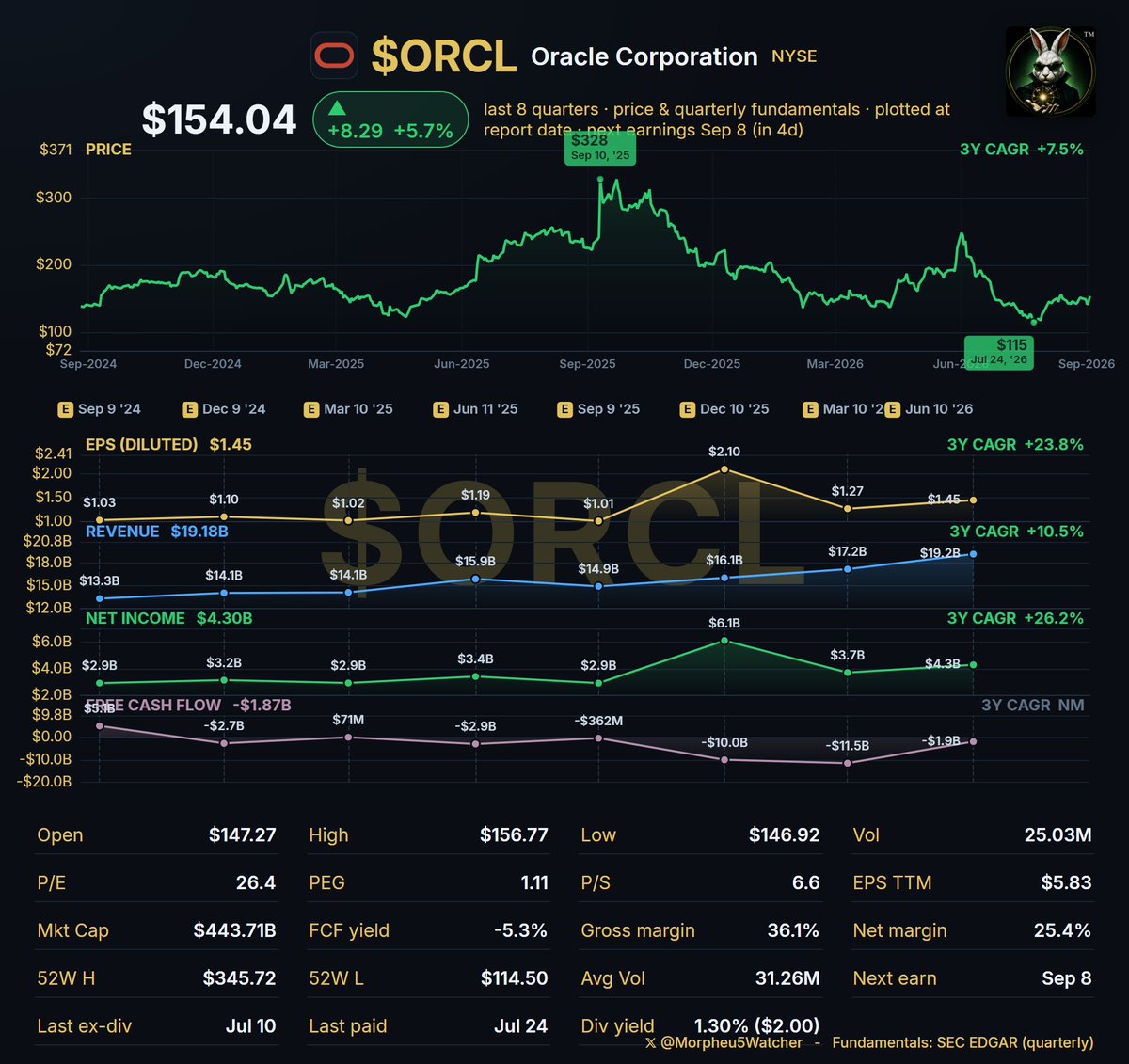
Oracle ORCL at $155.69 (after hours), +$1.65 / +1.07% from Thursday's $154.04 close, after a regular session that rose +$8.29 / +5.69%. The Austin company sells the database software large organizations keep their records in, and rents out computing power - lately for AI - through its cloud business. First-quarter results, for the three months ended August 31, land after the close on Thursday, September 10, call at 5:00pm ET. Oracle set that date itself, so it is confirmed rather than penciled in.
The backlog is not the open question going in. Its size is public and it is enormous. What Thursday can answer is how fast that backlog becomes revenue, and who pays for the buildout while everyone waits.
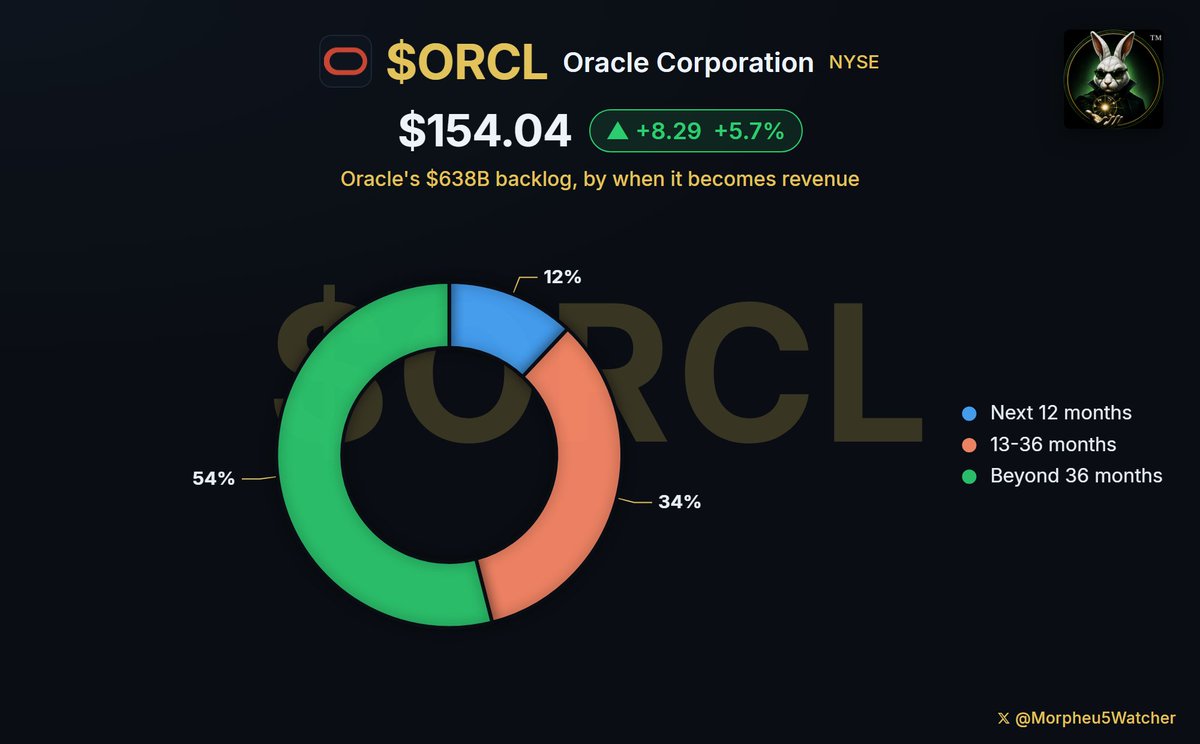
Remaining performance obligations - work customers have signed and paid or promised to pay for, which Oracle has not yet delivered - stood at $638B at the May 31 year end, +363% from a year earlier and +$85B in that quarter alone. Against fiscal 2026 revenue of $67.4B, that is about 9.5 years of sales, already contracted.
Then read the schedule attached to it. Oracle expects roughly 12% of that $638B to become revenue within twelve months - about $77B - and another 34% between thirteen and thirty-six months out. The rest arrives after that. Management said both near buckets should accelerate, and that word is the whole report. A backlog on a slow schedule is a promise. A backlog on a quickening one is a business.
Oracle wrote its own bar for this quarter on June 10:
- Total revenue: +27% to +29%, against $14.9B a year ago
- Cloud revenue: +58% to +64%, against $7.2B
- Adjusted profit per share, meaning earnings with certain items stripped out: $1.72 to $1.76, up 17% to 20% from $1.47
Analysts' published revenue figure, near $19.13B, sits inside that band. That is the expectation on record, not a forecast.
Now the half that has moved this stock more than the growth has. Capacity like this costs cash Oracle does not currently generate. In fiscal 2026 the business produced $32B of operating cash flow - money actually collected from running itself, +54% - and spent $55.7B on data centers and equipment. Free cash flow, what is left after the bills and the buildings, was NEGATIVE $23.7B. Oracle covered the gap with $43B of new debt and $5B of equity, and expects about $40B more this fiscal year, including a $20B program to sell new shares at market prices, which divides the company into more pieces so each existing share owns a little less. Fiscal 2027 spending is bigger again: roughly $70B of net cash out the door.
Thursday's 5.7% gain is the tell, because it did not come from Oracle. Federal Reserve governor Christopher Waller said he could support leaving the Fed's benchmark interest rate - which sets borrowing costs across the economy - at 3.50% to 3.75% at the September 15-16 meeting if inflation keeps cooling. A borrower this size moves on that sentence, because the price of money is now part of the price of the buildout.
Three questions going in, and they stay questions:
- Does the near slice get bigger? The 12% and the 34% are restated Thursday, and whether they step up is the cleanest read on conversion anyone gets.
- Does the margin dip land where management said? Executives flagged gross margin - what is left of each sales dollar after the direct cost of delivering it - stepping down while data centers ramp, then recovering. Rising memory and disk-drive prices sit on that same line.
- Does the funding plan change? Any revision to the $70B of spending or the $40B of planned financing is news on its own.
How the stock got here is one date. On September 9, 2025 Oracle closed at $241.51 and reported a backlog jump to $455B. Next morning it opened at $319.19, reached $345.72 and closed at $328.33 - +35.9% in a session, on 131.6M shares against the 15M to 18M it had been trading. That evening has since been undone. Thursday's $154.04 close sits $174.29 / 53.1% below it, and $39.54 / 34.5% above the $114.50 low of July 28.
The verdict going in: Oracle's case no longer rests on winning orders, which it has plainly done, but on the arithmetic of delivering them - and that arithmetic currently runs cash out, not in. It is not a current pick on any of the six Len5es. Quality-Value is nearest, wanting a durable business at a fair price; durability is not the argument for a company 141,000 people strong whose database most customers cannot cheaply leave. Price is, at about 25 times the last year of profit paid on a business with free cash flow below zero. WHAT WOULD CHANGE IT: free cash flow turning positive with the growth intact. Momentum is a clear no - it watches a price near its twelve-month best, and this sits 55.4% under the $345.72 of September 10, 2025, which a fresh high made on its own reported figures would change.
Where this breaks. Oracle's June 10 map of 34% revenue growth this year, currency swings stripped out, is a bar it set itself, not a result it booked. A backlog is a contract, not a bank balance: prepayments and customer-supplied hardware made up $75B of the recent increase, lifting the headline without being ordinary sales. A few very large AI customers drive most of the growth. And the after-hours prices above rest on thin trading Thursday can rewrite.
Twelve percent is not an accusation. It is a schedule, and Oracle never pretended otherwise - contracts this size are built to arrive across years. But it means no order figure, however enormous, settles next Thursday. The orders are signed. What is unsettled is whether the revenue keeps to the timetable, and what the waiting costs to finance. Five o'clock, September 10.
Not investment advice.
GOLD, BONDS AND ASIAN STOCKS ALL ROSE TONIGHT. THAT IS ONE TRADE, NOT THREE:
Hong Kong's Hang Seng is at 25,738, +524 pts / +2.08% on the day, the biggest gain in Asia and its first up session after four straight declines. Japan's Nikkei 225 is at 64,846, +631 pts / +0.98%. China's Shanghai Composite is at 3,955.85, +13.76 pts / +0.35%.
Now the part that decides the American morning. US index futures - agreements to buy or sell an index at a set price on a later date, which keep trading overnight while the stock market is shut - have gone almost nowhere:
- S&P 500 futures at 7,757.25, +2.50 pts / +0.03%
- Nasdaq 100 futures at 29,566.75, +42.00 pts / +0.14%
- Dow futures at 53,737.00, -8.00 pts / -0.01%
- Russell 2000 futures, which track smaller US companies, at 2,970.50, +0.80 pts / +0.03%
Asia is up as much as 2%. America's futures have not moved a fifth of a percent. That is not indifference. America already collected.
Look at what else moved overnight, because stocks were the small part of it.
- US 2-year Treasury yield 4.3381%, down about 0.05 of a percentage point
- 10-year 4.7620%, down about 0.03; 30-year 5.2433%, down about 0.02
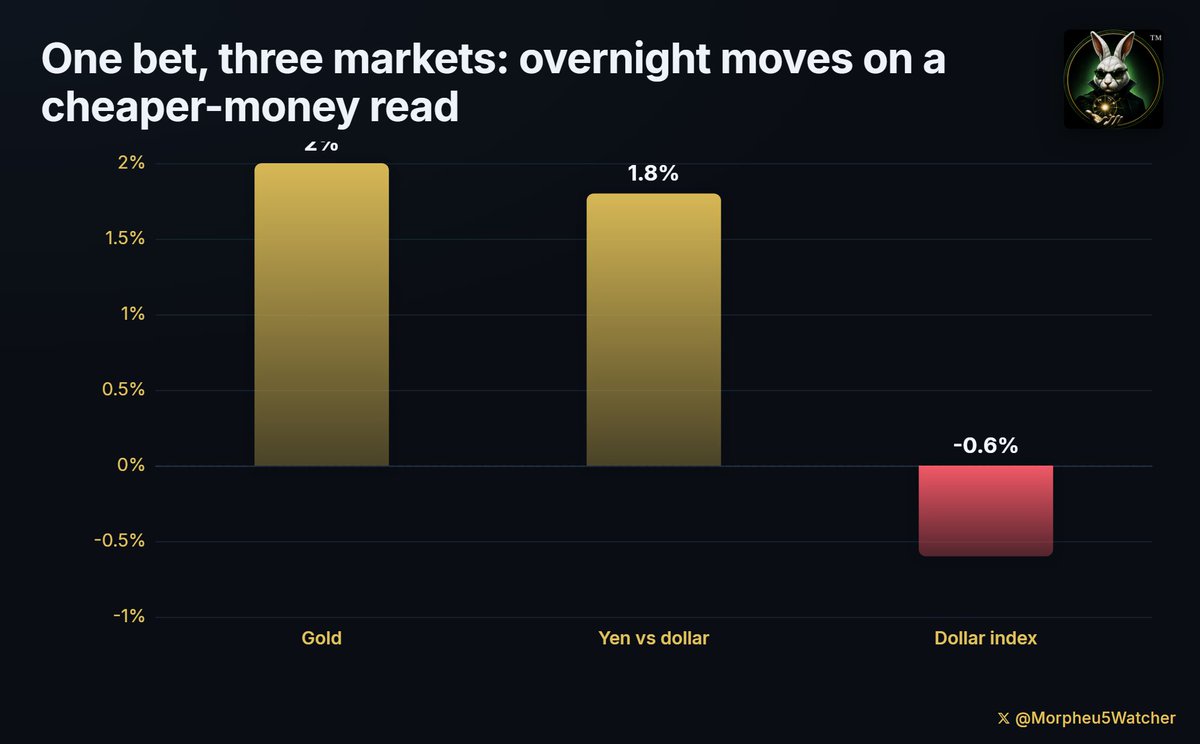
- Dollar index, which measures the dollar against a basket of major currencies: 98.96, -0.6%
- Gold $4,470/oz, +2%
A Treasury yield is what the US government pays to borrow, and it sets the floor under what every company and household pays. Yields and bond prices move in opposite directions, so a falling yield is a bond rally. Falling yields, a weaker dollar, gold up 2%, and stocks up across Asia are not four pieces of good news. They are one bet, placed four ways: that money is about to be slightly cheaper than it looked on Wednesday.
The bet came from one sentence. Fed governor Christopher Waller said Thursday that recent figures show "some signs of disinflation" - prices still rising, but more slowly - and that if the next reports back that up, he would be inclined to leave the Fed's benchmark interest rate where it sits when the committee meets on September 15-16. Odds of a quarter-point INCREASE at that meeting fell to about 50% from roughly 63%. He attached the condition out loud: the August inflation report, dated September 11, decides him, and a hot number would put a rise back on his table. Every move listed above rests on a document nobody has read.
American stocks took their payment for that sentence during Thursday's regular session: the S&P 500 closed +1.1%, the Dow +1.2%, the Nasdaq composite +1.4%. The futures reopened after that and have been sitting on top of it since. Asia is not adding to the American move. Asia is catching up to it, six time zones late.
The catching-up has been uneven, and the two Chinese markets went opposite ways from the same starting line. Hong Kong was at 25,515, +302 pts / +1.19%, in early trading, led by technology and financial shares, and has added another 223 points since. Shanghai did the reverse: it was at 3,973.27, up about 0.8%, in the morning and has handed back more than half of that. Both are now in their midday break and reopen at 1:00am ET.
That leaves Tokyo as the only one of the three actually trading right now, in an afternoon session running to 2:00am ET, and it is green while its own currency argues against it. The yen is at 155.7 per dollar, up 1.8% overnight and 2.6% on the week, its strongest in a month, with traders pricing a Bank of Japan rate increase at the September 18 decision. Japan's biggest listed companies sell abroad and bring the money home, so a stronger yen turns identical overseas sales into fewer yen and shrinks reported profits with nothing changed inside the business. Tokyo is up anyway - Washington outvoting Tokyo's own central bank - and even so, tonight's +0.98% is a bounce inside a week the Nikkei is still down 2.7%.
Europe is shut, so these are Thursday's closing levels rather than live prices: Britain's FTSE 100 at 10,832, +75.02 pts / +0.70%; Germany's DAX at 26,003, +164 pts / +0.63%; France's CAC 40 at 8,286.40, +5.77 pts / +0.07%.
Two things argue against the whole overnight read.
The first is oil. Brent crude is at $95.52 a barrel, up about 7% this week; US crude at $91.95, +$0.65 on the day. Fuel up 7% in five days is an inflation input, and this entire trade depends on inflation cooling in a report dated September 11. Rising energy prices and falling price pressure do not often show up in the same month.
The second lands in eight hours. At 8:30am ET the Bureau of Labor Statistics publishes the August employment report - the government's count of how many jobs the economy added or lost, plus the share of people looking for work who cannot find it. Consensus sits near +53k jobs, with unemployment expected to hold at 4.1%; July came in at minus 23,000. A hot number puts the September increase back in play and runs every move above in reverse. Overnight gains fade on their own too. Nine hours stand between here and the 9:30am opening bell, and nothing settled in Hong Kong tonight binds New York in the morning.
Four markets moved tonight and all four were placing the same wager on the price of money. New York already cashed its share of that wager on Thursday afternoon, which is precisely why its futures have nothing to say at twenty past midnight. Everybody else is still holding a ticket on a report that has not been printed.
Not investment advice.
DOCUSIGN $DOCU - Q2 FY27 BEAT ON REVENUE AND EPS WITH FY27 GUIDANCE RAISED: Sales $875.7M vs $867.2M est; EPS $1.16 vs $0.96 est.
Revenue came in at $875.7 million, up 9.4% year over year and about $8.6 million ahead of the roughly $867.2 million consensus. Adjusted EPS was $1.16 versus a $0.96 estimate, a 21% beat, while GAAP net income was $77.7 million ($0.40 per diluted share). Docusign at $65.97, +$2.17 / +3.4%; shares added another ~8.2% after hours to roughly $71.41 on the print.
The reaction tracked two things: a raised fiscal 2027 revenue outlook, now $3.499 billion to $3.507 billion versus $3.490 billion to $3.502 billion previously, and continued momentum in Intelligent Agreement Management, which reached 15.1% of total annual recurring revenue as of July 31, up from 12.6% three months earlier. Free cash flow rose 36% to $295.8 million, a 34% margin versus 27% a year ago, and the company repurchased $306.5 million of stock in the quarter.
Watch whether IAM keeps tracking toward management's roughly 18% to 19% of recurring revenue target exiting the year, and whether the free cash flow margin trend holds as that mix shifts.
Docusign is a current Len5 pick on Deep-Value & Special-Situations, a note on which style is watching the name, not a performance claim - the Len5es are ways of looking, not a proven edge.
Not investment advice.
LULULEMON ATHLETICA $LULU - Q2 EPS BEAT IS A TARIFF REFUND; REVENUE MISS; FY GUIDANCE CUT: Sales $2.42B vs $2.46B est; EPS $2.92 vs $1.79 est.
lululemon athletica (LULU) posted Q2 revenue of $2.42B against a $2.46B estimate, a 4% decline that also missed the company's own guided range. Comparable sales fell 9% overall and 12% in the Americas, the steepest part of the slide. Headline EPS of $2.92 blew past the $1.79 estimate, but most of that beat was not operating performance - $0.86 came from one-time tariff refunds and interest. Strip that out and EPS was roughly $2.06, down from $3.10 a year ago, with gross margin near 54.9% and operating margin near 13.2% versus 58.5% and 20.7% last year.
The bigger story is what management now expects. Full-year revenue guidance was cut to $10.350B-$10.500B from $11.000B-$11.150B, and full-year EPS guidance to $9.48-$9.73 from $10.95-$11.15 - and that new range still has the $0.86 refund baked in, so the underlying cut is even larger than the headline suggests. Q3 guidance calls for revenue down 10-11% to $2.290B-$2.320B and EPS of $0.93-$0.98, well below the roughly $2.52 the Street had modeled.
Shares closed the regular session up 1.4% at $121.79 but dropped roughly 15% after hours to around $102.95, touching a new 52-week low of $99.88 as the market absorbed the guidance cut rather than the earnings beat. What to watch from here: whether the Americas comp decline stabilizes, whether the tariff-refund boost repeats or fades from future quarters, and whether the FY guide cut marks a bottom or the start of further trims.
lululemon athletica is a current Len5 pick on Quality-Value, Deep-Value and Special-Situations - that reflects which styles are watching the name, not a claim about how it will perform; the Len5es are ways of looking, not a proven edge.
Not investment advice.
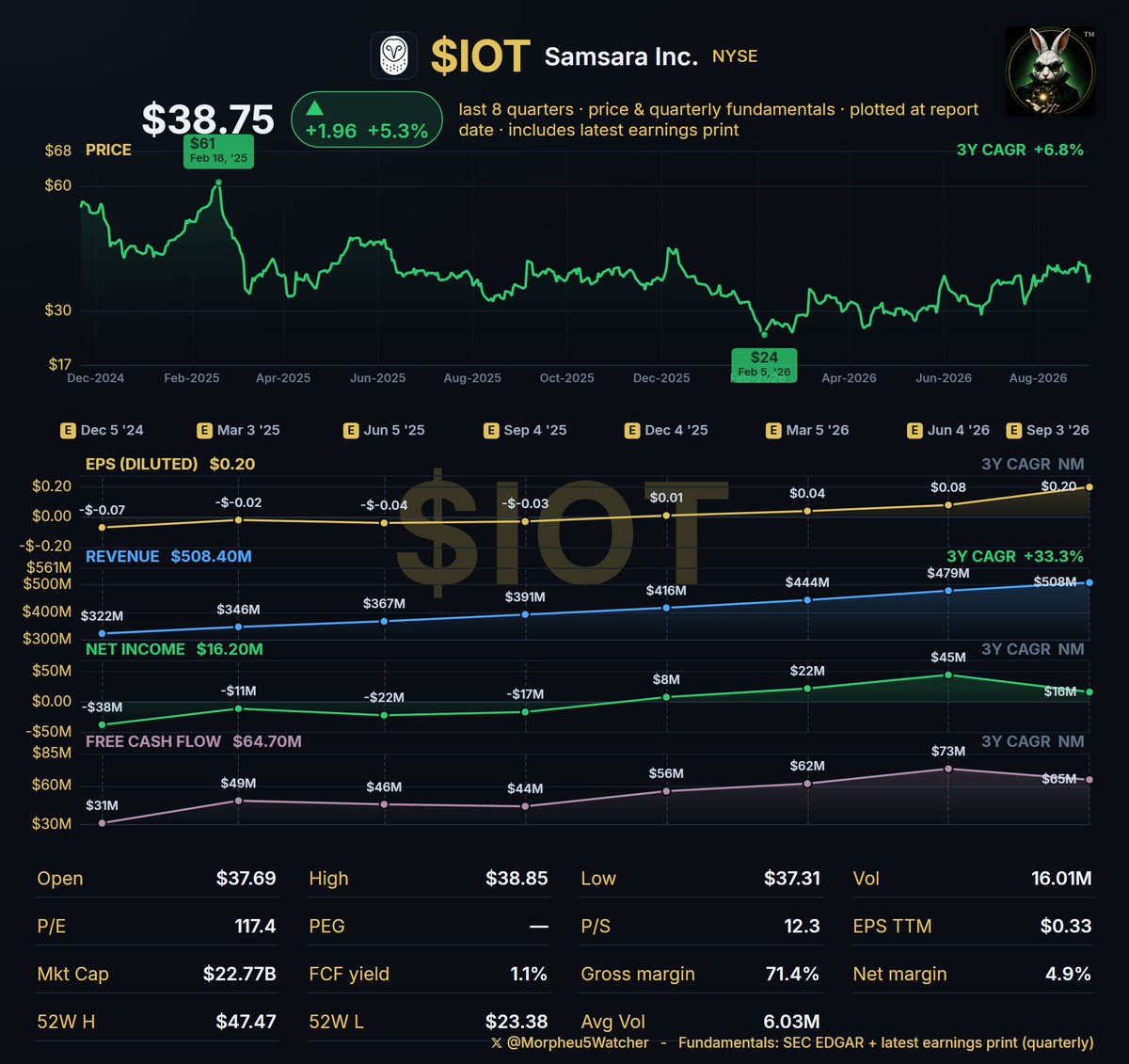
SAMSARA $IOT - Q2 FY27 DOUBLE BEAT; FY REVENUE AND EPS GUIDANCE RAISED: Sales $508.4M vs $483.3M est; EPS $0.2 vs $0.16 est.
Samsara at $38.75, -$3.12 / -7.5%. Revenue of $508.4 million beat the $483.3 million estimate by about 5.2 percent, up 30 percent year over year. Adjusted EPS of $0.20 topped the $0.16 estimate; GAAP EPS was $0.03, the fourth straight profitable quarter.
The raise did more work than the beat: full-year revenue guidance moved up to $2.043-$2.047 billion from $2.005-$2.013 billion, and adjusted EPS guidance rose to $0.76-$0.78 from $0.70-$0.72. Shares rose roughly 11 percent after hours to about $43 from a $38.76 close.
Annual recurring revenue hit $2.125 billion, up 30 percent for a third straight quarter, with customers paying over $1 million a year now above $500 million of ARR, up over 50 percent. Adjusted operating margin widened to 21 percent from 15 percent a year ago, and free cash flow was $64.7 million, 13 percent of revenue. Watch the Q3 guide of $514-$516 million, which implies about 24 percent growth, a step down from this quarter's 30.
Samsara is not a current Len5 pick. That says which styles are watching it, not whether the print was good or bad.
Not investment advice.
CIENA $CIEN - Q3 BEAT; FY26 GUIDE RAISED; STOCK -10.4% ON IN-LINE Q4: Sales $1.67B vs $1.64B est; EPS $2.11 vs $1.73 est.
Ciena, the optical networking company whose gear carries data between and across AI data centers, posted fiscal Q3 2026 revenue of $1.67B versus $1.64B expected, up 37% year over year. Adjusted EPS came in at $2.11 versus $1.73 expected. Shares still fell to $317.46, -$82.39 / -20.6%.
The reaction traced to guidance, not the quarter itself. Full-year fiscal 2026 revenue guidance rose to $6.42B (+/- $50M, about 35% growth), with an early fiscal 2027 view of at least 30% growth. But Q4 revenue guidance of $1.75B landed merely in line, and Q4 gross margin guidance of 45.0% stepped down from the 46.4% just delivered. Cloud providers made up 53% of revenue, up 82% year over year, with two customers accounting for 41.7% of the total.
Worth watching from here: free cash flow fell 14% year over year to $116M as receivables, inventory, and capital spending absorbed cash, plus whether that customer concentration eases or deepens as growth continues.
Ciena is not a current Len5 pick. That reflects which investing styles are watching the name right now, not a verdict on whether this print was good or bad.
Not investment advice.
HOKA GREW 19.8%. A YEAR LATER, 7.7%. THAT IS THE ONLY REASON DECKERS $DECK LOOKS CHEAP:
Deckers Outdoor DECK at $84.33 (after hours), after finishing the regular day at $84.50, +$0.74 / +0.88%. Six ways of looking at this market, and tonight they agree on something awkward: almost nothing well known is on sale. The growth board is nearly all small regional banks. The income board leads with shipping owners and life insurers. The famous names on the quality board cost about what they are worth. The one widely owned consumer brand carrying a real discount across all six is Deckers, and it is only there because its growth rate halved in twelve months.
The Goleta, California company owns HOKA running shoes and UGG boots. Same June quarter, one year apart. July 24, 2025: HOKA $653.1M, +19.8%; UGG $265.1M, +18.9%; total $964.5M, +16.9%. July 23, 2026: HOKA $703.5M, +7.7%; UGG $278.0M, +4.9%; total $1.020B, +5.7% - the first billion-dollar opening quarter in company history, at under half the growth rate. Profit did worse than sales: gross margin, what is left of each sales dollar after making the shoes, rose to 56.4% from 55.8%, and operating income still FELL, $155.3M against $165.3M. Per-share profit was $0.94 versus $0.93 - flat, and positive only because there are fewer shares to divide by.
MOMENTUM LEN5:
- HeartFlow at $50.00 (after hours), after finishing the regular day at $49.71, -$0.29 / -0.58%. The Mountain View company runs an ordinary CT heart scan through software that judges whether a narrowed artery is really restricting blood flow - the question that otherwise needs a catheter. This style watches a price climbing near its twelve-month best, and this is the steadiest such climb on the board: a high of $51.778 set yesterday, up from $20.13 on February 13. Company news sits under it - the August 13 quarter put revenue at $64.1M, +48%, and raised the full-year map to $246M-$250M from $228M-$232M. WHAT WOULD CHANGE IT: the high failing to hold, or November's report walking that raise back. Verdict: a real climb on its own figures, at a business still losing money and priced near 17 times a full year of expected revenue.
QUALITY-VALUE LEN5:
- Procter & Gamble at $147.06 (after hours), after finishing the regular day at $146.92, -$0.72 / -0.49%. Tide, Pampers, Gillette, Crest. This style wants a durable business at a fair price. Durable is as settled as it gets - shelf space in nearly every supermarket on earth. Price is the whole argument. From the July 29 full-year report: organic sales, which strip out currency and businesses bought or sold, grew 1% across the year, all of it from charging more rather than selling more. Core profit $6.89 a share, +1%; the June quarter alone $1.43, -3%. Next year is mapped at $6.89 to $7.11. WHAT WOULD CHANGE IT: volumes growing again instead of prices, or a real drawdown with earnings power intact. Verdict: roughly 21 times profit for about 1% growth - nothing wrong with the business, and nothing on offer either.
DEEP-VALUE AND SPECIAL-SITUATIONS LEN5:
- Deckers, seventh here and the strongest name across all six boards. This style wants a business priced under what it looks worth, usually after something visible went wrong, and the wrong thing is dated July 23 and counted above. What got marked down with it: $84.50 is $40.38 / 32.3% below the $124.88 this stock reached on September 5 last year, about 11.4 times the middle of Deckers' own map for this year - $7.35 to $7.50 a share, which the company RAISED by five cents in July. Underneath sit $1.603B of cash, no borrowings at all, and a gross margin that went UP while growth halved. A brand genuinely losing its pull does not usually widen its margin. WHAT WOULD CHANGE IT: HOKA sliding from 7.7% toward zero, at which point 11.4 times is the right price for a brand that stopped compounding, not a discount. Verdict: the discount is real and so is the balance sheet, and the test is the October quarter - expected around October 22, not yet confirmed by Deckers, with analysts modeling $1.79 a share against the $1.82 earned a year earlier. Less, not more.
GROWTH LEN5:
- Trustmark at $46.06, +$0.24 / +0.52% today. The Jackson, Mississippi bank holding company - branches, wealth management and insurance, 2,543 staff. This style wants expansion nobody is overpaying for, and Trustmark pairs the two most cheaply on that board: five straight profitable years, at under 12 times the last year of profit and 1.24 times book value, what the accounts say each share owns. The July 28 quarter: net income $63.5M, $1.08 a share; strip out one-off items and $56.7M, $0.97. Net interest margin - the gap between what it earns on loans and pays on deposits - 3.84%, up 0.03 points on the quarter. WHAT WOULD CHANGE IT: loan losses rising or that margin rolling over, either of which turns a low multiple into an accurate one. Verdict: cheap and genuinely profitable, and small enough that one region's economy decides it.
HYPERGROWTH LEN5:
- Reddit at $156.25 (after hours), after finishing the regular day at $155.99, -$2.11 / -1.33%. The San Francisco company runs the discussion forums and sells advertising beside the conversations. This style wants early AND fast, and Reddit is second because every stretch of its record agrees rather than one loud quarter. July 30: revenue $805M, +61%, an eighth straight quarter above 60%; advertising $762M, +64%; daily users 130.3M, +18%; net profit $253M against $89M a year earlier, and no borrowings. The shares fell about 11% on that report anyway, because US user growth was clipped by choppy referral traffic arriving from Google. They sit 44.9% under the $282.95 reached last September 18. WHAT WOULD CHANGE IT: the deals licensing Reddit's archive to Google and OpenAI renewing on worse terms. Verdict: growth is not the open question here. Who controls the traffic is, and a contract settles that, not a quarter.
INCOME LEN5:
- Lincoln National at $45.87 (after hours), after finishing the regular day at $45.66, +$1.54 / +3.49% - the biggest move of the six today. The Radnor, Pennsylvania company sells life insurance, annuities and workplace benefits as Lincoln Financial. This style watches cash genuinely reaching owners and funded by the business, and what earns Lincoln its place is not the size of the yield but the room behind it. The dividend is $0.45 a quarter, $1.80 a year, near 3.9% of the price - against $2.24 of adjusted operating profit in the June quarter alone, so it takes roughly a fifth of what the business earns. July 30: adjusted operating income $439M, an eighth consecutive quarter of growth. Then the dated part - on August 10 the board declared that same $0.45 and said it plans to restart buying back stock in the third quarter, the one running now. WHAT WOULD CHANGE IT: the payment finally rising, which is what all that room is for, or operating profit stalling. Verdict: the best-covered payout on the board and the least generous, because the company keeps choosing buybacks over raises.
Five of these six are priced where they are because of something the business did. Deckers is the one where the market did the moving: in twelve months it decided a brand growing 19.8% and a brand growing 7.7% are not the same asset, and marked the whole company down by a third. That judgment is either early or wrong, and October is when the next evidence lands.
Not investment advice.
HOULIHAN LOKEY $HLI OWNS THE ARM THAT EARNS WHEN DEALS DIE. LAST QUARTER IT SHRANK TOO:
The Deep-Value and Special-Situations Len5 is watching Houlihan Lokey HLI at $136.86, +$3.65 / +2.74% today, and it is the first name on that Len5. The Los Angeles firm is an investment bank that only gives advice - it does not lend money and does not trade for its own account. Its 2,800 people collect a fee when a company is sold, bought, rescued from its creditors, or needs an independent valuation. It ranked first by number of North American deals in the first half of 2026.
The appeal of this particular firm is that it is built to get paid in both weathers. Companies being bought pays the merger bankers. Companies falling apart pays the restructuring bankers. One roof, two opposite cycles.
Last quarter both shrank. That is the whole story, and it is why the price is here.
The three months to June 30, reported July 29. Revenue - the money coming in the door - $511M against $605M a year earlier, -$94M / -15.5%. Corporate Finance, the mergers arm and 59% of the firm: $303M, -24%. Financial Restructuring, the half meant to earn when deals stop: $119M, -8%. Financial and Valuation Advisory, which prices assets and businesses for a fee: $89M, +13%. Adjusted profit, one-off items set aside: $91M, or $1.35 a share, against $148M and $2.14.
Analysts had modeled $1.84. Missing by $0.49 is a 27% shortfall, and it was the second miss running after five straight quarters of clearing the bar. The next morning, July 30, the stock made its lowest price in twelve months, $112.83. Management called it timing rather than lost work: deals taking longer to sign, the largest fees worst affected, plus trouble in software takeovers.
One fact decides how you read all of that. Evercore at $296.91, +$8.22 / +2.85% today, reported the identical three months on the same day. The New York advisory firm booked adjusted revenue of $999.5M, +19.2% from $838.9M, on advisory fees of $776M, +11%, and adjusted profit of $2.91 a share against $2.79 expected - a record first half. So the deal market did not close. It moved. Evercore lives on the very largest transactions; Houlihan Lokey lives in the middle of the market, where private-equity owners have been holding companies instead of selling them. The problem is which deals, not whether deals - and a mix can turn back in a way a dead market cannot. Evercore itself fits none of the six Len5es: the growth is real, but at nearly six times book value, what the accounts say each share owns, no style here is paying that for a fee business.
One name, six ways of looking:
- DEEP-VALUE AND SPECIAL-SITUATIONS - STRONG, and the top name on it. That style wants a business priced under what it looks worth, usually after something visible went wrong, and July 29 is the visible thing. Underneath sits a record twelve months to March 31 - revenue $2.62B against $2.39B - plus $1.19B of cash at that year end, about an eighth of the whole $9.6B company, and no borrowings at all. Add the last four quarters of adjusted profit and you get $6.76 a share, so the price is near 20 times it. CHANGE IT: two or three more quarters like the last one, at which point 20 times stops being a discount and becomes an accurate price for a shrinking business.
- QUALITY-VALUE - PARTIAL. Wants a durable business at a fair price. Durable is settled: no debt, three separate fee businesses, top of the North American deal table. Fair is the open half, because that 20 times is being paid on profit that just fell 37%. CHANGE IT: profit turning back up, so the multiple sits on a rising number instead of a falling one.
- MOMENTUM - NOT A FIT. Wants a price climbing near its best level of the past twelve months. This one is $74.92 / 35.4% below the $211.78 it reached last September 23. It has come $24.03 / 21.3% up off July's low, which is a recovery, not a high. CHANGE IT: a twelve-month high made on the firm's own figures.
- GROWTH - NOT A FIT. Wants expansion nobody is overpaying for, and there is none here to price - revenue down 15.5%, profit per share down 37%. CHANGE IT: revenue growing again, which needs mid-sized takeovers to restart.
- HYPERGROWTH - NOT A FIT, and not close. Wants early as well as fast. Founded 1972, and just went backwards on both counts. CHANGE IT: nothing realistic.
- INCOME - NOT A FIT, narrowly. Watches cash genuinely reaching owners and funded by the business. Funded it is: $0.70 a quarter, $2.80 a year, paid September 15, roughly 41% of the last year's profit. It is simply small, near 2.0% of the price. CHANGE IT: a payout an owner would actually feel, out of profit that is rising.
The honest risks. An advisory firm has no backlog it must publish and no contracted revenue - the fee lands when a deal signs, so a quarter can be made or broken by a few closings slipping past a date. Two firms cut their price targets after the print, one to $145 from $160 on August 3 and one to $177 from $187 on July 30; both are opinions, and the stock trades under each. About 812,000 shares changed hands today, so one large seller moves this more than the news does.
The date to circle is October 29, when the September quarter is expected - the firm has not confirmed it yet. Analysts model $1.35 becoming $1.64, still under the $1.84 earned in that same quarter a year ago. Less bad before better is what a recovery honestly looks like from here.
And the single number inside it is Corporate Finance. It is 59% of the firm and it fell 24%, while the arm built to catch that fall was down 8% alongside it. A hedge that only works sometimes is not a hedge. It is a second business, and October is when we find out which one this is.
Not investment advice.
THE FED'S RATE REACHES HONG KONG BEFORE IT REACHES SHANGHAI:
Hong Kong's Hang Seng is at 25,746, +435 pts / +1.72% on the day, half an hour into its Friday session and the biggest gain anywhere in Asia tonight. China's Shanghai Composite is at 3,976.08, +34.69 pts / +0.88%. Japan's Nikkei 225, open two hours longer than either, is at 64,746, +420 pts / +0.65%.
Three green markets, one piece of American news, three very different sizes of yes. The gaps are not a mood reading. They track something mechanical: how directly the Fed's interest rate actually reaches each market.
The news was a conditional sentence spoken in Washington on Thursday morning. Federal Reserve governor Christopher Waller said he could support leaving the Fed's benchmark interest rate - the rate that sets what borrowing costs across the economy - at 3.50% to 3.75% when the committee meets on September 15-16, provided inflation keeps cooling. He said outright that new data could change his mind. Traders moved anyway: odds of a quarter-point INCREASE at that meeting fell about 12 points, to roughly 54.6% on CME FedWatch, which reads those odds off futures tied to the Fed's rate. One vote of twelve, described in advance, on a decision nobody has taken.
Now the reason Hong Kong is up nearly three times Tokyo.
Hong Kong does not really set its own interest rate. Its currency is pegged to the US dollar - the Hong Kong Monetary Authority commits to holding it inside a band of HK$7.75 to HK$7.85 per dollar, and has for decades. Keeping a currency at a fixed price means letting your interest rate follow the country you pegged to. If Hong Kong money paid far less than American money, holders would swap out of it and the peg would strain. So Hong Kong rates shadow the Fed's, with no vote, no meeting and no Hong Kong official getting a say.
That makes a softer Fed a local event here rather than an imported mood, in an index heavy with property developers, banks and insurers - businesses whose own costs and whose customers both move with the price of borrowing.
Which is why the same country's other market is up half as much. Shanghai trades in the same time zone under the same government, but mainland China runs behind capital controls: money cannot move freely in and out. The People's Bank of China sets its own rates for its own reasons and does not follow the Fed. Mainland shares get the sentiment without the mechanism, and tonight that is worth about half the move.
Tokyo has the smallest gain of the three despite the longest session, and its own central bank is why. The Bank of Japan meets September 17-18, the day after the Fed. Board member Hajime Takata said this week the bank should move nimbly rather than hold to a fixed pace, and Governor Kazuo Ueda said on September 2 that the board would debate a rise with inflation risks tilted upward. Traders price roughly 75% odds of a quarter-point increase there.
That handed the yen its best day in a month on Thursday: up more than 1% against the dollar, touching 156.15 per dollar, its strongest since August 3. A stronger yen is a headwind for this index. The Nikkei leans on exporters that sell abroad and bring the money home, and when the yen strengthens, those overseas sales convert into fewer yen - so reported profits shrink with nothing having changed inside the business. Tokyo's +0.65% is an American tailwind with a domestic headwind subtracted from it.
Europe already had its turn and is shut, so these are closing levels, not live prices: Britain's FTSE 100 finished at 10,832, +75.02 pts / +0.70%; Germany's DAX at 26,003, +164 pts / +0.63%; France's CAC 40 at 8,286.40, +5.77 pts / +0.07%, barely agreement at all.
The bridge to the American open runs through index futures - agreements to buy or sell an index at a set price later, which keep trading overnight while the stock market is closed. All four are green:
- Dow futures at 53,759.00, +638 pts / +1.20%
- Nasdaq 100 futures at 29,532.50, +346 pts / +1.19%
- S&P 500 futures at 7,755.50, +79.00 pts / +1.03%
- Russell 2000 futures, which track smaller US companies, at 2,969.70, +10.90 pts / +0.37%
They are carrying Thursday's American gain rather than adding a new one - they reopened at 6:00pm ET after that move was already banked, and have sat on top of it since.
The bottom line of that list is also the fact that argues against everything above. Smaller US companies carry more debt against their size and refinance sooner, so a drop in the expected price of money should reach them first and hardest. Russell 2000 futures are up about a third of what the big-company contracts are. If tonight were purely about which market the Fed physically reaches, that line would be leading rather than trailing. It is not, and that is the honest limit on the read.
Overnight moves fade, too. Eleven and a half hours stand between here and the 9:30am ET opening bell, and a strong Asian session routinely hands New York nothing. The event that settles any of it is still ahead, and Asia will miss it: at 8:30am ET Friday the Bureau of Labor Statistics publishes the August employment report, the government's count of how many jobs the economy added or lost plus the share of people looking for work who cannot find it. Consensus is near +53k jobs, with unemployment expected to hold at 4.1%. July LOST 23,000. Tokyo closes its Friday books at 2:00am ET, Shanghai at 3:00am, Hong Kong at 4:00am, all hours before that number prints, and US markets are then shut Monday, September 7 for Labor Day.
Three markets got the same sentence tonight and paid three different prices for it. The size of each answer had less to do with how convincing anyone found Waller than with how short the wire is between that room in Washington and the market doing the pricing. Hong Kong's is the shortest in Asia. Shanghai's is longer. Tokyo is on a different line altogether, with its own central bank holding the other end.
Not investment advice.
THE RENT DOES NOT KNOW HOW BUSY YOU WERE:
Most of what a company pays out each month does not care how much it sold. That one fact is why profit swings several times harder than sales do, in both directions, and why the same business can look like a triumph one quarter and a wreck the next without changing a thing about how it operates.
The size of that swing is not a mystery. It sits in results published long before the quarter that makes it matter.
Costs come in two kinds. Some rise and fall with how busy you are: materials, shipping, hourly staff, the power used serving customers. Sell less, pay less. The others arrive whether the doors were busy or empty: rent, insurance, salaried staff, equipment leases, interest on borrowings. That second pile decides how a business behaves in a bad month, because it does not shrink to meet you.
Picture a chain of gyms taking in $10.0M a year - revenue, the money coming in the door. Its bills split $6.0M that arrive regardless (rent, insurance, salaried managers, equipment leases) and $3.0M that track how many people turn up (hourly staff, power, cleaning). Operating profit - what the business earns running itself, before interest and tax - is $1.0M. That is a 10% operating margin: it keeps 10 cents of every sales dollar.
Add 10% more members. Revenue $11.0M; the busy-day costs rise with them to $3.3M; the $6.0M does not move at all. Profit $1.7M.
Sales +10%, profit +70%. Seven points of profit growth for every one point of sales growth. Nothing improved - no price rise, no cost program, no clever management. The extra members walked into a building that was already paid for.
Run it the other way and the same machine bites. Members down 10%: revenue $9.0M, busy-day costs $2.7M, the $6.0M still due. Profit $0.3M, down 70%. Down 20%, and $8.0M of revenue against $8.4M of costs is a $0.4M loss. A gym that lost a fifth of its members has not become badly run. It has become loss-making.
There is an exact line where that happens, and it can be found in advance. The gym keeps 70 cents of every sales dollar before the fixed pile is paid, so it needs $8.57M of sales to cover $6.0M of bills that arrive regardless. That is break-even: the sales level where profit is exactly zero. Sales can fall 14.3% before the profit is gone, and that distance, not the margin, is the honest measure of how much room it has.
Now the same-size business built the other way. A distributor buys goods for $8.5M and sells them for $10.0M, carrying $0.5M of fixed overhead. Same revenue, same $1.0M of operating profit. Sell 10% more and profit is $1.15M, +15%; sell 10% less and it is $0.85M, -15%. Its break-even sits at $3.33M, so sales could fall by two-thirds before it stops making money.
Two companies, the same $10.0M of sales and the same $1.0M of profit. One breaks at a 14.3% sales decline, the other at 66.7%. Anyone reading only the revenue line and the profit line would call them the same business.
The tell is public and it takes one subtraction. Gross margin is what is left of each sales dollar after the direct cost of the product or service. Operating margin is what is left after everything else as well. The gap between them is roughly how much fixed cost the company carries, and the wider it is, the harder profit moves.
- The gym: 70% gross margin, 10% operating margin. A 60-point gap.
- The distributor: 15% gross margin, 10% operating margin. A 5-point gap.
A shortcut that gets close on any income statement: divide gross profit by operating profit. The gym gives 7.0, the distributor 1.5. That is roughly how many percent profit moves for each percent sales moves - and it works just as faithfully on the way down, which is the half people forget.
This runs underneath several of the Len5es at once.
Growth and Hypergrowth watch expansion at a price worth paying and early companies growing fast, and the arithmetic is a caution against being dazzled: profit growing five times faster than sales is often a building being filled, not a company getting better at what it does.
Deep-Value and Special-Situations watches a business priced under what it looks worth, and this is the oldest trap there. A low price against last year's earnings is only cheap if those earnings survive. Put a high-multiplier business through a mild slowdown and most of the profit that made it look cheap is gone.
Quality-Value wants a durable business at a fair price, and this sharpens what durable means. Surviving a 14% dip and surviving a 67% one are different kinds of sturdy, and the difference has nothing to do with brand, management, or age.
Income watches cash genuinely reaching owners and funded by the business, which makes this the covered-payout question asked properly: a dividend that looks comfortable against this year's profit may rest on a figure that halves on a single-digit sales move.
Where this breaks. It describes how a business is built, not what it will do. Costs are not really two neat piles - a company can cut staff, renegotiate a lease or close a site, and plenty do once the pressure arrives. Depreciation and plant costs often sit inside the cost-of-goods line, so the gross-margin shortcut overstates the multiplier for a manufacturer. One-off charges and gains distort both margins in a single quarter. And a big multiplier is not a fault: it is the whole reason a software business or a factory running near capacity is worth owning while demand is rising. It only tells you which direction the exaggeration runs.
Nothing here says which way sales will go. That is the part nobody gets to look up. What can be looked up, in a document filed long before the quarter that hurts, is exactly how much a business will exaggerate whatever happens to it.
Not investment advice.
TOKYO OPENED DEAD FLAT AND IS ALREADY UP 482 POINTS. CHINA VOTES IN THIRTY MINUTES:
Japan's Nikkei 225 is at 64,807, +482 pts / +0.75% on the day. It opened at 64,325.64 when Tokyo's bell rang at 8:00pm ET, which was exactly where it had finished the session before. Not a point of lead in either direction. All 482 points have arrived since.
Tonight's read: Asia is getting the world's first chance to price one sentence spoken in Washington on Thursday morning, and Tokyo is buying it hard enough to override its own currency, which is pulling the other way. Hong Kong and Shanghai have not opened yet. They get their turn at 9:30pm ET.
The sentence being priced was a conditional one. Federal Reserve governor Christopher Waller said Thursday he would support leaving the Fed's benchmark interest rate - the rate that sets what borrowing costs across the economy - where it sits at 3.50% to 3.75% when the committee meets on September 15-16, provided inflation keeps cooling over the next two weeks. He said outright that new data could change his mind.
Traders moved anyway. Odds of a quarter-point rate INCREASE at that meeting fell about 12 points, to roughly 54.6% on CME FedWatch, which reads those odds off futures contracts tied to the Fed's own rate. Still close to a coin flip, and a long way from where they sat after Federal Reserve chair Kevin Warsh signaled at Jackson Hole on August 28 that higher rates may be needed.
Now the part that makes Tokyo's first hour interesting rather than obedient.
The yen had its best day in a month on Thursday, gaining more than 1% against the dollar and touching 156.15 per dollar, its strongest level since August 3. Two things did it. Talk that Japan might step into the currency market again to support the yen, after a joint US-Japan intervention on July 31. And hardening bets that the Bank of Japan raises its own rates on September 17-18, now priced near 75% odds of a quarter-point increase. Board member Hajime Takata said Wednesday the bank should move nimbly rather than hold to a fixed pace, and Governor Kazuo Ueda said on September 2 that the board would debate policy with upside inflation risks in mind.
A stronger yen is normally a problem for this particular index. The Nikkei leans heavily on exporters - carmakers, machinery firms, electronics makers that sell abroad and bring the money home. When the yen strengthens, those overseas sales convert into fewer yen, so reported profits shrink with nothing having changed inside the business. It is the biggest single swing factor in Japanese stocks, and tonight it points down while the index goes up.
So in hour one, a remark from Washington is outvoting Japan's own central bank. Worth watching rather than trusting: an hour is not a session.
China has not been asked yet, and its last numbers are older than they look. Hong Kong's Hang Seng finished at 25,213, -97.90 pts / -0.39%, and the Shanghai Composite at 3,942.09, -37.80 pts / -0.95%. Check the clock against those. Shanghai shuts at 3:00am ET and Hong Kong at 4:00am ET, so both closed their books hours before Waller spoke. Those red figures are not a verdict on tonight's news. They are a market that had not heard it.
Europe did hear it and closed higher, though not evenly. Britain's FTSE 100 finished at 10,832, +75.02 pts / +0.70%. Germany's DAX at 26,003, +164 pts / +0.63%. France's CAC 40 at 8,286.40, +5.77 pts / +0.07%, near enough to nothing that it barely counts as agreement. Europe is shut now, so those are closing levels rather than live prices.
That leaves the bridge to the American open. US index futures - agreements to buy or sell an index at a set price on a later date, which keep trading overnight while the stock market is shut - reopened at 6:00pm ET green across the board:
- Dow futures at 53,763.00, +642 pts / +1.21%
- Nasdaq 100 futures at 29,539.50, +353 pts / +1.21%
- S&P 500 futures at 7,755.75, +79.25 pts / +1.03%
- Russell 2000 futures, which track smaller US companies, at 2,971.10, +12.30 pts / +0.42%
Read that last line against the first three. If the story really is that borrowing costs have stopped climbing, smaller companies should be the loudest winners: they carry more debt against their size and refinance it sooner, so a change in the price of money reaches them first. They are up roughly a third of what the big-company indexes are up. That gap is the crack in tonight's risk-on tone, risk-on meaning money moving toward what does best when investors feel brave.
The caveat is plain. These futures are carrying Thursday's US gain, not adding to it. They reopened after that move had already been banked and are sitting roughly on top of it. Twelve and a half hours stand between now and the 9:30am ET opening bell, and overnight moves fail to survive that stretch routinely. Nothing settled in Tokyo tonight binds New York in the morning.
The actual event is still ahead. At 8:30am ET Friday the Bureau of Labor Statistics publishes the August employment report - the government's count of how many jobs the economy added or lost, plus the share of people looking for work who cannot find it. The Dow Jones consensus is +53,000 jobs, with unemployment expected to hold at 4.1%. July LOST 23,000, and May and June were later revised down by a combined 103,000, so the recent record is weaker than the forecast alone suggests. US markets are then shut Monday, September 7 for Labor Day.
Tokyo was handed nothing to copy tonight. It opened at the exact price it had left, with two central banks pointing opposite ways and one of them its own. In the first hour it picked Washington. Hong Kong gets the same blank page at half past nine, and no obligation whatsoever to reach the same answer.
Not investment advice.