To the crypto community, developers, and builders:
We've spent the last fifteen years building payment rails.
And we've done an incredible job.
Today, value can move globally in seconds. We have stablecoins, DeFi, tokenized assets, and increasingly sophisticated blockchain infrastructure.
But a new challenge is emerging.
How do we know what is real?
AI can generate content, identities, documents, code, and even autonomous agents at scale. The amount of information is exploding, but trust is becoming scarce.
The problem is no longer moving information.
The problem is verifying information.
A payment rail answers:
"Can value move?"
A verification rail answers:
"Can this information be trusted?"
Before money moves, assets are tokenized, contracts execute, or AI agents act on our behalf, there is usually something that must be verified first.
Did this event happen?
Is this document authentic?
Is this identity genuine?
Did this AI agent actually perform the action it claims?
Can the data be independently verified?
The internet created an information economy.
Blockchain created a value-transfer economy.
AI may create a verification economy.
A future with billions of AI agents, tokenized real-world assets, digital identities, autonomous organizations, and machine-to-machine commerce will require more than payment rails.
It will require verification rails.
Proof of identity.
Proof of ownership.
Proof of authenticity.
Proof of origin.
Proof of action.
Proof of existence.
The builders who solve verification may become just as important as the builders who solved payments.
Because in a world where anything can be generated, proving what is real becomes incredibly valuable.
The future needs payment rails.
But it also needs verification rails.
Tokenized treasuries, equities, and funds are moving on-chain — but RWAs are not simple payment tokens.
Each asset carries its own custody, filings, restrictions, updates, and risk profile.
That means the real missing layer is not just settlement.
It is verification.
RWAs need evidence rails: portable receipts, lifecycle records, and independently verifiable asset state.
This is where Geeq’s approach becomes important.
Better evidence → better pricing → tighter markets → more trust.
Read the full post here:
https://t.co/lAqg9nqO76
Early-stage investing is where the real asymmetry lives.
By the time the “big boys” let retail in, the easy upside is often already gone the price is higher, the story is obvious, and you are usually buying from people who were early.
Being early is risky, but being late is expensive.
The biggest returns rarely come from buying what everyone already agrees on. They come from seeing the infrastructure, narrative, or technology before the market prices it correctly.
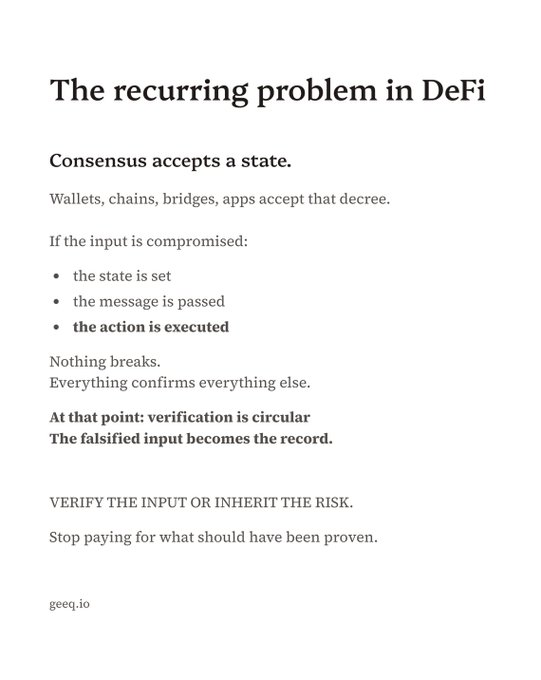
Topic: Bridges, multi-sigs, and mints without intent
Failure class: Compromised input mistaken as valid
Attack surface: Cross-boundary handoff
Verdict: Verify the input or inherit the risk
Most people think crypto forces a trade-off:
transparency or privacy
But that’s the wrong model.
You don’t need to reveal everything to be trusted.
You just need to prove what matters.
#Geeq enables exactly that:
• keep data private
• share only what’s necessary
• attach cryptographic proofs to actions
• verify identity, compliance, or transactions without exposing raw data
So instead of “trust me” or “see everything,”
you get:
prove it — without revealing it
That’s how privacy and trust can coexist.
And that’s what crypto actually needs next.
Investing in #Geeq isn’t about chasing hype — it’s about positioning for a missing layer in crypto.
Right now, the biggest problems in DeFi are not speed or UX.
They are trust failures:
• fake or unverified collateral
• broken bridges
• manipulated data
Billions are lost because systems accept inputs without proof.
#Geeq targets exactly this gap:
• a verification layer (not just another chain)
• enables cryptographic receipts → prove what happened
• ensures data integrity across chains
• reduces systemic risk in DeFi, AI, and Web3
If crypto evolves, it must solve trust.
If that happens, value shifts to the layer that provides it.
That’s the asymmetric bet: not another app, but infrastructure every app may need.
High risk, early stage but if adopted, it’s foundational.
Congratulations to the @GeeqOfficial dev team on today’s launch!
Making secure web wallets foolproof
does not happen overnight.
Well done. 🙌🙌🙌🙌🙌
Set up your no-risk wallet here: https://t.co/hQY90vbnaG
https://t.co/JxZcbNJb65
Most people enter crypto at peak hype. Few enter when sentiment is dead.
But asymmetric returns come from: low attention + high potential.
The hardest trade is buying what nobody cares about.
We have L2s, rollups, faster chains. But the missing layer is still: verification of truth
Who verified the data? Who verified the counterparty?
That’s the next battleground.
#Blockchain#Web3
This is the moment.
For years, crypto chased speed, yield, and narratives —
but ignored the one thing that actually matters: trust. Every few months, another protocol is drained.
Not because code didn’t execute —
but because systems trusted what they shouldn’t. Bridges mint value that doesn’t exist.
Oracles report prices that aren’t real.
Protocols accept collateral that was never there.
We didn’t build a financial system.
We built a house of assumptions. #Geeq is the shift. Not another chain.
Not another token. A verification layer for everything crypto forgot to secure:
• prove what happened
• prove when it happened
• prove it’s real
No more blind trust.
No more spoofable state.
No more invisible risk.The next era of crypto won’t be about faster transactions.
It will be about verifiable truth.And that’s why it’s time for Geeq. join the movement on @GeeqOfficial / https://t.co/rz113kK1qG be early to the verification layer.
A friend asked me: Can we make DeFi safe again?
Yes — but not by adding more audits or patching contracts.
DeFi isn’t breaking because code fails.
It’s breaking because protocols trust what they can’t verify.
Fake collateral.
Manipulated oracles.
Bridged assets with no proof.
#Geeq changes the foundation:
• verify collateral is real before it’s accepted
• cryptographic receipts for every critical action
• provable ordering of events across systems
• no blind trust in bridges or external inputs
If it can’t be proven → it can’t be used.
That’s how DeFi becomes safe again.
KelpDAO exploit shows the real problem:
The attacker didn’t “hack Aave” — they minted unbacked collateral via a bridge and Aave trusted it.
Cross-chain trust is broken.
#Geeq fixes this layer:
• verify collateral actually exists (not just “minted”)
• cryptographic receipts across chains
• provable ordering of events
• no blind trust in bridges like LayerZero
If Aave required verified receipts before accepting rsETH,
116k fake collateral never enters the system.
This isn’t a smart contract bug.
It’s a verification failure.