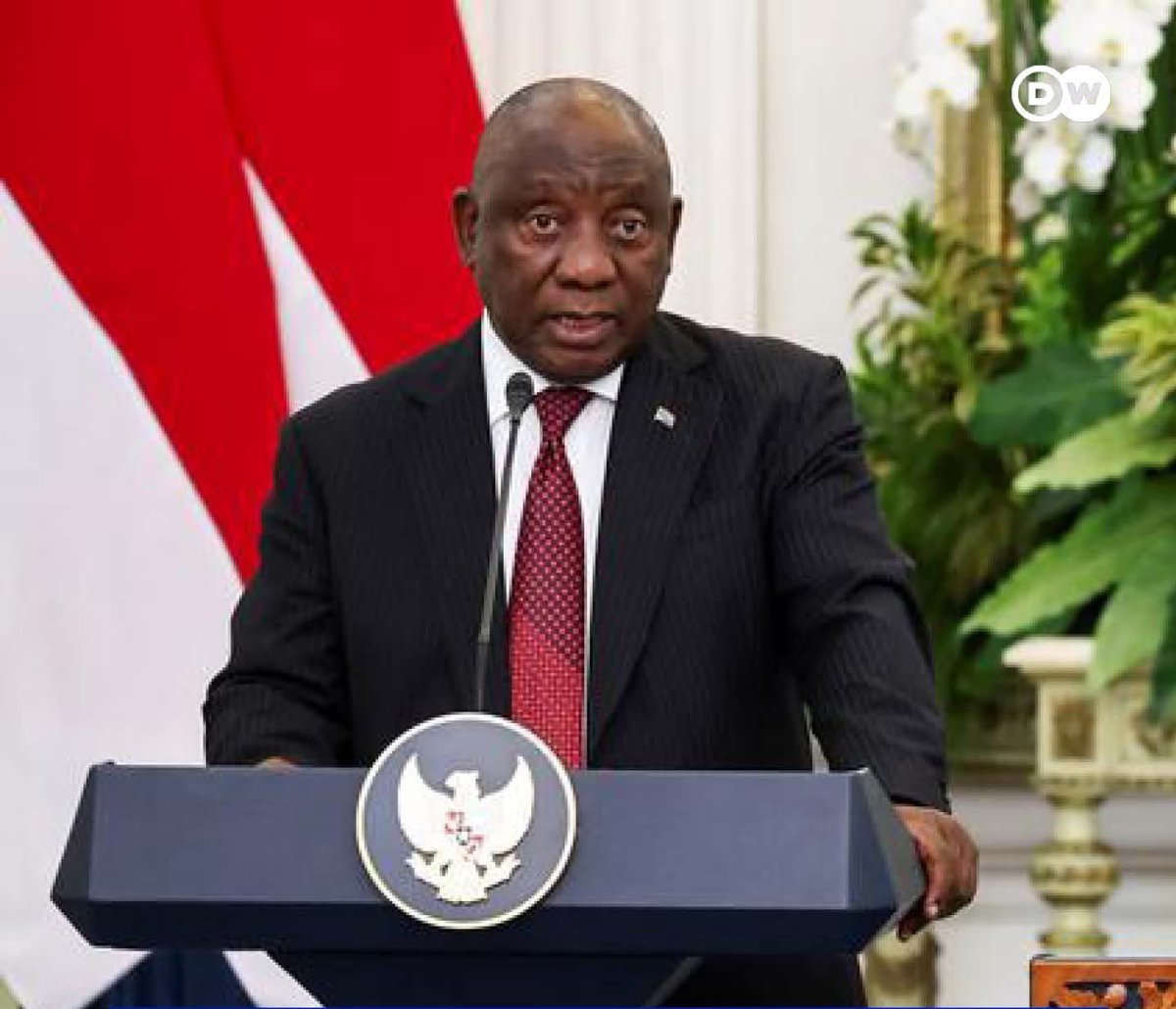
Cyril’s Net-worth when he took over South Africa 🇿🇦 was R6 Billion- his Net-worth skyrocketed in 2020 to R9 Billion in only 2 Years as President.
Since then he has requested that his finances not to be Disclosed.
Rough Estimates suggests that Cyril is around R24 Billion in 2025.
@AfricaFactsZone That country has too many problems just like Nigeria,the plane of their minister of energy and minerals crashed when he went to check a mine collapse site that killed many
DR Congo Players receive hero's welcome at 80,000 capacity Martyrs Stadium, after defeating Nigeria in the FIFA World Cup Qualifiers Play-offs.
They were received by DR Congo's President Felix Tshisekedi.
My piece is not specifically about land reform. Regarding land reform, I recently stated in a letter to The Business Day that Zimbabwe's land reform has been a significant failure, resulting in economic hardship for many people.
This is a truth, and Zimbabwe's agriculture has not recovered since its ill-advised land reform plan in the early 2000s.
NOT A MODEL FOR RSA
While we can all wish Zimbabwe well in its efforts to rebuild, the country's land reform is no model for South Africa.
South Africa's land reform is based on market principles. It supports growing investment in our agricultural sector, enabling it to play a meaningful role in resolving our triple challenge of low growth, poverty, and unemployment.
The starting point is the continuous affirmation of the strong property right, and thereafter, a release of the 2.5 million hectares of government land to appropriately selected beneficiaries with title deeds. This could be followed by blended finance and upskilling, collaboratively implemented with the private sector.
The 2.5 million hectares will not be the end of land reform; the process must continue on its market principles under the three pillars of (1) restitution, (2) redistribution, and (3) tenure.
To be clear, the South African government is still buying land from the open market for land reform processes, amongst other things. This is unlikely to change, and we all know that destructive policies won't help resolve our triple challenges.
Instead, it is investment and continuous efforts in opening export markets, addressing biosecurity weaknesses, and improving the logistics and efficiencies of municipal service delivery that will bring shared prosperity in South Africa's agriculture.
In March, the IMF published a paper examining the potential consequences of South Africa lowering its inflation target to 3%.
I won’t bore you with the technicalities, except that even under the IMF’s most favourable assumptions, by lowering the inflation target to 3%, South Africa would be opting for an upfront GDP loss of 0.4% and about 100 000 extra job losses.
Otherwise, the expectation is a 1.9% GDP decline and about 200 000 jobs lost.
Essentially, the 3% target is a gamble, and the IMF’s own paper acknowledges that the downside risk is substantial.
Yet Treasury has opted for the 3%. They obviously know something the IMF doesn’t.
But, given South Africa’s unemployment crisis, one has to wonder whether losing 100 000+ jobs to achieve a lower inflation target is really the optimal policy choice right now.
This seems like a policy designed for a different economic reality than the one South Africa actually faces.
‘maas’ isn’t a Dutch word Africans copied. It’s almost certainly Afrikaans borrowing from Nguni amasi – which is why Zulu/Xhosa say amasi/emasi and English in SA still calls the product maas. The dairy and the name were there long before settlers.
If you're thinking about how to bump up your career development in Law with a postgrad degree in 2026, you're at the right place - and you still have time! Applications deadline for postgraduate study is extended to end-November 2025! All the information you need is available at the link! https://t.co/3U9i91Otwg
The word "maas" for fermented milk in Afrikaans derives from the Nguni (Zulu/Xhosa) term "amasi," as noted in etymological sources like Oxford Reference and the Dictionary of South African English. This reflects the product's ancient roots as a pre-colonial staple among Khoikhoi and Bantu peoples, predating Dutch settlement. While Dutch "maas" means mesh (used in straining), the dairy-specific usage shows borrowing from indigenous languages, not vice versa—evidenced by the absence of pre-17th-century European fermented milk attestations matching this form.