One common problem in this part of the world is how easily we undervalue professional expertise when it involves Islamic knowledge.
You will comfortably pay a lawyer to review your agreement, an accountant to examine your records, and a consultant to advise your business.
But when you approach an Islamic finance professional, it suddenly becomes “Shaykh, please I want to ask one question.”
Meanwhile, that one question may require reviewing your contracts, analysing your business model, identifying Shariah risks, and recommending alternative structures.
Why should the Shariah expert be the only professional expected to work for free? There's a difference between educating people about Islamic finance and providing personalised professional consultation.
When someone regularly produces educational content, explains financial transactions, and answers general questions online, that's already a valuable contribution to society.
But when you approach that person to structure your investment, review your business, or develop a Shariah-compliant financial product, you're requesting a professional service.
They have invested years and substantial resources in acquiring knowledge, certifications, training, and practical experience. Their expertise deserves compensation just like that of other professionals.
Of course, there's nothing wrong with offering free consultations, especially to those who genuinely cannot afford them. But generosity should never become an entitlement.
We cannot keep complaining about the underdevelopment of Islamic finance in Nigeria while refusing to value the professionals needed to build the industry.
If you can afford to pay your lawyer, accountant, and business consultant, you should also budget for Shariah advisory services.
Islam encourages generosity, but it also recognises the value of people's time, labour, and expertise.
PS: Please before you slide into my DM, I charge 50k for consultation and that's to listen to you and guide you or answer questions relating to your investment or business. Then if you want me to do it for you or come up with solution, that's another discussion.
Thank you.
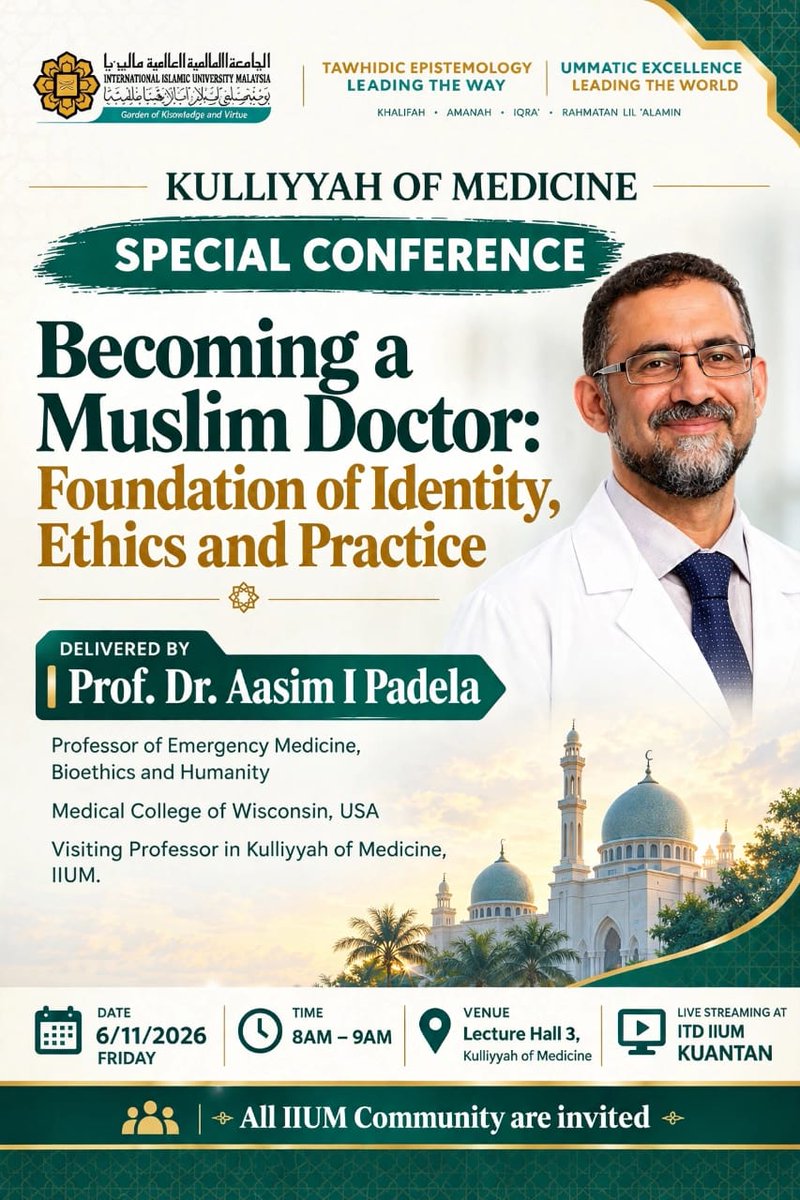
Just landed in KL for @OfficialIIUM programs this week to build upon our @MedicalCollege relationship in EM, Character Education, AI Ethics and Medical education. Here is one of the event that will be livestreamed... join in; I will draw upon my work with @KernNetwork@initiative4im and JCCV on character education & identity formation
https://t.co/2Yvk7UOKL3
We really need to exercise more humility in the way we approach Islamic education, particularly those of us who have been trained in Western or secular academic traditions. And I say this with the recognition that what we call Western education itself owes a considerable intellectual debt to earlier Islamic scholarship. But I digress.
The way Islamic scholarship establishes, evaluates, interprets, reconciles, and rejects evidence operates within an epistemological and methodological framework that is different from those of modern secular academic disciplines. Having a BSc, MSc, or PhD equips you with certain analytical skills, but it doesn’t automatically qualify you to approach Islamic texts with the same assumptions about evidence, authority, interpretation, and truth.
And I think this is where a certain intellectual arrogance creeps in. You become sufficiently competent in one intellectual tradition and begin to assume that its methods are universally transferable. You read a translation of the Qur’an, encounter an authentic hadith, and imagine that your ability to reason critically is sufficient to independently determine what the texts mean, even where generations of scholars have developed rigorous principles for precisely those questions.
This doesn’t mean Islam rejects logic or critical reasoning. Far from it. The Qur’an repeatedly calls us to reflect, reason, and examine evidence. Islamic scholarship itself has sophisticated traditions of reasoning, disagreement, and critical scrutiny. But reason operates within a methodology, and the authority assigned to different forms of evidence matters enormously.
Some analytical skills are transferable, certainly, but methodological competence in one discipline does not automatically confer expertise in another. The humility required is to recognise where our competence ends, learn the principles of the discipline before challenging its conclusions, and understand that unfamiliarity with a scholarly method is not evidence of its intellectual inadequacy.
You can be exceptionally educated in one field and still be a complete beginner in another. There’s absolutely no shame in that. The arrogance begins when we refuse to recognise the distinction.
@Waliabdull31 Exactly! This guy’s death has exposed just how many ignorant people walk around thinking they actually know something. The confidence with which some people display their ignorance is genuinely embarrassing, sai ka ga mutum fa kaman yasan me yake yi amma ina babu sam.
@Rayyanjada@Muhammad_Okoye The girl just graduated from Gombe State University, where she studied the very same Physics he’s talking about. I don’t see how memorizing the Qur’an would stop anyone from pursuing other things in life. Honestly, I don’t know what his problem is.
@daily_trust “Wait, you’ll enjoy the reforms later. Just be patient.” 😂
P.S.: These are the exact words Tinubu’s dogs used to say, o. I’m only being sarcastic, because apparently, Nigerians have lost their sense of humour these days. Even that one, Tinubu has taken from us. 😂
"Nigeria must win this election. You are not just campaigning for me as a candidate, you are campaigning for your own future, and that future is renewed hope"
— President Tinubu
@ogundamisi We're human, and we judge based on what we see in reality, not what's in your heart. Whatever your intentions may be, that's between you and your Creator.
@ItzMisschaos Gaskiya, sai dai hakan, don there's no way a tactical team would go on a rescue mission without any encounter or casualties.
Allah ya kyauta.