In celebration of World Investor Week 2026, CFA Society East Africa is hosting a #Free webinar on Smart Investing in the Digital Age: Choosing Credible Opportunities, Managing Risk, and Avoiding Scams.
Our CEO, Robert Ochieng, will be among the distinguished speakers.
Date: 7th October 2026
Time: 5.00 - 6.30 pm (EAT)
Register here: https://t.co/kIxUOGwpd8
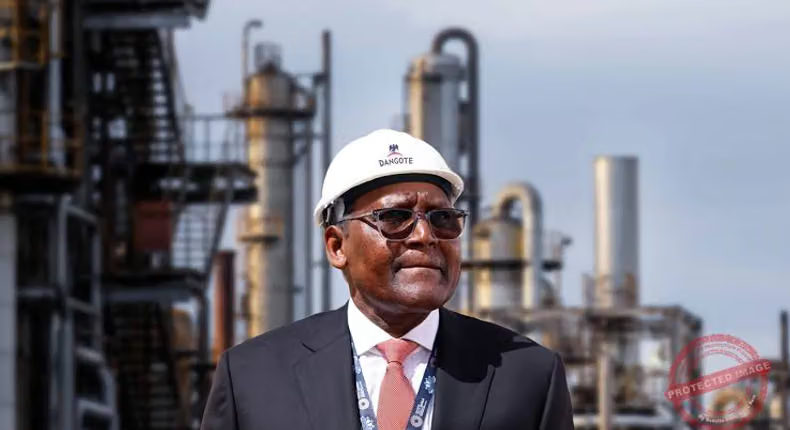
Dangote's Lamu refinery: $ 16bn. Kenya's FX reserves: ~$15bn.
The project is roughly the size of our entire reserve buffer.
But what does it actually mean for the economy?
Here's a sober look.🧵👇
3 KINDS OF STOCKS YOU NEED TO HAVE IN YOUR PORTFOLIO:
1⃣ Blue-Chip Stocks
These are the heavyweights, companies with large market share, consistent earnings, and a history of rewarding investors. They pay regular dividends. They’re less volatile than smaller companies. They provide stability and confidence for your portfolio.
With blue chips, you buy confidently and hold long-term. They are basically the foundation of your investment house.
>>
At some point, you will have to accept a simple reality, your ability to earn a salary will not last forever.
You'll get older. The job market will change. Younger people will enter the workforce with new skills and more energy.
Here is what must you do early?...🧵
5 Things to Consider Before Buying More Stocks...🧵🧵
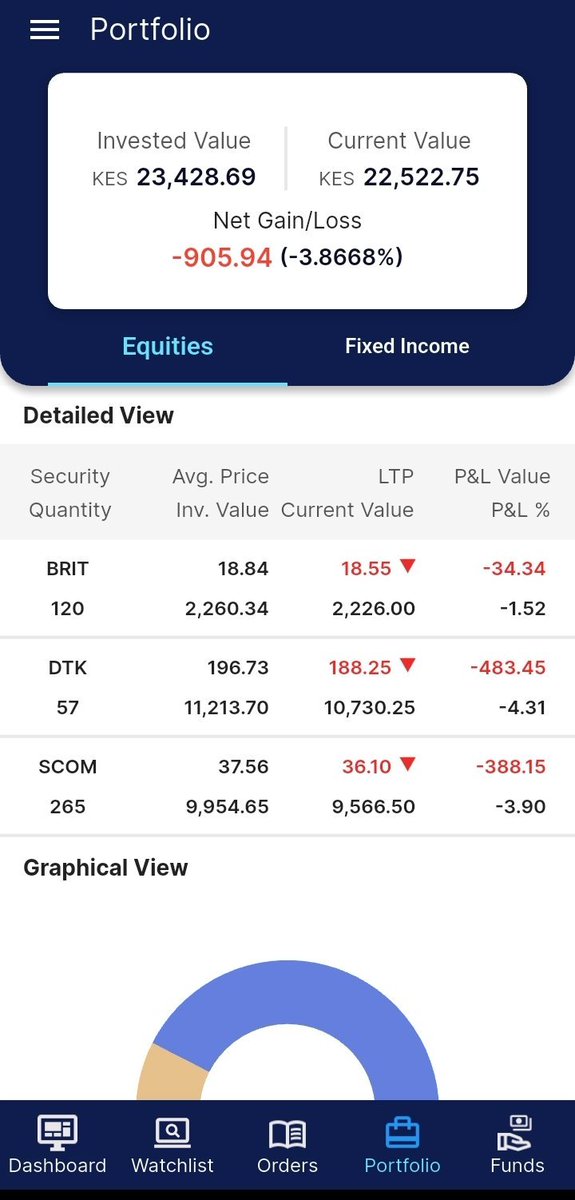
When you open your portfolio and see that almost every holding is in red, it is easy to feel that you have made the wrong investment decision. But a falling share price does not automatically mean that a company is a bad investment, just as a rising share price does not automatically make it a good one.
Before buying more shares, or selling the ones already held, there are a few things worth considering.
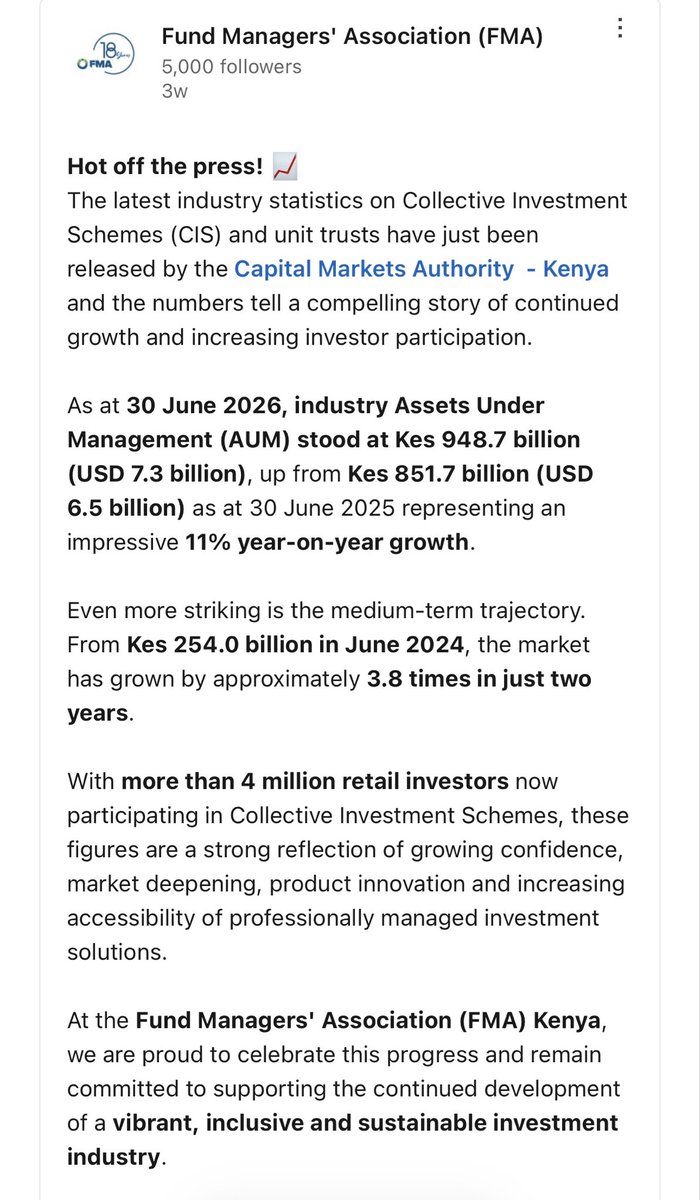
In other news, money market funds and other collective investment schemes AUM grows by Sh700b, 3.8X in two years, driven largely by retail investors. Where did this money come from if disposable incomes are falling? #GitheriMedia
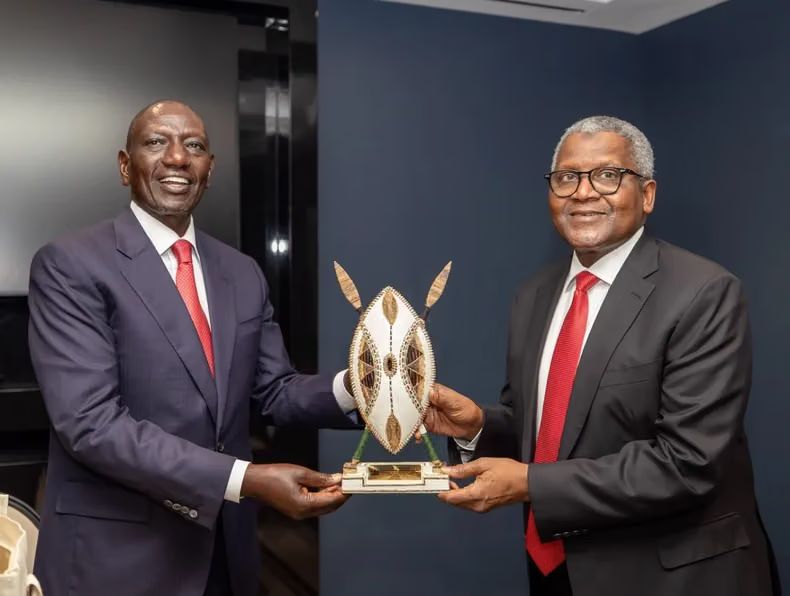
Three major projects backed by Dangote, Turkish investors, and East African governments aim to invest over $40 billion to reshape trade along the Indian Ocean coast.
A $17 billion refinery in Lamu, Kenya, spearheaded by Aliko Dangote, plans to process 700,000 barrels of crude oil daily for regional distribution.
Somalia and Turkish investors are developing a $4 billion port, special economic zone, and industrial hub near Warsheekh.
Tanzania and Uganda are collaborating on a $20 billion-plus energy hub at Tanga, including a refinery, pipelines, storage, and a marine terminal to serve East and Central Africa.
The NSE has shown signs of stabilising after the sharp mid-September profit-taking plunge. Some who panic-sold are already watching the rebound from the sidelines.
But what really happened, and why did seasoned investors see the sell-off differently?....🧵
Dear Shola.
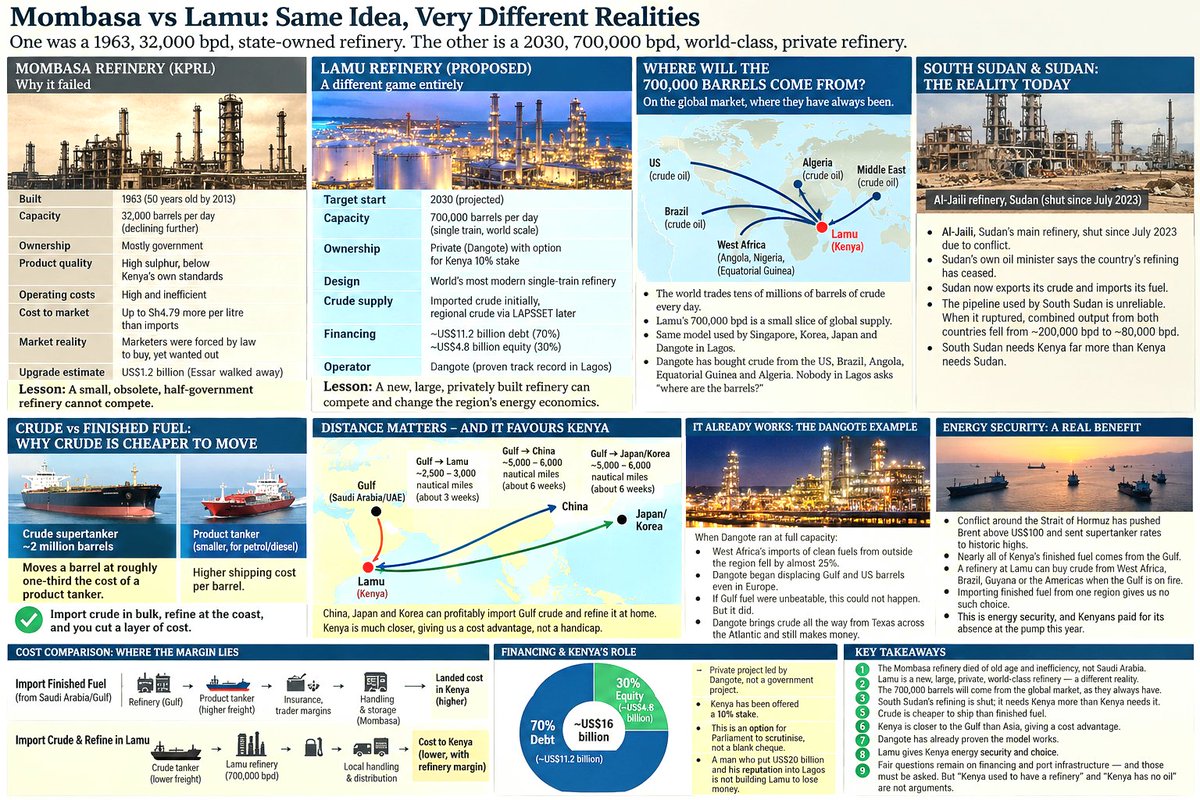
1/2 You say the Mombasa refinery proves your point. With respect it doesn't.
You are right that Kenya once had a refinery but you have the reason it died wrong. It was not killed by Saudi Arabia. It was killed by old age.
By 2013, that plant was 50 years old, built in 1963, and processing only about 32,000 barrels a day, falling further as marketers stopped buying. Its products were poor. Its diesel carried more sulphur than Kenya's own standards allowed. It suffered higher operating costs, inferior yields and chronic inefficiency, and its fuel cost up to Sh4.79 more per litre than imports.
Oil marketers were legally forced to buy from it and still wanted out. Essar looked at the $1.2 billion upgrade it needed and walked away.
So the lesson of Mombasa is not "Kenya cannot refine." It is "a tiny, obsolete, half-government refinery cannot compete." Lamu is the exact opposite: brand new, twenty times the size, privately built, and modelled on the most modern single-train refinery in the world. Judging a 2030 plant by a 1963 plant is like judging the SGR by the old metre-gauge railway.
You asked two questions and here are the two answers.
✅️1. Your first question: where are the 700,000 barrels a day?
On the sea, where they have always been. The world trades tens of millions of barrels of crude every single day. Lamu at full capacity would need a small slice of that. Singapore, Korea, Japan and Dangote in Lagos all buy this way. Dangote has bought US, Brazilian, Angolan, Equatorial Guinean and Algerian crude. Nobody in Lagos asks "where are the barrels?". You also said South Sudan already uses Sudan's refineries. That is out of date. Sudan's main refinery at Al-Jaili became a battlefield and has been shut since July 2023 please updateyourself. Sudan's own oil minister says the country's refining has ceased; it now exports all its crude and imports its fuel.
Sudan is even struggling to maintain the pipeline South Sudan depends on. When it ruptured, combined output from the two countries fell from about 200,000 barrels a day to around 80,000. Is that the reliable partner you are pointing to? South Sudan needs Kenya far more than Kenya needs Sudan.
On Turkana, your 20,000 barrels is correct. But nobody claimed Turkana would feed Lamu. Lamu starts on imported crude, exactly as Dangote does, and regional crude comes in as LAPSSET matures.
✅️2. Your second question: how can fuel from imported crude beat imported refined fuel?
This is the heart of your argument, so let me answer it with basic shipping and refining economics.
First, crude is cheaper to move than finished fuel. Crude travels in supertankers carrying about 2 million barrels. Petrol and diesel travel in much smaller product tankers. On long hauls, a supertanker moves a barrel at roughly one-third the cost of a medium product tanker. Import crude in bulk, refine it at the coast, and you have already cut a layer of cost.
Second, Lamu does not need to be cheaper than Saudi Arabia's refinery gate. It only needs to be cheaper than Saudi fuel landed in Mombasa, after product freight, insurance, trader premiums and handling. That gap is the refinery's margin. Today, that gap leaves Kenya in dollars.
Third, the proof already exists. When Dangote ran at full capacity, West Africa's imports of clean fuels from outside the region fell by almost 25%, and Dangote began displacing Gulf and US barrels even in Europe. If Gulf fuel were unbeatable, as you suggest, that could not happen. It happened.
You told us to check the distance between India or China and the Gulf. I did. It works against you.
The Gulf to China, Japan and Korea is roughly 5,000 to 6,000 nautical miles, around six weeks for a laden supertanker. The Gulf to Lamu is less than half that. If China and Korea can profitably import Gulf crude and refine it at home, Kenya, sitting far closer, has the advantage, not the handicap.
How to invest KES 1M in Kenya?
1M in an Infrastructure bond yielding 13% will give you 130K per annum.
1M in a dividend king like BAT at the NSE will give you 128K per annum after taxes. (Current div yield of 13.54%)
1M in a MMF with an annual yield of 10% will give you a return of 87K after taxes.
1M in a special fund with a return of 17% will net you a return of 170K after taxes
1M in SACCO savings with a rebate of 10% will give you 95K after taxes.
1M in the average rental property in Kenya (8% return from rental income, with 90% plus occupancy) will give you 75K after taxes.
1M in your bank savings account will earn you a very big ZERO after a whole year
Where are you investing your money?
For Dividend seeking investors, these are some of the stocks that will pay you well for owning them:
The most important metrics?
1. Dividend yield
2. Dividend payment track record
Takeaway investing tips for beginners:
1. Build an emergency fund of 3 to 6 months’ worth of expenses.
2. Have a long term horizon of 5 years or more to build wealth.
3. Start defensive by investing in less risky assets and be aggressive over time.
4. Diversify your portfolio by allocating several assets to reduce risks.
5. Consider starting small and watch your portfolio grow.
6. Invest consistently and your investment will compound over time.
A good salary can make your life comfortable. But a good salary on its own does not make you wealthy.
You can earn Ksh 200,000 every month and still have nothing meaningful to show for it if everything that comes in goes straight back out.
Wealth starts when part of your income is consistently converted into assets, investments, a business, property, or other things that can grow in value or generate income over time.
That is one of the conversations we have at the Abojani Personal Finance & Investing Masterclass.
Book your seat today!
Today the NSE had one of its worst days in years.
The NSE All Share Index (NASI) fell 3.38%, wiping out KES 139.63Bn, more than the KES 125Bn lost in the worst Covid-era sell-off.
Why is this happening? Should you panic-sell? Is the bull run over? 🧵
D-Day is here!
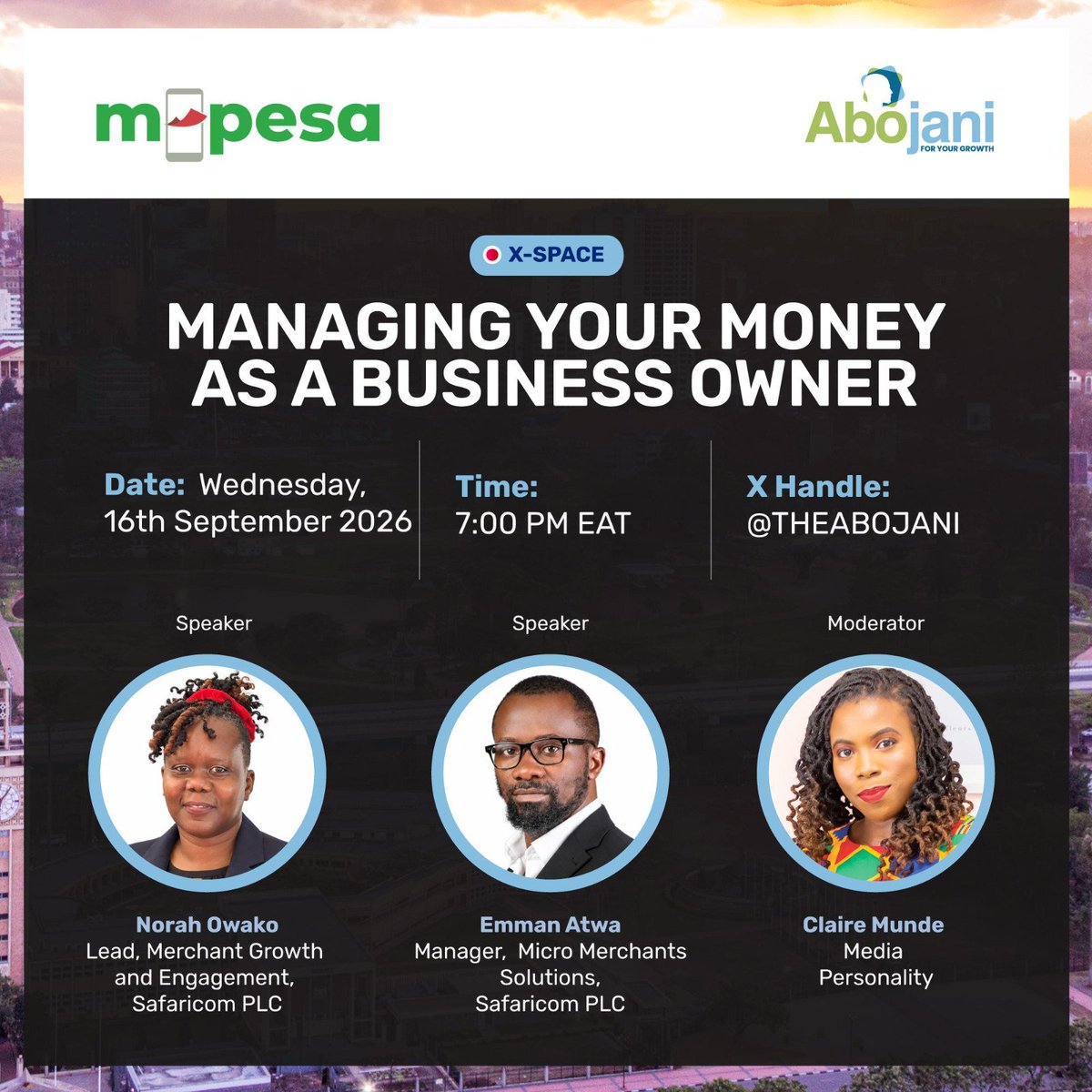
Tonight on X Spaces, we are having an important conversation for business owners and entrepreneurs: Managing Your Money as a Business Owner.
Running a business means dealing with sales, expenses, suppliers, employees, taxes, debt and, hopefully, profit. But making money from a business and managing that money well are two very different things.
We’ll be unpacking the practical side of managing business finances with Norah Owako, Lead, Merchant Growth and Engagement at Safaricom PLC, and Emman Atwa, Manager, Micro Merchants Solutions at Safaricom PLC.
Set reminder here: https://t.co/7CFPZRfQIR
Will Equity BCDC overtake Equity Bank Kenya by 2030?
Equity BCDC made a pre-tax profit of Ksh 16.9 billion in the first six months of 2026, compared with Ksh 29.4 billion for Equity Bank Kenya.
Join us this Wednesday, 9th September 2026, for our HY 2026 Banking Sector Analysis X Space, where we will unpack this and more.
Set a reminder: https://t.co/M1ZBRGENkc