@JimmyEsmaily@GermainLefebvre@joaconavajas@CrowdCog These variance signals weren't just passive responses.
They were linked to how well people monitored their own decisions.
🧠 Centro-parietal activity was the best predictor of metacognitive sensitivity — consistent with its role in evidence accumulation.
Our new preprint is out! 🎉 Dive into "Neural and Behavioural Correlates of Variability of Sensory Evidence."
Proud to collaborate with @JimmyEsmaily@GermainLefebvre@joaconavajas@CrowdCog
Read it here: https://t.co/ENrxqfcglV
@JimmyEsmaily@GermainLefebvre@joaconavajas@CrowdCog 📍 Frontal & centro-parietal areas:
showed a quadratic coding — strongest responses to intermediate variance levels.
📍 Occipital cortex:
tracked variability in a linear fashion.
Different brain regions, different coding styles for uncertainty!
@JimmyEsmaily@GermainLefebvre@joaconavajas@CrowdCog Participants judged the mean orientation of a sequence of gratings that varied in variance.
We analyzed EEG responses and found that both:
🔹 Stimulus-entrained (4 Hz) activity
🔸 Alpha-band (9–11 Hz) oscillations
tracked variability independently of the mean.
Most research on perceptual decisions focuses on the mean strength of sensory input.
But we asked:
🔍How does the brain represent the variability (i.e., uncertainty) in sensory evidence?
Using EEG, we tracked neural responses to changing variance while keeping the mean constant
🌟6. Working with these incredible scientists has been a unique and inspiring experience! Huge thanks to @CrowdCognition , @JimmyEsmaily, @arghavani121, and #Reza_Ebrahimpour for their invaluable contributions and support throughout this journey!
🎉 I'm thrilled to announce that our paper is out! We explore how subjective confidence—shaped by social influence—guides credit and blame assignments in hierarchical decision-making.
@CrowdCognition , @JimmyEsmaily, @arghavani121, and #Reza_Ebrahimpour
https://t.co/LfsRKCVCHQ
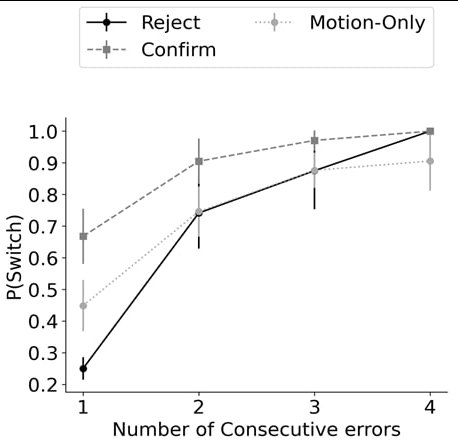
🧩5. Our work provides insights into the computational mechanism of credit assignment in hierarchical decisions. We found that participants accumulated evidence over trials until a strategy change threshold was reached, with switching probability rising after consecutive errors.