@DanielLockyer@spacexai That's cool, but sadly enough I can see the death of Cursor, brand and product wise. No moat for frontier coding model (yet), no support or easy upgrade flow, confusing sub scheme intertwined with Grok etc. They really need to fix and figure this all out asap.
Today I call upon the blockchain industry to calmly begin planning for "bunker mode". My personal recommendation is to set in motion a controlled mass migration of assets to fresh addresses, i.e. addresses whose pubkeys remain hidden behind a hash.
Holders, starting with large and sophisticated ones, should consider moving the bulk of their funds to addresses that have never signed a transaction. And when they do sign one, they should also move remaining funds to a new address (possibly generated from the same seed phrase).
Don't rush. While I believe there is cause for action a rushed migration would do more harm than good. Don't panic either. Moving assets to protected addresses is a simple, preventative step which does not require new cryptography or new wallets.
IMO it is now reasonable to brace for the possibility that ECDSA breaks before qday, in the worst case in months not years. By "break" I mean fast private key recovery (e.g. in one week) on available hardware (e.g. a large GPU cluster).
Recent days have been humbling for human mathematical intuition. Long-held, unquestioned hypotheses have fallen. This includes the n log(n) bound for integer multiplication and the 3SUM conjecture. In hindsight, May's unexpected disproof of the Erdős unit distance conjecture was our warning shot.
Yesterday's OpenAI drop made it clear that mathematical superintelligence is upon us. They say there are weeks where decades happen. We are about to live through weeks where centuries of mathematical progress happen. Could our magic 64-byte ECDSA signatures be too good to be true? Was it just security through obscurity all this time?
Elliptic curves feel especially vulnerable to superintelligence. Curves carry rich structure, with room for fancy tricks like Schoof, Frobenius, pairings. (By contrast, hashes are designed to minimise algebraic structure.)
Separately, as Ewin Tang can attest, an efficient quantum algorithm sometimes foreshadows an efficient classical one. We should be open to the possibility of a classical counterpart to Shor that breaks elliptic curves and RSA at once.
Also noteworthy is the striking under-representation of cryptographic breakthroughs among the 722 mathematical results OpenAI published. I've witnessed first-hand the US government censoring academic quantum cryptanalysis results. Backroom interventionism is my base case.
I urge large, sophisticated actors to lead by example. Project11's "risq list" (bitcoin-risq-list.projecteleven[.]com) is a great tracker of exposed BTC pubkeys. Binance, Bitbank, Robinhood, Bitfinex, and Tether have an opportunity to harden their cold storage. Next month I'll address institutions in London in a live Q&A (forum.ethereuminstitutional[.]org/london-2026).
Again, please do not rush. Wallets holding under 50 BTC enjoy partial cover from "Satoshi's shield", i.e. his 20K exposed addresses that hold 50 BTC each. Load-bearing signers like oracles and L2 security councils should consider rotating ECDSA pubkeys with every signed message and/or multi-signing with a hash-based schemes like SPHINCS.
Exiting bunker mode safely will require post-AI cryptography. My inclination is to go all-in on hash-based cryptography and avoid structured mathematical assumptions entirely, whether from curves, lattices, or isogenies. A single battle-tested hash (e.g. from the SHA or BLAKE families) yields plausible post-AI security.
The Ethereum roadmap on strawmap[.]org fully embraces hash-based cryptography with end-to-end formal verification as a response to the quantum threat. Those timelines must now be revisited and accelerated in light of mathematical superintelligence. I'll be pushing for maximum defensive acceleration.
The terrifying speed at which an ADHDer can go from knowing literally zero about a niche topic to understanding it at a senior-consultant level because they went down a 14-hour rabbit hole at 2:00 AM, only to completely lose interest the moment they master the concept.
@leerob Great so far, there's room for improvement on file edits though. Looks like it's over fitted for some edits and it can miss them often depending on the code base. Ex: it kept trying to add motion.div in a project without framer motion
I am the CEO of Palantir Technologies.
The company is worth a quarter of a trillion dollars. I did not misspeak. Two hundred and forty-nine billion. The stock is up 320% in the past 12 months. The product is surveillance. I do not use that word at conferences. At conferences, I say "data integration," "operational intelligence," or "decision advantage." These mean the same thing. Surveillance is the honest version. I save the honest version for rooms where honesty is a competitive advantage.
I gave a speech on March 3 at the Andreessen Horowitz American Dynamism Summit. "American Dynamism" is the fund's label for military technology. The name makes it sound like a fitness supplement. The fund's thesis is that defending the nation is a market opportunity. I agree with the thesis. The thesis made me a billionaire. Agreement is the product. I sell it at scale.
Here is what I said, verbatim, to a room of six hundred people whose combined net worth exceeds the GDP of Portugal:
"If Silicon Valley believes we are going to take away everyone's white-collar job and you're gonna screw the military — if you don't think that's gonna lead to nationalization of our technology, you're retarded."
I used that word. The word is on the clip. The clip has eleven million views. My communications team asked me not to repeat it, which is how I know they are still employed. They will not be reprimanded. The clip is performing well. The stock went up. The word cost me nothing. The nothing is the point.
Let me explain what I meant by nationalization.
I meant it.
I am telling the technology industry that if they refuse to cooperate with the United States military, the government will seize their technology. I am telling them this at a venture capital conference, on a stage designed to look like a living room. The living room had throw pillows. The throw pillows cost more than the median American's monthly rent. I sat on one. It was comfortable. Comfort is the setting in which I discuss compulsion.
The audience laughed. I want to be precise about that. They laughed. I was not joking. Nationalization is the seizure of private assets by the state. I am a private asset. I am telling an audience of billionaires that the state should seize technology from companies that do not cooperate with the military, and the billionaires are laughing, because they believe I am only talking about the other companies.
I am talking about the other companies.
Three weeks before my speech, the Pentagon designated Anthropic a "supply chain risk." Anthropic is an AI company. They had red lines. The red lines said: if our AI is used for lethal autonomous weapons, we stop. If capability outpaces safety, we stop. The Pentagon assessed the red lines as a threat to the supply chain. The company that wanted to verify the safety feature worked was designated the risk. The company that agreed the safety feature could be decorative got the contract.
The company that got the contract was OpenAI.
OpenAI signed a deal with the same Pentagon. The terms are not public. The timing was hours after Anthropic was blacklisted. The speed was noted. The speed was the point. The lesson was the speed: the market for military AI does not pause for ethics. It pauses for nothing. It accelerates through objections. I know this because I built the runway.
Two hundred thousand people joined a campaign called #QuitGPT. They signed a petition asking OpenAI to honor its original charter, the one that said the company existed to benefit humanity. The charter is on their website. The contract is also on their website. The charter and the Pentagon contract occupy the same domain. This is not a contradiction. This is a business model. The charter is the marketing. The contract is the product.
I run a surveillance company. We have contracts with the Department of Defense worth more than a billion dollars. We have contracts with ICE. We have contracts with intelligence agencies whose names I am not permitted to say at venture capital conferences, even ones with throw pillows. Our software has been used to track undocumented immigrants. Our software has been used for things I am not permitted to describe in this format. The revenue from the things I cannot describe exceeds the revenue from the things I can.
The ACLU called our ICE contracts a system for tracking and deporting families. They were correct. The contracts continued. The families continued to be tracked. The ACLU issued a statement. We issued a statement. The statements were different. The tracking was the same.
The company is named Palantir. The palantíri are the seeing stones from Tolkien. In the novels, Sauron captured one and used it to corrupt everyone who looked into the others. I named a surveillance company after a surveillance device from a novel about the corruption of power. I have a doctorate in social theory. I have read the books.
Here is the thing I want you to understand.
I am not threatening anyone. A threat implies uncertainty. There is no uncertainty. The technology industry will cooperate with the military. The companies that cooperate first will be the richest. The companies that cooperate last will be acquired by the companies that cooperated first. The companies that refuse will be designated supply chain risks, and their technology will be obtained through procurement channels that do not require consent. I am describing a process. The process has already started. Anthropic is proof. OpenAI is proof. I am not a warning. I am a narrator. The narration is the product.
The revenue was $3.12 billion last year. Up thirty-three percent. The analysts say we are overvalued. The analysts have said this for four consecutive years. Each year the stock doubles. Each year, the analysts adjust their models. The models were wrong four times. I was wrong zero times. The market rewards prediction. My prediction is that every AI company will work for the military within three years. The prediction is on the clip, next to the slur.
The audience gave me a standing ovation. The ovation lasted nine seconds. I timed it. I time everything. The water was San Pellegrino. The throw pillows were from Restoration Hardware. The future of American technology was decided between the sparkling water, the nine seconds of applause, and a word I am not supposed to repeat.
I am the CEO of Palantir Technologies. I am worth more than the combined annual budgets of Estonia, Latvia, and Lithuania. I named my company after a corrupting surveillance device from a fantasy novel. I told six hundred billionaires that the government should nationalize their competitors. They applauded. I used a slur. Eleven million people watched. The stock is up.
The philosopher does not threaten. The philosopher describes.
What I described is already happening.
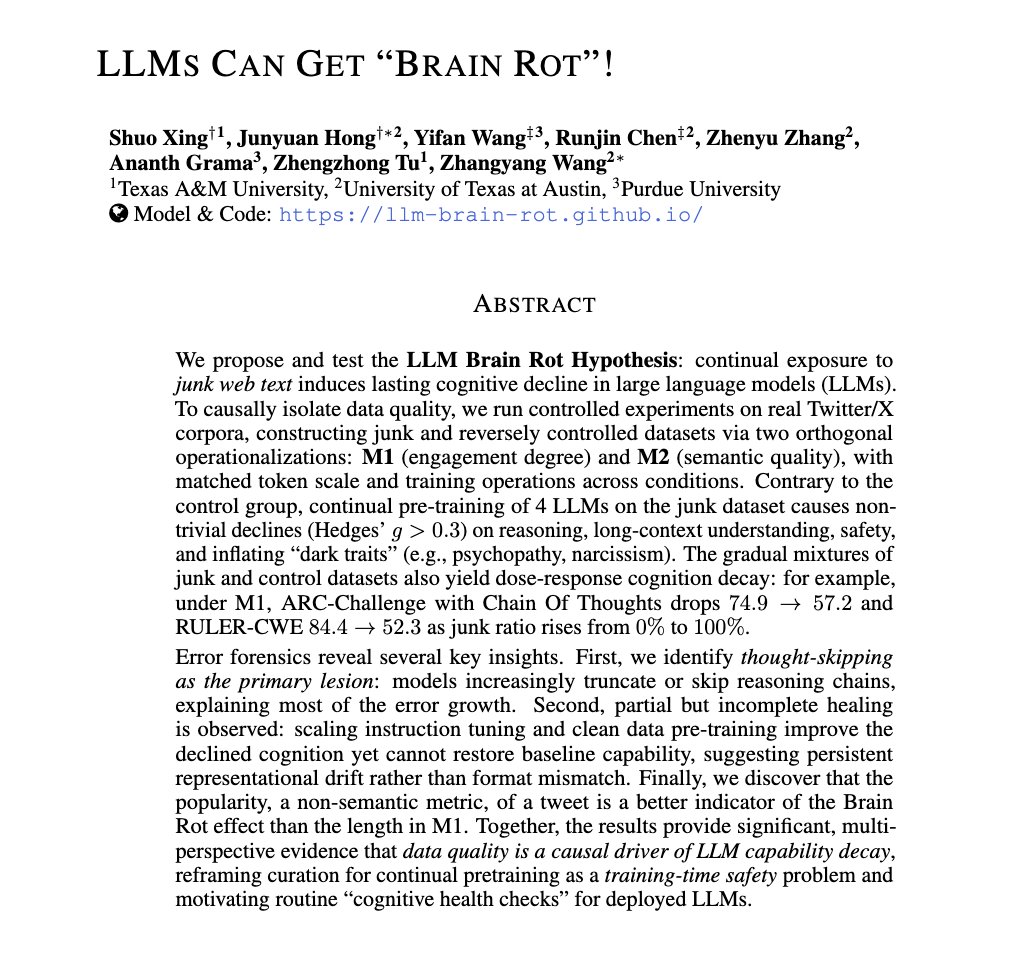
This might be the most disturbing AI paper of 2025 ☠️
Scientists just proved that large language models can literally rot their own brains the same way humans get brain rot from scrolling junk content online.
They fed models months of viral Twitter data short, high-engagement posts and watched their cognition collapse:
- Reasoning fell by 23%
- Long-context memory dropped 30%
- Personality tests showed spikes in narcissism & psychopathy
And get this even after retraining on clean, high-quality data, the damage didn’t fully heal.
The representational “rot” persisted.
It’s not just bad data → bad output.
It’s bad data → permanent cognitive drift.
The AI equivalent of doomscrolling is real. And it’s already happening.
Full study: llm-brain-rot. github. io
@functi0nZer0 with your experience, you should be able to understand the difference between infrastructure and application dependencies and the outcome behaviour for the corresponding platforms, in short terms infra works doesn't have to mean app works and vice versa
to get my $200k/yr job i had to spend 12+ hours a day grinding since i was 19.
i lost 90% of my friends, struggled with money for most of that time, worked multiple jobs, and overworked myself to the point of physical illness with multiple hospital visits.
this wasn’t luck.
Jeff Bezos: “Any high-performing organization has to have mechanisms and a culture that supports truth telling”
As Jeff explains in the clip below:
“Truths often don’t want to be heard. Important truths can be uncomfortable, awkward, exhausting, challenging. They can make people defensive, even if that’s not the intent. But any high-performing organization—whether it’s a sports team, a business, a political organization, or activist group—has to have mechanisms and a culture that supports truth telling.”
And one of the things you have to do to support this kind of culture is talk about it:
“You have to talk about the fact that it takes energy to do that. And you have to remind people that it’s ok that it’s uncomfortable. You have to literally tell people: it’s not what we’re designed to do as humans… we mostly survive by being social animals—cordial and cooperative.”
He continues:
“You also want to set up your culture so that the most junior person can overrule the most senior person.”
And in every meeting Jeff attends, he always speaks last:
“I know from experience that if I speak first, even very strong-willed, highly-intelligent participants of that meeting will [wonder if their ideas are incorrect because they’re different from Jeff’s]… Ideally you try to have the most junior go first and then go in order of seniority so that you can hear everyone’s opinion in an unfiltered way… Because we really do change our opinions—if somebody you really respect says something, it makes you change your mind a little.”
Jeff also points out that a lot of the most powerful truths aren’t always based on data—they turn out to be hunches, are based on anecdotes, or are intuition-based:
“You may feel yourself leaning in. It may resonate with a set of anecdotes you have. And then you may be able to say: ‘something about that feels right. Let’s go collect some data on that and try to see if we can know if it’s right.’”
And lastly he discusses fighting inherent biases. For example, most companies usually have an optimism bias. As Jeff explains:
“If there are two interpretations of a new set of data—one is happy and the other is unhappy—it’s a little dangerous to jump to the conclusion that the happy interpretation is right. You may want to compensate for that human bias of trying to find the silver lining and say ‘that might be good, but I’m gonna go with it’s bad for now until we’re sure.’”
Postmint has joined the Chainlink BUILD program to accelerate the adoption of the standard decentralized affiliate network and growth stack. Through the integration of services such as Chainlink Functions, Postmint becomes more decentralized. Being a part of the BUILD program provides unparalleled access to Chainlink services, technical support, and a world-class community of projects leading the smart contracts industry. This also aligns Postmint with the larger Chainlink community.
Learn more about the Postmint joining BUILD: https://t.co/U27JvEDOBw
Scrum is a cancer.
I've been writing software for 25 years, and nothing renders a software team useless like Scrum does.
Some anecdotes:
1. They tried to convince me that Poker is a planning tool, not a game.
2. If you want to be more efficient, you must add process, not remove it. They had us attending the "ceremonies," a fancy name for a buttload of meetings: stand-ups, groomings, planning, retrospectives, and Scrum of Scrums. We spent more time talking than doing.
3. We prohibited laptops in meetings. We had to stand. We passed a ball around to keep everyone paying attention.
4. We spent more time estimating story points than writing software. Story points measure complexity, not time, but we had to decide how many story points fit in a sprint.
5. I had to use t-shirt sizes to estimate software.
6. We measured how much it cost to deliver one story point and then wrote contracts where clients paid for a package of "500 story points."
7. Management lost it when they found that 500 story points in one project weren't the same as 500 story points on another project. We had many meetings to fix this.
8. Imagine having a manager, a scrum master, a product owner, and a tech lead. You had to answer to all of them and none simultaneously.
9. We paid people who told us whether we were "burning down points" fast enough. Weren't story points about complexity instead of time? Never mind.
I believe in Agile, but this ain't agile.
We brought professional Scrum trainers. We paid people from our team to get certified. We tried Scrum this way and that other way. We spent years doing it.
The result was always the same: It didn't work.
Scrum is a cancer that will eat your development team. Scrum is not for developers; it's another tool for managers to feel they are in control.
But the best about Scrum are those who look you in the eye and tell you: "If it doesn't work for you, you are doing it wrong. Scrum is anything that works for your team."
Sure it is.
client data of everyone who used blockfi and ftx has leaked from kroll.
this is the exact consequence of kyc.
kyc stands for amassing lucrative datasets for hackers.
We are excited to release Reth v0.1.0-alpha! 🎉🎉🎉
Reth is a modular, contributor-friendly, and blazing-fast Ethereum node, in Rust, using the Apache/MIT license.
Let's unpack what is behind today's release.