Lumilens just raised $700 million at a $5.5 billion valuation: two years old, with a hyperscale customer it won't name, and a contract worth billions over the next several years. That's one of the most significant early-stage funding rounds in data center infrastructure history.
The problem it's solving is worth understanding clearly. At 200 Gbps per lane and beyond, copper's physics becomes the limiting factor. Traditional passive copper can no longer reliably span beyond a single server rack at these speeds. When AI clusters are scaling to hundreds of thousands of GPUs, that constraint compounds across every connection in the system.
The market context behind the raise:
→ Global optical transceiver sales exceeded $23 billion in 2025, up roughly 50% year-over-year
→ The optical cable market for AI data centers is expected to grow more than threefold to 5.4 million units by 2029
→ NVIDIA expanded development of co-packaged optical interconnect architectures in May 2026 specifically for next-generation AI data center workloads
The industry is moving toward interconnect heterogeneity. Copper dominates short-distance scale-up connections within racks, while optical handles the long-distance, high-bandwidth scale-out networks between racks and clusters. Both markets are expanding simultaneously.
Within five years, all high-bandwidth data interconnects in the data center are expected to become optical. Lumilens is building directly toward that transition, and the capital being deployed behind it reflects how seriously the industry is taking the timeline.
Southeast Asia is emerging as one of the fastest-growing regions in the global infrastructure race.
High-capacity connectivity revenue worldwide is forecast to grow at 18% CAGR from 2025 to 2030. Southeast Asia is expected to outpace that at 22% annually, driven by hyperscaler investment, the geographic distribution of data centers, and enterprise AI adoption accelerating across the region.
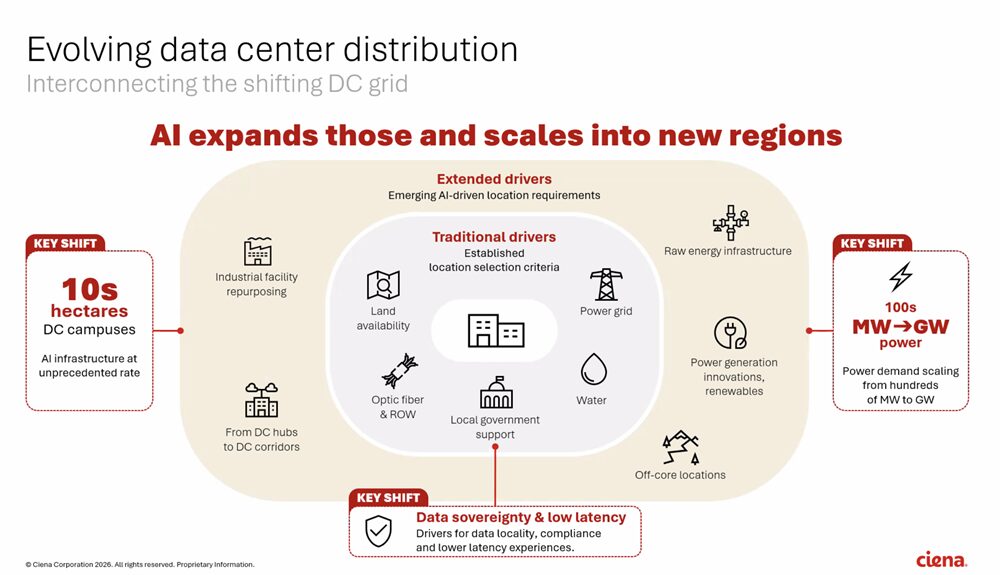
The Ciena diagram captures what's actually changing in how data centers get distributed. Traditional site selection criteria (land, fiber, local government support, power grid access) are still in play, but AI has layered new requirements on top of them:
→ Raw energy infrastructure and power generation innovation are now first-order variables, not secondary considerations
→ Data sovereignty requirements and low-latency needs are pushing facilities closer to end users, from DC hubs to DC corridors
→ Power demand is scaling from hundreds of MW to GW-scale campuses, requiring infrastructure that didn't exist in most markets two years ago
Indonesia, Malaysia, and the Philippines are already seeing this trend materialize. The Philippines specifically is positioned to benefit from several submarine cable systems expected to land in the country, strengthening its regional connectivity. Ciena is working with PLDT, Globe, and Converge to develop networks capable of supporting hyperscale-scale demand.
The markets that build AI-ready networks now (not just bandwidth, but high-performance, low-latency, predictable connectivity between distributed compute locations) will capture the next wave of hyperscale investment.
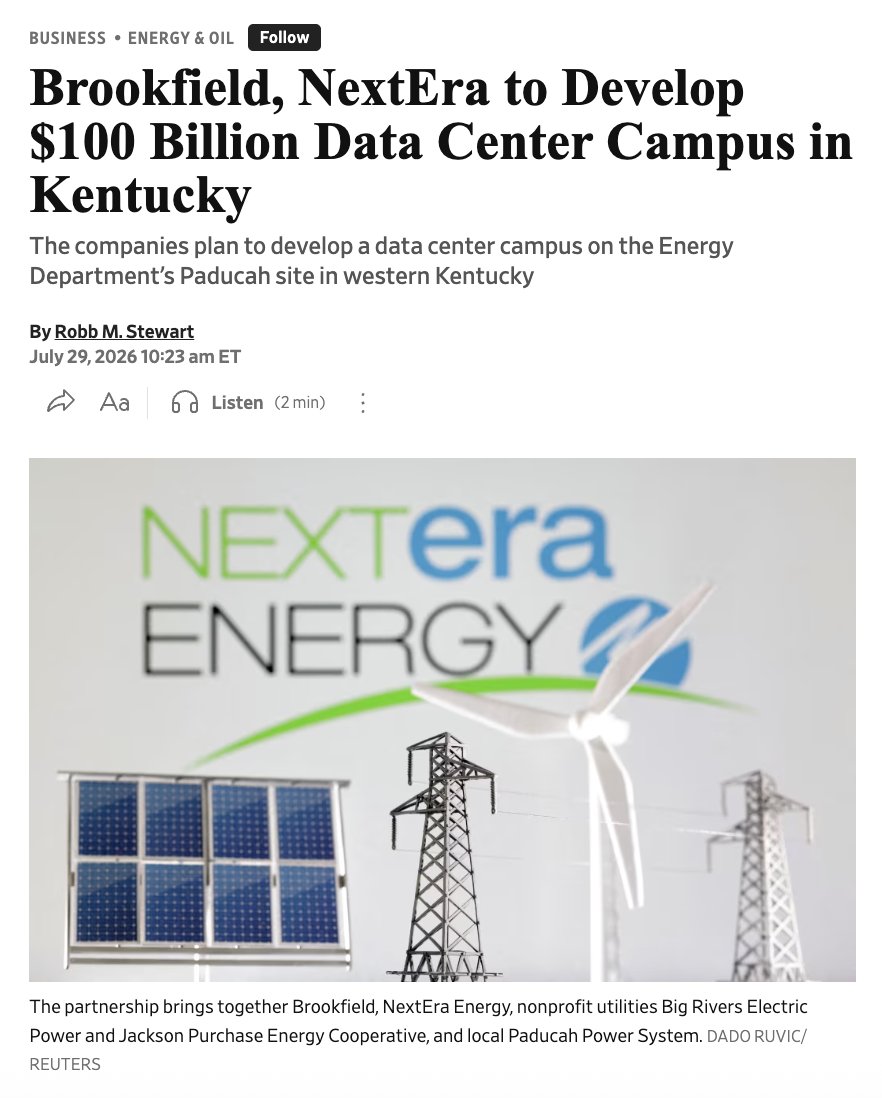
A Cold War uranium enrichment facility in Paducah, Kentucky just became the site of a $100 billion AI data center campus.
Brookfield and NextEra Energy, alongside Big Rivers Electric, Jackson Purchase Energy Cooperative, and Paducah Power System, are transforming part of the DOE's former Paducah Gaseous Diffusion Plant into one of the largest AI infrastructure projects in US history.
At full buildout in 2032, the campus targets 1.8 GW of utility capacity, 1.2 GW of compute capacity, and up to 4.6 GW of dedicated generation resources built and paid for specifically for the project.
The key details worth noting:
→ Data center power infrastructure costs will not be passed on to existing residential or small-business electricity customers
→ 2 GW of natural gas-fired generation and 2.6 GW of battery storage, all privately funded
→ DOE selected Brookfield following a competitive November 2025 Request for Offers, and separately selected NextEra to build the dedicated generation resources
The ratepayer protection piece is the part the industry needs to replicate everywhere. One of the most consistent concerns in markets from Maine to Virginia has been that data center growth shifts electricity costs onto residential customers.
This project was structured from the ground up to address that directly, and it shows what the development model looks like when the community equation gets taken seriously before the approvals happen.
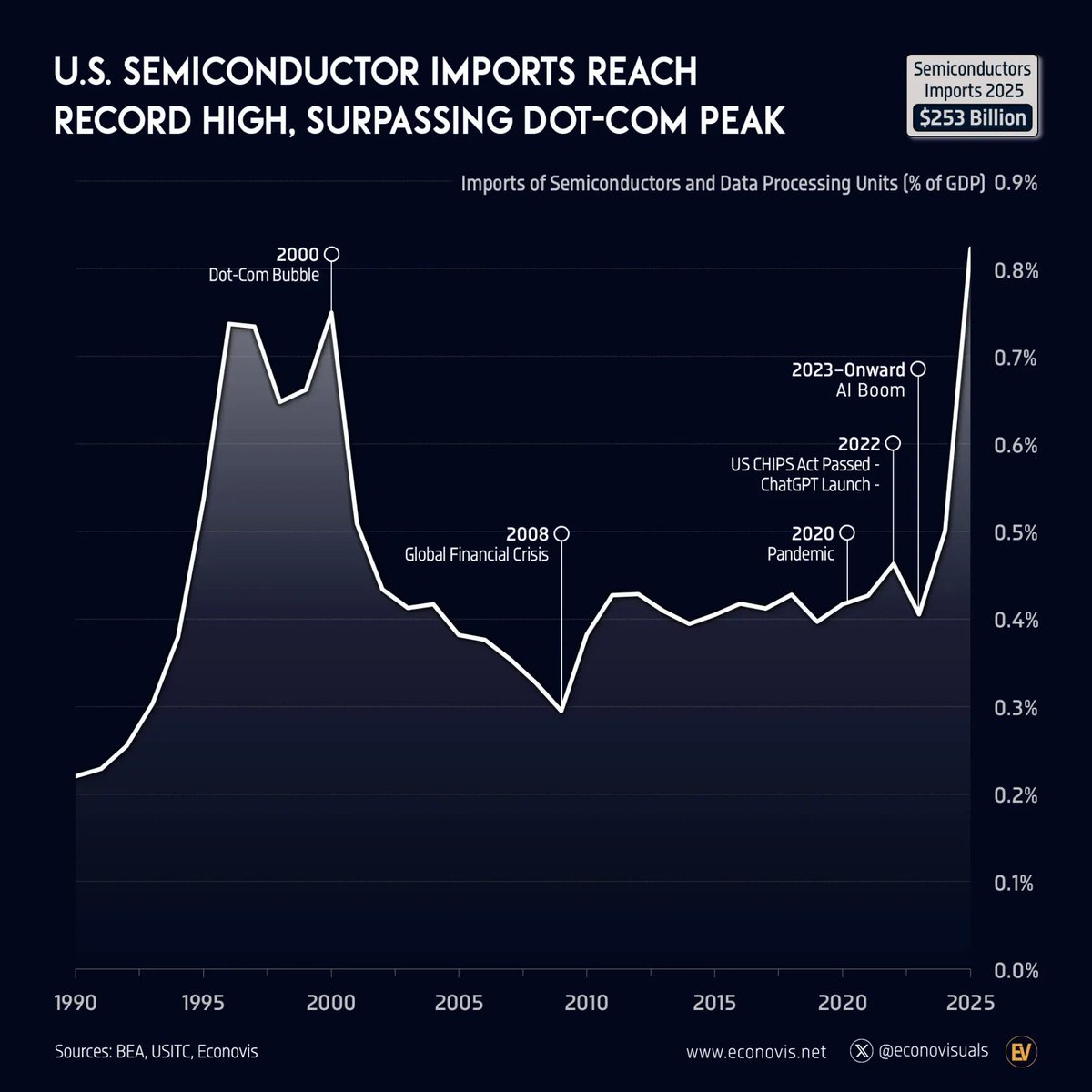
US semiconductor imports hit $253 billion in 2025 (0.9% of GDP) surpassing the previous record set during the Dot-Com boom. After two decades of stability at 0.3–0.5% of GDP, the line went vertical the moment the CHIPS Act passed and ChatGPT launched.
The demand is real. Companies are buying hardware at a pace the US hasn't seen since 1999, backed by actual hyperscaler capex commitments, cloud revenue, and AI infrastructure buildout, not speculative web traffic.
The Dot-Com comparison cuts both ways though. That peak was followed by a sharp correction. The current cycle has more structural demand behind it, but whether this is durable or a pull-forward is the question shaping every major capital allocation decision in this industry right now.
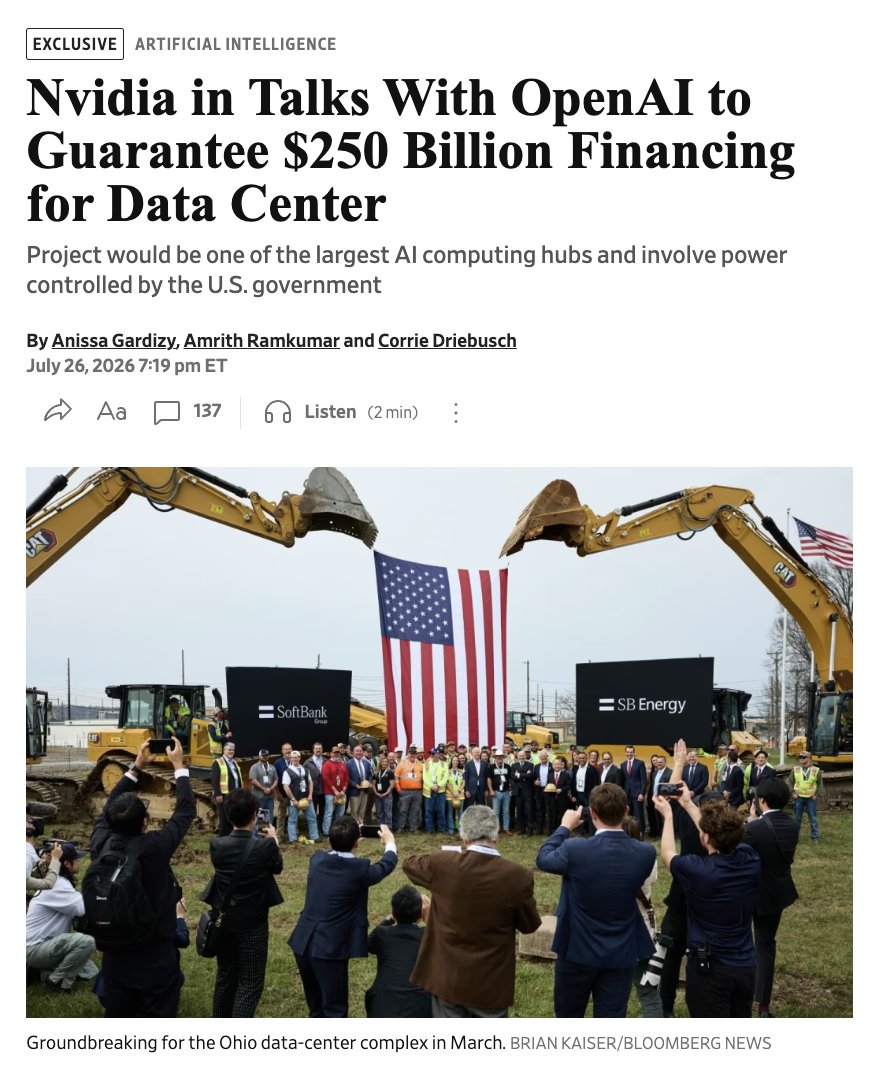
NVIDIA is in talks to provide $250 billion in financing guarantees for OpenAI's 10 GW data center in southern Ohio, part of a project that could cost more than $500 billion in total. The $250 billion covers the data center lease and debt financing. Separately, NVIDIA is also discussing financing OpenAI's chip purchases worth up to $350 billion.
Two things are happening simultaneously here that are worth understanding clearly.
For OpenAI, this would be the first step toward controlling its own infrastructure instead of renting from Microsoft, Amazon, and Oracle. That strategic shift, from tenant to owner, changes OpenAI's cost structure, its negotiating leverage, and its long-term competitive position in a way that goes well beyond any single infrastructure deal.
For NVIDIA, it guarantees chip demand for years to come. But critics are already raising the circular financing concern. NVIDIA backstops OpenAI's data center, OpenAI uses that financing to buy NVIDIA chips, NVIDIA books the revenue.
The power for the project is controlled by the US government and funded separately by Japan under a recent trade deal, tied to Tokyo's pledge to invest $33 billion in a natural gas plant. That detail alone tells you how far the AI infrastructure buildout has moved into the domain of geopolitics and sovereign capital.
Anthropic, Microsoft, and Google have also spoken to Commerce Secretary Lutnick about the site in recent weeks. The 10 GW Ohio project is shaping up to be one of the most consequential infrastructure decisions of the decade, and the competition for it reflects that.
Intel just posted its fastest revenue growth in 15 years. Revenue hit $16.1 billion in Q2 2026, up 25% YoY, well above expectations. Capital spending raised from $18 billion to $20 billion, with higher spending forecasted into 2027.
AI data center demand is what's driving it. Intel spent several difficult years losing ground while NVIDIA captured the AI compute wave. The combination of government backing for domestic chip manufacturing and hyperscalers actively looking for credible NVIDIA alternatives has given Intel a window it didn't have two years ago.
A competitive x86 alternative in AI infrastructure is good for operators, good for supply chain resilience, and good for the long-term health of the semiconductor ecosystem the entire buildout depends on.
As a proud partner of #YOTTA2026, we're excited to share that the full conference agenda is now live!
This September 28–30 at Caesars Forum in Las Vegas, Yotta 2026 brings together more than 6,000 senior leaders, 250+ speakers, and 300+ partners at the intersection of AI, energy, and digital infrastructure.
The agenda covers everything from chips, compute, and data centers to power, capital, and space-based infrastructure, the full range of technologies and investments shaping where AI goes from here.
Yotta is where the industry's biggest conversations happen, whether you're building, financing, powering, or operating AI infrastructure. It's where the people making the most consequential decisions in this space will be in the same room for three days.
Use code MDC20 to save 20% on your pass.
NVIDIA's ambition isn't to sell the best GPU in the data center but to own the entire data center stack.
The Vera Rubin platform alone has seven types of chips: the Vera CPU, Rubin GPU, and five others, plus networking, software, inference orchestration, and now even PC chips announced at Computex.
The numbers behind the ambition are hard to argue with. Revenue went from $26.9 billion in fiscal 2022 to $215.9 billion in fiscal 2026, with $358 billion projected for 2026. There's at least a $1 trillion revenue opportunity through 2027, with inference (not training) now cited as the larger commercial opportunity.
The competitive tension is the part worth paying closest attention to:
→ NVIDIA controls an estimated 81% of the AI data center chip market, but every major hyperscaler is actively developing proprietary silicon to reduce that dependency
→ NVIDIA acquired rights to sell Groq's LPUs for $20 billion to address inference workloads GPUs weren't designed to handle, a direct acknowledgment that the GPU alone doesn't own the full inference stack
→ The CUDA software moat may prove more durable than any individual chip architecture, which is why NVIDIA is investing heavily in software stacks, domain libraries, and enterprise AI platforms that create switching costs independent of hardware
The strategic question is whether vertical integration at this scale creates a defensible position as hyperscalers build their own silicon, or whether it accelerates their motivation to do so.
The data center buildout is reshaping extended stay hotel demand, and most people aren't tracking this angle.
Annual data center infrastructure investment grows 116% from 2024 to 2027. That capital brings thousands of construction workers into markets that lack the housing inventory to absorb them. Extended stay hotels are the primary beneficiary.
The markets leading the demand wave: Dallas-Fort Worth, Northern Virginia, Atlanta metro, Columbus Ohio, Pennsylvania, Illinois.
The real debate: is this demand sustainable once construction ends? One executive compares it to an oil boom: the faucet shuts off and never returns. Another argues data center clusters attract supply chain manufacturing, power infrastructure, and residential development that creates durable long-term demand well beyond the build phase.
The second thesis is the one worth watching.
The cooling decision used to be straightforward. At 5-10 kW per rack, air cooling works fine. At 100 kW+ per rack, where AI workloads are heading, it simply doesn't anymore.
The Cooling Viability Score (CVS) framework puts a number on what most data center engineers already know intuitively but struggle to communicate to investors and operators who aren't deep in the technical weeds:
→ Below 15 kW per rack — traditional air cooling scores near 90-100. High viability, low cost, works on existing infrastructure
→ 20-40 kW per rack — hybrid air and liquid-assisted cooling enters the picture. Viability scores improve significantly over pure air while allowing operators to leverage what's already built
→ 50 kW+ per rack — direct-to-chip and immersion cooling reach viability scores of 90-100. At this density tier, they're the only options that actually work
→ 100 kW+ per rack — where next-generation AI GPU workloads are heading, and where only advanced liquid cooling achieves the thermal performance and PUE efficiency required
The reason this framework matters beyond engineering teams is that cooling architecture is now a first-order investment variableA facility designed for 30 kW per rack that needs to support 100 kW workloads faces a retrofit problem that is expensive, time-consuming, and in some cases structurally impossible.
The physical decisions made in design today either accommodate the density curve or they don't.
Given that the computing capacity record in a single data center is doubling every 7 months, designing cooling infrastructure for today's densities instead of tomorrow's is a decision that compounds quickly in the wrong direction.
Everyone is focused on NVIDIA's Vera Rubin ramp for hyperscale data centers on the ground. The orbital data center opportunity is the catalyst that most analysts haven't fully priced in yet.
SpaceX is building AI infrastructure in orbit, and NVIDIA is already positioned for it: space-ready Vera Rubin chips, CUDA software adapted for orbital operation, and a serious internal commitment to the market that doesn't show up in any current consensus model. Jensen Huang has confirmed Vera Rubin faces no production delays, and "giant amounts" of chips are coming.
The opportunity is real but comes with a ceiling worth understanding:
→ Near term: NVIDIA supplies chips and CUDA infrastructure for SpaceX's orbital buildout, a revenue catalyst that the sell-side hasn't modeled because it's genuinely hard to size
→ Medium term: SpaceX's Terafab facility eventually produces proprietary silicon that displaces third-party chips, the same vertical integration playbook that every hyperscaler has run with custom ASICs
→ Long term: NVIDIA's software moat (CUDA and the broader developer ecosystem) may prove more durable in orbit than the hardware itself
The pattern is familiar. Hyperscalers adopted NVIDIA GPUs, scaled, then built their own chips. SpaceX will likely follow the same path. The question for investors is how long the hardware window stays open before the proprietary silicon arrives.
3M and Microsoft just announced a strategic partnership, and the technology at the center of it deserves more attention than the headline.
Microsoft's Azure becomes the first hyperscale provider to deploy 3M's Expanded Beam Optical (EBO) technology. Instead of direct fiber contact, EBO uses an expanded beam interface: faster to install, far more tolerant of dust and contamination, significantly easier to maintain.
In a facility deploying thousands of fiber connections under active construction conditions, the operational difference between a connector that needs constant cleaning versus one that doesn't compounds significantly across the deployment lifecycle.
Microsoft's early testing showed measurable reduction in network deployment timelines.
The partnership runs both ways. 3M deploys Microsoft AI across customer service, finance, and sales, with AI agents handling order management, credit checks, and delinquency assessments.
The companies solving the physical infrastructure problems at hyperscale are going to be embedded in every major facility for the next decade.
The cooling conversation in data centers has moved from "should we upgrade?" to "how fast can we get there?"
GPU power consumption is rising to levels that make conventional air cooling and even many single-phase liquid cooling systems increasingly inadequate for maintaining optimal operating conditions. IDTechEx projects that future GPUs will require thermal management capable of handling extremely high power densities while maintaining energy efficiency and system reliability.
The evolution of direct-to-chip cooling breaks down across three generations:
→ Gen 1 - Air cooling: works at low rack densities, becomes untenable above 30-40 kW per rack
→ Gen 2 - Single-phase liquid cooling: cold plates circulate liquid to remove heat, practical for 50-100 kW per rack, widely deployed today
→ Gen 3 - Two-phase liquid cooling and direct-to-plate: liquid undergoes phase change to absorb heat more effectively, capable of handling the extreme power densities that next-generation AI GPUs will generate, becoming an engineering necessity rather than a strategic option
The distinction between necessity and option is what matters here. Two years ago this was a future consideration. Today it is an active procurement decision on every serious AI infrastructure build. NVIDIA's Rubin platform has already made 100% liquid cooling the baseline and every operator building for it is making this transition whether they planned to or not.
The thermal management layer of the data center stack is being redesigned in real time. The companies that have solved it at scale are going to be very difficult to displace.
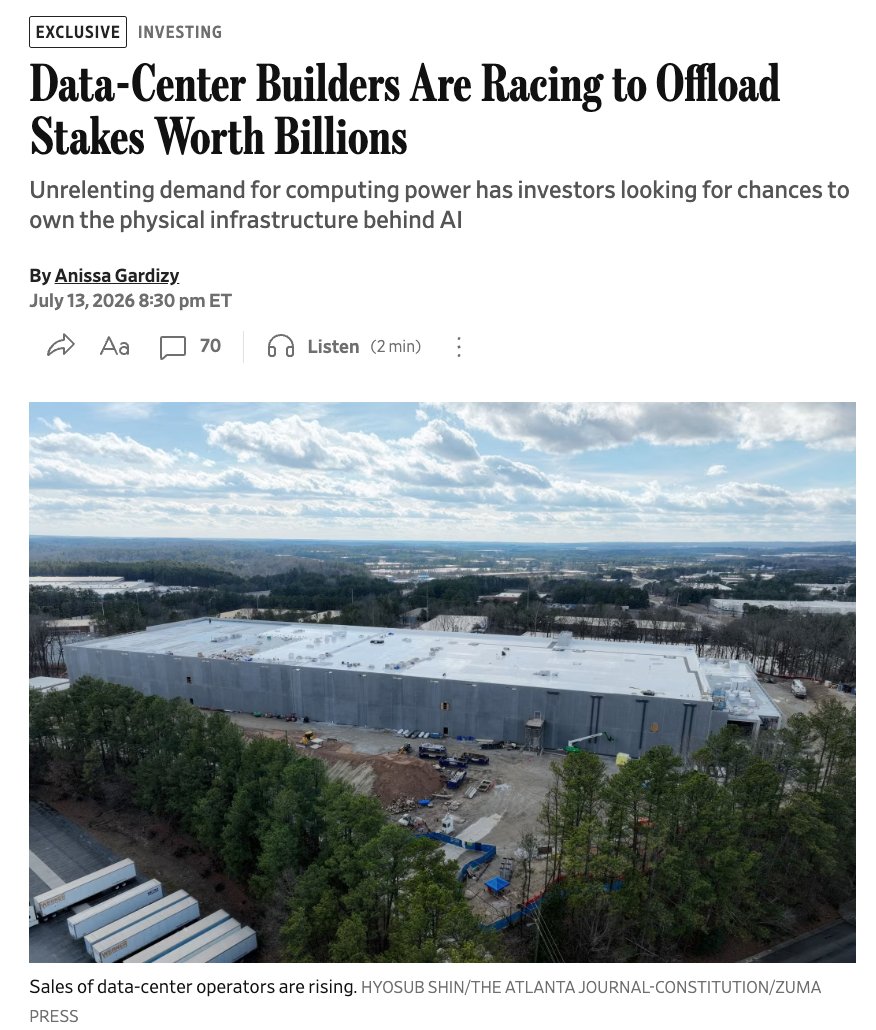
Data center builders and operators are working with bankers to sell majority equity stakes worth tens of billions of dollars, and the reason is straightforward: building at this scale requires more capital than most developers can carry on their own balance sheets.
The WSJ reports that unrelenting demand for computing power has investors looking for chances to own the physical infrastructure behind AI, and developers are responding by bringing in institutional partners rather than waiting for project financing to catch up with construction costs that have compounded significantly over the last 18 months.
This dynamic is worth understanding clearly. Two very different interpretations are being made of the same headline:
One read: developers are offloading stakes because costs are spiraling out of control and they're getting out while valuations are high. A bearish signal.
The other read: developers are offloading stakes because the asset class has been validated at a scale that attracts sovereign wealth funds, pension funds, and infrastructure allocators who weren't in the room two years ago, and bringing in that capital allows them to build more, faster, with less balance sheet risk. A bullish signal.
Building new data centers has gotten significantly more expensive, and that part is unambiguously true. But higher construction costs in a supply-constrained market with locked-in hyperscaler demand doesn't automatically mean the investment thesis has broken. It means the barrier to entry has risen, which tends to benefit the developers who are already through the gate.
The companies racing to sell stakes right now are the ones with assets to sell. That's not nothing.
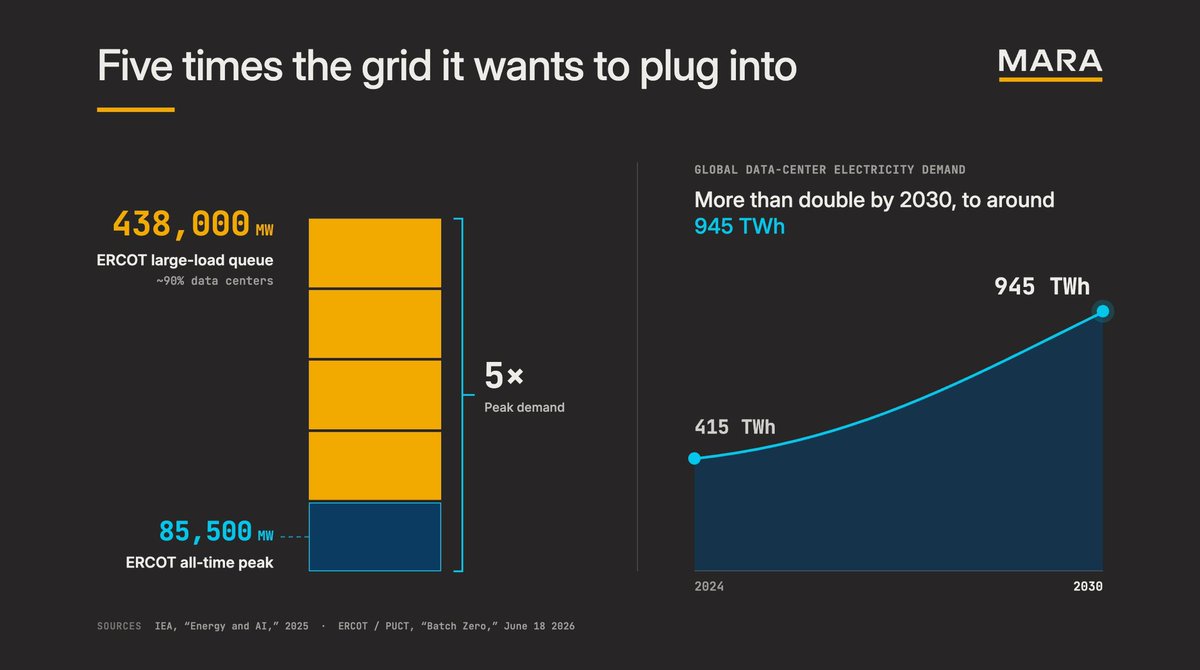
Two numbers on this slide tell the story of America's power grid problem better than any policy paper could.
→ ERCOT's all-time peak demand: 85,500 MW
→ Large-load requests in ERCOT's queue right now, 90% of which are data centers: 438,000 MW
That's five times the grid's historical peak sitting in a waitlist. And global data center electricity demand is projected to go from 415 TWh in 2024 to 945 TWh by 2030, more than doubling in six years.
The grid wasn't designed for this, and regulators know it. The policy response is already taking shape:
→ FERC is pushing grid operators to reform large-load interconnection rules to prioritize projects with on-site generation or demand flexibility
→ ERCOT approved a faster interconnection track for projects that bring their own power or can curtail load on demand
→ SPP has already implemented a framework fast-tracking data centers with co-located generation or load-flex capability
The direction is consistent across every major US power market: projects that depend entirely on the grid for their power answer are going to wait. Projects that bring their own generation, can curtail during stress events, and reduce the net burden on transmission infrastructure are going to move.
The queue is 5x peak demand. The only realistic path through it is to not need it or at least not need all of it.
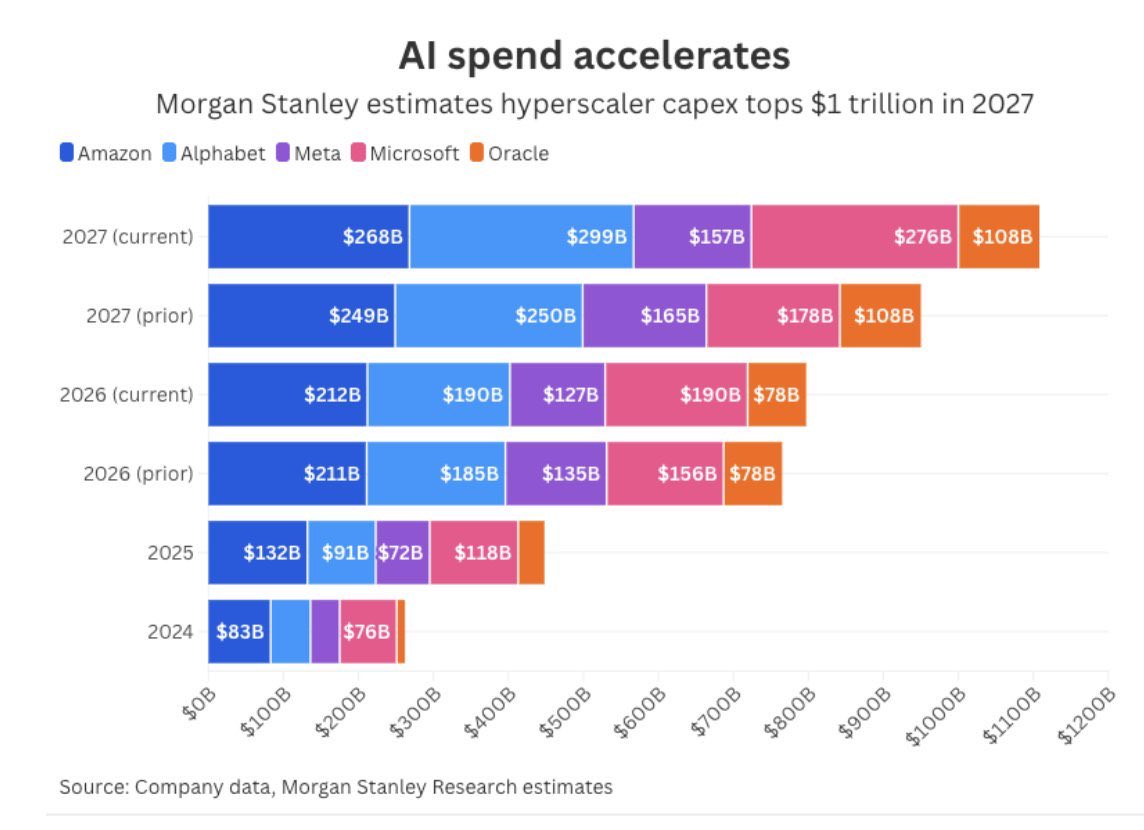
Morgan Stanley just revised hyperscaler capex estimates for 2027 upward and the new total crosses $1 trillion for the first time.
The current vs. prior comparison across each year tells the real story. Every time analysts set a ceiling, the companies raise it:
→ Microsoft revised up from $178B to $276B for 2027, a $98B increase in a single estimate revision
→ Alphabet revised up from $250B to $299B, now the single largest spender in the 2027 projection
→ Amazon revised up from $249B to $268B
→ Meta revised down slightly from $165B to $157B, the only company trimming in this cycle
→ Oracle holds at $108B across both estimates
The trajectory from 2024 to 2027 is the frame that matters most. Combined capex across these five companies goes from roughly $300B in 2024 to over $1.1 trillion in 2027, less than four years, nearly a 4x increase.
What this chart also shows is that the revision direction has been consistently upward with almost no exceptions since this cycle began. Every quarter that Wall Street models a plateau, the guidance comes in higher. At some point that changes but based on the current estimate trajectory, 2027 is not that year.
For the data center supply chain, equipment manufacturers, power companies, and construction firms downstream of these five balance sheets, this is the demand floor and it just moved up again.
Meta just nearly doubled its Louisiana investment. The Hyperion data center in Richland Parish is now a $50 billion project targeting 5 GW of compute capacity, up from the $27 billion figure announced in October and the original 2 GW design.
Bloomberg reports the total expected investment for the site could surpass $250 billion over its full lifecycle. For context, that's larger than the GDP of most countries.
What Meta is doing alongside the infrastructure build is worth noting:
→ Local Louisiana businesses have received more than $1.6 billion in contracts since breaking ground in December 2024
→ Full scholarships for every Richland Parish high school graduate starting with the class of 2026, plus a $5 million donation to Louisiana Delta Community College
→ More than $1 billion committed to local infrastructure improvements including roads, water, and wastewater systems
→ Teachers in Richland Parish received a $50,000 bonus this year, up from $10,000 last year
This is what genuine community investment looks like alongside infrastructure development not as a PR afterthought, but as a structured commitment that changes the economic reality of a rural parish that had very few comparable opportunities before Meta arrived.
Louisiana's 20-year sales tax exemption for data centers built before 2029, signed by Governor Landry in late 2024, played a direct role in securing and expanding this commitment. States that want this level of investment are competing on the full package not just tax breaks, but speed of permitting, power infrastructure, and a government willing to be a real partner in the build.
Future data center lease commitments just crossed $850 billion and this chart shows a curve that has no precedent in commercial real estate history.
In Q1 2023, total committed future lease value across these six companies was barely visible on this scale. By Q1 2026, it's approaching $800 billion in a single quarter's reading, with Oracle and Microsoft now the two largest contributors by a significant margin.
A few things worth noting beyond the headline:
→ Oracle's emergence as the largest single tenant by committed lease value is the story most people aren't paying enough attention to. Their data center expansion has been aggressive and largely behind the headlines dominated by the hyperscale narrative
→ Meta's gray segment appearing and scaling rapidly through 2025-2026 reflects their $65B+ capex commitment materializing into actual signed agreements
→ CoreWeave's teal slice is the one to watch. It's a neocloud player sitting in the same chart as the world's largest hyperscalers tells you something important about how the market has evolved
→ The acceleration from Q3 2025 to Q1 2026 is the steepest single-quarter jump in the entire dataset
These are future committed obligations, not historical spend, meaning this capital has already been contractually allocated. The operators on the other side of these leases have a revenue floor that most asset classes in commercial real estate would consider extraordinary.
Building a 1 GW AI data center costs $37.2 billion. Land and grid hookups account for less than 1% of that.
Epoch AI's cost breakdown puts the chip stack alone at $21 billion, more than half the entire build. The silicon is the real capital wall in AI infrastructure right now.
The full cost breakdown:
→ Compute (GPU chips): ~$21B — 56% of total
→ Networking: ~$7B
→ Servers & storage: ~$5B
→ Building & cooling infrastructure: ~$3.5B
→ Power infrastructure: ~$700M
→ Land & grid connection: under $200M
The implication for how this industry actually gets financed is significant. The scarce resource was never land or power connections but the ability to raise and deploy tens of billions in compute hardware before a single dollar of revenue comes in. It explains why hyperscalers are increasingly turning to project financing and off-balance-sheet vehicles to build these facilities at all.
This is also why the tariff conversation around semiconductors isn't academic. When chips represent 56% of a $37 billion build, any disruption to semiconductor supply chains or pricing flows directly into the economics of every project in the pipeline.
The data center industry talks constantly about power constraints and permitting delays. The quieter constraint is whether any entity outside the top five hyperscalers can actually finance a facility at this scale without creative capital structures.
Normal real estate logic says more supply cools prices.
In data centers right now, it isn't happening.
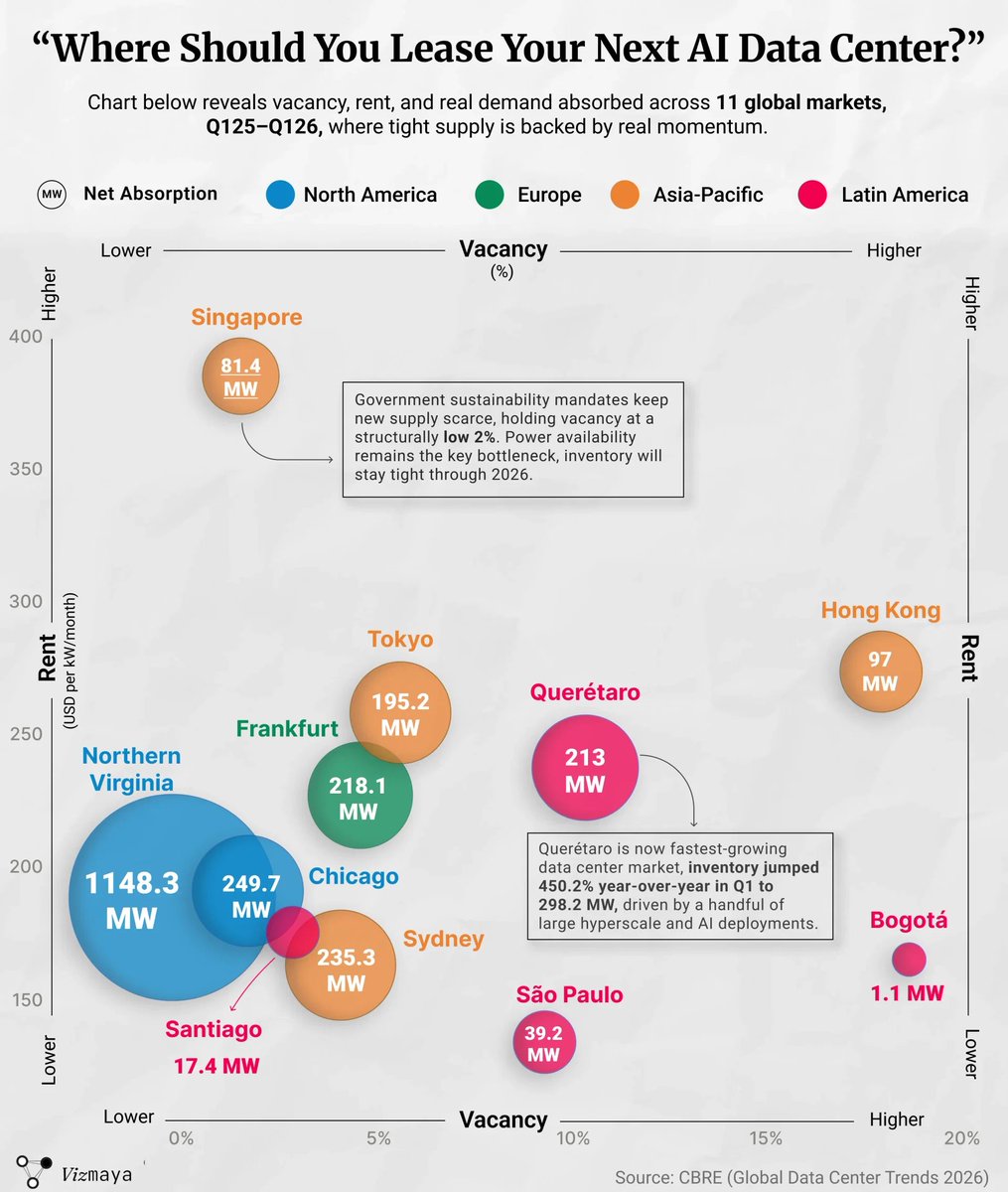
Northern Virginia absorbed 1,148.3 MW of new demand in a single year, the largest jump CBRE has recorded.
Vacancy rate: 0.3%. Singapore charges $402/kW/month with a government-mandated vacancy floor of 2% and still can't keep up.
Querétaro grew inventory 450% YoY and still absorbed 213 MW.
Supply and demand are rising together, not against each other.
Availability is the constraint. Vacancy below 2% means you're on a waitlist, not in a negotiation.
The right question is which markets have real, sustained absorption behind their scarcity, and which just look tight because they're small or policy-constrained.