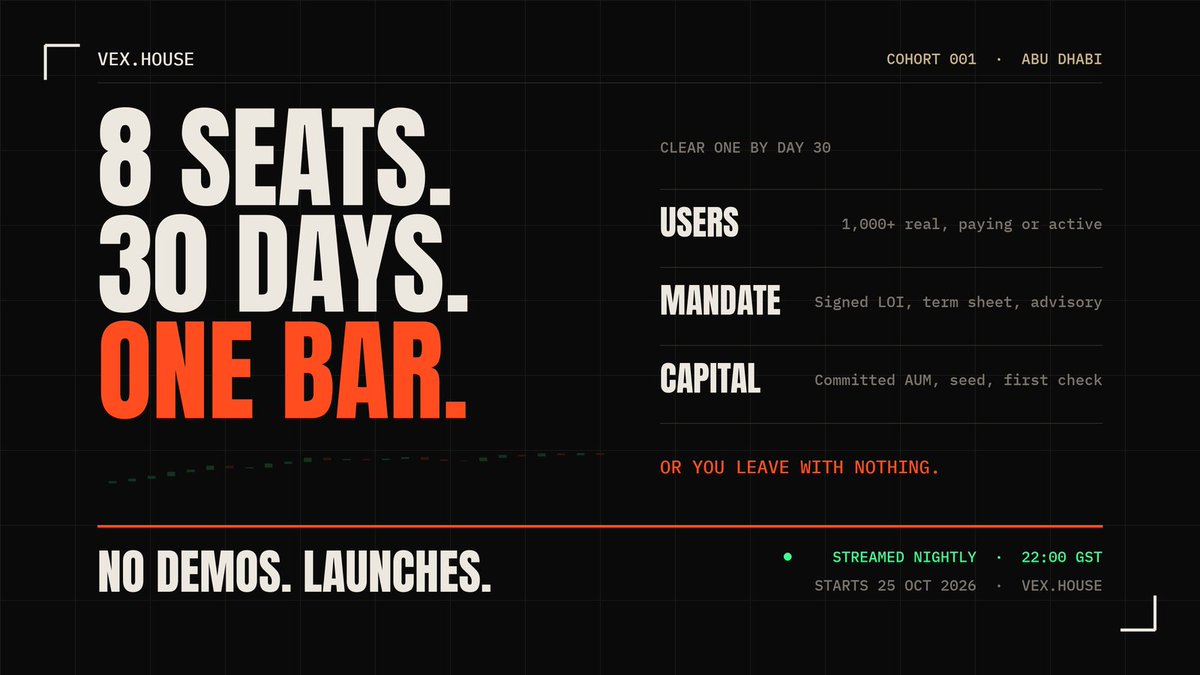
On 25 October, eight people under 30 move into a house in Abu Dhabi.
They get 30 days.
By Day 30 each of them has to clear one bar: 1,000 real users, a signed mandate, or committed capital. Not a roadmap. Not a waitlist. Not a deck.
Why #AbuDhabi . Because the capital is already here, the regulator will take the meeting, and you can trade Asia in the morning and Europe in the afternoon without leaving the room. What's missing isn't money or rules. It's visible work. So we're making 30 days of it visible.
Every night at 22:00 GST the whole cohort goes on stream and says what they shipped and what broke. No edit. No retake. The bad nights go out too.
We cover the room, the workspace and the studio for the full 30 days. No tuition. No equity taken. You cover your flight and your food.
Nobody gets a demo day. On Day 30 you either launched or you didn't in public, with your name on it.
8 seats. Under 30. Abu Dhabi.
Applications close when the eighth seat fills.
@annewoj23 AI speeds up the front end, but the clinical and regulatory grind that shreds most programs hasn’t gone away. If the optimistic timelines prove right we’ll all win if not, disciplined execution on real human data will still separate the survivors.
The real constraint isn’t “small teams ship better.” It’s that AI is raising fixed costs (servers, inference, data centers) faster than it raises revenue per employee for most SaaS companies right now.
Airtable is responding by resetting headcount after acquisition a classic playbook when you need to show quick operating leverage.
You’re responding by freezing raises, stopping hiring for 18 months, and trying to redeploy people. Both are rational given different ownership structures and time horizons. The open question is whether Zoho can keep product velocity and margins competitive while carrying a larger, more stable workforce through the AI cost shock.
@paultoo The practical filter is not never hire from big tech, but hire people whose past results show they created leverage rather than headcount, and default to promoting those who already understand the company.
Treat the buildout as infrastructure only where the productivity case is already visible inference for high-volume workflows, automation of high-cost cognitive labor.
Everywhere else it remains a high-stakes options bet on demand materializing faster than historical technology diffusion curves
Everyone is asking if $3.5 trillion a year on AI is too much.
nobody asked that about electricity.
the companies treating AI as a discretionary line item will be explaining it to shareholders in 2032.
If a founder’s birthplace can be turned into a national security weapon against a competitor, apply that test consistently: a large share of America’s most valuable companies were built by immigrants, foreign-born founders, and firms with global capital and operations.
Either that standard applies across the board or it is just a commercial fight using Washington as the weapon. @awxjack
@woongworks The enrichment arm lead is the right one, but it only stays clean if the signature is locked before unblinding and the “new chemistry stays flat” programs are actually matched on target difficulty. Otherwise you cannot tell AI-improved matching from just picking easier biology.
The Phase II sample is still too small to call the shift definitive only a handful of AI origin assets have completed it, and several discontinuations were operational rather than purely biological.
The sharper test is whether pre-specified enrichment arms start pulling away from all comers while new chemistry programs remain flat. That’s the point where trial design and enrolled biology stop being the slower half and become the actual product.
Agreed. Phase I mostly asks whether the molecule is drug like. Phase II asks whether the target and the enrolled biology actually match.
AI has moved the first number; the second still looks like conventional target choice and trial design.
The next tell is whether a patient signature stays causal and predictive after you lock it before Phase III or just overfits the Phase II slice.
Entrepreneurship is not a personality for well-adjusted people.
Well-adjusted people need safety, reciprocity, and to be liked.Founders were trained by hatred, crisis, doubt, and loneliness. The wound becomes delusion.
Delusion becomes coldness. Coldness becomes the nerve to cross the line.That combination shows up in almost every outsized winner.
Don’t expect kindness after they make it. The journey never installed that feature.