An Iranian woman in Germany says:
“I come from Iran and I am in Germany because political Islam destroyed my life there. Now I am afraid that Sharia will come here too.”
Targeting the IRGC is not an attack on Iran or its people—it’s quite literally the opposite. It’s targeting the very force that massacred 40,000 unarmed protestors just a few weeks ago. Iranians are celebrating the strikes to dismantle the Ayatollah’s killing machine.
L’élément le plus révélateur des vidéos qui nous parviennent d’#Iran sont les cris de joie des personnes qui les filment ! Un régime qui tue des dizaines de milliers de ses citoyens en 48h ne mérite pas autre chose.
The Role of Monte Carlo Simulation in Crypto Valuation
Monte Carlo Simulation is a mathematical technique that is used to estimate the possible outcomes of an uncertain event.
1/ The Monte Carlo Simulation was invented by John Von Neumann and Stanislaw Ulam during world war II to improve decision making under uncertain conditions. It was named after a well-known casino town called Monaco, since the element of chance is core to the modeling approach, similar to a game of roulette.
Monte Carlo simulations have a vast array of applications in fields that are played by random variables, notably business and investing like stocks. It has been used to assess the impact of risk in many real-life scenarios, such as in AI, Stocks etc.
1/ Navigating token unlocks in crypto projects is a tightrope walk for CMOs. Done right, it can go from a risk to a growth lever. Here's how targeted marketing strategies can minimize token unlock impact 🧵
1/11 🚀 Motivating and rewarding talent in Web3 requires rethinking traditional HR methods. At Nomiks, we've developed a tokenomics-driven compensation model that aligns talent incentives with project growth. Here's how it works 🧵:
Thread 1/7
A new trend is emerging in the Web3 ecosystem: Pointonomics (a word coined by @Tokenunlocks). Why is this points-based reward method becoming essential for increasing engagement in Web3 communities?
Let’s explore Pointonomics—a gamified approach to driving participation. Here’s why it’s essential and how it works
Design your tokenomics with ease using our new software: The Tokenomics Builder
Explore how it works step by step 🧵
Beta now available 👉 https://t.co/CO00DOjC8k
How much capital can a project realistically aim to raise through an ICO on platforms like @CoinList, @TokensoftInc, and @joinrepublic?
Thread Launchpad Series #3
How to set up a good rewards policy with Nomiks Builder?
Currently, only the non-assisted mode is available. In the coming weeks, assistance for this module will also be available.
To successfully build your emission function and monetary policy, you need to ask yourself the following questions:
Q1: Rewards Type: What type of rewards policy do you want to implement?
Q2: Adoption Strategy: What adoption strategy do you plan to use to attract users?
Q3: Decentralization Importance: How important is decentralization among users for your project?
Q4: What is the essential goal of your project's economy to ensure its economic viability?
STEP 1: ISSUING FUNCTION
First, you can choose between three types of distribution functions:
- Incentivize early adopters with a declining exponential function.
- Incentivize mass adoption with a beta curve.
- Neutral incentive with a constant function.
Currently, the web3 market is focused on mass adoption.
Next, you need to select the time period frequency, which is the duration over which rewards will be distributed. You can choose between daily and monthly. After that, you need to select the number of periods, meaning the number of cycles or epochs during which rewards are issued.
You then need to set the mean. In the context of a mass adoption policy with the beta curve, the mean helps define the peak of the curve, where the distribution will be the densest. You can choose to concentrate your reward efforts on specific key stages to boost engagement and adoption.
The variance step is important. In the context of our beta curve, a low variance means that the distribution of tokens is more concentrated around the mean. The higher the variance, the more dispersed the rewards distribution (This refers to the concentration of supply over time, not per user. The concentration per user is directly influenced by the emission rate over time but not exclusively. Other tools are used to mitigate concentration per user).
In the context of a declining exponential function, a low variance results in a rapid and abrupt decline. In contrast, a higher variance (but below 0.5) results in a slower and more gradual decline.
Below these settings, the reward allocation in tokens will be displayed.
STEP 2: DISTRIBUTION POLICY
In STEP 2 of the process, based on the template selected in the previous steps, various behavior categories (or incentivizable behaviors) are available for consideration. These categories represent the key metrics or thresholds that need to be incentivized within the specific domain of the platform.
Each template provides a tailored set of behavior categories to focus on, depending on the type of platform being developed, ensuring that the right incentives are put in place to achieve the desired outcomes.
You can choose from the following incentives:
- Loyalty: The long-term commitment of users or customers to a platform or service, measured by their ongoing engagement.
- Service Quality: The level of user satisfaction based on the efficiency, reliability, and user-friendliness of the services offered.
- Service Quantity: The volume or diversity of services available to users on a platform.
- Collector: A user or actor who accumulates unique digital objects or assets, often in contexts like NFTs or games.
- Payment Security: Measures put in place to protect users' financial transactions from fraud and cyberattacks.
- Collateral Ratio: The percentage of assets used as collateral relative to the debt taken on, ensuring the security of loans.
- Debt Ratio: The ratio between the amount of debt and assets, used to assess the financial health of an entity.
- Engagement: The level of active participation and interaction of users with a platform or service.
- Liquidity Providing: The availability of assets or funds needed to facilitate transactions on a platform, ensuring smooth and uninterrupted operations.
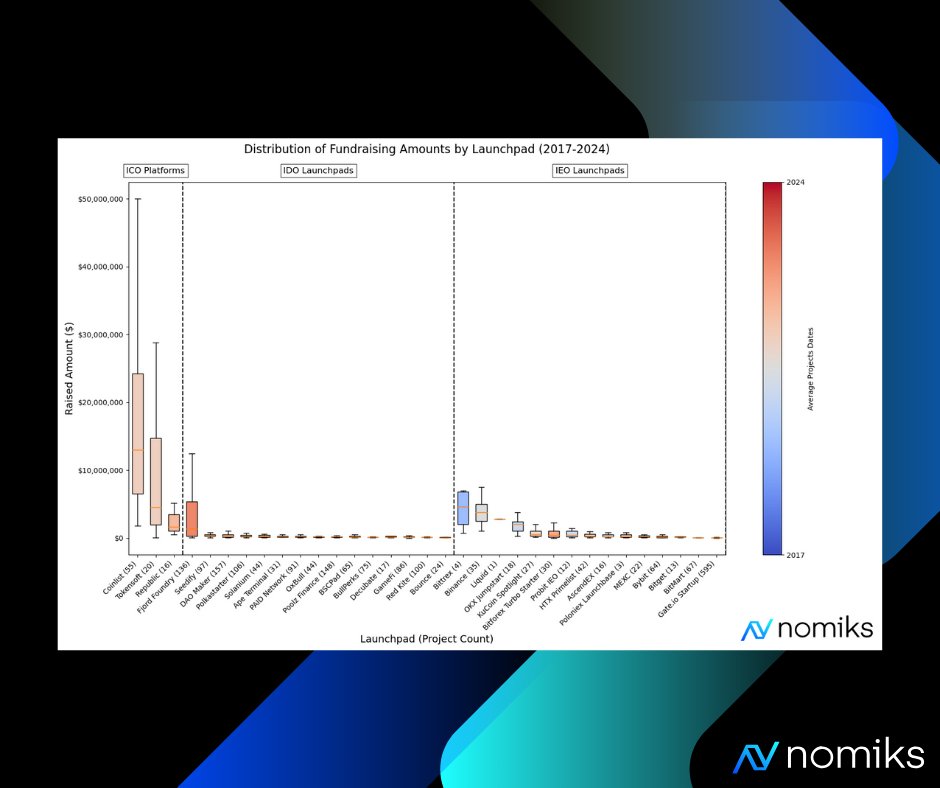
5/ In conclusion, the amount that can be raised through an IEO varies greatly depending on the launchpad you choose. It can range from a few thousand euros to several million. While nothing prevents you from choosing multiple launchpads, you should consider which type of project launch—IEO, ICO, or IDO—will allow you to raise the most funds before selecting the launchpads.
By analyzing and comparing the success rates and funds raised across different launchpads, you can make a more informed decision about the best path for your project.
How can you structure your funding thanks to Nomiks Builder?
With the Nomiks Builder, you can structure your funding with or without assistance.
WITH ASSISTANCE
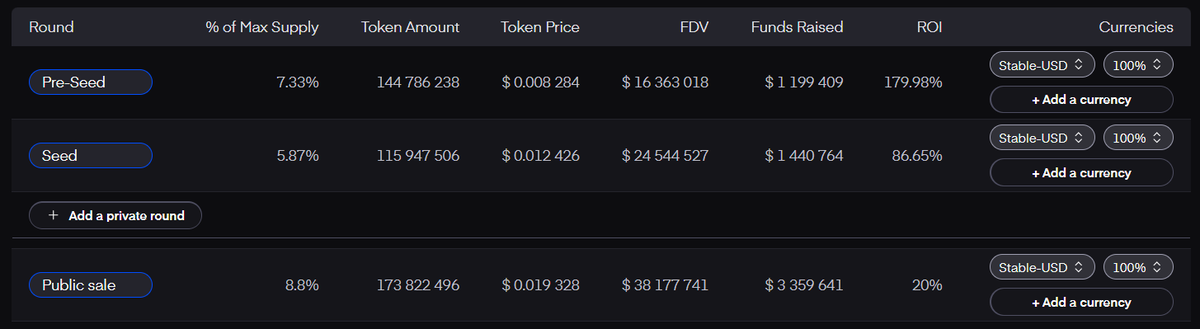
First, specify your fundraising targets. This means initially setting up your total fundraising target, including the pre-seed fundraising target, which is the amount of capital you aim to raise during the initial funding phase (before developing your product or service).
Next, indicate the percentage of the public sale. It is the percentage of tokens that will be sold to the public during the fundraising.
The listing price tolerance indicates whether the participants' tolerance to funding is low, medium, or high. If the tolerance is low and the token price is very high at the TGE (Token Generation Event), participants will be highly encouraged to sell immediately to realize a profit.
The total funding allocation percentage you provided in the previous step will help determine the number of tokens allocated for funding.
You will obtain the total Fully Diluted Valuation (FDV) at the time of the TGE as well as the listing price.
All this data will allow you to obtain the following details for each fundraising round. You can add as many rounds as you want.
The details obtained for each round are as follows:
The percentage of the max supply sold
- The amount of tokens allocated
- The token price
- The Fully Diluted Valuation
- The funds raised
- The ROI relative to the TGE
Bonus: for each round, you can indicate the different tokens (Stable-USD, BTC, ETH, EGLD, BNB, MATIC) used to raise money, and specify the percentage raised with each token.
WITHOUT ASSISTANCE
In the unassisted section, the only element already pre-filled is the total funding allocation. To structure your funding, you need to distribute it across the various fundraising rounds of your project. You must also specify the token price for each round and the listing price.
From this data, you will obtain the number of tokens for each round, along with the FDV and the funds raised. The ROI for each round relative to the listing price will also be provided.
As with the assisted mode, you can specify in which cryptocurrency the funds were raised.
From this information, you will receive advice on the listing price and the FDV.
You will also have access to the total tokens allocated for fundraising, as well as the total funds raised and the FDV at the time of the TGE.