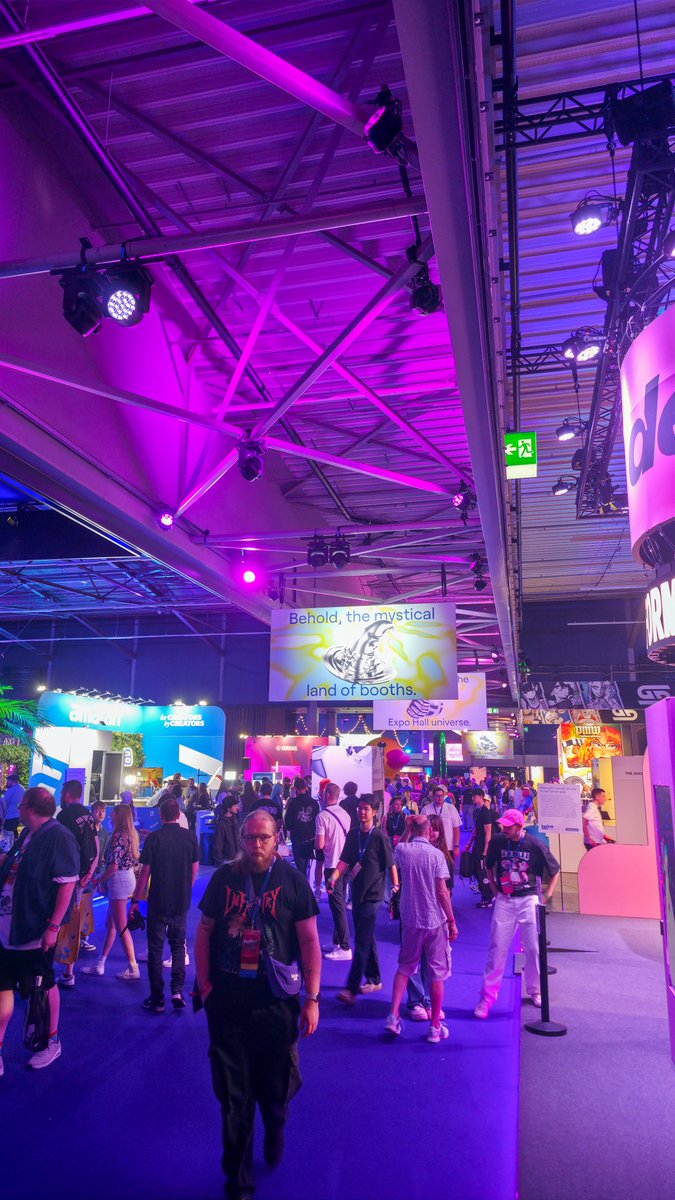
Flew out to TwitchCon
The timing worked out well this year: right before the event, Twitch released a batch of infrastructure updates: expanded monetization for smaller channels, the ability for streamers to create badges for their communities, more interactivity around Bits, new Hype Trains, significant improvements to mobile IRL tooling, and the announcement of an anti-viewbotting system.
Then, during the opening, they added one more thing on top: 1440p quality from Affiliate level and up, plus a vertical streaming format.
So the conversations on-site were not abstract. There was a lot to discuss: how the platform is changing tools for streamers, what this means for smaller channels, how interactivity is going to evolve, and what the industry should do next with trust in metrics.
Let’s see what comes out of it.
Good to see partners, friends and colleagues in person. GL everyone
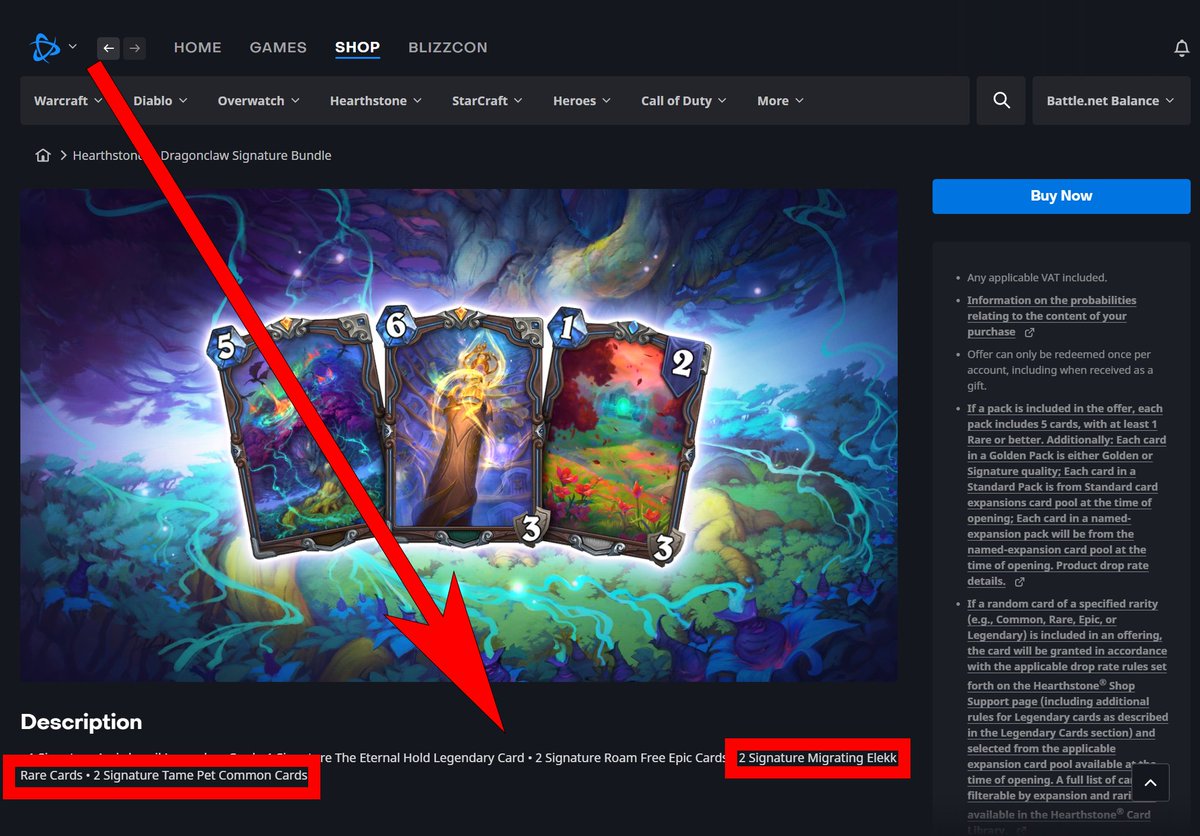
Is this an accidental spoiler for future bundles, or just a scam?
Just after last update I bought the bundle based on its https://t.co/GBkBavxsUr client description specifically for the two Pet Hunter cards, since they won’t rotate out with the next rotation in six months. They took my money and gave me every card except those two. Very disappointing.
My @Team__Spirit teammates recorded an interview with me. It is a short conversation about
the club’s journey, the years behind it, the decisions that shaped it, and everything that
usually stays behind the scenes
Leaving it here for those who want to look a little deeper into this story
Thank you for your response. I hope the discussion will be productive.
I understand that managing time is difficult with so many game modes and such a demanding update schedule. Best of luck, and I’ll be very glad if you’re able to find the right balance between releasing new content and polishing what is already there🤝
Guys, it's really cool that you added the new Faire. I genuinely respect your artists and regularly support their work by buying it.
However, the fact that, two weeks after breaking the Standard meta, you came back with a change to just one card - which you simply reverted to its original form - is very disappointing.
I'm going to take a break for a couple of months. Hopefully, I'll return once you've addressed the current issues, from Rogue to Shaman.
Today, Discord reminded me that I've been subscribed for six years and gave me a badge to mark it.
It's funny because Discord first came into my life through work. In 2017, I worked on promoting it through streamers. Back then, it was a niche gaming messenger, and the integration looked a little strange by today's standards: a banner on the channel, the streamer's own server, and an agreement that they would drop in from time to time.
No one really needed an explanation of what Discord was. What wasn't obvious was why a viewer should go to yet another server after the stream, and why the streamer should keep showing up there. Another messenger, another chat, another place that somehow had to be kept alive.
In the end, for many people, that became the place where everything between streams happened. Then work, teams, bots, process automation, and entire communities moved there too.
I can't remember when Discord stopped feeling like "one more place". But the badge is a reminder that it happened quite a while ago.
Over the past few days, news has been making the rounds that Twitch added a "Clip it" feature. But this is not the full Auto Clips system yet. In my opinion, it is actually the weakest part of it: the streamer has to say the command, Twitch saves the moment and creates a clip for later review.
I have already had a chance to try the test version of the full Auto Clips system, and that version is much more interesting: AI finds potential moments itself by analyzing chat activity, vocal intonation and what is happening on screen, then creates captioned clip drafts and lets the creator approve or reject them.
For now, it looks like Twitch is trying to break into short-form video while TikTok is ramping up its own livestreaming. They announced this Auto Clips module back in October 2025 and launched a partial Alpha test. This May, they shared the first test results and started accepting applications for Beta testing. And just a month ago, they opened Dual Format to everyone. It lets you set up the scene once, after which all future clips are created in both horizontal and vertical formats.
Another potentially interesting feature they promised is automatic marking of the moments associated with these clips as navigation points inside the VOD, with quick jumps between them. As I understand it, this would be roughly similar to the audience attention graph on YouTube videos. That also sounds pretty cool: it could make editors' lives easier or help smaller channels save on editing.
Overall, against the backdrop of so much AI slop, it is nice to see them using AI for something genuinely useful. It will be interesting to see how effective it turns out to be, but so far it looks cool😎
Hearthstone is probably the best background game for work. While going through documents, I hit top 16 in Europe😎
In case anyone needs it, deck code:
AAECAZ3DAwbDgweNnQfGrwflwQeExAfoxQcMyaAElPUFupYHzpsH9a8H9sEHg8IH5MUH5cUH5sUH58UHw+MHAAA=
Decided to write a small backstage breakdown of how we made not just AI NPCs, but a live RPG format for stream.
Last week, SilverName and I were figuring out, setting up and writing prompts for AI NPC mods for Skyrim, adapted specifically for the stream format: first Mantella, then SkyrimNet. Before that, I had already worked with text-based LLM games like AI Dungeon and Pax Historia, which were built from scratch specifically as LLM games, but I had never really dealt with this type of technology as a layer on top of an already existing game. And honestly, it looks even cooler. Instead of just a modpack, it turned into a full real-time LLM director layer with context and TTS around it.
World activation. Thanks to actual writers, the world of Skyrim and the stories of more than 3,000 of its residents are already built extremely well. For the AI, this means a huge data layer as a starting point. The classic SkyrimNet package, like Mantella, gave every character in the world the ability to speak from their own point of view and with knowledge of their own biography. Once the Inworld/ElevenLabs TTS module was added, we could even bring in regional speech patterns and accents, almost like in Tolkien's novels. The best part here is persistent context and memory of the protagonist's actions. If you insult a character, they can remember it and possibly tell others, which will affect how people treat the player. A random tavern incident caused by the player can also become a rumor across the whole city.
Interactivity. The weakest part of most AI mods right now is that, by default, they can mostly hold dialogue, but that dialogue does not really turn into action. Player actions also do not influence dialogue strongly enough. SkyrimServerAction helps solve this. It allows NPCs to interact with the character not only through words. It opens up trading, crafting services and more complex scenarios. If an NPC becomes friendly with the protagonist, they can become a companion, set up a real camp during a shared journey, and in case of a conflict with the player or another NPC, report it to the guards, who can actually arrest the character and send them to jail. It also improves feedback: NPCs can change their attitude and interaction format based on the player's equipment and rumors about them.
Boundaries. The hardest and most time-consuming part of calibrating this whole ecosystem was definitely the prompts that define what NPCs are allowed to say and do. The goal was to make sure NPCs do not feel like cardboard, speak according to their social status, but still avoid language that is not acceptable on stream. They also need to stay inside the lore of the world they live in and never break the fourth wall. On top of that, we needed a separate prompt layer to preserve the in-game economy, so all characters understand the value of money, do not create it out of nowhere and do not break realism. And, of course, an additional context prompt with local memes and stream identity, adapted to the lore realities of the game world.
Overall, as a direction, this looks very strong and promising. I have seen interest in these modules from AAA, but the fact that modders are moving faster in terms of practical implementation is even more impressive.
Let's see where this goes. But considering the need for real-time AI processing, I expect GaaS games of this type to appear in the future, most likely subscription-based🤝
Congratulations to my teammates from the @TSpirit_Dota2 roster on winning the qualifiers and making it to The International 2026 in Shanghai! Now we wait for the third Aegis to come home 🤝
The routine wasn't thrown off for nothing by a ten-hour tournament.
Congratulations to @SilverNameHS on his comeback to the professional scene and qualifying for the Masters Tour Playoffs!
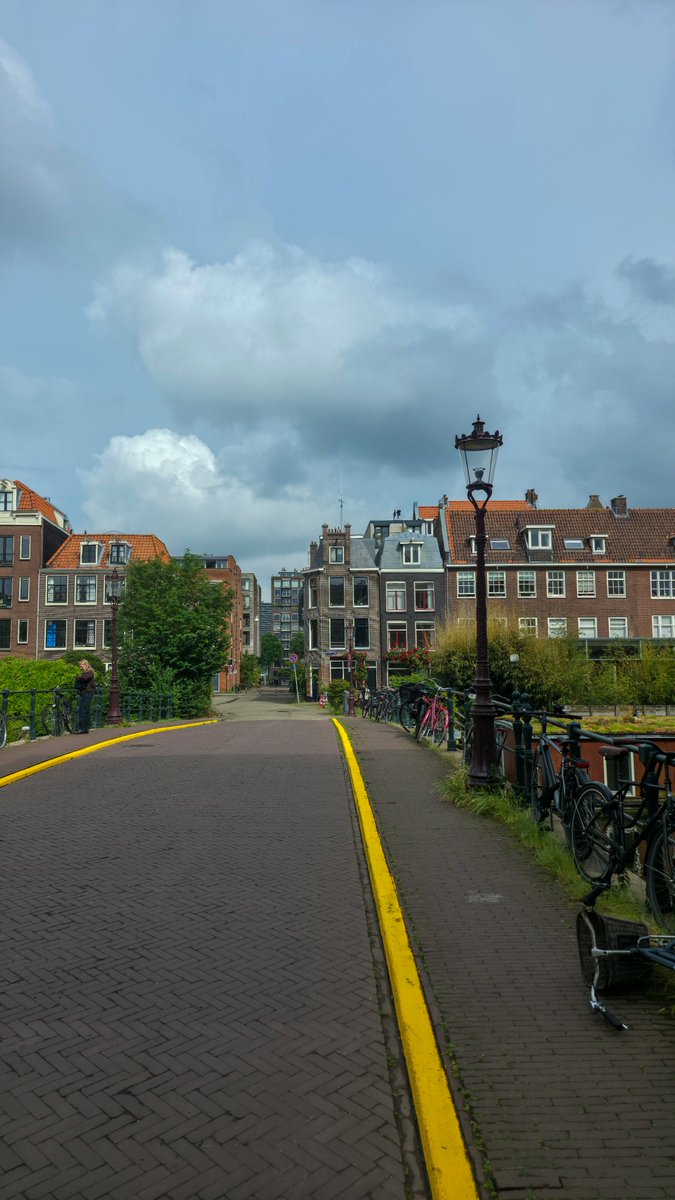
After TwitchCon, I made a short but productive stop in Amsterdam.
Met with partners, went through current business and closed a couple of questions that clearly needed a face-to-face conversation.
I like these kinds of side missions. 40 minutes from Rotterdam, and you are already in a city where the work was waiting and the location itself did not get in the way of thinking.
P.S. I mostly travel for work, not tourism. Still, Amsterdam is definitely in my personal top 10.
Stumbled across a nice milestone today: 10 years subscribed to SilverName on Twitch
It instantly made me think about how much we’ve done together over that time🤝
A pretty solid stretch, when you stop and think about it
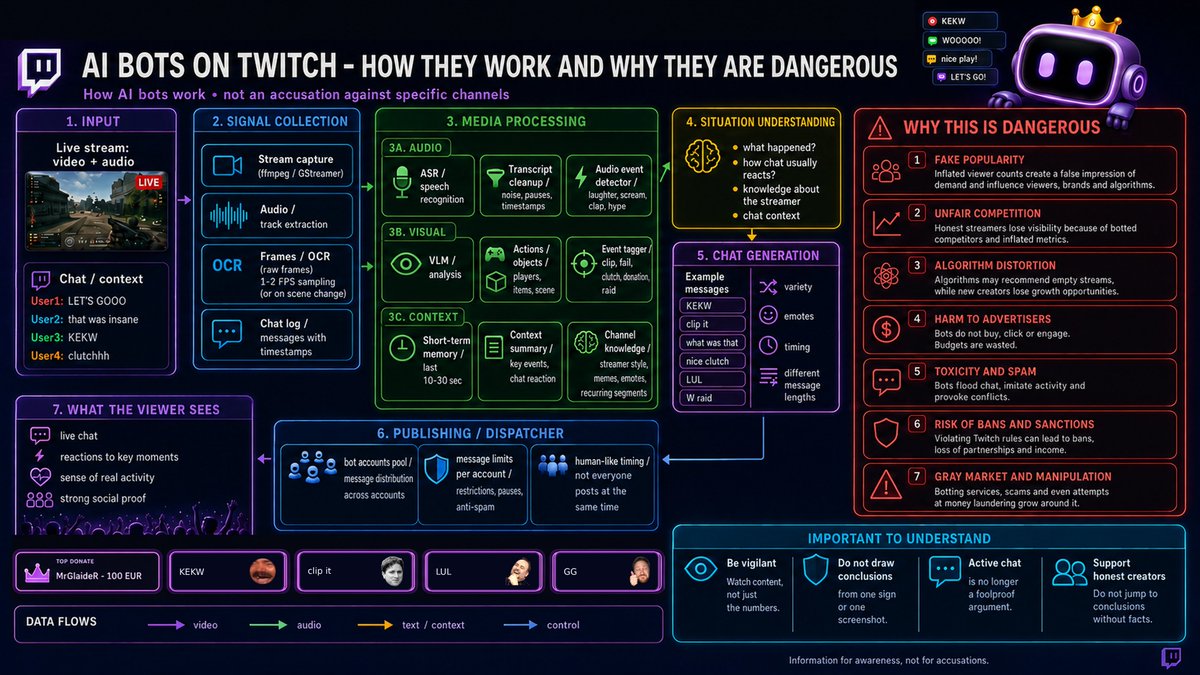
Viewbotting is going through an unpleasant evolution. In the past, it was often easy to spot: high CCV, dead chat. A channel looked like it had 10k viewers, but felt like 300. No reaction to fails, clutches, raids, donations or highlights.
AI chatbots are already changing that mechanic. They do not just "sit" in the viewer count. They can create the background noise of a live Twitch chat: "KEKW" after a fail, "W" after a clutch, "clip it" after a highlight, "KEKW" after a funny moment, "W raid" after a raid. For Twitch, that is often enough. Chat does not have to be deep to feel alive. It just has to match the moment.
A viewer does not enter an analytics dashboard. They enter a scene: viewer count, chat, emotes, pace, jokes. If all of that feels alive, the channel earns trust before the viewer even understands what is happening on stream.
The key is not to fall into paranoia. Weird chat, sudden growth or silent viewers are not proof of viewbotting. But "the chat is alive" is no longer a bulletproof argument either.
A live channel is not proven by one "W" in chat. You see it in returning viewers, organic clips, local memes, real conversations, activity outside Twitch and the fact that the community keeps existing after the stream ends.
Twitch is introducing a CCV cap for channels it identifies as persistently viewbotting. The cap is supposed to be based on historical non-viewbotted traffic.
That is a good move. And after the Streams Charts and Audiencly report on the scale of viewbotting, it is hard to argue that the platform did not need a stronger response.
But the situation is not that clean.
More than a year ago, Twitch introduced Shared Viewership for collaborations. It combines viewer counts across participating channels and lets that combined number affect discovery, including sorting by viewership.
For real collaborations, the idea makes sense.
But it also opens a very obvious problem: four channels with a combined 10,000 viewers can take four places in the top with that number displayed on each. If one of those channels has bots, those bots become part of the shared count.
So one new enforcement mechanism reduces artificial online numbers, while another platform mechanic can multiply them across discovery.
That matters because Twitch is not just a video player. Its real power is attention distribution. The viewer count affects visibility, commercial value, audience decisions and the chance for new creators to move up through strong content.
There is also the advertising side.
In August 2025, Twitch said invalid ad traffic detection is separate from active viewership calculations. Advertisers should not pay for bot impressions, and creators should not be paid for them.
So either Twitch has a working detection system but is not applying it broadly to visible CCV, or advertisers are not as protected from bot traffic as the public position suggests.
Neither version sounds good.
The cap is a correct step. The execution will matter more than the announcement.
Belgrade now has a new level for the phrase “let’s discuss it over coffee.”
A friend invited me to the opening of Belgrade 360 Deck. In the end, everything was as usual: coffee, business, conversations. Just on the 41st floor, with a pretty solid view 😎