Real gambling duty, May to July:
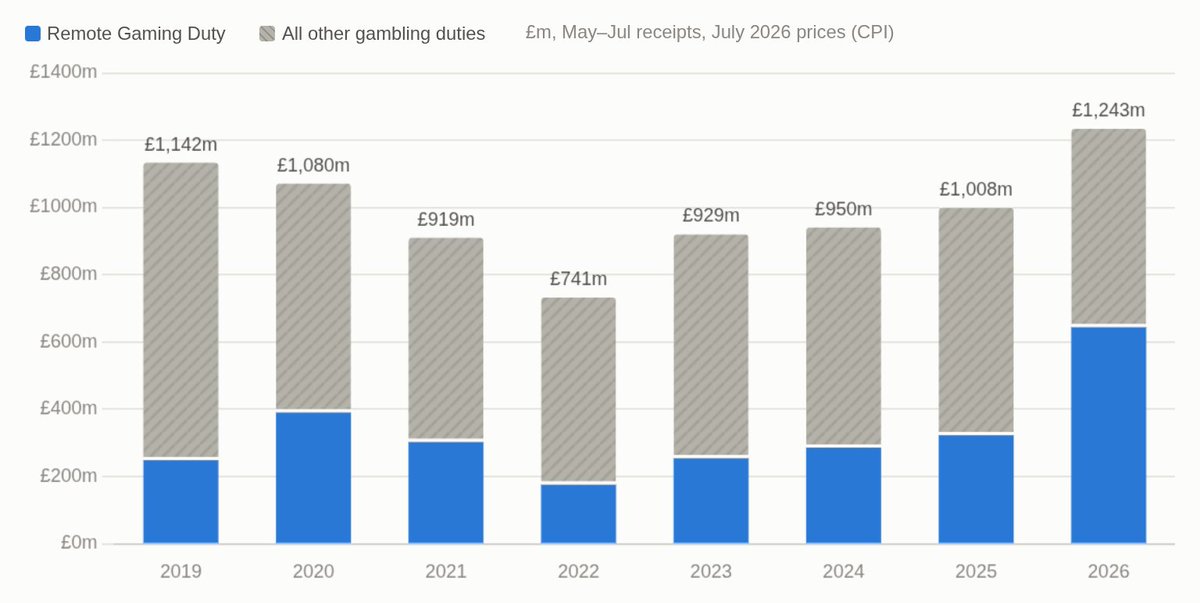
2017: £1,249m
2026: £1,243m
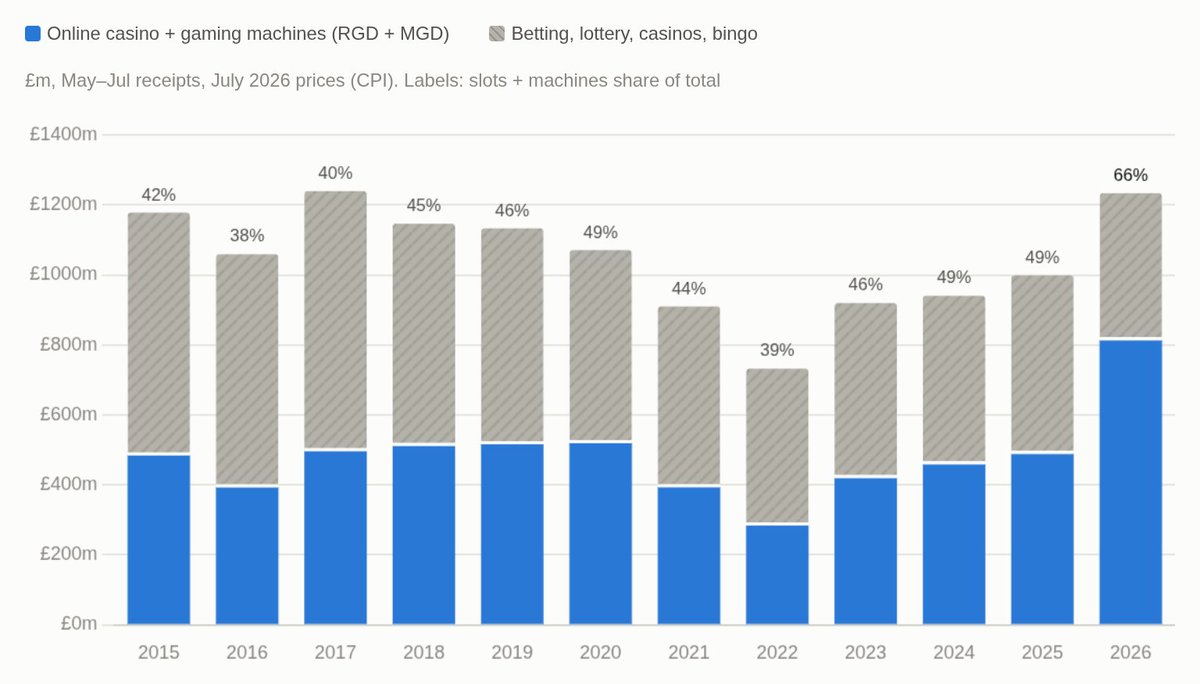
A decade of 'reform' and tax rises has raised no extra money. It has made the Treasury depend on slots: online casino + machines went from 40% of the take to 66%. Betting, lottery & land casinos fell 43% 📉
May-July 2026, first quarter at the new 40% rate:
💻 Online casino: £653m (53% all gambling tax)
🏇Everything else: £590m
The paradox of harm 👇
In the 2025 Budget Rachel Reeves told the Commons that remote gambling carries the highest levels of harm and should therefore bear the heaviest tax. The government said online slots and casino games are generally considered more harmful than other forms of gambling. Racing was carved out of the 25% online betting rate because of its unique circumstances, and the BHA welcomed the decision as protecting revenue and the 85,000 jobs the sport supports. The reformers' aim was to curb online casino and protect racing and the high street. The first figures show the tax changes doing the opposite.
The Treasury now depends on online casino.
Slots and casino went from 23% of the May to July gambling tax take in 2019 to 53% in 2026. Every other duty has shrunk in real terms. In July 2026 prices, all other gambling duties raised £884m in May to July 2019 and £590m in 2026, a fall of a third. Betting duty fell from £251m to £174m, lottery duty from £295m to £221m, and Machine Games Duty from £267m to £169m. A government that set out to curb online casino now needs its revenue more than any other gambling tax.
Online casino has not been curbed. Taking RGD receipts back to gaming yield, online casino still grew 6% to 15% year on year in the first quarter at 40%, with the cleanest measure (the July payment) up 9.4%. Growth slowed from 11% to 20% before the change, but players kept playing. In the same quarter machine yield was flat, betting yield fell 3%, and National Lottery stakes fell 12.5%. The product the tax targeted held up best, and the products it was meant to spare weakened.
The cost falls on the heaviest players. The government expected operators to pass up to 90% of the increase on to customers, through higher prices or lower payouts. On a slot, a lower payout means the player loses faster per pound staked. Players who keep playing at the same intensity, which tends to be the heaviest ones, absorb the extra cost, and some cut back on betting and the lottery to keep playing. A tax meant to reduce harm takes more from the people it was meant to protect.
Racing was protected on paper, but it is losing in practice. Its tax rate did not change, but the shops that take racing bets are closing because of the rise on online gaming:
William Hill's owner Evoke has confirmed around 270 shop closures, after pre-tax losses more than doubled to £549.1m, largely due to UK tax rises.
Betfred is closing 132 shops with about 600 jobs, leaving 1,094, down from a peak of 1,680 in 2017.
Flutter is looking to close up to 100 Paddy Power shops across the UK and Ireland.
Entain is closing Ladbrokes shops in Ireland, which it says is cost-cutting rather than tax, and ended Coral's 52-year Cheltenham Festival sponsorship citing higher taxes.
Each closure takes money out of racing. On average each Betfred shop pays racing nearly £31,000 in media rights and levy, so Betfred's 132 closures alone remove about £4m from the sport. Betting shops fell 3.6% to 5,617, the 12th consecutive reporting period of decline. Exempting racing bets from a tax rise is no help to racing if the counters taking those bets close.
Arcades are taking the shops' place. Adult gaming centre GGY rose 11.3% to £761.4m, while retail betting fell 3.3% to £2.42bn. An arcade slot is taxed at 20%, half the 40% rate on the same game online. Betfred, one of the biggest racing bookmakers on the high street, is exploring a move into adult gaming centres. The result is the betting counter closing and the machines reopening in an arcade.
The next proposal would speed this up. In June the Social Market Foundation proposed raising Machine Games Duty on Category B slot machines to 40%. In August Gordon Brown backed an MGD rise, saying it could raise up to £500m. The Times has reported that the Chancellor is considering doubling MGD in the 28 October Budget. Entain has told the Prime Minister that a BGC-commissioned study puts the cost at 1,470 shop closures and 15,900 jobs.
Machines made up 48.2% of non-remote betting GGY, and that income pays for the counter, the screens and the racing coverage. An arcade is machines only, so it can reprice and stay open. A betting shop whose machine margin is cut loses the income that keeps its counter running. A higher MGD, justified on machine harm, would close more racing counters and leave the machines in arcades.
Online sports betting faces the next rise. Remote betting GGY fell 6.6% to £2.45bn in 2025-26, even though online betting turnover rose about 4.5%. From April 2027 remote sports betting moves from 15% to 25%. Racing stays at 15%, but it shares apps, accounts and marketing budgets with football betting, which will be under more pressure.
The scorecard so far:
Aim: curb online casino.
Result: online casino yield still growing, and now 53% of the gambling tax take.
Aim: protect racing.
Result: hundreds of racing counters in betting shops closing and Coral's Cheltenham sponsorship gone.
Aim: protect the high street.
Result: betting shops closing while arcades grow, with Betfred looking at becoming an arcade operator.
Aim: reduce harm.
Result: the heaviest players pay the higher price, and spend shifts towards machines and slots.
It is early days, and most of the adjustment has not happened yet. Operators are still repricing games, cutting bonuses and marketing, and deciding which products, brands and shops to keep at the new rates. Players respond with a lag, and some will move to unlicensed sites that pay no UK duty at all. If the slots base erodes as these changes take effect, receipts from every gambling duty could fall together, leaving the Treasury dependent on one product with a shrinking base.
From 2027 the rates will be:
Online slots and casino 40%
Online sports betting 25%
Racing and betting shops 15%
Gaming machines, including arcades, 20% (40% on Category B under the SMF proposal)
That rate structure produces more arcades and more online slots, and fewer betting shops and less betting on sport and racing. Reformers wanted the opposite. The products the policy was meant to restrain are the ones growing, the ones it was meant to protect are shrinking, and the Treasury now needs the revenue from the first group.
What to watch next: the October 2026 RGD payment will show whether the slots base holds once operators and players have adjusted further. The 28 October Budget will show whether machines get the same treatment. Racing should watch levy and media rights income as shop closures go through. Neither HMRC nor the Gambling Commission can show whether the same players are moving money from betting and the lottery into slots and arcades, which is the question that matters most for harm.
Sources: HMRC UK Betting and Gaming Statistics, July 2026 tables (receipts May to July each year); ONS CPI (D7BT) for real terms; Gambling Commission Industry Statistics April 2025 to March 2026; HM Treasury Budget 2025 gambling duty measures; SMF MGD proposal (June 2026); Gordon Brown, BBC Today (August 2026); company announcements from Evoke, Betfred, Flutter and Entain as reported by Sky News, Bloomberg and trade press. Implied yields are duty receipts divided by the duty rate.
Ronnie O’Sullivan:
“I think Wu Yize is going be the number one in the world in three years. He’ll be world champion very quickly.
He’s more like the old Steve Davis and has bigger potential.
I worked with him for 2-3 days. This boy is very special. He’s only 22.”