Tool lists don't make you rich — they make you busy.
Not everyone using Codex and Claude side by side is wealthy.
The moat was never the stack.
It's the customer you built something for while everyone else was still 'masterin
https://t.co/rHn3WSPTxp
Everything you need to master in 2026 to get rich:
• Using Fable 5 for planning, Codex for execution
• Hermes agent
• Coding loops
• Running Codex/Claude Code side by side
• /goal
• Running local models
• Karpathy's Autoresearch
• Building an X audience
• Creating videos
• How machine learning works
• How databases work (been using Convex)
• Using API's
• Training your own LoRAs
• Elimination of doom scrolling
• Most importantly: focus
The $20-$40 number is US-only though.
Run the same price in India, Brazil, or SEA and your conversion craters. Regional pricing isn't a nice-to-have, it's the difference between a dead funnel and a live one outside the US.
https://t.co/vEkL9HgdzS
You don’t always need to over-optimize conversion.
Sometimes the easiest lever is just increasing your subscription price.
From my tests, US users are willing to pay $20–$40+/month and around $99/year for AI apps if the value is clear.
Low pricing isn’t always “better conversion.”
Sometimes a higher price + a better product makes your app look more premium in the user’s eyes.
And that can increase perceived value too.
Don’t underprice yourself too early.
Life changing until you want that artifact to live somewhere real. The open question with artifacts isn't the feature — it's whether they become durable reusable mini-apps or just another walled garden you can't export to your
https://t.co/AGnyOzuUF6
@gregisenberg The encouragement is real but the system fights it.
America emotionally welcomes the weird founder while the visa process quietly deports them.
The culture and the paperwork are misaligned you felt that gap yourself for years before last year.
Happy Birthday America 😊
@alex_barashkov Genuine question — where does a self-built Toolcraft app actually beat Figma?
I can see it for batch generative variations and on-brand asset pipelines.
But multiplayer, versioning, and client handoff are Figma's real moat. What's the workflow where DIY wins outright?
Calling it "included" while it burns usage 2x faster is a stretch. You're not paying in dollars yet, you're paying in rate limits. That's still a real cost, just harder to see on the invoice. The free window for Fable 5 is a hook, not a gift.
You don't need a better prompt.
You need a system.
→ One rough idea.
→ 10 minutes.
→ 3 platform-ready pieces.
Thursday, I'm showing exactly how.
Obsidian + Claude Code.
No coding. No complex setups.
Sign up here → https://t.co/QdzkCWTdvN
The new entry-level UX skill isn't Figma.
It's shipping.
- AI writes the microcopy.
- Generates the flow.
- Builds the component library.
So what's left for you?
Knowing what to build.
Why to build it.
And how to get it out the door.
That's the job now.
Applying to multiple jobs and not hearing back could simply means one thing - using the same resume for every job you apply to.
That's an auto-filter for the ATS system.
You can easily upload your resume on ChatGPT, paste the job description and ask it to rewrite your resume to match the job.
That's a lot of work for someone planning to apply to 50 roles.
I built https://t.co/meadFVFqIP to fix this pain.
I'm fully committed to designing and building products with AI, all in 2026 and beyond.
This is exactly what I love doing, and I aim to excel at it.
The goal is to launch and build in public.
1 product every month.
January - https://t.co/meadFVFqIP
February - ???
Let's go 🚀
I launched a product yesterday, incase you missed it.
It's called Useresumate. It helps job seekers get past ATS filters.
Let me tell you why I built it.
A friend of mine applied to 50 jobs last year.
He's a senior product designer with 10 years of experience. Great portfolio. Strong references.
He got 3 callbacks.
Not because he wasn't qualified. Because his resume never reached a human.
Over 90% of large companies use Applicant Tracking Systems.
These are algorithms that scan your resume before any recruiter sees it.
Wrong keywords? Filtered out.
Wrong format? Filtered out.
Missing a specific phrase from the job description?
Filtered out.
You could be the perfect candidate.
But if your resume doesn't speak ATS language, you're invisible.
I've spent over 13 years in product design. I currently work at Amazon, worked at https://t.co/8E0yYmeEyT in The Netherlands, and Etisalat (Lagos-Nigeria).
I've seen how systems create invisible barriers. How small friction points eliminate good people.
The job application process has a massive friction point. And most candidates don't even know it exists.
So I built a tool that fixes it.
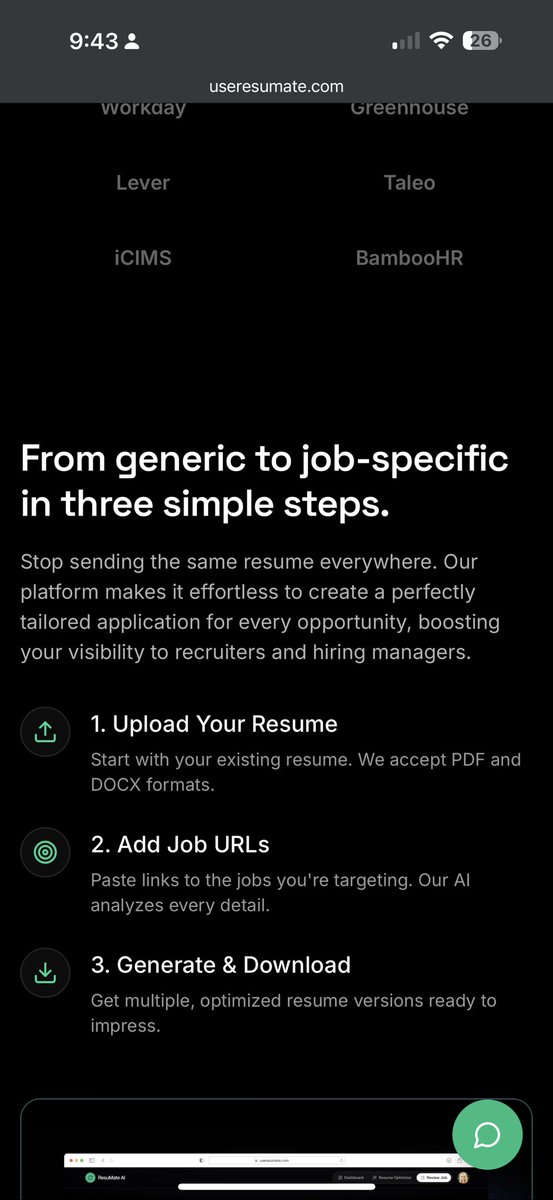
→ Upload your resume.
→ Paste a job descripton.
→ Get an optimized version that matches what the ATS is looking for.
Not keyword stuffing.
Actual rewriting that sounds like you, but speaks the language these systems want to hear.
It's free to try. 3 optimizations per month. No credit card required.
Try it here: https://t.co/VbCNIR7KrH
I'm building this in public.
I'll share what I learn about the job market, what's working, what's not, and how AI is changing how we apply for jobs.
If you know someone stuck in the application black hole, send them this email. It might save them months of frustration.
I launched a product yesterday, incase you missed it.
It's called Useresumate. It helps job seekers get past ATS filters.
Let me tell you why I built it.
A friend of mine applied to 50 jobs last year.
He's a senior product designer with 10 years of experience. Great portfolio. Strong references.
He got 3 callbacks.
Not because he wasn't qualified. Because his resume never reached a human.
Over 90% of large companies use Applicant Tracking Systems.
These are algorithms that scan your resume before any recruiter sees it.
Wrong keywords? Filtered out.
Wrong format? Filtered out.
Missing a specific phrase from the job description?
Filtered out.
You could be the perfect candidate.
But if your resume doesn't speak ATS language, you're invisible.
I've spent over 13 years in product design. I currently work at Amazon, worked at https://t.co/8E0yYmeEyT in The Netherlands, and Etisalat (Lagos-Nigeria).
I've seen how systems create invisible barriers. How small friction points eliminate good people.
The job application process has a massive friction point. And most candidates don't even know it exists.
So I built a tool that fixes it.
→ Upload your resume.
→ Paste a job descripton.
→ Get an optimized version that matches what the ATS is looking for.
Not keyword stuffing.
Actual rewriting that sounds like you, but speaks the language these systems want to hear.
It's free to try. 3 optimizations per month. No credit card required.
Try it here: https://t.co/VbCNIR7KrH
I'm building this in public.
I'll share what I learn about the job market, what's working, what's not, and how AI is changing how we apply for jobs.
If you know someone stuck in the application black hole, send them this email. It might save them months of frustration.