Never forget how India’s so called 'liberal ecosystem' defended Tahir Hussain.
When Intelligence Bureau officer Ankit Sharma was murdered during the Delhi riots in 2020 and his body was recovered from a drain, the ecosystem did not stand with Ankit’s family.
It rushed to manufacture victimhood for the accused.
The likes of Rana Ayyub declared that Tahir had been arrested merely “because he’s a Hussain.” Others portrayed him as an innocent Muslim being framed by a vindictive Hindu-majoritarian state. Every uncomfortable fact was dismissed as propaganda. Every demand for justice was labelled communal.
Today, a Delhi court - not the BJP, not television anchors, not “WhatsApp University” - has convicted former AAP councillor Tahir Hussain of murder, kidnapping, promoting enmity and rioting in the killing of Ankit Sharma.
The mask has fallen.
For this ecosystem, the presumption of innocence is sacred when the accused suits its politics. But a murdered Hindu becomes an inconvenient footnote, his family’s grief erased because acknowledging his killers would destroy their preferred narrative of the Delhi riots.
They did not merely get the story wrong.
They attempted to reverse the roles of victim and perpetrator to turn a convicted murderer into a symbol of persecution and bury Ankit Sharma twice: once in a drain, and again beneath their propaganda.
Never forget the crime.
And never forget those who defended the criminal.
Two Tomahawk missiles, reportedly fired from George Soros's Bedford residence in New York, in a bid to sabotage Shri Nitin Gadkari's infrastructure work, hit the Delhi-Dehradun Expressway this morning. Thankfully, no lives were lost.
When I visited India a few years ago, I got my blood work done at 7am by a Healthcare worker who visited me, got the reports by 9am, doctor's appointment at 10am, followup multiple scans at 2pm, scan results came back at 3pm, followup doctor's phone appointment at 4pm, and medication delivered at 5pm at my doorstep.
All this costed me 3000 rupees (~$30)
PM Narendra Modi chaired a high-level performance review meeting with the Council of Ministers.
It is widely expected that we will soon have a Cabinet reshuffle.
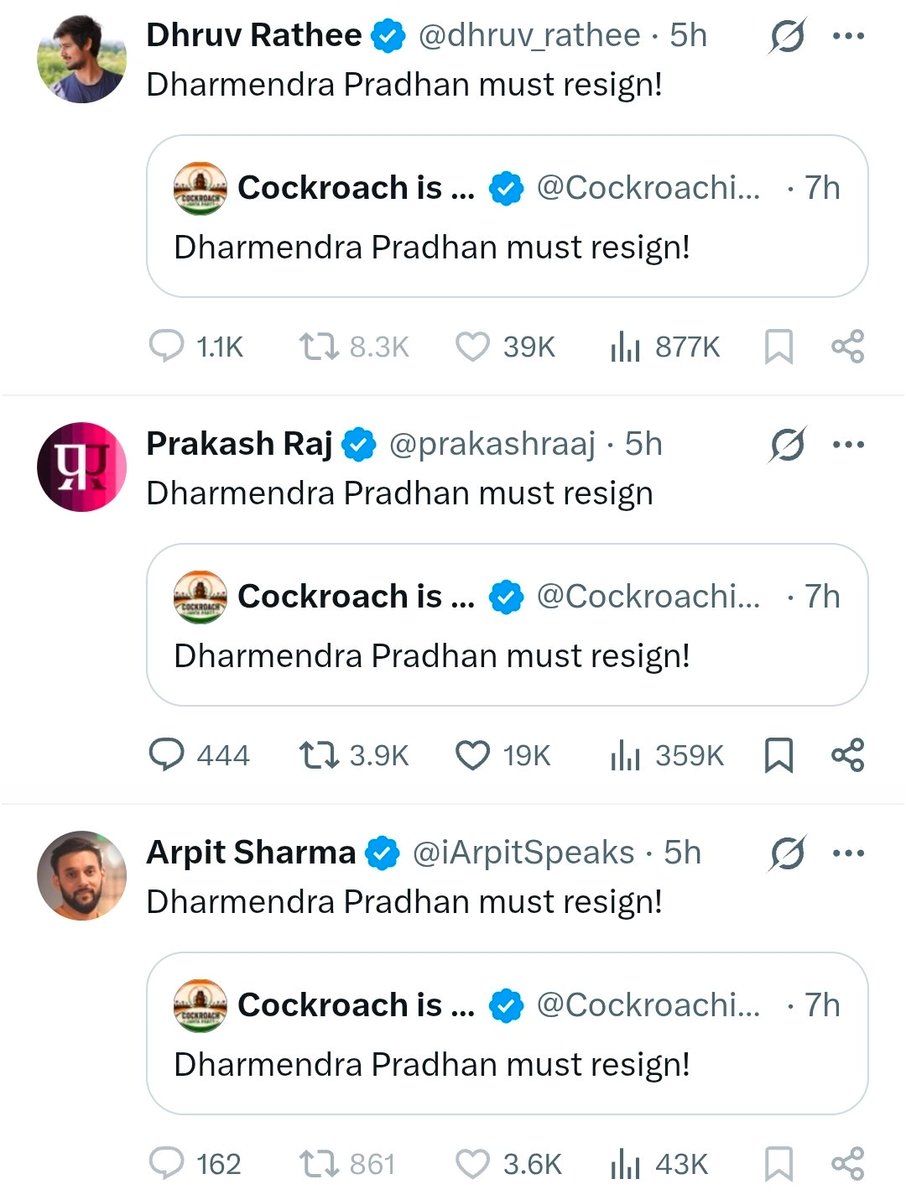
Dharmendra Pradhan's performance has been below par and there are chances that he won't survive the changes.
And the desperate attention hungry cockroaches of Cockroach Janta Party will be the first one to take the credit. Get ready for dialogues like...Jhukti Hai Duniya, Jhukane Wala Chahiye.
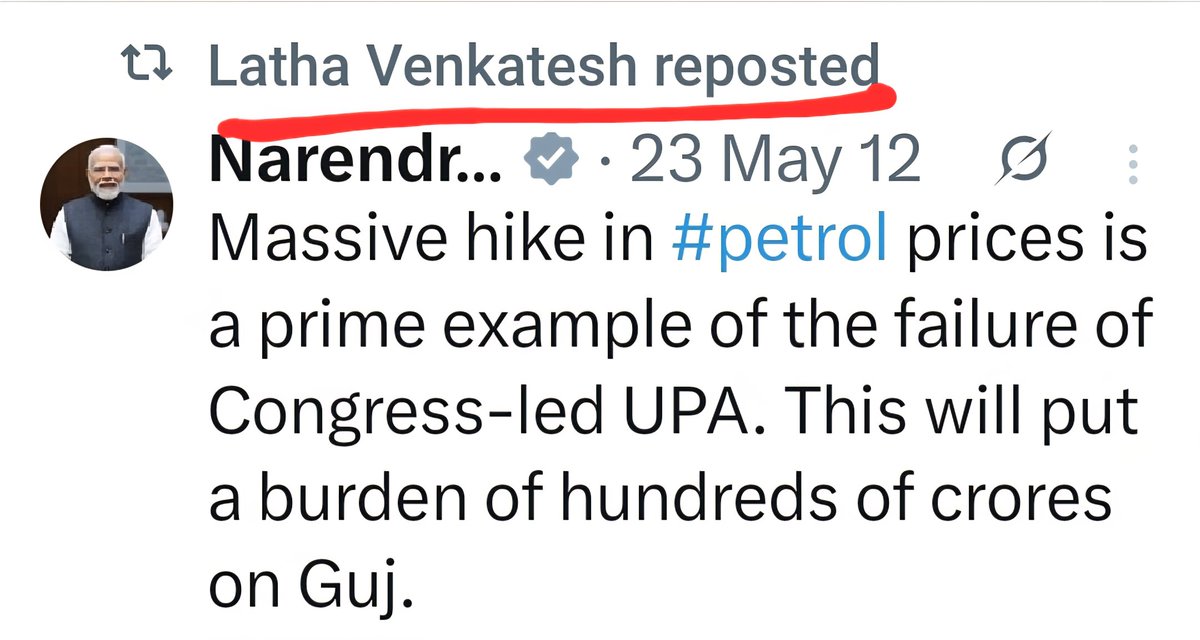
Just couple of hours ago, @latha_venkatesh (over)smartly retweeted a 2012 tweet of then Gujarat CM @narendramodi ji. It appeared on my timeline.
But it seems she removed her retweet after the @CNBCTV18News#FakeNews controversy.
Fortunately, I happened to take a screenshot, to respond a little later.
Latha Venkatesh tried to peddle the narrative that the 2012 fuel hike by the Manmohan Singh led government is comparable to today's price hike.
It is not!!
In 2026, fuel prices have risen because a war between Israel and Iran has shaken global oil markets, pushing crude prices up worldwide.
India, which imports most of its oil, is simply absorbing that external shock.
In 2012, under Manmohan Singh, petrol prices were hiked by ₹7.5+ in one go. Not because of a sudden war, but due to internal fiscal stress and wrong policy decisions.
Big difference.
One is a war-driven global crisis. The other was a domestic policy shock. Don’t confuse compulsion with choice.
When you're making a comparison next time, don't be selective with facts, Latha!!
🇮🇳 Becoming the launchpad for the world! 🌎🚀🛰️
The remarkable surge in foreign satellite launches underscores India's growing prowess in space technology.
Affordable innovation, precision engineering, and cost-effective successful missions are making India a preferred destination for satellite launches globally.
There’s a reason I say these bastards hate the nation’s development itself. They hide behind propaganda, twist facts, and demean every bit of progress just to push their agenda and drag the nation down.
Indonesia High-Speed Rail (Jakarta–Bandung)
Network Length: 142.3 km
Project discussions started: 2008
Construction started: 2015
Opened: 2023
Time taken: ~8 years
Construction pace: ~17.7 km/year
Project Cost: ~₹60,000 crore (~US$7.3B)
Cost per km: ~₹420 crore/km
Execution: Built by China
India High-Speed Rail (Mumbai–Ahmedabad)
Network Length: 508 km
Project studies / planning started: 2013
Construction started: 2021 (full-scale civil works)
Expected completion: 2029 (current broad target)
Time taken: ~8 years
Construction pace: ~63.5 km/year
Project Cost: ~₹1.98 lakh crore
Cost per km: ~₹390 crore/km
Construction entirely by India
True Indians knows that India is doing a much better job but tum jaise deshdrohiyon ka ghar nahi chalega India ko nicha dikhaye bina :)
Paperwork for 142km Indonesia started in 2008, construction began in 2015, opened in 2023, took 8yrs to construct just 140kms of HSR that too China was constructing it jiska tu roz muh me leta rehta.
Meanwhile Indian HSR is 508km long, construciton began in 2021, expected to complete in 2029 i.e. 8yrs, much faster than Indonesia.
You'll praise Indonesia for a job that was done slower than India but not India because it is haram for you Bangladeshi pille.
The second Joint Commanders’ Conference #JCC2026 themed as ‘Military Capability in New Domains’ will be held at @SWComd_IA , Jaipur on 07–08 May 2026, bringing together the top leadership of the #IndianArmedForces and #MoD.
Coinciding with the first anniversary of #OpSindoor, the conference will focus on future warfare, emerging domains like cyber, space & cognitive warfare, while advancing #Atmanirbharta through innovation, indigenisation and civil-military fusion.
Hon’ble Raksha Mantri will attend this landmark conference.
@DefenceMinIndia@SethSanjayMP@SpokespersonMoD@rajnathsingh
🔴 𝐑𝐞𝐦𝐞𝐦𝐛𝐞𝐫𝐢𝐧𝐠 𝐭𝐡𝐞 𝐝𝐚𝐫𝐤 𝐞𝐩𝐢𝐬𝐨𝐝𝐞 𝐰𝐡𝐞𝐧 𝐂𝐨𝐧𝐠𝐫𝐞𝐬𝐬 𝐩𝐮𝐭 𝐚 𝐩𝐫𝐢𝐜𝐞 𝐭𝐚𝐠 𝐨𝐧 𝐲𝐨𝐮𝐫 𝐥𝐢𝐟𝐞. 🫵🏻
On this day in 2010, the Congress-led UPA government pushed the Civil Nuclear Liability Bill in the Lok Sabha, triggering outrage, protests, and an Opposition walkout.
▪️ Brought under the India-United States Civil Nuclear Agreement framework
▪️ Liability cap fixed at just ₹500 crore in case of a nuclear disaster
▪️ Widely criticised as undervaluing Indian lives
▪️ Opposition walked out, calling it pro-corporate and anti-people
▪️ Questions raised over pressure from the United States
▪️ Seen as shielding foreign suppliers from real accountability
▪️ Sparked nationwide outrage over safety and sovereignty
This wasn’t a reform by any means — it was compromise.
𝐖𝐡𝐞𝐧 𝐠𝐨𝐯𝐞𝐫𝐧𝐦𝐞𝐧𝐭𝐬 𝐬𝐭𝐚𝐫𝐭 𝐩𝐫𝐨𝐭𝐞𝐜𝐭𝐢𝐧𝐠 𝐜𝐨𝐫𝐩𝐨𝐫𝐚𝐭𝐢𝐨𝐧𝐬 𝐨𝐯𝐞𝐫 𝐜𝐢𝐭𝐢𝐳𝐞𝐧𝐬, 𝐬𝐨𝐯𝐞𝐫𝐞𝐢𝐠𝐧𝐭𝐲 𝐛𝐞𝐜𝐨𝐦𝐞𝐬 𝐧𝐞𝐠𝐨𝐭𝐢𝐚𝐛𝐥𝐞 𝐚𝐧𝐝 𝐬𝐚𝐟𝐞𝐭𝐲 𝐛𝐞𝐜𝐨𝐦𝐞𝐬 𝐬𝐞𝐜𝐨𝐧𝐝𝐚𝐫𝐲.