In 𝘏𝘰𝘸 𝘞𝘦 𝘓𝘦𝘢𝘳𝘯, Stanislas Dehaene—one of the world’s leading cognitive neuroscientists and winner of the Nobel-equivalent Brain Prize—identifies the 4 Biological Pillars of Learning. Without all 4 of these pillars in place, learning is fragile and will not last: 🧵
From the geometric foundations of Pythagoras to the algorithmic brilliance of Turing, mathematics is a continuous relay race of genius.
The "YOU" section is waiting for a breakthrough. If you could solve one unsolved mystery in math, science, or tech, which one are you claiming for your square?
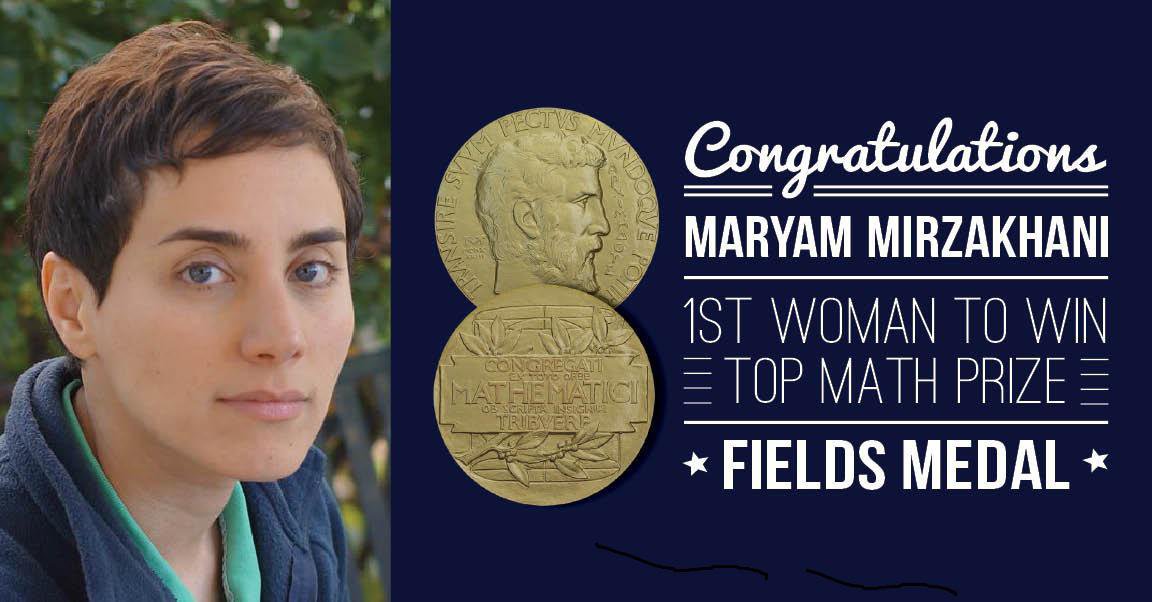
Today, May 12, we celebrate the birthday of Maryam Mirzakhani (1977–2017) - the first woman and first Iranian to win the Fields Medal.
Her groundbreaking work on Riemann surfaces and moduli spaces continues to inspire mathematicians worldwide.
May 12 is now International Women in Mathematics Day.
Television is going to revolutionise education!
[Television changes education a little but it’s hardly a revolution]
Microcomputers are going to revolutionise education!
[Microcomputers change education a little but it’s hardly a revolution]
The internet is going to revolutionise education!
[The internet changes education a little but it’s hardly a revolution]
Multimedia CD-ROMs are going to revolutionise education!
[…]
Gamification is going to revolutionise education!
[Gamification changes education a little but it’s hardly a revolution]
AI is going to revolutionise education!
Chinese scientists have developed,
The best shortest-path algorithm in 41 years!
A team from Tsinghua University has broken Dijkstra's "sorting barrier" - the first improvement since 1984.
Just use for a world-map 🤯
Paper - https://t.co/0AhR5O7vl4
https://t.co/a9KMVRuYGx
It's not an exaggeration — Chinese is just amazing!!! Listen to this poem where almost every word is pronounced "yu" (of course with different tones and meanings), yet it still tells a detailed and vivid story:
🔻🔻🔻🔻🔻
Yu Yu wanted to go fishing. He came to my house and found me. He said to me, "I want to go fishing in the shallows of Yushui. Will you go with me?" I replied, "I plan to sell a piece of jade. Yu Yu wants to buy it, so I have to go to his house." So I went to Yu Yu's house together with Yu Yu to meet him and try to sell the jade. Just then, it started to rain heavily. The rainwater flooded Yu Yu’s house. I said to Yu Yu, "I originally planned to go fishing in the shallows of Yushui — should I fish now, or sell the jade?" While taking shelter from the rain at Yu Yu's house, I sold the jade to him. When the rain stopped, Yu Yu and I slowly left Yu Yu's house and went to the shallows of Yushui to go fishing.
👍👍👍👍👍
I asked 200 tech coaches at the National Tech Coach event to name their One Best Thing in EdTech right now.
The results? Absolute gold 😎
You can use this doc for your next newsletter, PD, or your own learning 💡
https://t.co/8r3feEqTFy
Enjoy and thank you to all who contributed! 😀
#edtech #edchat #teachers #letsfindaway #wayground #quizizz #teachertwitter @waygroundai@ForwardEdgeOH@teacher2teacher
Math.
The Coastline Paradox involves the idea that a coastline's length is difficult to measure precisely because it depends on the scale of measurement. Smaller scales reveal more detailed features, like tiny inlets, increasing the measured length "indefinitely." Thus, a coastline's length is not a fixed value but varies with the measurement's granularity.
By Sketchplanations, @sketchplanator, Source: https://t.co/t8EjNCOHE2, Used with permission.



![abakcus's tweet photo. A very useful math poster about numbers by Keith Enevoldsen. [https://t.co/ujavvfozI6] https://t.co/Bn5NwA3Fd8](https://pbs.twimg.com/media/G9taUb6W0AAO6yb.jpg)





