The late Ed Sandford was born August 20, 1928. He played in 5 consecutive NHL All-Star Games with the Boston #Bruins. In 1952-53 he led all scorers in the playoffs with 8 goals and 11 points. He succeeded the retired Milt Schmidt as Bruins' captain in 1954-55.
"Ted Williams did not come to bat in the seventh.
He was second up in the eighth.
This was almost certainly his last time to come to the plate in Fenway Park, and instead of merely cheering, as we had at his three previous appearances, we stood, all of us;
Stood and applauded.
Have you ever heard applause in a ballpark?
Just applause.
No calling, no whistling, just an ocean of handclaps, minute after minute, burst after burst, crowding and running together in continuous succession like the pushes of surf at the edge of the sand.
It was a sombre and considered tumult.
There was not a boo in it.
It seemed to renew itself out of a shifting set of memories as the kid, the Marine, the veteran of feuds and failures and injuries, the friend of children, and the enduring old pro evolved down the bright tunnel of twenty-one summers toward this moment.
At last, the umpire signalled for Fisher to pitch;
With the other players, he had been frozen in position.
Only Williams had moved during the ovation, switching his bat impatiently, ignoring everything except his cherished task.
Fisher wound up, and the applause sank into a hush.
Understand that we were a crowd of rational people.
We knew that a home run cannot be produced at will;
The right pitch must be perfectly met and luck must ride with the ball.
Three innings before, we had seen a brave effort fail.
The air was soggy;
The season was exhausted.
Nevertheless, there will always lurk, around a corner in a pocket of our knowledge of the odds, an indefensible hope, and this was one of the times, which you now and then find in sports, when a density of expectation hangs in the air and plucks an event out of the future.
Fisher, after his unsettling wait, was wide with the first pitch.
He put the second one over, and Williams swung mightily and missed.
The crowd grunted, seeing that classic swing, so long and smooth and quick, exposed, naked in its failure.
Fisher threw the third time, Williams swung again, and there it was.
The ball climbed on a diagonal line into the vast volume of air over center field.
From my angle behind third base, the ball seemed less an object in flight than the tip of a towering, motionless construct, like the Eiffel Tower or the Tappan Zee Bridge.
It was in the books while it was still in the sky.
Brandt ran back to the deepest corner of the outfield grass;
The ball descended beyond his reach and struck in the crotch where the bullpen met the wall, bounced chunkily, and, as far as I could see, vanished.
Like a feather caught in a vortex, Williams ran around the square of bases at the center of our beseeching screaming.
He ran as he always ran out home runs:
Hurriedly, unsmiling, head down, as if our praise were a storm of rain to get out of.
He didn't tip his cap.
Though we thumped, wept, and chanted "We want Ted" for minutes after he hid in the dugout, he did not come back.
Our noise for some seconds passed beyond excitement into a kind of immense open anguish, a wailing, a cry to be saved.
But immortality is nontransferable.
The papers said that the other players, and even the umpires on the field, begged him to come out and acknowledge us in some way, but he never had and did not now.
Gods do not answer letters."
"Hub Fans Bid Kid Adieu."
John Updike.
October 22, 1960.
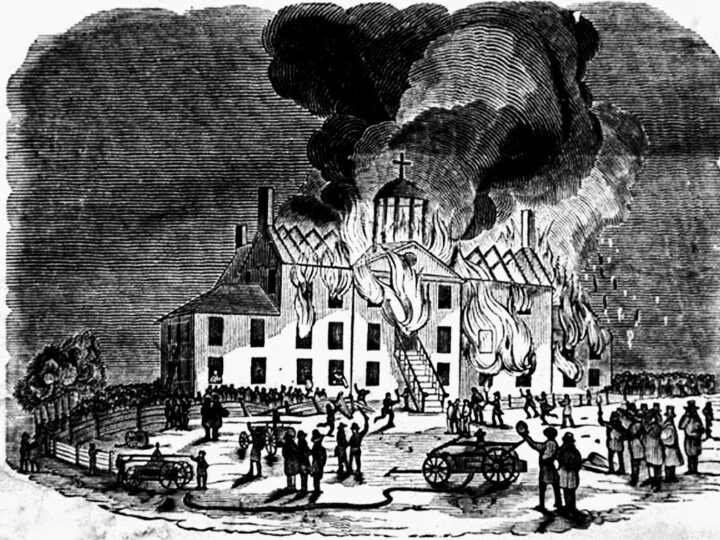
On August 11, 1845, a mob of angry #Bostonians burned to the ground the Ursuline Academy in #CharlestownMA, a boarding school for girls of all denominations. The nativist mob was paranoid about the growing presence of Irish Catholics in the town. It was the early stages of a sustained physical assaults against Irish immigrant communities in greater Boston that lasted for two decades.
https://t.co/WovX16IdwL
In 1945 the USS Indianapolis secretly delivered the parts for the atomic bomb that would hit Hiroshima.
Days later, mission done, a Japanese submarine put two torpedoes into her. She sank in 12 minutes.
Nearly 900 men made it off the ship alive and into the open ocean. Then it got worse.
No one knew they were missing. Three separate Navy stations picked up the distress signals and every one of them ignored it. One officer thought it was a Japanese trap. Another had ordered not to be disturbed.
So the men floated. For almost five days. No food, no fresh water, burning by day and freezing at night. Some drank seawater and went insane. And the whole time, the sharks were circling and feeding. It is considered the worst shark attack in human history.
When rescue finally came by accident, only 316 of the nearly 1,200 crew were still alive.
The Navy needed someone to blame for the disaster. They chose Captain Charles McVay, one of the men who survived it. He became the only U.S. captain in the entire war to be court-martialed for losing his ship to the enemy.
At his trial the Navy did something almost unheard of. They brought in the Japanese commander who sank the ship to testify against him. Instead, the enemy captain told the court that zigzagging would have made no difference and that McVay did nothing wrong.
They convicted him anyway.
For years afterward McVay got hate mail from the families of the dead. Some sent letters every Christmas telling him he murdered their sons. In 1968 he walked onto his front lawn and shot himself, holding a toy sailor he had kept since he was a boy.
Case closed. For fifty years.
Then in 1996 an 11-year-old named Hunter Scott watched Jaws with his dad and got hooked on the 30 second speech about the Indianapolis. He made it his sixth grade history project.
He tracked down and interviewed nearly 150 survivors. He dug through more than 800 documents. And buried in there he found what the Navy had left out, including that they knew enemy subs were operating right on the ship's route and never warned McVay.
A kid's school project turned into a national story. It reached Congress. In 2000 lawmakers passed a resolution clearing McVay's name and President Clinton signed it. The Navy officially cleared his record in 2001.
The captain the Navy spent decades blaming was finally exonerated by a sixth grader.
Hunter Scott grew up and became a naval flight officer.
“Retreat? Hell, We Just Got Here!”
Today, we remember the legacy of Marines who fought at the Battle of Belleau Wood during World War I, helping to cement the Corps' reputation as the world's premier fighting force.
During the intense battle, the 4th Marine Brigade, comprised of the 5th and 6th Marine Regiments, and the 6th Machine Gun Battalion, fought aggressively through the wheat fields and woodlands in France, helping to stop a major German advance toward Paris in 1918. The Battle of Belleau Wood became a major turning point for the Corps, providing Marines with experience in large scale operations.
Legend has it that Marines were later called Teufel Hunden ("Devil Dogs" in German) due to the relentless tenacity while taking enemy positions during the battle. Because of the Marines’ unwavering commitment, the 5th and 6th Marine Regiments were awarded the French Croix de Guerre, an award presented to individuals or units for acts of valor and bravery on the battlefield.
Semper Fidelis.
✍️ (U.S. Marine Corps Graphic by Lance Cpl. Matthew Morales)
📷(U.S. Marine Corps photo by Cpl. Garrett Gillespie)
#USMC #BelleauWood #SemperFi
Executive Mansion, Washington, Nov. 21, 1864.
Dear Madam,--
I have been shown in the files of the War Department a statement of the Adjutant General of Massachusetts that you are the mother of five sons who have died gloriously on the field of battle.
I feel how weak and fruitless must be any word of mine which should attempt to beguile you from the grief of a loss so overwhelming. But I cannot refrain from tendering you the consolation that may be found in the thanks of the Republic they died to save.
I pray that our Heavenly Father may assuage the anguish of your bereavement, and leave you only the cherished memory of the loved and lost, and the solemn pride that must be yours to have laid so costly a sacrifice upon the altar of freedom.
Yours, very sincerely and respectfully,
A. Lincoln
When asked which was the best team he had ever played for, Ted Williams responded without hesitation:
"The United States Marine Corps."
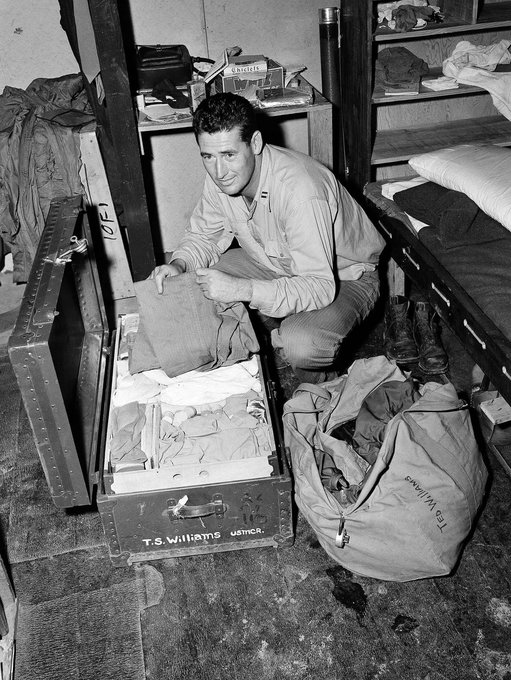
Ted Williams packs his flying clothes into a footlocker at the First Marine Air Wing bay,
Korea,1953.
Ted Williams had a:
.436 on base percentage in the 1930's,
.496 in the 1940's,
.476 in the 1950's,
.451 in the 1960's.
"Nobody was more loyal, generous, courageous, more respected than Ted Williams.
He sacrificed his life and career for his country.
But he became what he always wanted to be , the greatest hitter ever."
Yogi Berra on Ted Williams.
"For my money, Ted Williams is the greatest hitter of all-time.
I'd take him over Babe Ruth, I'd take him over Ty Cobb.
I'd take him over Cobb because of the combination of power and average.
I'd take him over Ruth because with Ruth, you can only speculate about what he would have done in the modern era.
Ted Williams hit .388 at the age of 39 in 1957.
Ted was what few of us ever become;
He was exactly what he set out to be.
He said he wanted to be able to walk down the street some day and have people say:
"There goes the greatest hitter who ever lived".
And if they don't say that, it's only because they don't know what they're talking about."
Bob Costas.
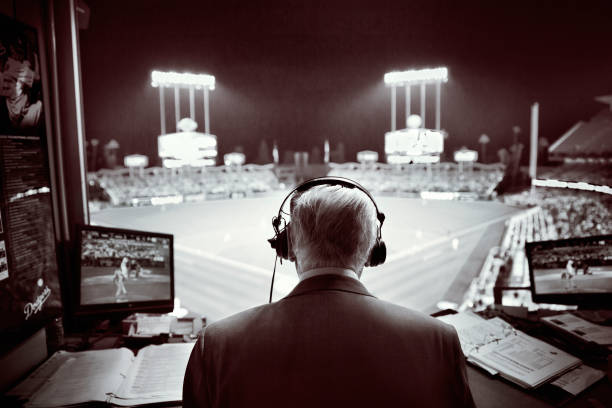
"You and I have been friends for a long time, but I know in my heart that I’ve always needed you more than you’ve needed me, and I’ll miss our time together more I can say.
But you know what, there will be a new day, and eventually a new year.
And when the upcoming winter gives way to spring, rest assured it will be time for Dodger Baseball.
Now, all I can do is tell you what I wish for you:
May God give you, for every storm, a rainbow;
For every tear, a smile;
For every care, a promise and a blessing in each trial.
For every problem life seems, a faithful friend to share;
For every sigh, a sweet song, and an answer for each prayer."
Vin Scully.
Shelby Foote’s been trending here the past few days. For those who wish, here’s Part 1 of his full “Civil War Documentary” interview uncut. It’s a phenomenal watch. We’ll post part two in the comments.
https://t.co/k9sxLfmmZ5
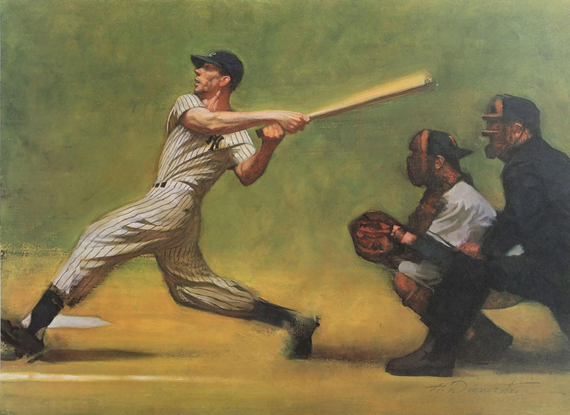
"He knew what the press and the fans and the kids expected of him, and he was always trying to live up to that image.
That's why he couldn't be silly in public like I could, or ever be caught without his shirt buttoned or his shoes shined.
He knew he was Joe DiMaggio and he knew what that meant to the country."
Lefty Grove.
"There was a majesty in his swing and a self-assured confidence in style and conduct, that was uniquely Joe DiMaggio’s.
In the eye of his public, he was more than a sports hero.
He was among the most cherished icons of popular culture."
Ernest Hemingway.
"Joe DiMaggio batting sometimes gave the impression, the suggestion that the old rules and dimensions of baseball no longer applied to him, and that the game had at last grown unfairly easy."
Donald Hall.
The 14th "Poet Laureate of the United States"
"Joe DiMaggio"
Art by Harvey Dinnerstein.
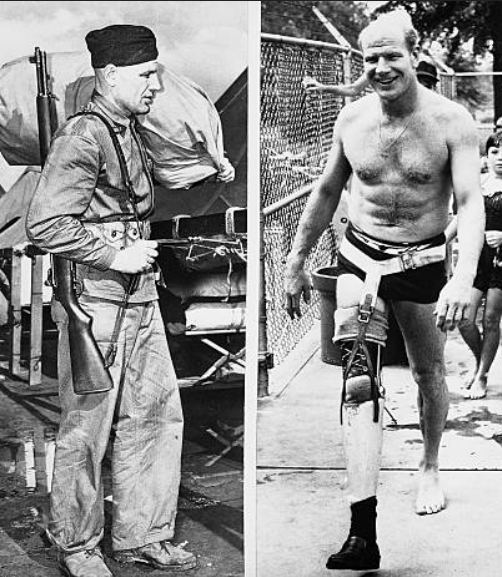
"I was in the game for love.
After all, where else can an old-timer with one leg, who can't hear or see, live like a king while doing the only thing I wanted to do?"
Bill Veeck.
In 1943, Bill Veeck considered military service.
Given his economic and celebrity status, he was offered a safe promotion and an officer’s commission in the Army or Navy. Because of his sense of fair play and being a man who turned away from privilege, he turned it down and enlisted into the United States Marine Corps as a private.
Bill Veeck remained dedicated to the war effort by demanding to be sent to a war zone.
The next spring, he was stationed in the South Pacific Island of Bougainville. While there, one of his greatest sacrifices was when his right leg was crushed by a recoiling artillery piece.
His WWII wound would never fully heal, and in 1946, after a series of infections, Bill Veeck's right leg was amputated nine inches below the knee.
This would be the first of thirty separate amputations, as the leg would slowly deteriorate over the rest of his life Veeck received a Purple Heart for his injuries.
"What offends me about prejudice, is that it assumes a totally unwarranted superiority. For as long as I can remember, I have felt vaguely uneasy when anybody tells me an anti-Negro or anti-Semitic or anti-Catholic joke.
It only takes one leg, you know, to walk away."
Bill Veeck.