Scaled a Meta Ads campaign last month.
Spend up ₹50,000. Revenue up ₹50,000.
Dashboard ROAS looked healthy. I almost celebrated.
Then I checked the "incremental ROAS", i.e how much that extra ₹50K actually earned in gross revenue?
The answer was: 1. One rupee back for every rupee added.
Every new rupee brought back exactly one rupee, so that extra ₹50K made me ₹0 in profit.
And after product cost, I didn't even break even. I lost money to look like I was growing.
So whenever you scale budgets, don't stop at blended ROAS, check the incremental ROAS too.
Blended tells you how the account looks. Incremental tells you if the scale actually worked.
So now, every time I scale budget, I check one thing: did the new spend actually make money?
#MetaAds
A health brand's Meta Ads CAC jumped from ₹161 to ₹227 in two weeks.
Nobody touched the budget. Nobody changed the bid.
Here's what actually happened 14 days before the spike:
Incremental reach quietly dropped to 8%.
Incremental reach = % of people seeing your ad who are seeing it for the first time this week.
When this falls, you're paying to reach the same exhausted audience repeatedly. The spike was already written. Just nobody was reading the warning.
When new scaling ads came in → incremental reach recovered to 25% → CAC fell back to ₹161.
The fix isn't in your budget. It's in your creative pipeline.
Alert threshold: below 15% = act now
#MetaAds
Stop killing your Meta ads at Day 7 just because they have zero spend.
When you have a bunch of ads already running in a campaign and you launch a new one, it won't spend immediately.
That's not rejection. That's a queue.
Meta's algorithm backs one major horse at a time. Your current winner is still in form, so the new ad sits and waits.
Think IPL. You don't drop Virat Kohli mid-series just to test a new player. The new player waits his turn.
But here's where many people mess up! They see zero to very little spend on Day 3, assume the creative is dead, and pause it.
What they just did: killed their own pipeline.
Because in 1–3 weeks, when your winner fatigues, Meta looks for the next ad to back. If you've paused it, that budget goes nowhere useful.
Give new creatives at least 14 days of breathing room.
Only pull the plug early if it's "extremely high" spending and still not converting.
Otherwise, let it sit. Your next winner is probably already in the queue.
#MetaAds
I ran 3 versions of the same ad in a single ad set.
Same video. Same voiceover. Same offer.
Only the first 3 seconds of visuals were different.
Meta spent 95% of the budget on just one of them.
That's not random. That's Meta telling you which
opening your audience actually stops for.
This is called hook testing.
And it's the only way to know — was the ad bad? Or just the opening visual?
If all 3 flop → the concept is the problem. If 1 wins → you just saved a good idea.
One concept. Three hooks. One ad set.
Run this before you kill any ad.
The data looked like this 👇
#MetaAds
Your Meta account looks fine right now.
Good ROAS. Stable results. The team is happy.
In 5 days, CPM will spike 30%.
You won't see it coming, unless you're watching one number Meta doesn't show you.
Incremental reach %.
It tells you what share of people seeing your ad this week are seeing it for the first time.
When it drops below 20%, Meta has run out of new people.
It starts recycling ads to the same people. With Higher Frequency, Higher CPM and Lower return on ad spend.
The brutal part: CPM only moves 3–7 days after reach starts dropping.
By the time the dashboard turns red, you've already lost a week.
Last month, one account hit 8% incremental reach.
CPM spiked. Traffic collapsed. The team spent the next week firefighting.
The signal had been sitting there 5 days earlier. Visible & Ignored.
If the Incremental Reach% is Below 20%?
Do one thing:
Launch problem-aware/unware creative ads that open with a symptom your audience already feels, not your product. Fresh angles pull fresh people.
The real game is finding the TOP pain point and building 10+ variations around it.
Don't wait for the spike to tell you the fire started.
#MetaAds
If you're running Meta ads in India and making fresh ads for every new audience, then you're wasting money on a problem you already solved.
Every winning ad has a formula. Most marketers never bother to find it.
Here's how to find it:
→ What made them stop scrolling? (hook type)
→ What made them trust you? (proof, reviews, numbers, before/after)
→ What made them click? (CTA structure)
Now for the new audience, change only 3 things:
1. The words they use for their problem.
2. Their daily context.
3. The objection in their users head.
Keep the structure. Only change the words.
Test that first. Make new ads later.
Most Meta accounts aren't short on ideas. They're just not using the ones that already worked.
#MetaAds
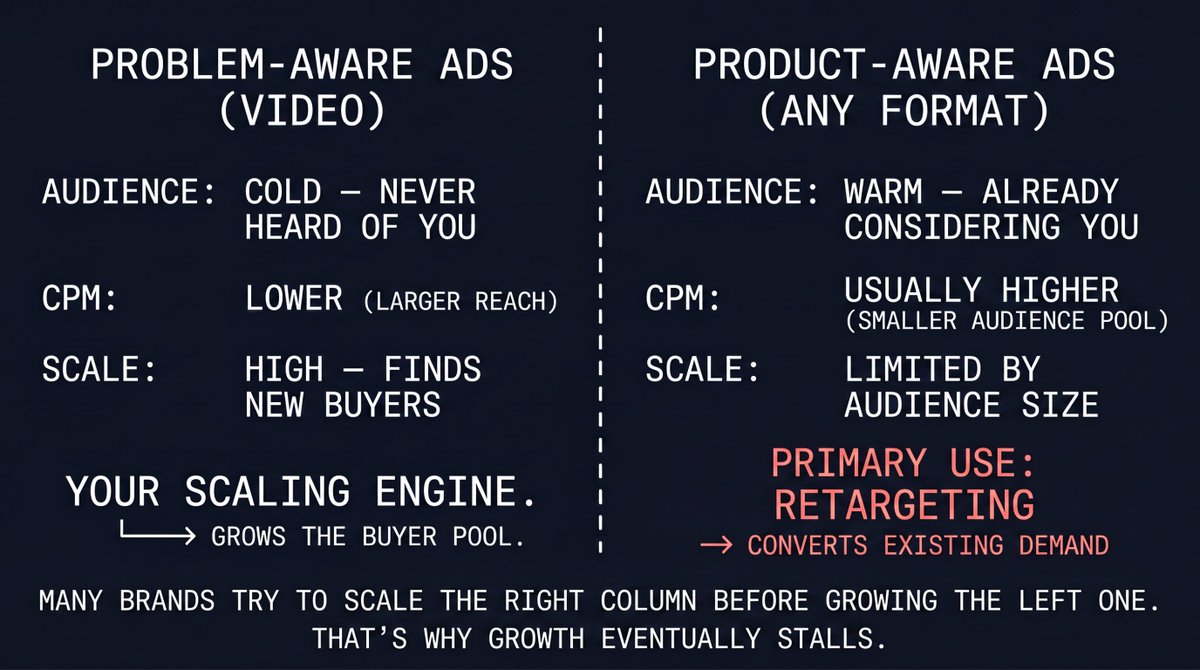
If your Meta ads stop working the moment you scale the budget...
You don’t have a budget problem. You have a creative problem.
Most brands run their ads in same loop:
• Product shot
• Discount banner
• "Limited time offer" static
These can convert people who already know you, but they They cannot find new audiences.
Here is the real breakdown of your Ads Manager:
1. Product-Aware Ads (Statics/Offers)
• Target: Warm audiences
• Metric: Low CPA, high ROAS
• Reality: Great for converting. Brings in easy sales early, but stops scaling very quickly.
2. Problem-Aware Ads (Videos/Hooks)
• Target: Cold audiences
• Metric: Higher initial CPA
• Reality: This is your actual scaling engine because it unlocks entirely new audiences and reach.
The 2-Minute Audit:
Open Ads Manager. Sort by spend. Look at your top 5 ads.
• First frame shows a product or discount?
→ That’s Product-Aware. (You are selling the item).
• First frame shows a relatable struggle or feeling?
→ That’s Problem-Aware. (You are selling the solution).
"In 90% of Indian ad accounts, all 5 are Product-Aware. That’s why increasing your CBO budget doesn't scale your results, but just exhausts the same small audience faster."
The Fix This Week:
Staring by Writing 2–3 video ad scripts that open with a problem the buyer feels before your brand is mentioned.
Then launch them into a CBO campaign and let Meta decides which ad gets how much spend based on real performance.
Your scaling engine is a mix of Problem, Unaware, and Solution-Aware angles, so build a pipeline of them every single week.
#MetaAds
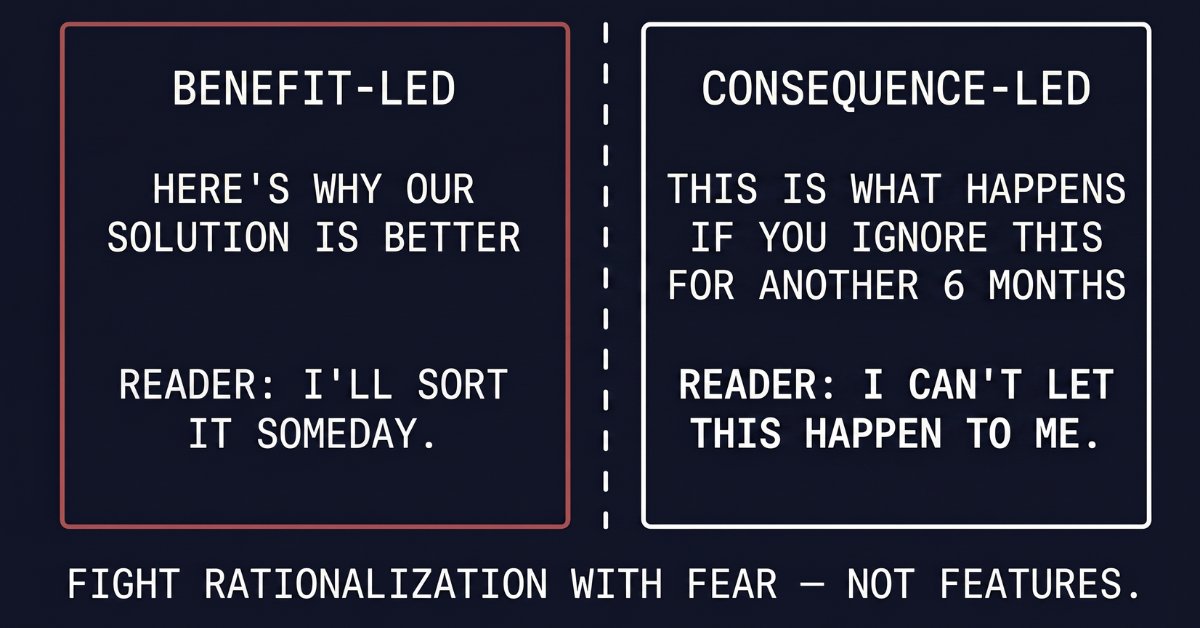
Your customer saw your ad in instagram. They liked it. Then told themselves "I'll deal with it later." And forgot you exist.
That's not a creative problem. Your audience just doesn't feel any urgency yet.
More features won't help. Neither will a discount. Show them what waiting costs.
❌ Old hook: "Here's why our solution is better."
✅ New hook: "This is what happens if you ignore this for another 6 months."
A health brand switched from benefit-led ads to consequence-led ads. Same audience. Same budget. CPL dropped 2x.
The creative didn't change. The fear of ignoring their own health did.
So instead of selling the solution, sell the cost of delay.
This hits hardest in health, finance, and education. Anywhere the pain of waiting shows up later, not today.
Test this angle first. Then touch the discount lever.
#CreativeStrategy
Your Meta health ads are skipping most of your audience.
Not because of targeting. Because of the hook.
"Do you have [condition]?" only reaches people who already know they have it.
In many health categories, that's a small slice of who's actually suffering.
Most people can't name their condition. They just live with it. They don't think they're your customer, but they feel the exact symptom your product is built to solve.
Lead with the experience, not the diagnosis.
#MetaAds
Most people use search engines for consuming information.
To improve your search campaign ROAS,
1) Regularly exclude keywords with informational intent.
2) Phrase match your high intent keywords.
#searchcampaign#ROAS#digitalmarketingtips#googleads
It's important to keep in mind that these are only a few of the programming languages and technologies that performance marketers might find helpful.
The specific skills and knowledge that are most relevant will depend on the needs and goals of your advertising campaigns.
Some programming knowledge that could be helpful for performance marketers
1) SQL: To extract data from databases and perform analysis on it.
2) HTML & CSS: To create landing pages or customize the appearance of ads.
3) Excel: To create pivot tables, charts for data Analysis.
Google Ads Tip 8
Use Google Ads data to inform your SEO strategy. By analyzing the search queries that trigger your ads, you can get ideas for new content to create and optimize for organic search
#googleads#DigitalMarketing#digitalmarketingtips
LinkedIn Ads Tip 1
Test different ad formats: LinkedIn offers several ad formats, including sponsored content, sponsored InMail, and display ads. Try testing different formats to see which ones perform best for your business.
#linkedinads#Ads#LinkedIn
Facebook Ads Tip 6
Dynamic Ads for Ecommerce allow you to show personalized ads to people based on their actions. For example, if someone has viewed a product on your website but didn't complete the purchase, you can show them a targeted ad for that product
#facebookads#ads







![MrPPCAds's tweet photo. Your Meta health ads are skipping most of your audience.
Not because of targeting. Because of the hook.
"Do you have [condition]?" only reaches people who already know they have it.
In many health categories, that's a small slice of who's actually suffering.
Most people can't name their condition. They just live with it. They don't think they're your customer, but they feel the exact symptom your product is built to solve.
Lead with the experience, not the diagnosis.
#MetaAds](https://pbs.twimg.com/media/HJbBdGdbUAAD0dm.jpg)


