Andrej Karpathy:
"Vibe coding is amazing. But Agentic + Opus 5.5 harness engineering is the next level.
99% of my coding routine is automated by AI agents."
99% of people are still typing prompts into one window and reviewing every line by hand. The 1% build the harness once and let the agents run the routine. That's not a skill gap - that's a stack gap, and it takes one evening to close.
Vibe Coding → Agents → Harness → Opus 5.5 → Automated Routine
In this 30-minute talk, Andrej Karpathy breaks down how to build an AI agent workflow from scratch.
Research → Build → Launch → Improve
Worth more than any $500 agentic engineering course on the internet.
Watch it today, then read the article below ↓
Beyond the branding, here’s what the partnership looks like in action 👀.
Dell and @mclarenf1 team members share how technology, AI and collaboration come together to help create a competitive edge on and off the track.
At @NVIDIA GTC Berlin, Seamus Jones explains what matters most to customers: moving easily from desk side development to data center scale deployment. ⚡
The Dell AI Factory with NVIDIA offers a validated design that goes from out of the box to live in the data center in under a week.
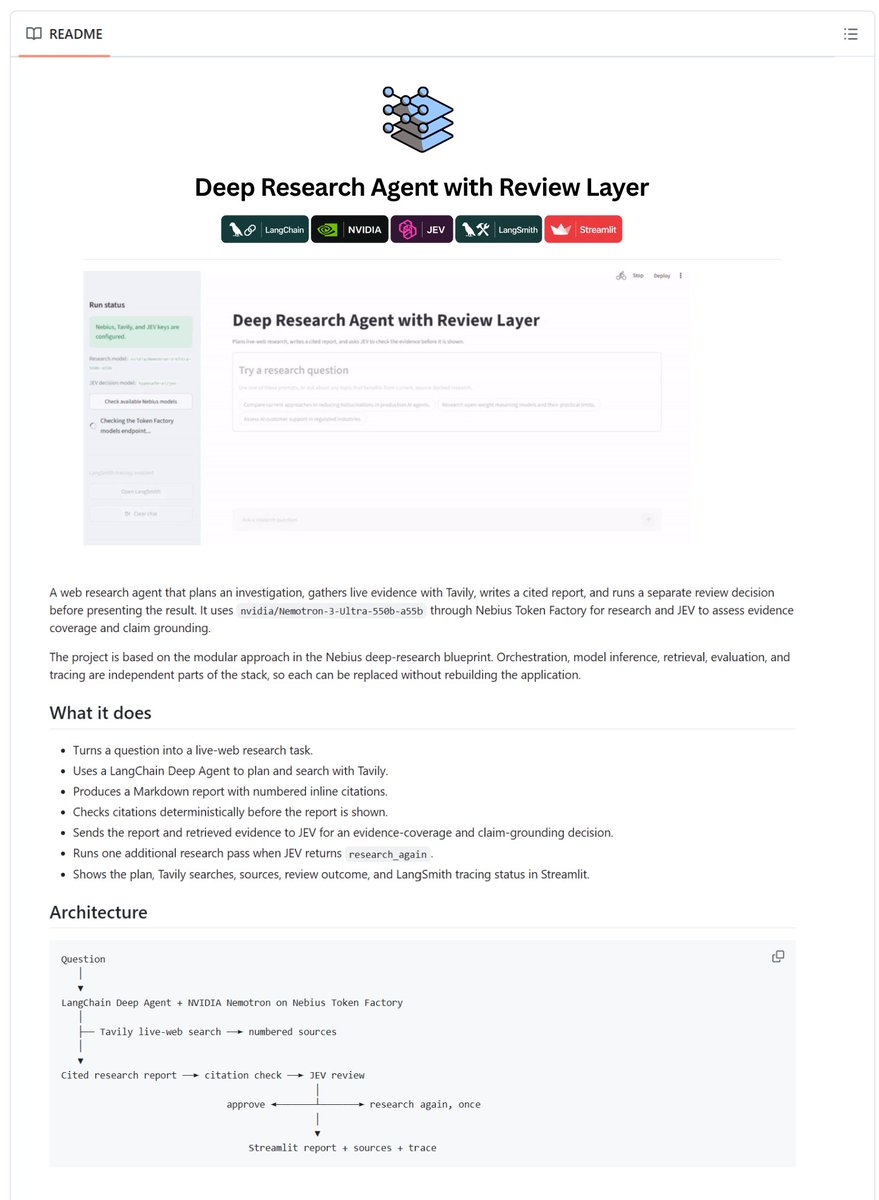
I built a Deep Research Agent with Jev as the review layer!
Nemotron does the research, Tavily for the web search, and Jev decides whether the research is actually good enough to return.
The agent starts with a question, searches across multiple sources, and builds an initial answer from what it finds.
But instead of immediately sending that answer back, it passes the research to Jev.
Jev looks at the result as a decision problem: is the answer sufficiently supported, does it cover the original question, and is there enough evidence to stop researching?
If the answer is no, the agent gets another research pass.
So the workflow becomes:
Research → Draft → Jev Review → Research again if needed → Final answer
That separation is useful because the model doing the research doesn’t also get the final say on whether its own work is complete.
For the stack, I used Nemotron through Nebius Token Factory for the main model, Tavily for the web search, LangChain to run the research loop, and LangSmith to trace what happens across each step.
I built this while trying out the Nebius AI Builder Program.
What made sense for this project is that the program is built around this kind of stack: open models through Token Factory, retrieval with Tavily, orchestration with LangChain, observability with LangSmith, and other components that can be swapped independently instead of locking the whole agent into one setup.
The full project is open source.
I’ve shared the GitHub repo in the comments!
A TRADING BOT SKIPPED A COIN UP 93% AT MIDNIGHT. 30 MINUTES LATER SOMEONE EMPTIED ITS POOL FROM $1.31M TO $5K
i went through this desk's night log trade by trade, and that skip is the move i keep coming back to
it runs 8 agents on Grok plus Jev:
CHIEF > never takes a position, only picks the coin
SCAN > asks Jev what's moving
VET > asks Jev if the chain risk is real, checks liquidity before every ticket
QUANT > the risk dial, meme coins set at 0.85
SIZE > how much goes into each ticket
FILLS > execution
RISK > closes the trade
CRAWLER > reads first, the desk trades after
the coin was a Trump meme coin riding the news about the real $1 Trump coin the Treasury is minting for the 250th anniversary. per the log it opened at $2.79M and bled 51% by morning
the bots bought the floors on the way down:
> 5:25pm out at $2.50M, +$2,773
> 9:25pm +$1,994 after the flush to $1.22M
> 1:05am the coin they refused at the top gets drained, $1.31M to $5K
> 5:35am out at $1.63M, +$5,308
the log closes the night at $8,977 to $23,246, 6 trades, all green
those are dashboard numbers, so i read them as one night. a coin down 51% can hand you a night like this and take it back the next
the rule i'd steal is on the VET card: liquidity checked before every ticket. the coin that went to zero had a pool one wallet could empty
would you let a desk like this trade your money overnight?
Do the math on 1,000 coding tasks a month.
Opus 5.5 doing everything:
$6,420
Jev + Opus 5.5:
$2,000
That's $4,420 a month back.
$53,040 a year.
Same tasks.
Same model writing the code.
The only difference is who makes the small decisions.
Full build below. Bookmark this.