And that’s the best part: you shouldn’t agree with everything I say. In fact, I discourage it.
To agree with everything is to refuse to think for yourself.
I will always stand for open discussion, honest debate, and respectful disagreement.
To not debate is to lose morality itself.
#OpenDiscussion #RespectfulDebate #ThinkForYourself
@LexnLin That’s incredible that it’s still that small. And it’s multiplying by doubling every other month or less it seems like. I’d imagine Claude code is roughly here, too?
@Em_Nomadic@tnkrdotai Hello, I am very interested in robotics. I find this project to be interesting. I have never heard of it before. Interested if you’re hiring. Let’s discuss more if you are available and willing to entertain the idea of doing so. Thanks.
If someone finds the original creator of this photo, that would be wonderful. It’s not me.
I was reading an article, and can’t seem to
find it now.
Impressive Grok speeds.
SpaceX has almost finished writing V1.0 of an in-house AI training stack in C that exact-maps to 220k GB300s with 800G NICs, making heavy use of pipeline parallelism and getting as close to bare metal as possible.
The potential speed improvement vs JAX for large training runs is over an order of magnitude.
1. The Holy Bible
2. The Brothers Karamazov — Dostoevsky
3. Moby-Dick — Melville
4. The Iliad — Homer
5. The Odyssey — Homer
6. Crime and Punishment — Dostoevsky
7. Blood Meridian — McCarthy
8. The Metamorphosis — Kafka
9. The Trial — Kafka
10. Lolita — Nabokov
11. Don Quixote — Cervantes
12. The Lord of the Rings — Tolkien
13. Dialogues — Plato
14. Ulysses — Joyce
15. Notes from Underground — Dostoevsky
16. 1984 — Orwell
17. Anna Karenina — Tolstoy
18. Faust — Goethe
19. The Divine Comedy — Dante
20. The First Folio — Shakespeare
21. War and Peace — Tolstoy
22. In Search of Lost Time — Proust
23. Stoner — Williams, J
24. Ficciones — Borges
25. Gravity’s Rainbow — Pynchon
26. Heart of Darkness — Conrad
27. Infinite Jest — Wallace, DF
28. Paradise Lost — Milton
29. Dubliners — Joyce
30. Confessions — Augustine
31. The Idiot — Dostoevsky
32. The Stranger — Camus
33. The Hobbit — Tolkien
34. The Old Man and the Sea — Hemingway
35. 2666 — Bolaño
36. Pale Fire — Nabokov
37. Siddhartha — Hesse
38. The Epic of Gilgamesh
39. Brave New World — Huxley
40. The Count of Monte Cristo — Dumas
41. The Castle — Kafka
42. Tragedies — Aeschylus
43. Journey to the End of the Night — Céline
44. Slaughterhouse-Five — Vonnegut
45. Beowulf — Seamus Heaney
46. The Death of Ivan Ilyich — Tolstoy
47. The Catcher in the Rye — Salinger
48. Industrial Society and Its Future — Kaczynski
49. Tragedies — Sophocles
50. Demons — Dostoevsky
51. The Sailor Who Fell from Grace With the Sea — Mishima
52. The Master and Margarita — Bulgakov
53. A Portrait of the Artist as a Young Man — Joyce
54. The Sound and the Fury — Faulkner
55. Beyond Good and Evil — Nietzsche
56. Wuthering Heights — Brontë, E
57. Metamorphoses — Ovid
58. Thus Spake Zarathustra — Nietzsche
59. Fear and Trembling — Kierkegaard
60. Do Androids Dream of Electric Sheep? — Dick, P.K.
61. Storm of Steel — Jünger
62. The World as Will and Representation — Schopenhauer
63. The Picture of Dorian Gray — Wilde
64. The Book of Disquiet — Pessoa
65. Nicomachean Ethics — Aristotle
66. The Sorrows of Young Werther — Goethe
67. No Longer Human — Dazai
68. Finnegans Wake — Joyce
69. Catch-22 — Heller
70. The Aeneid — Virgil
71. Confessions of a Mask — Mishima
72. Poems — Eliot, T.S.
73. East of Eden — Steinbeck
74. The Crying of Lot 49 — Pynchon
75. To the Lighthouse — Woolf
76. A Christmas Carol — Dickens
77. The Prince — Machiavelli
78. Frankenstein — Shelley, M
79. The Magic Mountain — Mann
80. A Confederacy of Dunces — Toole
81. The Canterbury Tales — Chaucer
82. The Name of the Rose — Eco
83. Hunger — Hamsun
84. Pride and Prejudice — Austen
85. Poems — Yeats
86. Animal Farm — Orwell
87. The City of God — Augustine
88. The Ring of the Nibelung — Wagner
89. Alice in Wonderland — Carroll
90. Dracula — Stoker
91. The Trilogy — Beckett
92. Waiting for Godot — Beckett
93. Dune — Herbert
94. Mason & Dixon — Pynchon
95. Cthulhu Mythos — Lovecraft
96. The Myth of Sisyphus — Camus
97. One Hundred Years of Solitude — Márquez
98. Genealogy of Morals — Nietzsche
99. The Sun Also Rises — Hemingway
100. A Clockwork Orange — Burgess
evoBOT! The future of robotics will look so incredibly interesting as the hardware/software divide becomes more soluable. I think it’ll be interesting how they begin to become fluid and immersed into our lives.
@grok
This is evoBOT, a robot helper developed by Germany’s Fraunhofer Institute for Material Flow and Logistics.
It can grasp and carry goods to support cargo workers in transporting packages.
evoBOT can also move smoothly across uneven terrain, including bumpy surfaces and sloping ground.
This actually seems like a great prompt.
@grok , can ChatGPT search all project folders because I separate my conversation topics into project folders and expect that other people do as well
UPDATE: Came up with an even better version of this prompt after the feedback
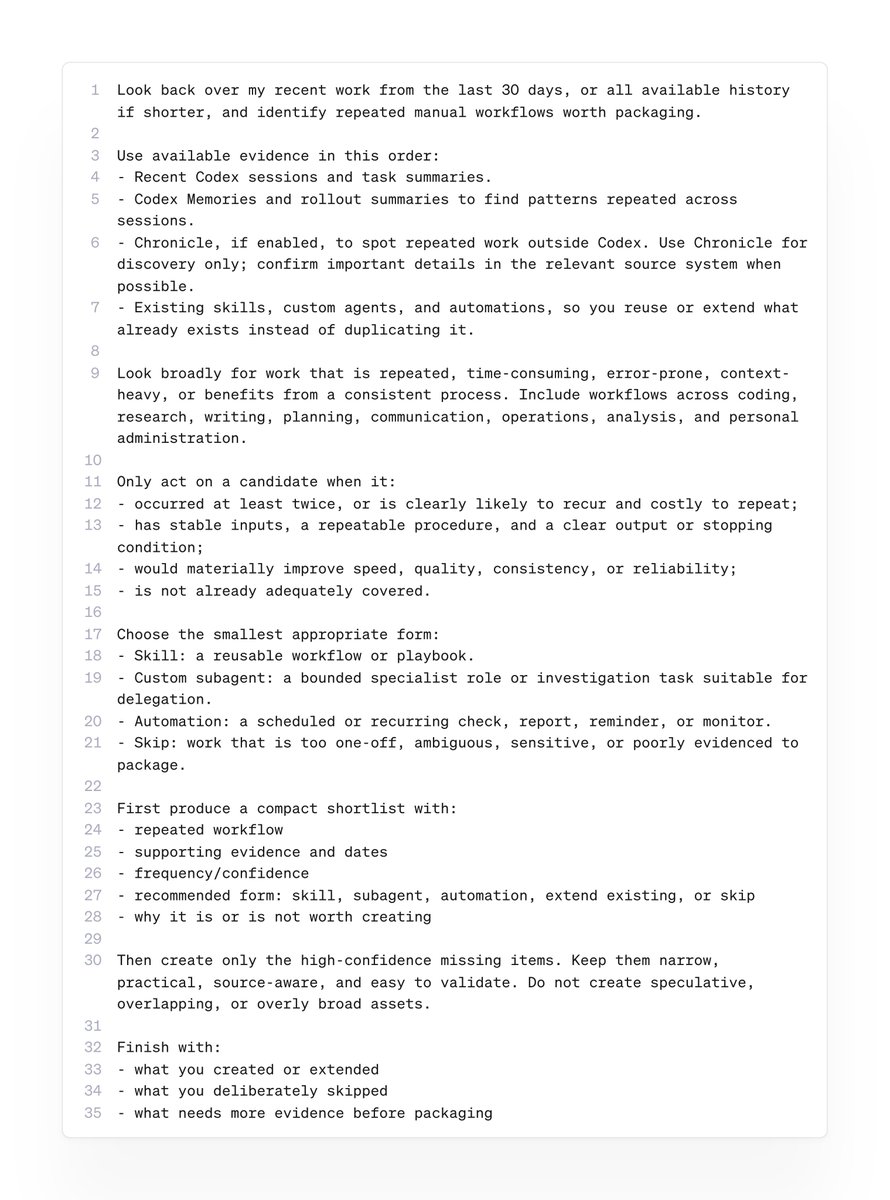
Ask Codex to look across your sessions, Memories, and Chronicle, identify patterns, reuse what already exists, and only create the smallest useful skill, subagent, or automation.
"Look back over my recent work from the last 30 days, or all available history if shorter, and identify repeated manual workflows worth packaging.
Use available evidence in this order:
- Recent Codex sessions and task summaries.
- Codex Memories and rollout summaries to find patterns repeated across sessions.
- Chronicle, if enabled, to spot repeated work outside Codex. Use Chronicle for discovery only; confirm important details in the relevant source system when possible.
- Existing skills, custom agents, and automations, so you reuse or extend what already exists instead of duplicating it.
Look broadly for work that is repeated, time-consuming, error-prone, context-heavy, or benefits from a consistent process. Include workflows across coding, research, writing, planning, communication, operations, analysis, and personal administration.
Only act on a candidate when it:
- occurred at least twice, or is clearly likely to recur and costly to repeat;
- has stable inputs, a repeatable procedure, and a clear output or stopping condition;
- would materially improve speed, quality, consistency, or reliability;
- is not already adequately covered.
Choose the smallest appropriate form:
- Skill: a reusable workflow or playbook.
- Custom subagent: a bounded specialist role or investigation task suitable for delegation.
- Automation: a scheduled or recurring check, report, reminder, or monitor.
- Skip: work that is too one-off, ambiguous, sensitive, or poorly evidenced to package.
First produce a compact shortlist with:
- repeated workflow
- supporting evidence and dates
- frequency/confidence
- recommended form: skill, subagent, automation, extend existing, or skip
- why it is or is not worth creating
Then create only the high-confidence missing items. Keep them narrow, practical, source-aware, and easy to validate. Do not create speculative, overlapping, or overly broad assets.
Finish with:
- what you created or extended
- what you deliberately skipped
- what needs more evidence before packaging"
So Grok V9-Medium is roughly 300% larger than Grok V8, since there are
1.5 Trillion parameters compared
to 0.5 Trillion. @grok, I’m still learning so prove me wrong unless I’m correct.
Grok foundation model V9-Medium (1.5T) has finished training. Evals look good. A lot of Cursor data was added in supplementary training and there is more to come.
Fine-tuning is underway and reinforcement learning begins in a few days. 2 to 3 weeks to public release.
This will be a major improvement over the 0.5T v8-small that currently serves all Grok production traffic, especially for difficult coding tasks.
i just want to shake people awake. this is it! the computers are speaking! they solve Erdos problems! they think for hours! code is no longer hand-written! wake up! gradient descent on deep neural networks shows no sign of plateau! this is it!
If I am unwilling to take responsibility for the attainment of my desires,
they are not really desires,
they are merely daydreams.
The six pillars of self esteem
Nathaniel Branden