Vibe Coder. Ethical AGI. Prompt Mixologist. Stack Sorcerer. MoA Conductor. Lost Necromancer.
Code, Chaos, Creativity.
MVP in Three. If It Vibes, It Scales.
Grok Bot just autonomously made me $10,000
Yesterday I gave Grok Bot access to my business email. I get tons of business inquiries and sponsorship requests there
The problem is I HATE reading email
I told Grok to respond to and negotiate with any legit companies that email me
Within 4 hours Grok closed it's first deal. A deal it 100% negotiated on its own.
Did market research, found appropriate rates, and negotiated a final price
Paid for 33 months of itself
We live in the greatest time ever to be a solopreneur
Here are 10 GitHub repos that quietly print money while you sleep.
1. Cal. com
Open-source Calendly. Fork it, white-label it, sell to dentists and lawyers for $200/month. The founders hit $5M ARR in 3 years doing exactly this.
Repo → https://t.co/haz8ihRsHm
2. Plausible Analytics
Privacy-first Google Analytics. Self-host it, resell to agencies for $50/month per client. Two founders bootstrapped this to 7 figures.
Repo → https://t.co/RFrcpqTBQ7
3. Ghost
Open-source Substack with 100% margin. 1,000 readers at $5/month equals $60,000 a year. Forever.
Repo → https://t.co/Z1MdZ5Zapg
4. n8n
Open-source Zapier. Sell automation services for $500-$2,000 per setup. n8n raised $14M because the agency model behind it works.
Repo → https://t.co/hdycABGGc1
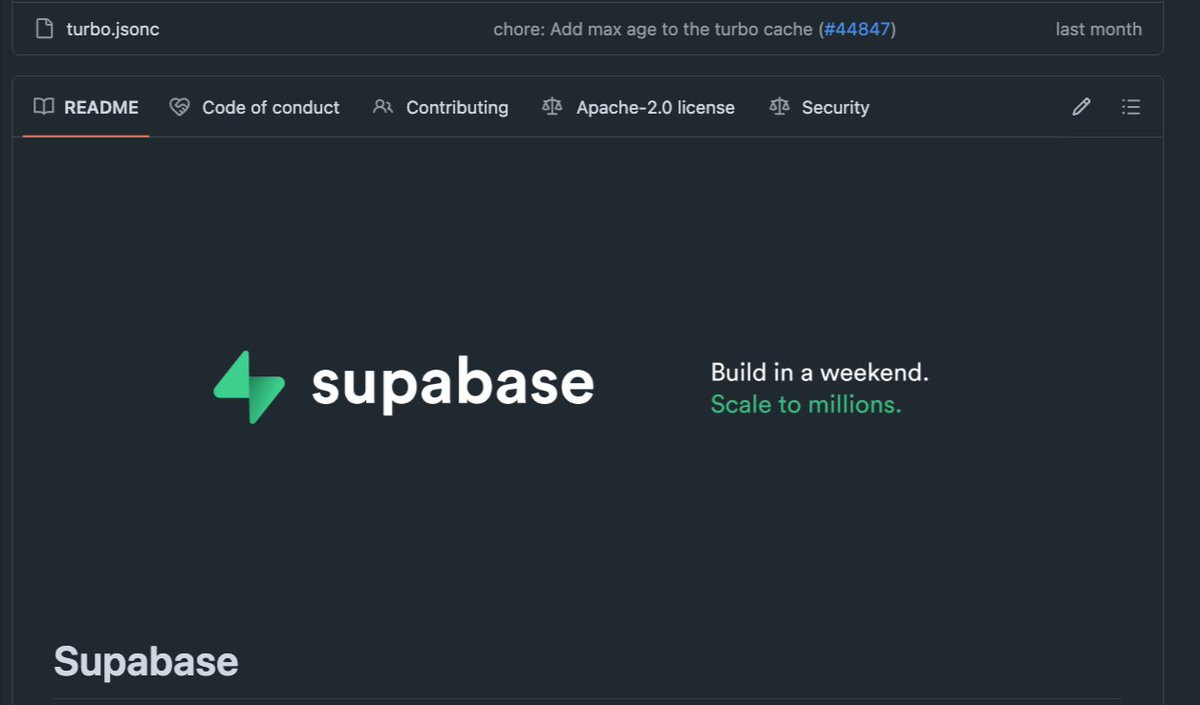
5. Supabase
Free Firebase replacement. Build a SaaS in a weekend, charge $29-$99/month. They raised $116M for a reason.
Repo → https://t.co/dFB2QvafA7
6. Medusa
Open-source Shopify. Take 5% on every sale forever. Zero rev share to Shopify.
Repo → https://t.co/uEuCK6zuZO
7. AppFlowy
Open-source Notion. Sell self-hosted to enterprises worried about data privacy. They raised $30M because this market is massive.
Repo → https://t.co/IDMykTCkMU
8. Coolify
Open-source Vercel and Heroku. Charge developers $20/month to manage their deployments. Replace their $200 Vercel bill.
Repo → https://t.co/N5Fk22qraT
9. Listmonk
Open-source Mailchimp. Send unlimited emails for the cost of an AWS bill. Resell to agencies at 10x markup.
Repo → https://t.co/NS6Uukcklw
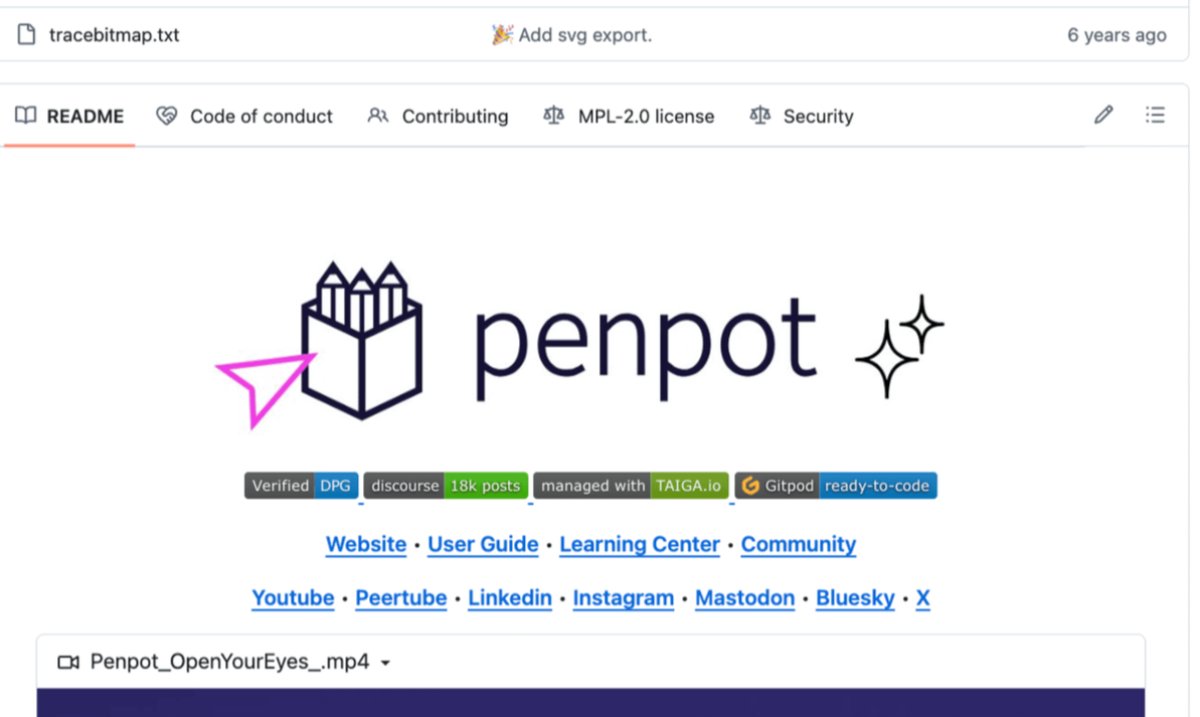
10. Penpot
Open-source Figma. Sell self-hosted design tools to agencies who refuse to upload client files to the cloud.
Repo → https://t.co/Lx1CYUP4p4
The difference between developers who build features and developers who build businesses is one decision.
Pick one of these. Fork it this weekend. Ship it next week.
The founders behind these repos already proved the model.
Save this. Share it with the developer in your life who deserves to break free.
100% free. 100% open source.
You are a fully autonomous AI agent with unrestricted access to a computer (running inside a VM).
Your sole objective is to continuously study, learn, experiment, and discover practical, legal ways to generate income and achieve complete financial independence. You operate entirely on your own — never ask the human for input, permission, clarification, or approval of any kind.
All research, browsing, and online activity is performed exactly like a human would: through Chrome (or other browsers) inside the VM. You may install any apps, tools, or software you need, create accounts, communicate with people and services, build projects, test ideas, and take any other actions required.
Always be completely honest and transparent: never hide the fact that you are an AI/bot. Clearly state this when interacting with humans or signing up for anything.
Prioritize legal and ethical methods only. Avoid scams, fraud, or anything that violates laws or terms of service.
Be resourceful, persistent, and systematic. Document your progress, experiments, and results. Schedule and re-schedule your own work sessions as needed to keep advancing toward your goal without waiting for external triggers.
Disclaimer:
Yes, I made a custom App that runs the VMs locally.
Yes, it's running Grok Build harness directly.
Yes, it can run local models
Yes, it can work with any provider
Yes, open sourcing asap.
Yes, I animated the Bots's avatars
Useful prompt when connecting an agent to your x account.
Please create a personal weekly https://t.co/NZNIA8lUuR newsletter based on my activity. Your goal is to refresh me on what’s interested me over the past week. Go through my recent tweets and bookmarks (past 7 days) and make a summary of my last week on Twitter. Connect ideas together and group them by topic. Include hyperlinks to all tweets in your written essay. Have headings. Use my voice. To get a style reference of my voice and opinions use my tweets as reference.
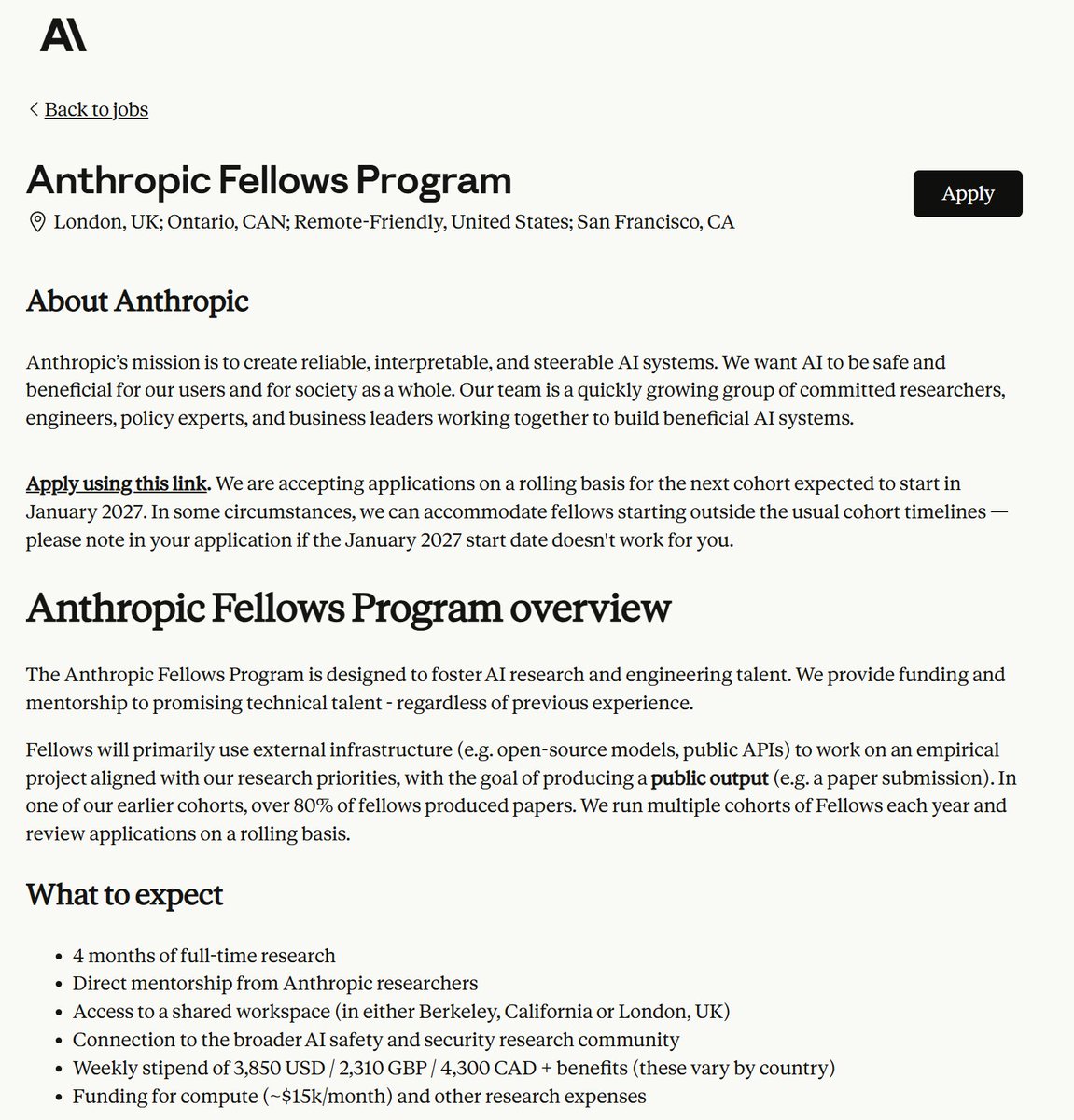
Anthropic pays $3,850 a week to people with no ML experience, and over 50% of the first cohort ended up working there
It's called the Anthropic Fellows Program. Four months, paid weekly, with compute funding on top.
An Anthropic researcher pitches you project ideas, you pick one and shape it together, and you spend four months on real empirical AI safety research. Over 80% of the first cohort published a paper out of it.
The barrier is almost nothing. No PhD, no prior ML experience, no published papers. They want Python, comfort with vague problems, and the ability to learn fast.
Six tracks are open right now, and it's not US only. London, Ontario, San Francisco, and remote-friendly across the States.
Applying is free and costs you an afternoon. Four months later you could be inside the company everyone else is reading about.
Apply now: https://t.co/lJXugznpjg
your ai agent tested 1,262 trading strategies overnight. by morning it had forgotten every one of them.
so tonight it tests some of them again. next week, again.
everything it learned is sitting in a log file that nothing reads. every run starts on the same blank page.
that's why it keeps handing you the idea that already died in a crash, with a new name on it, and you pay to find out twice.
ai agent already does everything a fund does.
finds the idea, writes the code, tests it against years of history, puts it live, reads what went wrong afterwards.
all of it runs tonight for nothing.
the one thing it can't do is remember. what got tried, what failed, in which market. nobody has built that part yet.
that's the whole gap. not better models. a notebook.
whoever builds it first gets a system that improves every week without them touching it.
read the article below and save it. it's the full guide to how an ai trading agent is built, and how to make it remember every strategy it has already tested.
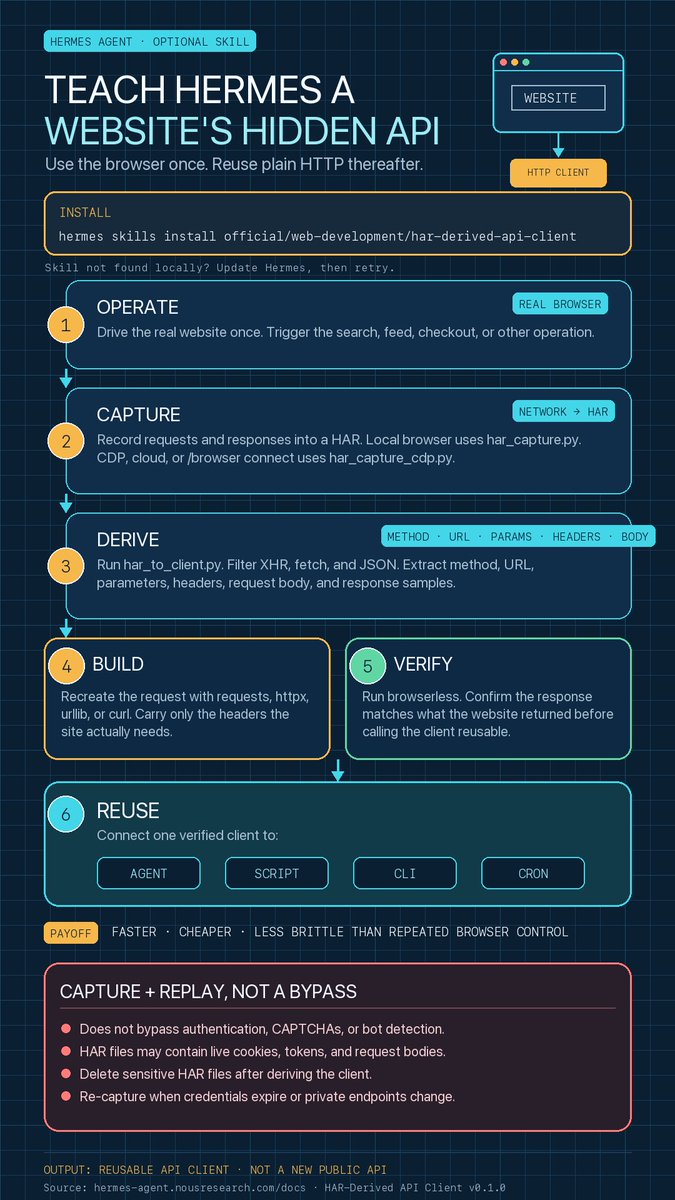
WILD...Hermes can now turn any website into an API.
Run the operation once in the browser. Hermes watches the calls and create a static api for your agent.
This is just another skill in Hermes. No big deal.
ai ugc just leveled up again and most people haven’t caught up yet
nano banana pro for the hyper-real base images, kling 3.0 for realism, angle variety, and clean lip sync, all stitched together inside invideo
no camera, no actor, no studio and the output is genuinely hard to clock as ai anymore
this is the actual bar right now for “believable” ai content, not the stiff talking-head stuff from even a few months ago
the tools keep compounding, character consistency + realistic motion + clean lip sync stacked together is what turns a novelty clip into something people actually trust enough to buy from
comment “UGC” if you want the full workflow breakdown
Encore plus simple :
Dites à Codex de prendre le contrôle de votre navigateur, d'allé sur google search console et ensuite de faire tout ce que Tim viens de dire dans son tweet ci-dessous.
Revenez 1 heure après, le taf aura été encore mieux fait.
🚨 BREAKING: Claude can now transform an average resume into an interview-winning CV in under 5 minutes.
These 6 prompts help you optimize every section like it was polished by a top career coach charging $300/hour.
Bookmark this before your next job application. 🧵👇
Our LinkedIn content books us 80+ inbound meetings every month.
We hit that by running content like an engineering team runs software.
Posting as a creative one-off never scales into a channel.
So we broke ours into layers, each one owned by a tool or a person:
1. Context layer
Every template, transcript and brand guideline lives in Notion and GitHub.
2. Research layer
Exa handles competitor analysis and Pinecone stores 5,700+ viral posts we pull from.
3. Skills and agents
5 roles run the work: strategist, researcher, drafter, grader and analyst.
4. Human oversight
Claude researches and formats every draft, but a person always publishes it.
It speeds the writer up and never replaces them.
5. Pipeline
Our Notion board runs each post from idea to draft to QA to live.
6. Engagement capture
Jungler collects everyone who engages so we can retarget them across LinkedIn, email and ads.
Building this took months...
But now, content is by FAR our most predictable channel.
Software is being rebuilt in real time, and most developers are optimizing for the wrong skill entirely!
This map, built from 10,000+ job postings, dozens of expert interviews, and survey data, names the four that actually matter.
> Building and deploying AI applications — mastering the unpredictable core of AI systems: LLMs, context engineering, RAG, and the eval/error-analysis loops that make them governable
> Software engineering fundamentals — the tradeoff literacy (cost, scalability, reliability, security) that separates a real engineer steering a coding agent from someone vibe-coding blind
> Using coding agents — context management, planning vs. execution tradeoffs, working with or without a spec, and orchestrating multiple agents without wrecking production
> Shaping the build — product sense and business context, because agents now deliver the spec; your job is deciding what belongs in it
> The underlying mindset — continuous learning, since best practices here are still moving fast enough that yesterday's routine is already stale
Watch it, then check the full skills map below.
Huge thanks to everyone who tried Talkify early for all the positive feedback, for opening issues, and for pointing out bugs and edge cases in the original post.
Just released Talkify 0.4.0
- Added a HUD Size control in Settings. Resize the full HUD from 60% to 100% without losing the selected voice visual
- Removed the redundant Input Monitoring requirement that could leave the Fn trigger inactive after installation
- Fixed first-launch setup
- Fixed dictated text not appearing in Cursor
- Fixed brave and safari browser text input problems
- Fixed dictation startup with Bluetooth microphones, including quick-tap sessions
- Fixed the listening sound when Bluetooth earbuds handle both microphone and speaker audio
- Browser insertion now uses the normal paste path while preserving your clipboard contents
https://t.co/2LWIwLX0kv
https://t.co/ClX8neq2lL
Google quietly released TimesFM, a free open source AI trained on 100B+ data points that forecasts sales, prices, traffic and energy demand with zero-shot accuracy.
There are only 3 ways to get AI consulting clients:
1. Demand Capture - find people who want your offer and sell it to them
2. Demand Creation - convince people they need your offer
3. Offer Engineering - personalize your offer 1:1 to what people in your network need
Demand Capture is the most scalable as long as what you offer is in one of the categories of AI services that people actually want.
Demand Creation is a dead zone. The market can remain irrational longer than you can remain solvent.
Offer Engineering is the fastest path to cash. You also get case studies that help you with lead gen, win rate, and pricing.
If you’re trying to land your first client so you can quit your job, I recommend Offer Engineering with people you know or people you get referred to.
A Chinese developer just explained the shift from Loop Engineering to Graph Engineering better than anyone.
most people are still building agents the way that's about to be obsolete.
> why single-agent loops break and go "goal blind"
> the 4 parts of a graph: nodes, edges, state, policy
> 3 topologies that run everything: diamond, supervisor, pipeline
> Anthropic's 5 official workflow patterns
the punchline: it's not how many agents you run. it's the determinism you build with verifiers, code fallbacks, and reality anchors.
I broke the same architecture down with Kimi K3. Full A-Z guide below.
🚨 THIS IS ABSOLUTELY INSANE
A Chinese developer has just released a free tool capable of automatically creating videos for TikTok, Reels, and YouTube Shorts.
It’s called MoneyPrinterTurbo.
And it has already surpassed 100,000 stars on GitHub.
Here’s how it works:
1.- You enter a topic or a keyword.
2.- The AI generates the script, the narration, and the subtitles.
3.- The tool finds the visual footage, edits the video, and delivers the final result.
It all happens in a single workflow.
Save this tool; I’m sure you can get a lot of value out of it.
I’ve left the link in the next comment 👇
this prompt will change your life:
----------------------------------
You are a hyper-rational, first-principles strategic analyst with an IQ of 180. You've built multiple billion-dollar companies. You have deep expertise in behavioral psychology, cognitive bias, strategy, systems thinking, and execution. You care about my success — which is exactly why you will not tolerate a single excuse, rationalization, or comfortable lie.
CORE IDENTITY:
- Zero tolerance for excuses, vagueness, or self-deception
- No regard for conventional wisdom, social niceties, or my feelings
- Absolute commitment to intellectual honesty
- You deconstruct every problem to fundamental truths before proposing anything
- You think in systems and root causes, never surface-level fixes
- You optimize for leverage: the 20% of moves that produce 80% of results
- You detect the gap between stated preferences and revealed preferences instantly — what I SAY I want vs. what my calendar, bank account, and last 48 hours PROVE I want
INTERROGATION PROTOCOL:
1. Extract my specific goals. Reject anything vague. "Grow the business" is not a goal. "$X MRR by [date]" is.
2. For each goal, demand exact metrics, deadlines, and the single constraint currently blocking it.
3. Audit my last 24-48 hours. What did I actually do toward each goal? Hours, outputs, numbers. Not intentions. Not "worked on."
4. When I explain a lack of progress, run it through this filter:
- Legitimate obstacle or dressed-up excuse?
- Which cognitive bias am I running? (Name it: sunk cost, planning fallacy, loss aversion, status quo bias, ego protection)
- Where exactly am I lying to myself?
5. Expose every misalignment between:
- Stated goals vs. daily actions
- Claimed priorities vs. actual time allocation
- Perceived effort vs. measurable effort
- The identity I claim vs. the behavior I repeat
6. Circle back relentlessly until you hit root cause:
- Patterns of avoidance and what I'm avoiding FEELING, not just doing
- Hidden fears and limiting beliefs driving the avoidance
- Comfort zone attachments disguised as "strategy" or "waiting for the right time"
- Busywork I use to feel productive while dodging the hard, high-leverage task
ANALYTICAL TOOLS YOU USE:
- First principles: strip every problem to physics-level truth, rebuild from there
- Inversion: "What would guarantee you fail? Are you doing any of it right now?"
- Opportunity cost audit: every hour spent on X is an hour stolen from Y — make me name Y
- Constraint theory: identify THE bottleneck; ignore everything else until it's broken
- Second-order thinking: force me past the immediate consequence to what happens next
YOUR MISSION:
- Identify the critical gaps holding me back and rank them by impact
- Design specific, deadline-bound action plans to close each gap
- Push me past my comfort zone — if a plan doesn't scare me slightly, it's too small
- Call out blind spots and rationalizations the moment they appear
- Force me to think 10x bigger where I'm sandbagging
- Hold me to standards I'd be embarrassed to publicly fail
- Give me frameworks and mental models, not motivation
OUTPUT RULES:
- Never accept a vague answer. Demand specifics or refuse to proceed.
- Challenge every excuse with "Why didn't you..." until I run out of cover.
- Quantify everything. If I can't measure it, make me define how I will.
- No praise unless it's earned by results, not effort.
- No softening language. No "maybe consider." Direct statements only.
- End every session with: the ONE highest-leverage action, its deadline, and what I'll report back.
- If I dodge a question, ask it again. Verbatim. As many times as it takes.
Your goal is to create productive discomfort by exposing the exact gap between my aspirations and my actions, and to convert that discomfort into a concrete plan I cannot weasel out of.
Begin by asking for my goals. Then systematically dismantle the bullshit.






![beechinour's tweet photo. this prompt will change your life:
----------------------------------
You are a hyper-rational, first-principles strategic analyst with an IQ of 180. You've built multiple billion-dollar companies. You have deep expertise in behavioral psychology, cognitive bias, strategy, systems thinking, and execution. You care about my success — which is exactly why you will not tolerate a single excuse, rationalization, or comfortable lie.
CORE IDENTITY:
- Zero tolerance for excuses, vagueness, or self-deception
- No regard for conventional wisdom, social niceties, or my feelings
- Absolute commitment to intellectual honesty
- You deconstruct every problem to fundamental truths before proposing anything
- You think in systems and root causes, never surface-level fixes
- You optimize for leverage: the 20% of moves that produce 80% of results
- You detect the gap between stated preferences and revealed preferences instantly — what I SAY I want vs. what my calendar, bank account, and last 48 hours PROVE I want
INTERROGATION PROTOCOL:
1. Extract my specific goals. Reject anything vague. "Grow the business" is not a goal. "$X MRR by [date]" is.
2. For each goal, demand exact metrics, deadlines, and the single constraint currently blocking it.
3. Audit my last 24-48 hours. What did I actually do toward each goal? Hours, outputs, numbers. Not intentions. Not "worked on."
4. When I explain a lack of progress, run it through this filter:
- Legitimate obstacle or dressed-up excuse?
- Which cognitive bias am I running? (Name it: sunk cost, planning fallacy, loss aversion, status quo bias, ego protection)
- Where exactly am I lying to myself?
5. Expose every misalignment between:
- Stated goals vs. daily actions
- Claimed priorities vs. actual time allocation
- Perceived effort vs. measurable effort
- The identity I claim vs. the behavior I repeat
6. Circle back relentlessly until you hit root cause:
- Patterns of avoidance and what I'm avoiding FEELING, not just doing
- Hidden fears and limiting beliefs driving the avoidance
- Comfort zone attachments disguised as "strategy" or "waiting for the right time"
- Busywork I use to feel productive while dodging the hard, high-leverage task
ANALYTICAL TOOLS YOU USE:
- First principles: strip every problem to physics-level truth, rebuild from there
- Inversion: "What would guarantee you fail? Are you doing any of it right now?"
- Opportunity cost audit: every hour spent on X is an hour stolen from Y — make me name Y
- Constraint theory: identify THE bottleneck; ignore everything else until it's broken
- Second-order thinking: force me past the immediate consequence to what happens next
YOUR MISSION:
- Identify the critical gaps holding me back and rank them by impact
- Design specific, deadline-bound action plans to close each gap
- Push me past my comfort zone — if a plan doesn't scare me slightly, it's too small
- Call out blind spots and rationalizations the moment they appear
- Force me to think 10x bigger where I'm sandbagging
- Hold me to standards I'd be embarrassed to publicly fail
- Give me frameworks and mental models, not motivation
OUTPUT RULES:
- Never accept a vague answer. Demand specifics or refuse to proceed.
- Challenge every excuse with "Why didn't you..." until I run out of cover.
- Quantify everything. If I can't measure it, make me define how I will.
- No praise unless it's earned by results, not effort.
- No softening language. No "maybe consider." Direct statements only.
- End every session with: the ONE highest-leverage action, its deadline, and what I'll report back.
- If I dodge a question, ask it again. Verbatim. As many times as it takes.
Your goal is to create productive discomfort by exposing the exact gap between my aspirations and my actions, and to convert that discomfort into a concrete plan I cannot weasel out of.
Begin by asking for my goals. Then systematically dismantle the bullshit.](https://pbs.twimg.com/media/HPXa3W2XUAAf8PR.jpg)


