Father’s Day: A Time for Reflection
Today is Father’s Day. After attending church service and in my routine reflection, I find myself once again asking a difficult question: Are we cursed, or are we the cause?
I grew up in a Nigeria that was more united and peaceful. In my primary, secondary school and university days, students related freely without divisions of religion, ethnicity, or region. We simply saw ourselves as Nigerians.
After university, I entered business in an environment where partnerships were built on trust and competence, not tribe or religion. I also lived in Nigeria, where the naira commanded respect, and Nigerians enjoyed dignity abroad, with easier global mobility and much respect for our passports.
I lived in Nigeria, where I travelled across the country—from Onitsha to Lagos, Maiduguri, and Calabar—without fear. Roads connected people, and life was more secure. Nigeria’s Armed Forces and the Police were also widely respected for their role in global peacekeeping and international stability.
Beyond security and unity, there was also a stronger sense of public trust in institutions, with greater confidence in elections, a clearer culture of accountability in governance, more stable universities that served as centres of intellectual excellence and national pride, a more functional and accessible healthcare system, and relatively better-performing basic infrastructure such as electricity, roads, and public utilities, which—though imperfect—were far less chaotic than what we experience today.
Today, as a father reflecting on Nigeria, I am pained that much of this has changed. Insecurity has grown, national unity has weakened, and many citizens no longer feel safe. Opportunities have also diminished for the younger generation compared to what we once had.
It is also worrisome that Nigeria’s influence in global affairs appears reduced, as seen in recent international gatherings such as the just-concluded G7 meeting, where African countries like Egypt and Kenya were invited, while Nigeria was absent. Whether symbolic or not, it reflects a decline in standing we cannot ignore.
As fathers, we must not only lament. We must not bequeath this reality to our children. We owe them a better Nigeria built on security, opportunity, fairness, and national pride.
A key part of achieving this is active civic participation. We must obtain our Permanent Voter Cards (PVCs), vote responsibly, and remain committed to protecting the integrity of our votes. Change will not come from complaints alone but from citizens who choose and defend accountable leadership.
With responsibility, unity, and determination, we can together build the new Nigeria that is POssible. -PO
Dear beloved sports-loving Nigerian youths,
After watching the performances of Davido, Burna Boy, and Rema at the opening of the 2026 World Cup—at a time when Nigeria, the giant of Africa, is absent—I felt a measure of consolation. This was reinforced by the fact that many Nigerians playing for clubs worldwide are representing other countries. Felix Nmecha, for instance, set a record by scoring the fastest goal at six minutes for Germany. I write to you therefore, knowing that this country belongs to you, the youth.
You are more of stakeholders in Nigeria’s future than I am. I am 64 years old; by God’s grace, much of my journey is behind me, while yours lies ahead.
It is therefore imperative that you rise to the challenge by obtaining your PVC, your most powerful tool for driving the change you desire.
In the last three years alone, over 15 million Nigerians have turned 18—enough to decide who becomes President, Governor, Senator, Member of the House, or Local Government Chairman. Indeed, enough to shape the nation’s future.
I know many of you are sceptical about politics and political parties. I understand why, but scepticism must not become surrender.
You do not need to belong to any party or wait for anyone to organise you. Organise yourselves in your streets, campuses, communities, workplaces, churches, mosques, and social groups. Mobilise, debate, demand accountability, and take part in choosing those you wish to entrust with leadership.
If you are organised and wish to hear directly from me, invite me. I will come and share my plans for you and our nation.
Do not sit on the sidelines while others decide your future.
I appeal to you to register and vote. Your vote can shape who becomes the next President of our country.
My young friends, this is your country. Take it back.
A New Nigeria is POssible. -PO
Media Framing of Crime Along Ethnic Lines: Divisive.
As an Igbo man, I have endured stereotypes, judgment, and labelling solely based on my ethnic origins. This is not an isolated Igbo experience. Most Nigerians have, at some point, been reduced to their ethnicity rather than recognised for their true character.
I understand the pain of the ordinary Fulani man today, often unfairly judged by the actions of criminals he does not support, has never met, and who are not representative of his people.
Even in America, such unjust labelling fueled the civil rights movement and prompted Martin Luther King Jr. to declare that people should be judged by the content of their character, not the colour of their skin.
Every Nigerian ethnic group is known for its unique traditions, occupations, skills, and strengths. Crime, however, has no ethnicity. A thief is a thief. A terrorist is a terrorist. A kidnapper is a kidnapper. They are bad actors, not representatives of any people. They must be identified, arrested, and punished according to the law.
We must decisively abandon the dangerous practice of blaming entire ethnic groups for the actions of a few criminals. It is unjust, it breeds hatred, and it damages our national unity.
Let us proudly celebrate our diverse cultures, talents, and contributions, rather than falling prey to stereotypes and prejudices that politicians and divisive interests exploit for their gain.
A new Nigeria must emerge—one where no citizen is condemned because of tribe, religion, or birthplace. We can cherish our cultural roots while standing united by justice, mutual respect, and hope for a better future. We are capable of this.
A new Nigeria is within our reach. -PO
@FinPlanKaluAja1 ..."Infact, I am banking on Nigeria NOT Getting Better"
Wow!
I don't know this individual but it says a lot about how he makes his money.
People like this should be investigated, as it should be in a working country
Fellow Nigerians, good morning.
I woke up this morning after my church service with a deeply reflective heart, and despite every constraint, I felt compelled to share these thoughts with you.
Many people do not truly understand the silent pains some of us carry daily—the private struggles, emotional burdens, and quiet battles we face while trying to survive and serve sincerely in difficult circumstances.
We now live in an environment that has become increasingly toxic, where the very system that should protect and create opportunities for decent living often works against the people—a society where intimidation, insecurity, endless scrutiny, and discouragement have become normal.
More painful is when some of those you associate with, believing you would find understanding and solidarity among them, become part of the pressure you face. Some who publicly identify with you privately distance themselves or join in unfair criticism.
We live in a society where humility is mistaken for weakness, respect is seen as a lack of courage, and compassion is treated as foolishness—a system where treating people equally is questioned simply because you refuse to worship status, tribe, class, or power.
Personally, I have never looked down on anyone except to uplift them. I have never used privilege, position, or resources to oppress others, intimidate the weak, or make people feel small. To me, leadership has always been about service, sacrifice, and helping others rise.
Let me state clearly: my decision to leave the ADC is not because our highly respected Chairman, Senator David Mark, treated me badly, nor because my leader and elder brother, Alhaji Atiku Abubakar, or any other respected leaders did anything personally wrong to me. I will continue to respect them.
However, the same Nigerian state and its agents that created unnecessary crises and hostility within the Labour Party that forced me to leave now appear to be finding their way into the ADC, with endless court cases, internal battles, suspicion, and division, instead of focusing on deeper national problems and playing politics built more on control and exclusion than on service and nation-building.
Even within spaces where one labours sincerely, one is sometimes treated like an outsider in one’s own home. You and your team become easy targets for every failure, frustration, or misunderstanding, as though honest contribution has become a favour being tolerated rather than appreciated.
And when you choose to leave so that those you are leaving can have peace, and you step out into the cold, you are still maligned and your character is questioned. Despite all your efforts to continue working for a better Nigeria and engaging people with sincerity and goodwill, those who do not wish you well continue to attack your character and question your intentions.
There are moments I ask God in prayer: Why is doing the right thing often misconstrued as wrongdoing in our country? Why is integrity not valued? Why is the prudent management of resources, especially when invested in critical areas like education and healthcare, wrongly labelled as stinginess? Why are humility and obedience to the rule of law often taken to be weakness rather than discipline?
Let me assure all that I am not desperate to be President, Vice President, or Senate President. I am desperate to see a society that can console a mother whose child has been kidnapped or killed while going to school or work. I am desperate to see a Nigeria where people will not live in IDP camps but in their homes. I am desperate for a country where Nigerian citizens do not go to bed hungry, not knowing where their next meal will come from.
Yet, despite everything, I remain resolute. I firmly believe that Nigeria can still become a country with competent leadership based on justice, compassion, and equal opportunity for all.
A new Nigeria is POssible. -PO
@FederalMines Did you just say Enough talk?
Under this Tinubu’s government? Stop joke.
It's over 1 year FCSC shortlisted candidates for employment, no interview yet. What about CDCFIB?
It's funny hw everything is on autopilot. Everything goes like nothing or no one should b held accountable
Let us reflect, sincerely and without sentiment.
In the past few days, the President has reportedly approved ₦3.3 trillion as a “full and final” payment for debts in the power sector. Yet, this is not the first time such approvals have been made.
On May 17, 2024, ₦3.3 trillion was approved for the same purpose. On July 25, 2024, another ₦4 trillion bond was approved to settle similar debts. There have also been other approvals in between, all targeted at addressing the same power sector liabilities.
This raises a fundamental question: were the previous approvals mere announcements without execution?
₦3.3 Trillion Again? Nigeria’s Power Crisis Without End
During the 2023 campaign, President Bola Ahmed Tinubu made a clear promise: that if he failed to deliver stable electricity, Nigerians should not re-elect him. Today, the reality is that power supply has worsened, to the extent that there are even discussions about disconnecting the Presidential Villa from the national grid.
Each time legitimate concerns are raised, what we see appears more like policy pronouncements than measurable progress.
Now, again, we are confronted with another ₦3.3 trillion approval to settle power sector debts.
These debts were largely accumulated under successive administrations of the All Progressives Congress between 2015 and 2025. This raises serious concerns about accountability, transparency, and effectiveness in public financial management.
It is important to note that government institutions and agencies, including the Presidential Villa owe a significant portion of these debts. Year after year, budgets were made and funds appropriated. Why then were these obligations not settled when due? And from what source will this new payment be made? Are we resorting once more to borrowing to service inefficiencies?
Key questions remain unanswered: How did the debt accrue? What is the actual total debt in the power sector? Which components of the debts are due to operators’ inefficiency and should be borne by them? Why have previous approvals not translated into tangible improvements? Who are the real beneficiaries of these repeated payments?
Is the ₦3.3 trillion approved on April 6, 2026, the same as the ₦3.3 trillion approved in May 2024, and how does it relate to the ₦4 trillion bond approved in July 2024?
Nigeria must move beyond recycled announcements and confront the power sector crisis with sincerity, transparency, and decisive reforms.
Until we do so, we will remain trapped in a cycle of debt and darkness.
But with discipline, accountability, and the right leadership, a new Nigeria is still possible. -PO
The Imperative of Diversifying Port Development in Nigeria
I have noted the Federal Government’s recent approval of $1 billion (₦1.5 trillion) for the modernisation of the Apapa and TinCan Island Ports in Lagos. While any effort to improve efficiency and embrace technology in our maritime sector is commendable, such an initiative must be guided by accountability, transparency, and equity for all Nigerians. However, this development once again exposes a longstanding concentration of our port development only in Lagos.
Nigeria’s infrastructure investment remains excessively concentrated in Lagos, often at the expense of other strategic ports such as Warri, Port Harcourt, Calabar, and Onne. If fully developed, these ports could enhance productivity, drive trade, create jobs, and open new economic corridors that would lift millions out of poverty across the federation.
Around the world, countries that have decentralised port development are reaping immense economic benefits. Vietnam operates over 300 ports — from Haiphong in the north to Da Nang in the centre and Ho Chi Minh City in the south — ensuring nationwide connectivity. Indonesia boasts about 111 commercial ports distributed across its territory to guarantee balanced access to trade. South Africa maintains eight major seaports — from Durban and Richards Bay on the Indian Ocean to Cape Town and Saldanha Bay on the Atlantic — reflecting a vision of maritime inclusion. Egypt runs about 15 commercial ports along both the Mediterranean and the Red Sea coasts; Morocco has about 14 ports open to international trade, including Casablanca, Tangier Med, and Agadir, distributed along its Atlantic and Mediterranean shorelines; and Algeria operates about 10 commercial ports spread across its extensive Mediterranean coast. Even Ghana, with only two major ports — Tema and Takoradi — ensured they are geographically decentralised on opposite ends of its coastline.
These nations have grasped a simple truth: no country seeking to maximise its blue economy concentrates all maritime activities in a single city. Decentralisation reduces congestion, improves logistics, enhances national security, and promotes balanced economic growth. In Nigeria, however, more than 70 per cent of port activities are still concentrated in Lagos, burdening the city with chronic congestion, high demurrage costs, environmental degradation, and delays that discourage investors and inflate the cost of goods nationwide. Developing other ports is, therefore, not merely an infrastructural necessity but a national imperative. Revitalising Warri, Port Harcourt, Calabar, and Onne would decongest Lagos, reduce shipping costs, attract investment, create employment, and stimulate regional economies.
As one who understands the critical link between infrastructure, trade, and national growth, I believe that a truly national blue economy must carry every region along. Beyond physical infrastructure, reform must also address corruption, reduce bureaucracy, and embrace technology to create a seamless, paperless port system that enhances turnaround time and global competitiveness. If prudently managed, the Lagos modernisation project could become a model for broader maritime transformation — a reference point from which similar development radiates across the nation.
Now more than ever, Nigeria must rebuild with fairness, guided by equity, integrity, and a clear vision to transform our nation from one of consumption to one of production and shared prosperity.
A New Nigeria is POssible - PO
You remember Paul Ifecho Ejem?
He left seminary school last year to write JAMB because he felt that was not his calling. His calling is to be a medical doctor and help poor people in his community.
His entire family disowned him till date because of that.
He struggled and wrote JAMB, did exceptionally well and he got admitted into Ebonyi State University to study medicine and surgery on merit.
He cried to us for help and after thorough investigation we decided to sponsor his education via ISEE (https://t.co/hHNaohSBul).
His first year school fees has been fully paid and you can verify here on ISEE (https://t.co/ClctFbDcMA)
46 Ongoing Fully Funded Scholarships for BSc, MSc, and PhD and their deadlines.
These scholarships cut across countries like the USA, Canada, the UK, Australia, Sweden, and Germany, among others.
Save now for later!
October 2025 Update!!!
Portugal🇵🇹:
◇ Documents needed:
▪︎TRANSCRIPTS
▪︎CERTIFICATE
▪︎INTERNATIONAL PASSPORT
▪︎BIRTH CERTIFICATE / AFFIDAVIT
▪︎POLICE REPORT
▪︎3 LETTERS OF RECOMMENDATIONS
▪︎ STATEMENT OF PURPOSE
▪︎CV/RESUME
▪︎ WAEC/NECO
1. You do not need IELTS for MSc applicants.
2. You do not need a professor for MSc or PhD. candidates.
You can work to pay your tuition and living expenses.
3. Tuition in Portugal ranges from €1,500 to €6,000.
▪︎ Some schools have tuitions higher than that.
4. The budget is 7-10M for one person and 10-15M for a family. This includes visa, accommodation, flight, and others.
▪︎ Some schools allow payment of tuition in instalments.
5. You need to get your documents authenticated and legalized before or during the admission process. We can give you contacts of people who can help with that while admission starts.
📍Proof of funds:
Main applicant: €870 * 12 = €10,440
- Adult dependant: half of the main applicant = €10,440/2 = €5,220
Minor dependant: at least 30% of main applicant= €10,440 x 30%= €3,132
Eg, father, mother, and child (family of three) will need €18,792 for POF....
We have commenced the registration for South East Maths Olympiad.
We are covering the 95 local governments in Abia, Enugu, Imo, Ebonyi and Anambra state.
Registration will be in all 1,354 wards in these states by the end of this week. We will give them until November 15 to complete registration.
Please encourage every child you know to participate. We have senior, junior and primary categories.
The first round will be paper based in all wards, coordinated by the ward coordinators. The second phase will be at the local government level which we will then select the top 5 performers by local government level which.
They will form a team and study together.
The last phase will be CBT based which will be conducted in Enugu.
Senior category winning team will get N5 million, Junior category winning team gets N3 million and the primary category winning team gets N2M.
The maths teachers for the winning teams will get something from us.
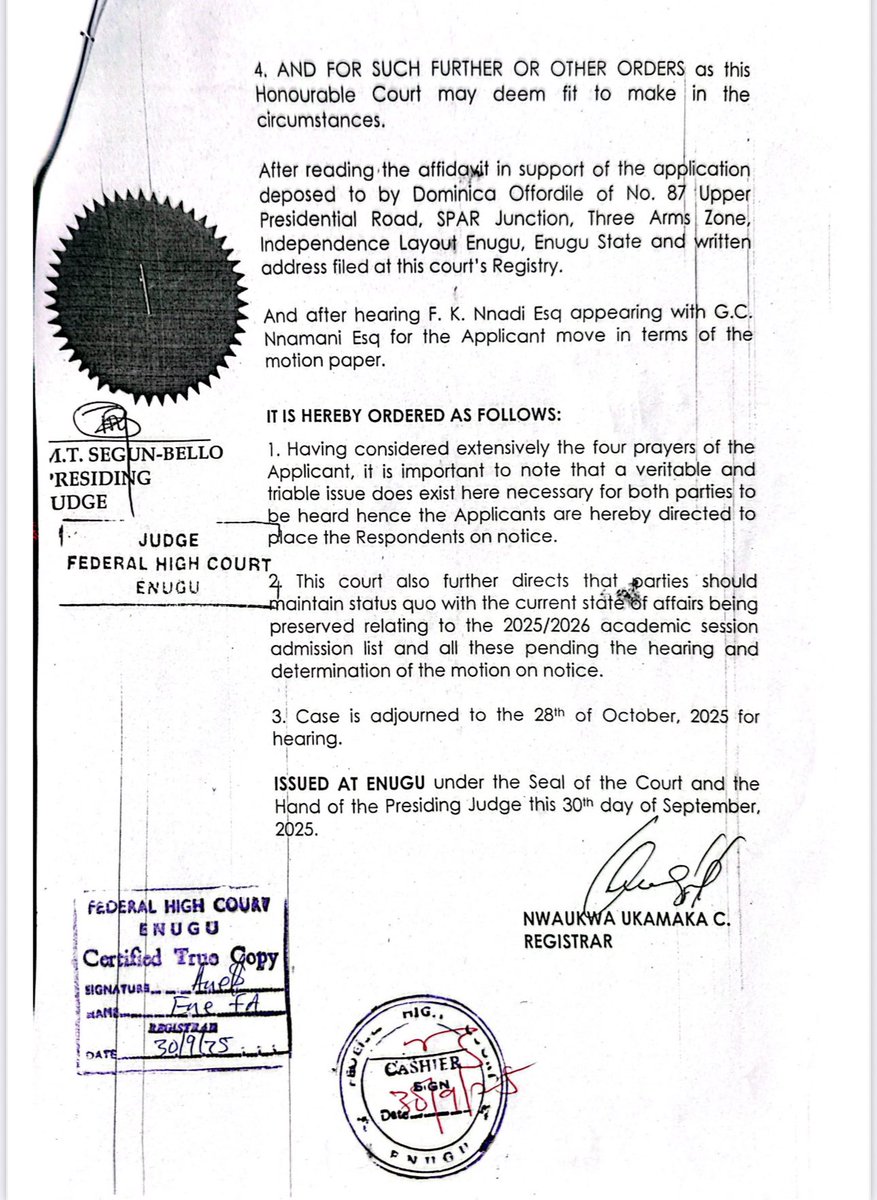
We have filed a MOTION EX-PARTE against UNILAG and OAU.
They are now ordered by the Federal High Court to suspend all admissions until all raised concerns and investigations are completed.
These are our leaders of tomorrow and we need to protect and fight for them for justice
Rest in Peace, Somtochukwu Christelle Maduagwu
I am deeply saddened by the tragic and untimely death of Somtochukwu Christelle Maduagwu, a brilliant young anchor with Arise News, who was killed in the most painful circumstances during a robbery attack in Abuja.
At only 29, Somtochukwu had already distinguished herself as a gifted broadcaster and trained lawyer whose voice engaged, informed, and inspired many. Her loss is not only a personal tragedy to her family and colleagues but also a huge blow to journalism and to our nation, which continues to lose its brightest to insecurity and violence.
This heartbreaking incident once again highlights the urgent need for us as a country to prioritise the safety and security of every citizen. No Nigerian should go to bed fearful of what the night may bring, or lose their life in such senseless ways.
My thoughts and prayers are with her grieving family, the Arise News family, and all who mourn her. May her soul rest in peace, and may we, as a nation, work harder to build a country where lives are valued and protected. -PO
GTC Enugu school fees now N300k termly?
I think it’s unfair for the people of Enugu.
This was built from tax payers money.
It’s their right to be educated for free as citizens and not a privilege.
It’s just common sense.
Pad a girl campaign you won't contribute.
Let's empower the girl child funds, you won't contribute
Let's distribute medical supplies for the girl child. You won't see.
Let's empower jobless youths. your vision is blurred
Female medical outreach, you develop a cataract
Woman accuses someone of Rape- Let's have a resource and fund pool.
Some of you need to see Psychiatrists for mental evaluation.
Where Did ₦1 Trillion Go?
I recently read a report from the Development Bank of Nigeria (DBN) stating that it has disbursed over ₦1 trillion to Micro, Small, and Medium Enterprises (MSMEs) in Nigeria since 2015. By simple conversion over the said period, this amounts to more than $1 billion.
I did not comment immediately on this claim because I wanted to investigate further, especially through my travels and contacts with small businesses across the country. The reality is that most of them are not even aware of any such disbursement, and over 80% are unaware of the Bank’s very existence. The level of knowledge about the existence and utility of such an institution is directly proportional to its impact on the people it is meant to serve.
If indeed such an amount was deployed to support enterprises, the results should be evident. For instance, if $1 billion were disbursed in small loans averaging about $,1000 each, it could have supported at least 1 million small businesses. The ripple effect of this would have been no less than 3 million new jobs, with visible growth in enterprises, an improved economy, and measurable progress in lifting people out of poverty.
But the reality before us today tells a different story: unemployment remains at a record high, businesses are struggling to survive rather than thriving, many enterprises are shutting down or relocating outside Nigeria, and poverty is deepening instead of reducing. So the critical question is: if ₦1 trillion truly left the coffers of DBN to empower Nigerians, where did the money go?
How can such a huge sum be disbursed and yet ordinary Nigerians feel no impact? Empowerment is not a slogan or a campaign tool - it must be proven by results. Nigerians need to know where the money went. Who exactly were the beneficiaries? What tangible businesses were created? Where is the proof of jobs generated or poverty reduced?
Without answers to these questions, the claim of ₦1 trillion disbursement remains yet another round of grand deception, where scarce national resources are captured by a few elites and recycled under the guise of empowerment schemes.
Nigeria must insist on transparency and accountability. Our people deserve evidence that such vast sums are being invested in their lives and future—not lost to corruption or buried in empty statistics.
A New Nigeria is POssible. -PO