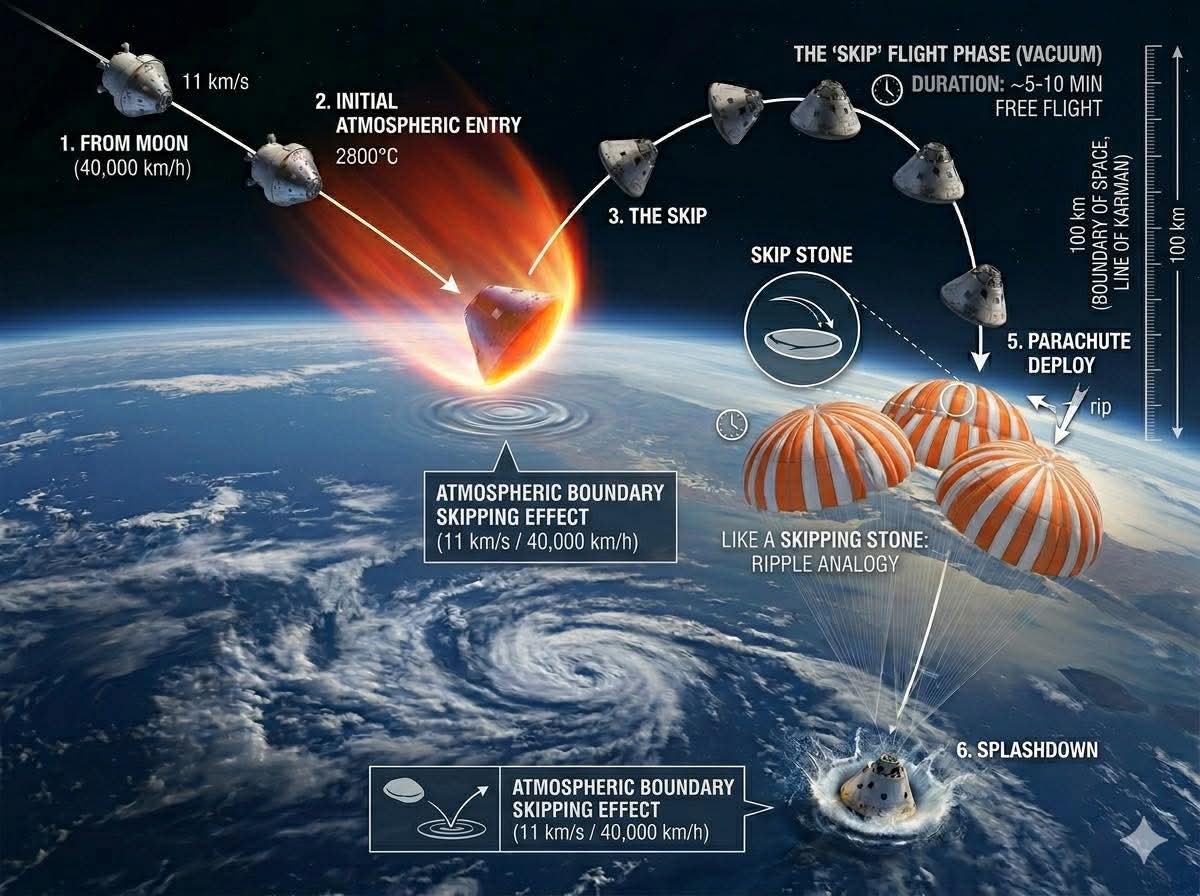
The Artemis 2 crew, returning from a lunar flyby, is doing something they've never done with people on board.
Orion is flying at 40,000 km/h. At that speed, the atmosphere isn't air, it's a wall. You can't just dive down—the crew would be crushed by the G-forces, and the ship would burn up.
So they came up with this idea. Orion will enter the atmosphere, heat up to 2800 degrees, and bounce back into space. Like a pebble bounces off water. Remember throwing flat stones down a river as a kid?
Up there, it has a couple of minutes to cool down. Then it reenters and lands.
The trick is that such a jump drops the G-forces from 10g to 4g. The difference between tolerable and done.
The Apollo missions returned differently. They didn't jump, they simply glided through the upper atmosphere like a skier down a hill, gradually losing speed. One pass and that's it. It worked, but the G-forces were severe.
The Soyuz reenters the ISS quite simply. Its speed is half that of Orion, and the atmosphere handles it in one pass. No tricks needed.
But Orion arrives from the Moon. Different speed, different task. That's why they came up with this jump.
But if the calculations are off even slightly, the rebound will throw the ship back into orbit, into space. There are no braking engines left. They'll simply wait for the Earth to pull them in. With a finite supply of oxygen. And if the rebound is even higher, they'll be blown off into space altogether.
I hope everything goes perfectly...
O Clube de Regatas do Flamengo agradece a Filipe Luís por toda a dedicação e conquistas ao longo dessa jornada como treinador. Desejamos sucesso na sequência da carreira.
#obrigado
vai com deus narigudinho do meu coração eu te criticava mais não queria isso eu te xingava mas não queria que vc saísse era só raiva de torcedor puto e chateado te amo pra sempre meu ídolo, estou sem acreditar nisso ainda