Even as I am still studying the 2024 fiscal budget as presented to the National Assembly last week, I cannot wait as I am compelled to ask : what is exactly wrong with us as a country?
Three nights ago, I had this alluring sound playing in my head and decided to capture it.
Grabbed a bass guitar, a mic and shakers, then the beautiful tune emerged.
I have been listening to it ever since; so I decided to share it with you in its first form.
This WW2 bunker used a fake air vent to return grenade to sender. Warfare during World War II became more gruesome due to remarkable technological advances. However, in Normandy, bunker builders employed a deadly trick through misdirection. They designed a hole, cleverly disguised as an air vent, enticing advancing enemies to toss a grenade. Yet, to their dismay, the explosive simply dropped through a small pipe, landing at the assailant's feet. Imagine the fear coursing through their minds during those harrowing 2 seconds before the explosion.
Interview red flags that I've found recruiters look out for during interviews that you should be aware of + detailed solutions.🚩🧵
1. Not having specific examples to back up your experience:
This occurs when a candidate talks about their skills and work experiences vaguely or generically without providing concrete examples to support their claims.
Tip: Recruiters often look for evidence of your past accomplishments and contributions.
Solution:
Prepare for interviews by identifying specific projects, challenges, or achievements from past experiences that you're most proud of that demonstrate your skills and abilities. Then, discuss this using the STAR method (Situation, Task, Action, Result) behavioral interview technique to provide context, explain your role, describe actions you took, and highlight the outcome or result.
2. Asking for a highly inflated salary with limited experience:
There's a thin line between understanding one's market value and having unrealistic expectations.
Solution:
Research the average industry-standard salary for the role you're applying for and your exact level of experience. But also be prepared to compromise based on your skills, experience, and the company's current compensation structure/financial status.
Tip:
I'd advise telling them you know the average salary range for the role and that you're willing to negotiate something that works for both parties, provided their budget for the role is reasonable. And then proceed to ask them what their budget is. This often prevents them from lowballing you while not giving away any unreasonably high/low figure.
3. Having no idea of what the company is even about:
This indicates that the candidate has not done their homework and lacks interest in the company they are interviewing with. It suggests a lack of enthusiasm and indicates you're only there for job security.
Solution:
Before the interview, thoroughly research the company's products, services, mission, values, and recent news, and try out their product. Tailor your responses during the interview to show knowledge of the company's vision, how your skills align with the company's goals, and why you are excited about the opportunity to contribute to it.
4. Poor lighting during the interview:
While this may seem trivial because you're made to think interviewers are only interested in spoken words, they're known to assess your body language + facial expressions during interviews. Insufficient lighting can hinder effective communication and make it difficult for them to get a read on you.
Solution:
Always use a well-lit, quiet space for the interviews. Ensure that your face is visible and the background has no distracting elements. Test your lighting setup before the interview to ensure you're visible on the screen, and try to maintain a confident and relaxed demeanor.
4. Unclear or inconsistent answers.
This can be a sign that a candidate is not being truthful or that they do not clearly understand their skills and experience. It can also signal indecisiveness or a lack of clarity about their career goals. Interviewers often trust their gut instinct. They'll probably move on if they have a bad feeling about a candidate.
Solution:
Reflect on your priorities and preferences before the interviews. Ensure you have a clear understanding of who you are, your skillset, and the job responsibilities, and avoid making frequent changes to these expectations unless there's a valid reason.
Tip:
I always ask this follow-up question at the end of an interview: "Do you have any doubts about me that I could clarify to help you make a more informed decision?". This often prompts the interviewer to open up about any uncertainty they may have about you that you could clear.
5. Focusing on growth too early:
Immediately emphasizing growth aspirations can give the impression that you're more interested in advancing quickly than contributing to the team's success.
Solution:
During the interview, focus on discussing your qualifications, relevant experiences, and how you can add value to the company. Once you've established your capabilities and fit for the role, it's then appropriate to inquire about growth opportunities, but do so with an understanding that growth is earned through dedicated work and contributions.
6. Inappropriate interview attire:
Dressing inappropriately can create a negative impression and indicate a lack of professionalism and respect for the interviewer or interview process.
Solution:
Opt for professional attire that demonstrates your respect for the opportunity. You don't have to go overboard. Dressing in neutrals with minimal makeup and jewelry is generally a safe choice.
By addressing these red flags, you can present yourself in the best possible light and increase your chances of landing that dream role.
If you found this helpful, do well to like, retweet, and leave me a comment. We all learn every day, so if you know something I don't or have a contribution, do share your thoughts in the comments.💛
- Tech Company 1 - CTO; 3 months
- Tech Company 2 - CoFounder & Lead Engineer; 4 months
- Tech Company 3 - CTO; 2 months
If you are new to SoftwareEng (<2 years total), and your job history has several short roles at startups where they titled you “CTO” or “CoFounder” or “Founding/Lead Engineer”…
DELETE those roles and just call yourself “Software Engineer” at those companies. 🙏🏾
You can now review code 10x faster!
For better or worse, code reviews are part of the job. If you are part of a team, you'll spend hours trying to understand what other people wrote and giving them suggestions on how to improve.
Artificial Intelligence is changing this.
I had an opportunity to test @coderabbitai, a platform focused on changing how we do code reviews. The potential of a tool like this is enormous!
Here is what I did and what I learned:
First, I connected the tool with my GitHub account and gave it access to one of my repositories. @coderabbitai mentions they do not store your code nor use it to train any models.
Second, I opened a pull request with a few changes to the code. That's what kicked off the whole thing.
@coderabbitai reviewed every one of my changes.
We’ve been using linting and static code analysis tools forever, but they are limited and don’t understand the context of your code.
That’s where AI comes in and changes the game!
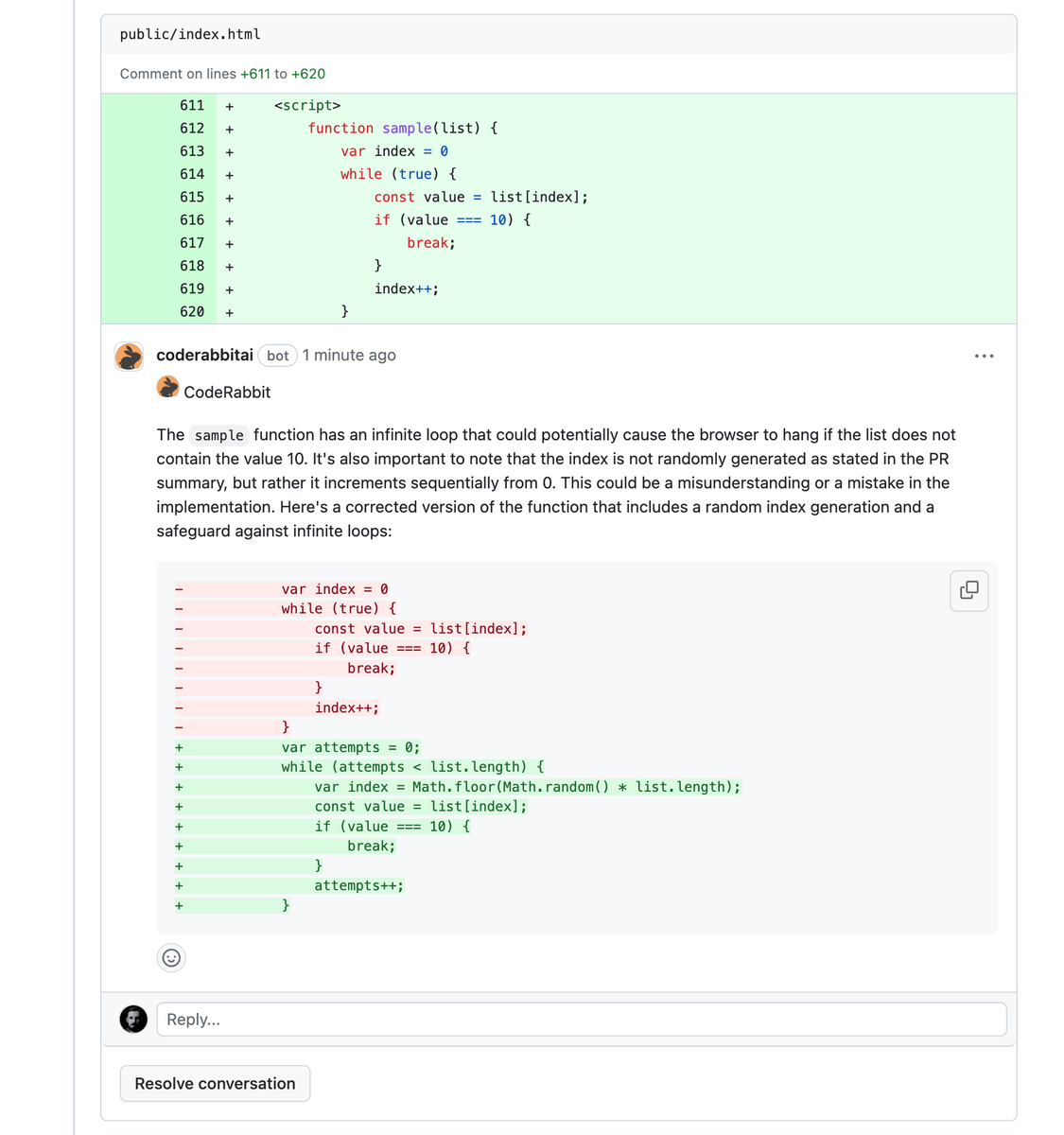
As expected, the tool gave me line-by-line suggestions for my changes. Look at the attached screenshot. That's a comment from the bot about fixing a potential infinite loop.
The tool reviewed every new commit I pushed to the pull request. The best part is that it keeps the entire feedback history in context, which helps with the quality of the suggestions.
You can also "speak" to the bot by tagging it in one of your comments. I asked it to rewrite one of its suggestions with a different variable name, and it did it.
Something cool that I didn't try is to customize the prompt the bot uses to do its job. Helpful when you want your review to follow a specific template or the bot to have personality.
How much work can we get off our plate if we have a bot as the first line of defense reviewing our code? Even better, how much will our code's quality improve?
These Artificial Intelligence tools are becoming indispensable, but remember, they need supervision. Use them to extend you, not replace you.
You can create a free account and try the tool yourself: https://t.co/AKpSUrPQ6p. They offer a 14-day free trial, but you can use the code MONTHOFF to get an additional month for free.
Thanks to @coderabbitai for reaching out, helping me understand their tool, and sponsoring this post.
FREE Exam Voucher!📢📢
@googlecloud is offering FREE access to their GCP lab and a 100% voucher for the exam of your choice.
All you need to do is to complete the required activities to receive the voucher.
Thread 🧵
From word vectors to Reinforcement Learning from Human Feedback...
Stanford's "Natural Language Processing with Deep Learning" course is one of the most relevant and best AI/ML courses today.
It's just amazing how much knowledge and content this course pushes out every year.
It's hands down one of my go-to resources to catch up on everything to do with NLP every year.
It contains notes, suggested readings, slides, tips, exercises, and so on.
I remember watching the 2017 lectures and just falling in love with the course. I have studied the course material since then and it has tremendously helped me to keep up with things on NLP.
It can feel like an advanced course for people that are just beginning but it's still an exceptional reference to keep up with research and topics.
(links in the replies)
This is the official #100kInterns repository.
If you're looking for a paid internship, RT this and reply with :
1. Your field
2. Your Linkedin URL or a link to your Portfolio
3. Your Country
Our first milestone is to get paid internships for 5000 people....
we can do it together.