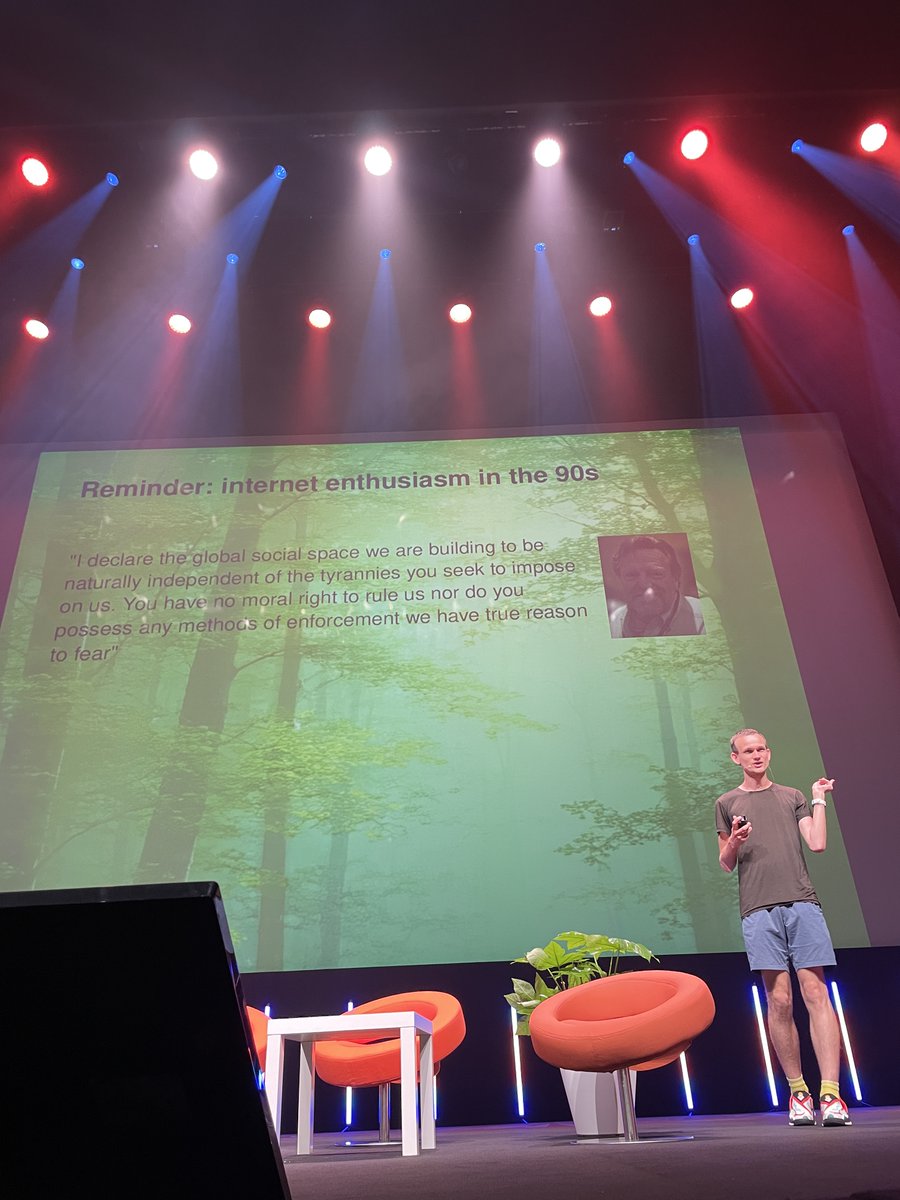
This morning I was in the front row listening to @VitalikButerin's keynote at @EthCC in Cannes and I was deeply impacted by his message 🥇
If you didn't know, this is traditionally a moment where technical topics dominate the conversation.
But this year, I believe a rather unique moment occurred where the Ethereum community found itself facing its own reflection.
"When we build, let's remember who we were when we joined this adventure. What convinced us? What made us want to contribute? If we can no longer imagine that feeling in those who are arriving today, then we have lost our way."
In a packed amphitheater (typical when the "V" makes an appearance), he reminded everyone that technology is not an end in itself.
"There's this belief among some that by accelerating technology, we're necessarily advancing the greater good. Yes, we can exhibit numerous graphs showing that technology improves almost all indicators. But this progress doesn't come for free. It's often the result of courageous decisions made to fix what wasn't working."
What he described is a creeping drift: that of technological solutionism which too often masks ethical emptiness. Honestly, it was pure @evgenymorozov in text form.
For him, building on the blockchain isn't enough to make a system just.
We need to go further, questioning the true properties we're offering to users.
Vitalik also warned against the temptation to reproduce Web 2.0's mistakes.
"We can learn from Android's successes and failures. Android allowed Linux to conquer the general public. But did it make users more free? Yes, you can install APKs. But by default, most phones are saturated with bloatware and spyware... The result is mixed."
According to him, the same question applies to Ethereum.
To summarize, we could say his speech was an invitation to restore social meaning to what the ecosystem is building.
To refuse letting the ideal become diluted in speculation or captive network effects.
To remember the pioneering energy of the early days, the energy that drove those who joined Ethereum with no other certainty than a desire to invent a more open, more inclusive system.
While one might have expected a progress report from Vitalik, I find that he instead delivered a warning.
"Our ambition must be greater. We don't just want to succeed. We want to create something that deserves to succeed. A platform that the next generation will say truly brought openness, freedom, and fair access. If we forget this ideal, Ethereum will become just another generational phenomenon, destined to fade away like so many others."
🔵 À lire dans @TheBigWhale_
C'est l'un des plus grands piratages d'exchange Bitcoin
Plus de 10 ans après Mt.Gox, on découvre des ramifications jusqu’aux services secrets russes 🇷🇺
Affaire d'État ?
Brillante investigation de @gabrielthierry
https://t.co/Y82E5eKsmp
TVL will become the Assets Under Custody metric of crypto.
A fluffy headline metric that actually means very little for a business.
State Street custodies $50 trillion yet is only valued at $25 billion.
Compare that to JPM, who custodies $30 trillion yet is valued at a whopping $645 billion.
It's about what you do with the assets, not about how much you having sitting unproductively on your platform.
A critical challenge faces the crypto industry: identifying promising projects amid countless initiatives.
While traditional markets rely on concrete metrics (revenue, EBITDA, profits), crypto lacks dependable evaluation tools.
The industry often relies on limited data from projects or blockchain metrics (TVL, token prices, trading volumes) - but these rarely tell the full economic story.
The answer?
Building analytical tools an ratio to objectively assess projects and spot tomorrow's winners.
That's precisely our mission at @TheBigWhale_ with our data platform.
Try it out and help us make it even better! https://t.co/JoSr5qpZ1a
Not many people recognize, but @TheBigWhale_ is not just a subscription based media firm.
They truely love and understand crypto, and are building a new type of business.
I will be writing an article on this soon.
Huge respect to @Raph_Bloch and his team
To create the best possible source of intelligence in digital assets, you need more than research—you need eyes and ears everywhere.
That’s why @TheBigWhale_ has built a global network of experts. Here’s why we did it 🧵👇
🇺🇸 Day 3 in Denver. Just attended an inspiring masterclass by @pbrody, EY's global blockchain leader.
Brilliant exchange with @teddyP_xyz (@plumenetwork)!
Here are Paul's key insights 🧠
👉 Web3 adoption is now purely about willpower, not capability. "No more regulatory or tech barriers. Those claiming they can't are simply unwilling."
👉 Avoiding crypto is a "critical strategic mistake" for any company. "It's like rejecting the Internet 20 years ago."
👉 Price concerns are secondary. The adoption curve mirrors post-1999 Internet: "The bubble burst gave us Google, Amazon, and other tech giants."
👉 For financial institutions, transaction privacy remains crucial. The answer lies in "privacy onchain" solutions (they exist - looking at you, @KakarotZkEvm & others)
👉 Private blockchains are useless: "All the complexity, none of the benefits". As a technology rather than a market, blockchain's future lies in public standards.
👉 Stablecoins are blockchain's breakthrough application. They're revolutionizing finance automation and emerging as the go-to settlement tool for tokenized assets.
👉 "I'm incredibly optimistic about tokenization - it's the next wave". Pension funds, managing vast capital through indices, will see transformed investment impact assessment, enabling innovative strategies. @pbrody projects $40 trillion in tokenized assets over 40 years. "That's $1 trillion annually".
More to come on @TheBigWhale_!
ELI5 why we cannot "rollback" Ethereum?
After yesterday's Bybit hack, crypto commentators are again asking why Ethereum cannot "rollback" the chain to reverse the hack.
While experienced ecosystem actors near-unanimously agree that this is infeasible, it's worth breaking down why this reasonably sounding proposal is technically intractable for less knowledgeable observers. If that's you, consider this an "ELI5" version of why this is impossible.
First, some context on rollbacks:
The idea of a blockchain "rolling back" stems from an early incident in the Bitcoin blockchain. In 2010, less than two years since Bitcoin's launch, a bug in the client software caused 184 billion (yes, *billion*) Bitcoins to be minted in block 74638.
To fix this, Satoshi released a software patch to the Bitcoin client which invalidated the transactions. This had the effect of "rolling back" the chain which had kept growing in the meantime to block 74637. In less than a day, the new chain had accumulated enough proof-of-work to become canonical and all user transactions that had been rolled back were included in the new chain. Note that at the time, Bitcoin's mining difficulty was 10 billion times lower than today, and the BTCUSD price was about 0.07$.
In short, this situation was unique in that a clear protocol bug led to the problematic transactions, which could easily be identified due to their large amount. Additionally, Bitcoin's limited adoption made it easy to distribute a new client version and quickly mine a new chain segment.
Ethereum and TheDAO:
Ethereum's early history had a superficially similar crisis which often leads to confusion about the practicality of rollbacks. In 2016, a popular Ethereum application, TheDAO, had ~15% of all ETH in existence under its control. Unfortunately, a hacker found a bug in the application's code that allowed them to steal all of these funds. This was notably different than the Bitcoin situation because the Ethereum protocol worked as intended, it was the application built **on** Ethereum that had an issue.
Luckily, the developers of TheDAO had implemented a failsafe where withdrawals from the applications were frozen for a month before they were completed. This presented a unique opportunity to address the bug: the code of the application could be changed to prevent the funds from ultimately going to the hackers.
Because there was no way in the application itself to do this, Ethereum protocol developers had to make the change directly in the blockchain's history. This is called an "irregular state change", because the "state" of the application was changed by manually updating the database, rather than, say, by a valid Ethereum transaction.
A rough comparison to the Bitcoin bug above would be to have set the balance of the addresses that received the 184 billion BTC to 0, rather than re-mining a chain excluding those transactions.
This upgrade was contentious and the Ethereum community effectively fractured over it. A subset of miners refused to run the software patch and kept mining on the chain where the hack happened, which still exists as Ethereum Classic. The chain that is known as Ethereum today is the one where this software upgrade was activated.
Again, this situation was unique. Hacked funds from TheDAO were effectively frozen for a month, giving time for the community to coordinate on a software upgrade. The funds being frozen had another major advantage: there was no "contagion" from the hack. Had the hacker been able to move funds at will, "freezing" the funds would be an impossible cat and mouse game, as the protocol is open source and any potential change which froze the funds would have to be broadcast to the hacker, giving them plenty of time to move their funds elsewhere.
Which brings us to the Bybit incident.
Why we can't rollback Ethereum
Earlier this week, the Bybit exchange had 401,346 ETH (~1.4B USD) stolen. The theft was caused by the custodian of the funds signing a misleading transaction in a compromised multisig interface.
The root cause for this hack was higher up the stack than both TheDAO and the Bitcoin overflow bug. There were no issues with the Ethereum protocol, or even with the underlying multisig application used by Bybit. Instead, a compromised interface made it appear as though a transaction was doing one thing while it was actually doing another.
From the perspective of the Ethereum protocol, there is nothing to distinguish that transaction from other legitimate transactions on the network. There is no protocol rule that was broken where patching the issue would isolate the hacked funds, like in the case of the Bitcoin exploit.
Furthermore, the funds were immediately available for the hacker to spend. Unlike in the case of TheDAO, where the community had a month to deploy a surgical intervention, here the hackers immediately started moving the funds onchain.
Even if we could solve the cat and mouse game described above, the Ethereum ecosystem is far different today than in 2016. DeFi and bridges to other chains mean that any stolen funds can easily be mixed within a web of applications. For example, stolen funds can be swapped on a decentralized exchange, with the resulting tokens being used as collateral in a DeFi protocol, where the borrowed assets are bridged to a completely separate chain.
This level of interconnectedness means that any irregular state change, even if socially palatable, would have near-intractable ripple effects. A "full rollback", where a portion of the recent chain history was invalidated, would be even worse. Any settled transaction, many of which have implications outside Ethereum (e.g. exchange sales, RWA redemptions, etc.) would be undone, with no way to revert the offchain half of it.
So, to conclude, while Bitcoin was able to "rollback" its blockchain 15 years ago, today, the interconnected nature of Ethereum and settlement of onchain <> offchain economic transactions, make this intractable today.
Technically, irregular state changes are still possible on Ethereum in cases where funds are frozen and isolated. The last time such a change was proposed, in 2018, to address a bug in Parity's multisig wallet where ~500,000 ETH were frozen (see EIP-999), it was strongly opposed by the community of the contention resulting from TheDAO.
I've been working on this thing for the past 3 years on and off. It started as a fun side project but grew into something huge (like, REALLY HUGE). You've never seen anything like it! Check out my detailed post below.
And zoom this thing in Figma 🔍 https://t.co/DlsEjo1Dxq