Mom travel hack:
If your kids are too old for sippy cups but won't do well with open cups on a plane, getting collapsible water bottles like this are a godsend! Pour their drinks in, and the drinks can be capped when not being sipped!
#travelingwithkids#TravelTips#momhack
@KeithSmithNBA@MsBforStudents Everything about your post is awesome- helping teachers, helping those who help teachers! 🫶
I teach at an urban high school in MA. We go back soon, so it's almost time to get ready and get our back to school faces on! 🥳
https://t.co/R1Ij4YqMwY
Back to School Giveaway is here! 🎒
Win AirPods 4, RORRY charger, STANLEY, Kindle, or $50 Amazon gift card.
5 winners, 1 random item each!
Easy Entry Rules:
1. Follow @RORRYOfficialUS
2. Like & Repost this post
📅 Aug 20 — Aug 30
#RORRY#BackToSchool#giveaway
@SteelCityHelps 🤩Teaching over 20+ years
🤯Switching to block scheduling this year (+2 additional sections of classes!)
⛱️Still have some break left
❤️🖤Looking forward to meeting my new students!
https://t.co/R1Ij4YqMwY
#clearthelist2026#teachersofx
@JohnLegere Hi, John! I teach AP Seminar and Co-Taught Senior English in Brockton, MA. We're switching to block scheduling this year, so it'll be an adventure changing up my format!
#johnclearmylist
https://t.co/R1Ij4YqMwY
@ClearTheList2 AP Seminar: English 10 and Co-Taught Senior English in a MA urban school. 📚⌨️ We’re moving to block scheduling for the first time this year,so I’m picking up a few extra sections! 🥳 https://t.co/R1Ij4YqMwY
@SteelCityHelps 10th and 12th grade teacher in urban school in MA. Always looking to keep my classroom engaging while recognizing the needs of each student!
https://t.co/R1Ij4YqMwY
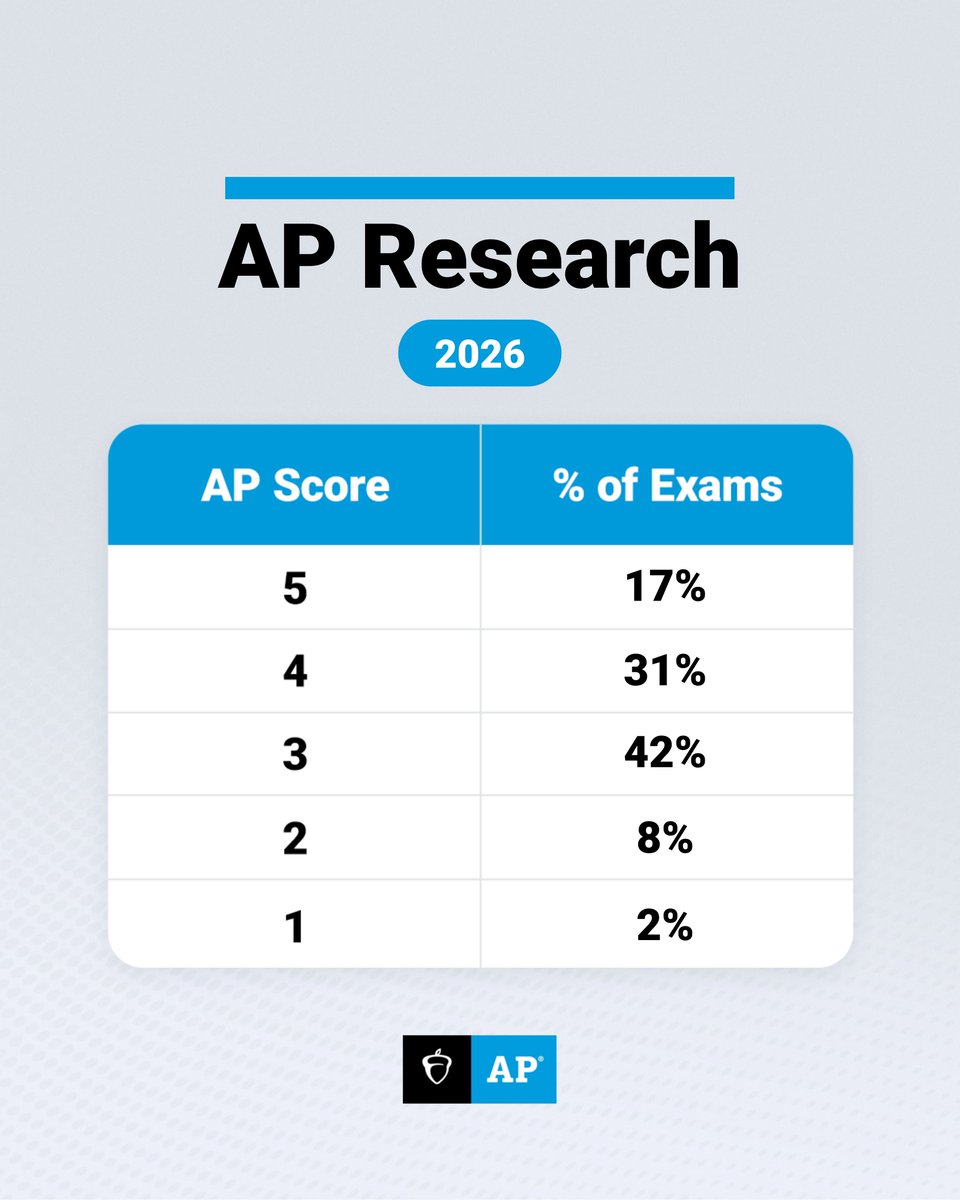
The 2026 AP Research scores:
5: 17%; 4: 31%; 3: 42%; 2: 8%; 1: 2%
AP Research papers were developed and submitted by ~53,000 students this year, less than 1% of the high school population.
About the AP Research scores
We hear often from Higher Education and employers about the need for students to develop and demonstrate durable skills. And when we surveyed AP students across all 40+ subject areas last year to ask whether what they learned in the AP course was relevant to their futures, AP Research received higher ratings than any other AP subject, period. (The next highest-rated for future relevance were Calculus, English Literature, Seminar, Spanish Language, and Spanish Literature.)
And this makes sense to me, given the persistence, self-management, and transferable skills students develop and demonstrate in AP Research. Over the course of the year, each student independently designs, plans, and carries out an original scholarly investigation on an academic topic, problem, issue, or idea of their own choosing—selecting their own research question, methodology, and sources. This kind of sustained, self-directed inquiry mirrors the authentic work of university researchers.
The course culminates in a 4,000–5,000-word academic paper and a 15–20-minute presentation with oral defense. (Students must defend their research question, methodology, and findings before a panel of evaluators—answering probing questions that test the depth and rigor of their scholarship.) The paper accounts for 75% of the AP score, and the presentation and defense for 25%.
The scoring rubric is designed to reward papers that go beyond summarizing existing research to make genuine contributions to knowledge: articulating a clear and defensible research question, applying a sound and replicable methodology, presenting logical reasoning supported by sufficient evidence, and demonstrating mastery of academic conventions including accurate citation.
The topics AP Research students pursue reflect genuine intellectual curiosity across virtually every discipline—from the sciences and social sciences to the humanities and the arts. Each year, the range and inventiveness of the research questions students generate impresses and sometimes astonishes the faculty who read and score these papers.
In short, AP Research students build and use a set of transferable research and writing skills—including literature review, research design, data analysis or textual analysis, argumentation, and citation—that are directly applicable in college coursework regardless of major. Students who complete AP Research demonstrate that they can identify a meaningful question, engage seriously with the scholarly literature, collect and analyze evidence, and communicate findings to an academic audience.
AP Research scores of 5: Papers earning AP 5s demonstrated original inquiry—a well-defined research question, a detailed and replicable methodology, logical reasoning that ties evidence to conclusions, and skillful use of academic conventions.
AP Research scores of 3 or higher: Papers earning at least a 3 advanced meaningfully beyond summary—they articulated a focused research purpose, engaged credibly with sources, and presented findings in appropriate academic form.
All subjects’ AP score distributions for 2026 will be posted here when available: https://t.co/OrkaQhPZYO
I'm close to having score results to begin sharing for this year's AP Exams. Here's a quick overview of how this will unfold.
The scoring of AP essays and free-response questions by ~30,000 professors and teachers - this year's AP Readers - runs throughout the first three weeks of June, with some make-up exam scoring continuing thereafter.
Once scoring is complete, the psychometric work begins. These annual processes ensure that this year's students are neither disadvantaged by tougher questions or stricter grading, nor advantaged by easier questions or easier grading.
Statistical analysis identifies the precise difficulty and scoring stringency of each question in comparison to prior years. If a given exam version proves to be easier, a higher number of points is required to earn scores of 5, 4, 3, or 2 on that version; if harder, a lower number is required. This work is led for the AP Program by the current president of the National Council on Measurement in Education.
After Readers have finished scoring and psychometricians have set the specific "cut scores" (points required) for each exam version, I'll be able to start sharing key findings as we collectively wait for this work to be completed across all 40+ AP subjects so that scores can be sent to colleges, students, and educators in early July.
Here's what I'll be covering as results come in:
• The focus areas of the free-response questions. (This year's exam questions were crafted by educators from virtually every state and DC; each question is worked on by a minimum of 15 professors and teachers before appearing on the test. I'll use this opportunity to pay tribute to their superb work.)
• Any statistically significant increases or decreases in the difficulty of this year's questions or scoring rigor.
• Particular content areas within the multiple-choice section where students scored especially well, or particularly struggled.
• Specific components of the free-response questions where students scored especially well, or particularly struggled.
All of this is very much an attempt to share in real time the data I'm receiving, to tide us all over until scores are released in a few weeks.
A few reminders:
• I'll report each subject as it's completed, and that timing will depend on how long it takes to score this year’s questions, so I can’t publish a schedule for sharing these updates. But I will have this info for all subjects no later than June 30.
• Because these score distributions include all students worldwide, individual classrooms will often have score distributions that are either higher or lower than this aggregation.
• AP Exams aren't scored on a curve. Rather, as many students as earn the points necessary for college credit receive a score of 3 or higher.
• If you're an AP student, here's information about how to make sure you're able to view your AP scores starting July 6: https://t.co/u2bTSrgujK
• You have until June 20 to indicate which college should receive your free score send: https://t.co/XL9cPGLw7f
• If you're an AP educator, here's information about how to view your students' AP scores starting July 6: https://t.co/oO5ufXWaVe
@jtshiffman@jtshiffman I wanted to pop over and say thank you for your gift! 🫶. My students use dry erase all the time for brainstorming and the markers are truly helpful! Thank you again!!!
@jtshiffman Wow! You rock! I teach at an urban school in MA. I teach AP Seminar and love it! After 13 years of teaching AP Lang, I am transitioning to cotaught seniors (and moving classrooms for the 4th time in 5 years), and looking forward to both switches!
https://t.co/R1Ij4YqMwY