Las 10 leyes del pecado:
1. El pecado te llevará más allá de dónde pensabas llegar.
2. El pecado te alejará por más tiempo de lo que habías pensado.
3. El pecado te costará más de lo que querías pagar.
4. Pecas a tu manera; pero tienes que regresar a la manera de Dios.
5. El pecado engendra pecado.
6. El pecado te lleva a justificar lo que has hecho.
7. El placer es efímero y temporal, pero las consecuencias del pecado son duraderas.
8. No hay pecado oculto que Dios no ponga de manifiesto.
9. Mi pecado comienza cuando yo quiero, pero las consecuencias comienzan cuando Dios quiera.
10. Nadie se burla de Dios.
In the ongoing discussions Christians have on the topic of AI, I rarely hear serious thought being given to the intellectual and spiritual danger it poses to young people, so I greatly appreciate this conversation between @ericmetaxas and apologist John Lennox.
All Christians should carefully consider Lennox's warnings on how an overreliance on AI and modern technology will weaken us as thinking Christians:
"...Reading has dropped. Look at the statistics that have been published recently in the US and in the UK. And what concerns me massively about that is this: On the Christian level, our source of food is 'man shall not live by bread alone, but by every word that proceeds from the mouth of God.'
As it affects our witness, we've only got one offensive weapon, the Sword of the Spirit, the Word of God. And this is such a subtle attack on the will to read, that we need to develop a whole new set of arguments and thinking to show that, young people, you can use AI to destroy yourself. And the addiction to it is as bad as the addiction to heroin.
But you can use it to learn. In other words, instead of asking for it to create an essay for you and do your work for you, you can say, if you were going to approach this topic, what lines of research should I follow?
...We need educators now who know how to shift pupils from the lazy situation to saying, 'Here's a tool. It's here to stay. How can we use it creatively?'"
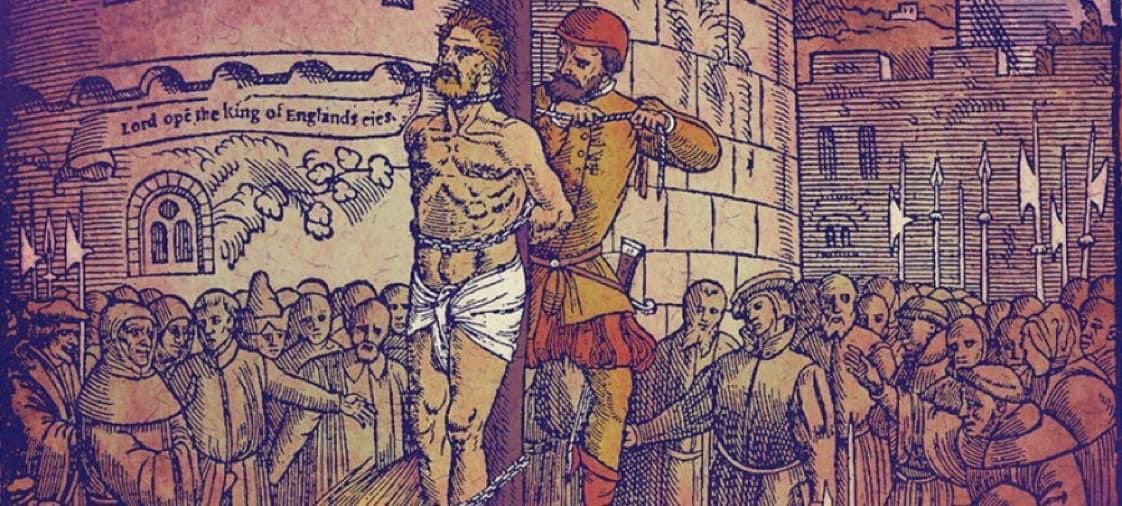
They strangled William Tyndale, burned his body, and tried to erase his English Bible.
Seventy-five years later, his words filled the King James Version.
In the early 1500s, ordinary English people could not legally read an unauthorized translation of Scripture in their own language.
Tyndale believed even the poorest farmer should be able to read and understand the Word of God.
He reportedly told one clergyman that if God spared his life, he would cause a boy driving a plow to know more of Scripture than he did.
Denied support in England, Tyndale fled to continental Europe and began translating from the original Greek and Hebrew.
In 1526, he produced the first printed English New Testament translated from Greek.
Copies were smuggled into England, where church authorities confiscated and publicly burned them.
But Tyndale continued.
He moved from city to city, lived under false names, and quietly translated more of the Bible while his enemies searched for him.
Then an Englishman named Henry Phillips befriended him, betrayed him, and delivered him to the authorities.
Tyndale spent more than a year imprisoned near Brussels. In 1536, he was condemned as a heretic, tied to a stake, strangled, and then burned.
His final prayer was reportedly:
“Lord, open the King of England’s eyes.”
Within three years, King Henry VIII authorized the Great Bible for English churches. It drew heavily from Tyndale’s work.
Then, in 1611, the translators of the King James Bible preserved much of his language. One textual study estimated that Tyndale’s words account for 84 percent of its New Testament and 76 percent of the Old Testament books he translated.
His enemies destroyed his body.
They could not destroy his words.
Every time English-speaking Christians read phrases like “Let there be light,” “the salt of the earth,” or “the powers that be,” they are still hearing the voice of William Tyndale.
If your theological convictions are not actively making you more gracious, humble, and repentant than your beliefs are not being shaped by Jesus they’re motivated by a desire to be argumentatively “right.”
“But to the wicked God says: “What right have you to recite my statutes or take my covenant on your lips? For you hate discipline, and you cast my words behind you. If you see a thief, you are pleased with him, and you keep company with adulterers.” — Psalm 50:16-18
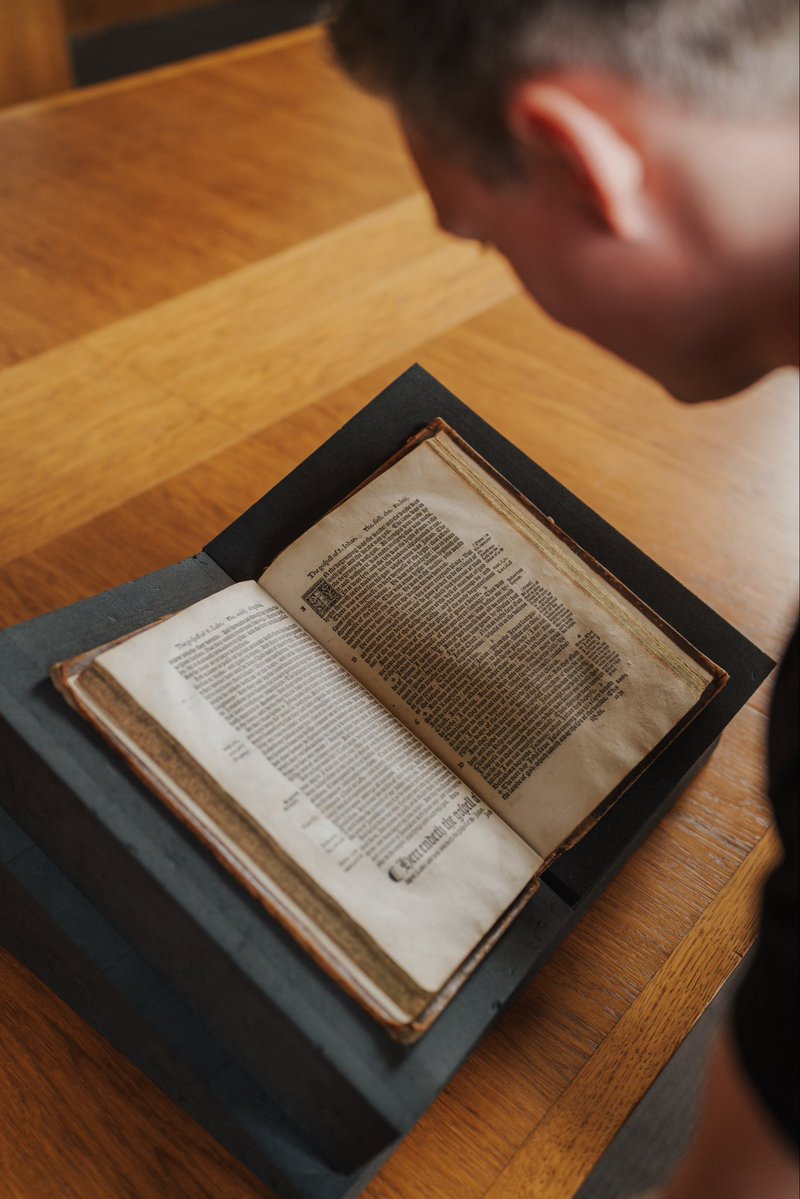
Pretty special day today getting the opportunity to spend some time with a 1536 Tyndale New Testament. This spectacularly preserved copy was printed the very year William Tyndale was burned at the stake.
Tyndale is usually credited with coining or first popularizing a small but highly influential set of English biblical terms. One of which you can see on the very page Im looking at: atonement.
Tyndale’s motivation was basically translation + theology: he wanted an English word that could carry the biblical idea of estranged parties being made “at one” again, especially God and sinners through Christ.
The word “atonement” appears to have existed just before Tyndale; Thomas More is often cited as an early user around 1513, meaning “reconciliation” or settlement after conflict. But Tyndale seems to have been the one who gave it its powerful biblical-theological career in English Bible translation, especially from 1526 onward.
The word literally expressed “at-one-ment.” In early English, “atonement” meant something like being at one, concord, agreement, reconciliation. That made it useful for rendering biblical concepts of reconciliation between God and humanity.
Tyndale used “atonement” because “reconciliation” alone did not fully capture, in earthy English, the biblical idea that Christ’s saving work makes God and sinners “at one.” It was a translator’s solution, but also a Reformation theological choice.
𝗣𝗿𝗼𝗽𝗵𝗲𝘁: “Behold, something greater than Jonah is here” (Matt 12:41).
𝗣𝗿𝗶𝗲𝘀𝘁: “But I say to you that something greater than the temple is here” (Matt 12:6).
𝗞𝗶𝗻𝗴: “Behold, something greater than Solomon is here” (Matt 12:42).
Sinners cannot imagine that the things they love are the very things that keep them from happiness. Their fear of the light and refusal to let go of the darkness is a struggle against joy.
“The symbol of authentic Christian leadership
“is not the purple robe of an emperor, but the coarse apron of a slave;
“not a throne of ivory and gold, but a basin of water for the washing of feet.”
— John Stott
It is extremely important to distinguish between faith as the ground of our justification (wrong) versus faith as instrument of our justification (right).
Justification is grounded upon the obedience and satisfaction of Christ; that is the “stuff” of the righteousness we receive from Him. Faith is merely the (sole) instrument—the empty hand—by which we lay hold of His righteousness.
If you construe faith as the ground rather than the mere instrument of justification—if the stuff of our righteousness is our believing—then you make faith into a work and the Gospel into a new law.
This excerpt from Horatius Bonar explains this distinction well.
https://t.co/YqW8RBydPL
“Faith is not our saviour. It was not faith that was born at Bethlehem and died on Golgotha for us. It was not faith that loved us, and gave itself for us; that bore our sins in its own body on the tree; that died and rose again for our sins. Faith is one thing, the Saviour is another. Faith is one thing, and the cross is another. Let us not confound them, nor ascribe to a poor, imperfect act of man, that which belongs exclusively to the Son of the Living God.”
“And it will be said in that day,
‘Behold, this is our God for whom we have waited that He might save us.
‘This is Yahweh for whom we have waited;
‘Let us rejoice and be glad in His salvation.’”
— Isaiah 25:9
O, for that day!
“Many sermons (even from the gospels) are far from Christ-centered. How is this possible?
“The preacher has looked into the text principally to find himself and his congregation, not to find Christ.
The sermon is consequently about ‘people in the Gospels’ rather than about Jesus Christ who is the gospel.
“The real question the preacher has been interested in asking and answering, is not
‘How do we find Christ in this Gospel?’ but ‘Where am I in this story? What have I got to do?’”
— Sinclair Ferguson
“If I say to a man that the sun is risen and shines on the earth,
“if he questions or denies it, and asks me to prove it, it is sufficient to say, ‘It proves itself by its own light.’
“If he then says that this is no proof to him because he cannot see the light of the sun, then it is a satisfactory answer to say that he is blind.
“If he is not blind, it is useless to argue with him because he is contradicting the witness of his own eyes and leaves himself with no satisfactory rule by which he could ever be convinced about anything.
“So if I tell a man that the ‘heavens declare the glory of God, and the firmament shows his handiwork,’ or that the ‘invisible things of God from the creation of the world are clearly seen, being understood by the things that are made,’ and he asks me how I can prove this,
“it is a sufficient answer to say that these things in and by themselves prove the existence of the infinitely wise and powerful Creator, and that he ought to be able to reason that out for himself.
“If he says that it does not appear to him that the universe was ever created but that it only came into being by chance,
“then it is sufficient to say that he is delirious and does not have the use of his reason, or that he is arguing in express contradiction to his own reason, as the heathen philosophers admitted.
“And if I declare to anyone that the Scripture is the word of God, a divine revelation, and that it proves and manifests itself to be so, and he replies that by the use of his sense and reason it does not appear to him to be God’s word,
“then it would be a sufficient reply to secure the authority of Scripture…to say, ‘All men have not faith,’ in the light of which alone we can see the marks of its divine origin impressed on it.”
— John Owen
Jonathan didn’t “get naked” for David.
In the ancient world, a royal robe symbolized authority and succession.
By giving David his robe, armor, and weapons, Jonathan acknowledged God’s chosen king.
Nothing sexual—just loyalty and submission.
Watch the full video to see why this claim falls apart: https://t.co/wlI8JzjewO
#DavidAndJonathan #BiblicalSexuality #Apologetics
Be frequent in prayer, and it will help you much. “Draw near to God” (James 4:8).
Complain of the slipperiness of your nature, of your weakness to withstand Satan’s assaults, and entreat God to give you strength that you may hold out.
—John Cotton, Works 2:163
Christian maturity is not less than accurate knowledge of Scripture and theology, but it is more than that.
Those who care most for sound doctrine are susceptible to the temptation to divorce sound doctrine from sound living.
But if the truth hasn’t changed you, you don’t know as you ought to know.
“Ah, Good Shepherd, my guilt! my guilt! I cannot go before the Holy One. I have done evil in His sight, and He is clear in judging. ‘Tis at my peril if I appear before him. ‘Tis as much as my soul is worth! For He is a consuming fire, and on my own responsibility I cannot go.”
“Be it so, brother. Be it at My peril then. Be it on My responsibility. ‘As much as your soul is worth’? As much, rather, as My soul was worth when I gave My soul a ransom for sin! Therefore be it on My responsibility, for I am responsible before the Holy One for poor lost sheep such as you are. Come, under My cover, My name, My righteousness, My responsibility. He cannot cast you out.”
“But, ah, Good Shepherd, even still; my weakness! my weakness! I cannot come. I am without strength. My feeble heart misgives me. My resolution fails me, and the bruised reed gives way.”
“Be it so. Not your resolution settles, rules, carries the glorious case this day, but Mine. Not that you are resolute to come; but that I am resolute to bring. Rest nothing on your own resoluteness: rest everything on Mine. Take hold on My resoluteness; let go of your own. O trust Me, trust Me! . . . Not because you are good at coming, but because I am good at bringing!”
— Hugh Martin