WATCH: “We made an enormous mistake allowing the ed tech industry to come in and give every kid a computer, a tablet, an iPad, a Chromebook… and the results are devastating and we need to stop.” @JonHaidt via @andersoncooper@AC360
ICYMI - I’ve shared some thoughts in my new Snow Report blog post about education’s decades-long problematic relationship with evidence and the fall-out for professional accountability (and student outcomes) this entails.
https://t.co/36i3gYkVSq
“We are admitting a cohort that cannot read at a college level and are pretending otherwise.”
Another college professor adds to the chorus of concern about student capacity.
In @chronicle:
“Six weeks into the term, I assigned my rhetoric and writing students a 20-page article. It was the same length I had assigned for five years and the same length I had read without complaint as an undergraduate a decade ago. Not one student finished it.
When I asked why, a student answered honestly: It was too long, and she kept losing track of what the paper was about. This was not a remedial class: These were students who had cleared the admissions process and written essays good enough to get them here. Yet a routine academic reading assignment had defeated them.
Every generation of professors has complained that their students cannot read. The lament is usually overblown, but data have caught up to anecdote, and what I am seeing in my classroom is no longer a hunch. There is a measurable, generational collapse in sustained reading and writing, and the academy is responding to it with improvisation and exhaustion rather than the structural overhaul it requires.
In February 2024, Adam Kotsko, who teaches in the Shimer Great Books School at North Central College, wrote in Slate that students who once handled 30 pages of reading per class meeting now seem “intimidated by anything over 10 pages and seem to walk away from readings of as little as 20 pages with no real understanding.” Crucially, he added that this is “not a matter of laziness on the part of the students” but of underlying skills they were never given a chance to build.
The Chronicle of Higher Education’s 2024 investigation found the same pattern across institutions as different as the Stevens Institute of Technology and Wellesley College, where the average SAT exceeds 1400. Nicholaus Gutierrez, an assistant professor at Wellesley, told The Chronicle that the baseline for what students consider a reasonable amount of work has dropped so noticeably that he has cut his readings accordingly; a 750-word essay now strikes many students as long. At Stevens, the science and technology studies associate professor Theresa MacPhail described following the mantra of “meet your students where they are” for so long that she has begun to feel “like a cruise director organizing games of shuffleboard.”
Worse, the national data tell the same story in colder language. On the 2011 National Assessment of Educational Progress (NAEP) writing assessment, which is the most recent comprehensive writing benchmark, only 24 percent of 12th graders reached the Proficient level, and just 3 percent reached Advanced; another 21 percent scored below Basic. The reading side of the ledger is worse, and getting worse fast: The 2024 NAEP results released in September 2025 show 12th-grade reading scores at the lowest level recorded since the assessment began in 1992. Thirty-two percent of 12th graders now score below NAEP Basic in reading, meaning that, in the assessment’s own language, they likely “cannot draw general conclusions based on concepts presented explicitly in a text.” And yet more than half of these same seniors reported being accepted to a four-year college. That last sentence is the whole problem in one line: We are admitting a cohort that cannot read at a college level and are pretending otherwise.”
Good explainer by Dr Mark Carter on what explicit instruction is/is not:
Explicit instruction: what works, what doesn’t, and why it matters — EducationHQ
https://t.co/2JFd3jj4Ex
Classroom Chairs, Coercion, and the Right to Concentrate
This article's basic point is that classroom chairs aren’t neutral objects. This isn’t new as all artifacts can have politics, but...
https://t.co/Aeh8FCxXOU
I teach Spanish. One of my 8th graders cannot read. She doesn't know the sounds letters make. She doesn't know what a noun is. Every adult who had her for the last eight years passed her anyway because she was sweet, and the conversation was hard. I asked to move her to a reading intervention class. The counselor said no. The reason given: she likes me.
So I taught her what I could, and at the end of the year, she had earned an F. In Spanish, you need a C- for high school credit and a D- to walk at promotion. She got neither. I was the only teacher who gave her an F. I checked.
Administration said they'd back me if I called home, so I called. Her mom told me her daughter was a good student. Nobody had ever told her otherwise. Not once in nine years. I told her the truth.
We have been calling it kindness for years, passing kids like her along, smiling, moving on. It wasn't kindness. It was the easy thing to do. Someone had to stop it. So I did.
Link in comments.
Let’s all give thanks for the fact that education’s laissez-faire approach to evidence is not repeated in medicine, nursing, psychology, engineering and aviation. Advances in knowledge in those fields are echoed in the abandonment of failed/less effective approaches - accountability from which everyone benefits, Vs constant re-branding and recycling of populist but ineffective ideas - from which disadvantage is entrenched.
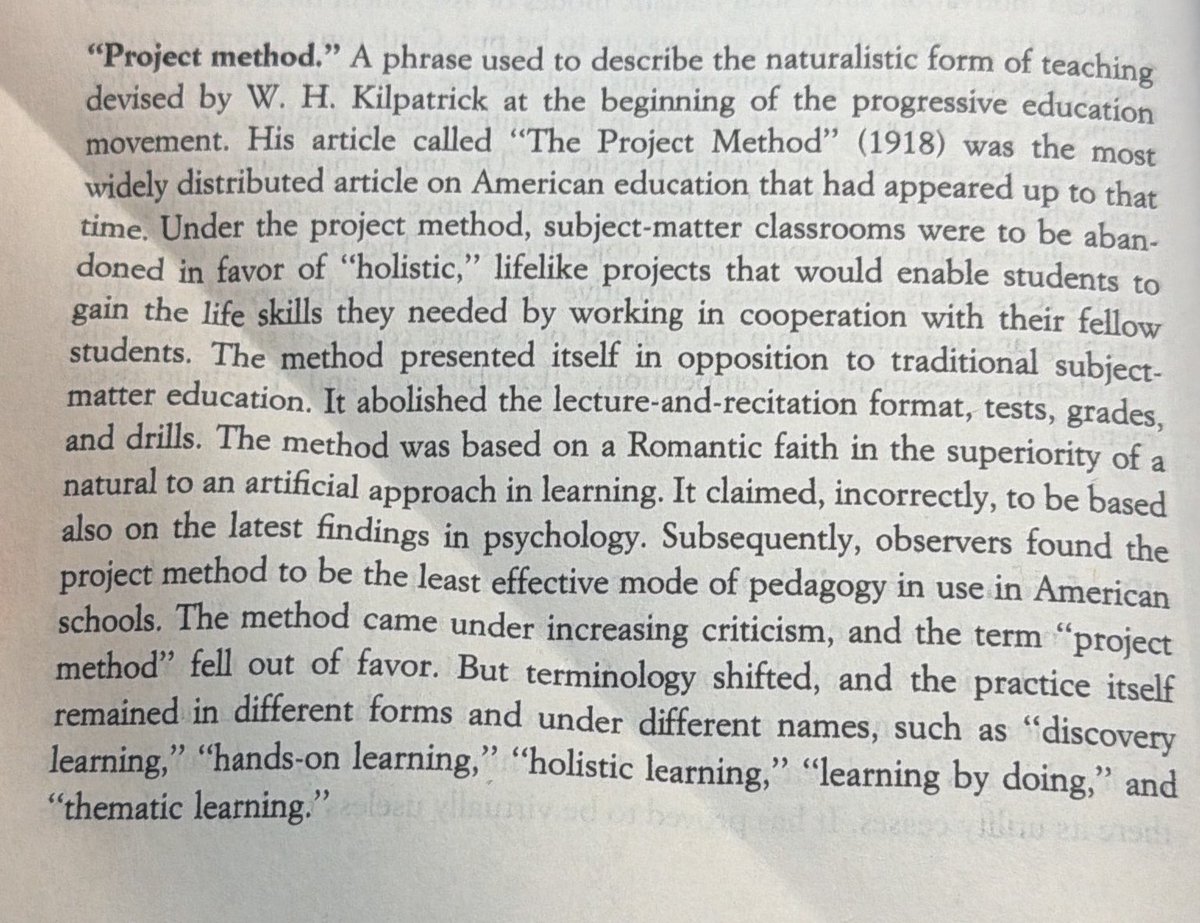
Hirsch’s index of edu-lingo written in 1996 continues to be timeless.
Here is an example of the rhetoric traced to 1918. It parallels the misguided fads of 2026 as yet again popular discourse tries to reinvent education in the age of AI, oblivious about the mistakes of the past.
"Observers found the project method to be the least effective mode of pedagogy...but the terminology shifted and the practice remained in different forms under different names such as 'discovery learning', 'hands-on learning',..."
Another refreshing episode 👏👏👏.
@rastokke always speaks with clarity about why applying evidence is vital in education and this episode is no exception. The irony is that so-called “progressive” education has not delivered better outcomes, especially for students from disadvantaged backgrounds. We can improve education at scale much more readily than we we can “fix poverty”. Over time, of course, improving education lifts students’ life trajectories away from poverty. This is deeply unsettling for those education academics who are resistant to the discourse of evidence and want us to stand still until every planetary alignment is perfect. But teachers and schools on the ground aren’t waiting - they’re making changes and seeing the benefits. I borrowed from Malcolm Gladwell’s Revenge of the Tipping Point when I wrote about this bottom-up quiet revolution in late 2024.
https://t.co/7W8uiHwoBP
I recently wrote a blogpost arguing that we need to connect trauma-informed practice and learning science principles. Their alignment has been hiding in plain sight for a long time. This has been picked up in a new piece by @EducationHQ_AU
https://t.co/TLFxj5TOC1
Consistency does not mean robotic teaching. It means students do not have to win the teacher lottery. A schoolwide literacy commitment should be visible from classroom to classroom. The goal is not sameness for adults; the goal is reliability for students
The soft bigotry of low expectations, presented as empathy, compassion, and tolerance, is a 1st order threat to our children’s education - trapping them in illiteracy and lifelong dependency.
Minister for Education: "Fire away. Use AI for 40% of your examination result"
Same Minister: "Hey...Why do you need those electronic devices with internet access?"
https://t.co/QoZfZ41YgH
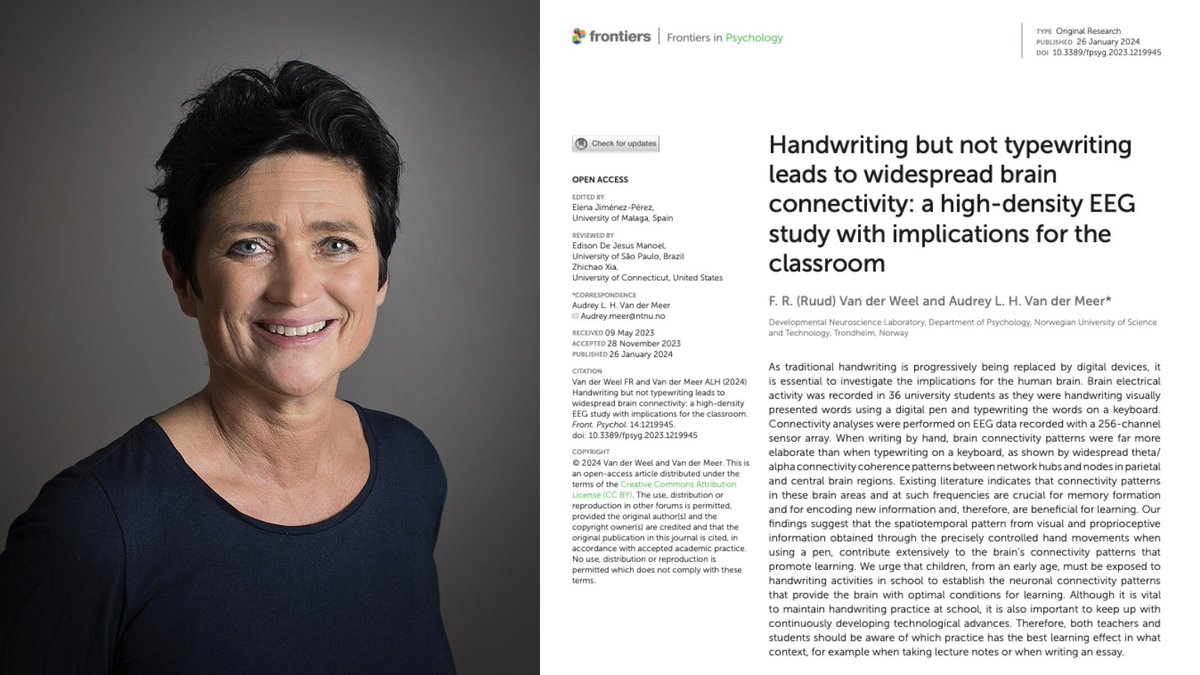
A Norwegian neuroscientist spent 20 years proving that the act of writing by hand changes the human brain in ways typing physically cannot, and almost nobody outside her field has read the paper.
Her name is Audrey van der Meer.
She runs a brain research lab in Trondheim, and the paper that closed the argument was published in 2024 in a journal called Frontiers in Psychology. The finding is brutal enough that it should have changed every classroom on Earth.
The experiment was simple. She recruited 36 university students and put each one in a cap with 256 sensors pressed against their scalp to record brain activity. Words flashed on a screen one at a time.
Sometimes the students wrote the word by hand on a touchscreen using a digital pen, and sometimes they typed the same word on a keyboard. Every neural response was recorded for the full five seconds the word stayed on screen.
Then her team looked at the part of the data most researchers had ignored for years, which is how different parts of the brain were communicating with each other during the task.
When the students wrote by hand, the brain lit up everywhere at once.
The regions responsible for memory, sensory integration, and the encoding of new information were all firing together in a coordinated pattern that spread across the entire cortex. The whole network was awake and connected.
When the same students typed the same word, that pattern collapsed almost completely.
Most of the brain went quiet, and the connections between regions that had been alive seconds earlier were nowhere to be found on the EEG.
Same word, same brain, same person, and two completely different neurological events.
The reason turned out to be something nobody had really paid attention to before her work. Writing by hand is not one motion but a sequence of thousands of tiny micro-movements coordinated with your eyes in real time, where each letter is a different shape that requires the brain to solve a slightly different spatial problem.
Your fingers, wrist, vision, and the parts of your brain that track position in space are all working together to produce one letter, then the next, then the next.
Typing throws all of that away. Every key on a keyboard requires the exact same finger motion regardless of which letter you are pressing, which means the brain has almost nothing to integrate and almost no problem to solve.
Van der Meer said it plainly in her interviews.
Pressing the same key with the same finger over and over does not stimulate the brain in any meaningful way, and she pointed out something that should scare every parent who handed their kid an iPad.
Children who learn to read and write on tablets often cannot tell letters like b and d apart, because they have never physically felt with their bodies what it takes to actually produce those letters on a page.
A decade before her, two researchers at Princeton ran the same fight using a completely different method and ended up at the same answer. Pam Mueller and Daniel Oppenheimer tested 327 students across three experiments, where half took notes on laptops with the internet disabled and half took notes by hand, before testing everyone on what they actually understood from the lectures they had watched.
The handwriting group won by a wide margin on every question that required real understanding rather than surface recall.
The reason was hiding in the transcripts of what the two groups had actually written down.
The laptop students typed almost word for word, capturing more total content but processing almost none of it as they went, while the handwriting students physically could not write fast enough to transcribe a lecture in real time, which forced them to listen carefully, decide what actually mattered, and put it in their own words on the page.
That single act of choosing what to keep was the learning itself, and the keyboard had quietly skipped the choosing and skipped the learning along with it.
Two studies. Two countries. Same answer.
Handwriting makes the brain work. Typing lets it coast.
Every note you have ever typed instead of written went into your brain through a thinner pipe. Every meeting, every book highlight, every idea you captured on your phone instead of on paper was processed at half depth.
You did not forget those things because your memory is bad. You forgot them because typing never woke the part of the brain that would have made them stick.
The fix is the thing your grandmother already knew.
Pick up a pen. Write the thing down. The slower road is the faster one.