All you need to change your life;
- A plan for direction
- A Will for dedication
- A heart of Gratitude for maintaining joy regardless of outcome.
#Alive#becoming
Best thing I’ve heard all week. Concrete and actionable steps to wealth building and preservation.. Ms Lámidé Elizabeth is doing the lord’s work with the Podcast: Building wealth without borders.
YouTube:
https://t.co/Li4Z9nE8BB
“Great Nations are not built on borrowed Technology”
The ability for a nation state to attain self-reliance on the most important issues of development is tantamount to true independence and hence growth. Africa must wake up.
In 1987 America refused to sell India a supercomputer.
It then offered a weaker model instead, with conditions. Civilian use only. No technology transfer. No re-export. And an American official would be posted in India to monitor how the machine was used.
India said no, and handed the job to a man who had never seen a supercomputer in his life.
His name is Vijay Bhatkar.
He was born on 11th October 1946 in Muramba, a village in Akola district in Maharashtra. He started school directly in class 4. He took his engineering degree at Nagpur, a master's at Baroda and a doctorate at IIT Delhi.
India had wanted the machine for a very ordinary reason. Weather forecasting, which for a country of farmers is not a luxury. The Indian Institute of Science wanted one for research.
The Americans classed supercomputers as dual use technology, meaning it could also help a nuclear or missile programme. So the export was blocked.
In March 1988 the government set up the Centre for Development of Advanced Computing in Pune, and made Bhatkar its founder and executive director.
Before that, the Prime Minister asked him 3 questions.
Can we do it. Bhatkar said he had never seen a supercomputer, only a photograph of the Cray, and that yes, they could.
How long will it take. He said less time than it would take to keep trying to import one.
How much will it cost. He said the entire effort, including building the institution, would cost less than buying the Cray.
He was given about 30 crore rupees and 3 years.
The start was not glamorous. He has said that for the first 6 months he could not recruit a single person, including his own secretary, because of bureaucratic delays.
His team took a different route from the Americans. Instead of building 1 enormous processor, they linked many ordinary processors together to work in parallel, using parts that could be bought off the shelf.
The prototype was ready in 1990. They called it Param, which in Sanskrit means supreme.
Then came the part he did not expect. Nobody believed it was a supercomputer. It did not look like a Cray. He has said even his own computer science professors doubted it.
So he took it abroad, to a major international supercomputing conference, and had it demonstrated and benchmarked in public. It was formally recognised there as a supercomputer.
In 1991 they completed PARAM 8000.
An American newspaper carried the story under a headline that has stayed famous in India. Denied supercomputer, angry India does it.
Versions of the machine were later exported to Germany, the United Kingdom and Russia. India went from being refused the technology to selling it.
He has one line he repeats.
Great nations are not built on borrowed technology.
Random evening thoughts:
There's a certain type of liberation that comes from knowing your current place in the world.
As a black man and Nigerian, I know for example that there is no amount of book I want to read and no level of wealth I want to get to that will make the other races respect me on a fundamental level...
I know that due to the unfortunate history and depressing present of my people, I could be the literal black Einstein and it wouldn't stop white or Asian media from ripping me to shreds over a minor editing mistake in an academic paper.
At best to them, I'd be a marginally smarter monkey nig€€r in a fancy lab coat.
This is why we must completely and totally reject any shred of desire for external validation.
We must strive to radically improve our material, social and political realities.
We must do so on our terms without giving a microgram of a fuck about what "others" think unless it concerns our interests.
Who gives a shit for instance, if they think we're all low IQ bumbling primates swinging on vines?
Hell, let them thinkthat while we build.
(hide your strength;, bide your time)
Let them call us names and think the worst of us. It doesn't mean jackshit.
We will build our societies to serve us and our descendants. We will aggressively defend our interests by any means necessary, and we will do it without apology.
AND CRUCIALLY,
We must maintain this indifference to external opinions even after our improved realities are undeniable.
When building, we must never fall into the trap of using "revenge" as our primary ideology.
We shouldn't seek emancipation to necessarily get back at the white man.
But do it because we deserve that shit and because we can.
Basing a society's struggle on an external boogeyman makes your movement brittle.
Several generations later and you could literally be the next Isra*l
Bogeyman no dey finish
Anyway,
I'm rapidly getting to that point these days.
I used to be mildly upset at white racists depicting me and our people as vermin. I used to silently fume at their nauseating ignorance.
These days I know that nobody will like us or give us a shred of respect until we get our home in order.
Until we become strong against all odds.
Is Nigeria going the Argentina way??
Seemingly stabilizing economy with better outward benefits like high performing stock market, increased investor confidence etc but… higher inequality which will eventually lead to a cycle of cosmetic reforms to hide a failed system..
🤔😏
But a person whose social battery naturally refills through constant interaction can sustain a relationship-heavy strategy differently from someone who must repeatedly recover from it.
You can imitate the behaviour, but the internal cost may be higher.
@Officially_Kriz@NaijaFlyingDr As Buffet said once “Diversification is protection against ignorance. It makes little sense if you know what you are doing.”
I’ll like to believe that he’s a businessman in it for the long haul, not just to turn a quick profit. Concentration risk doesn’t apply to ownership.
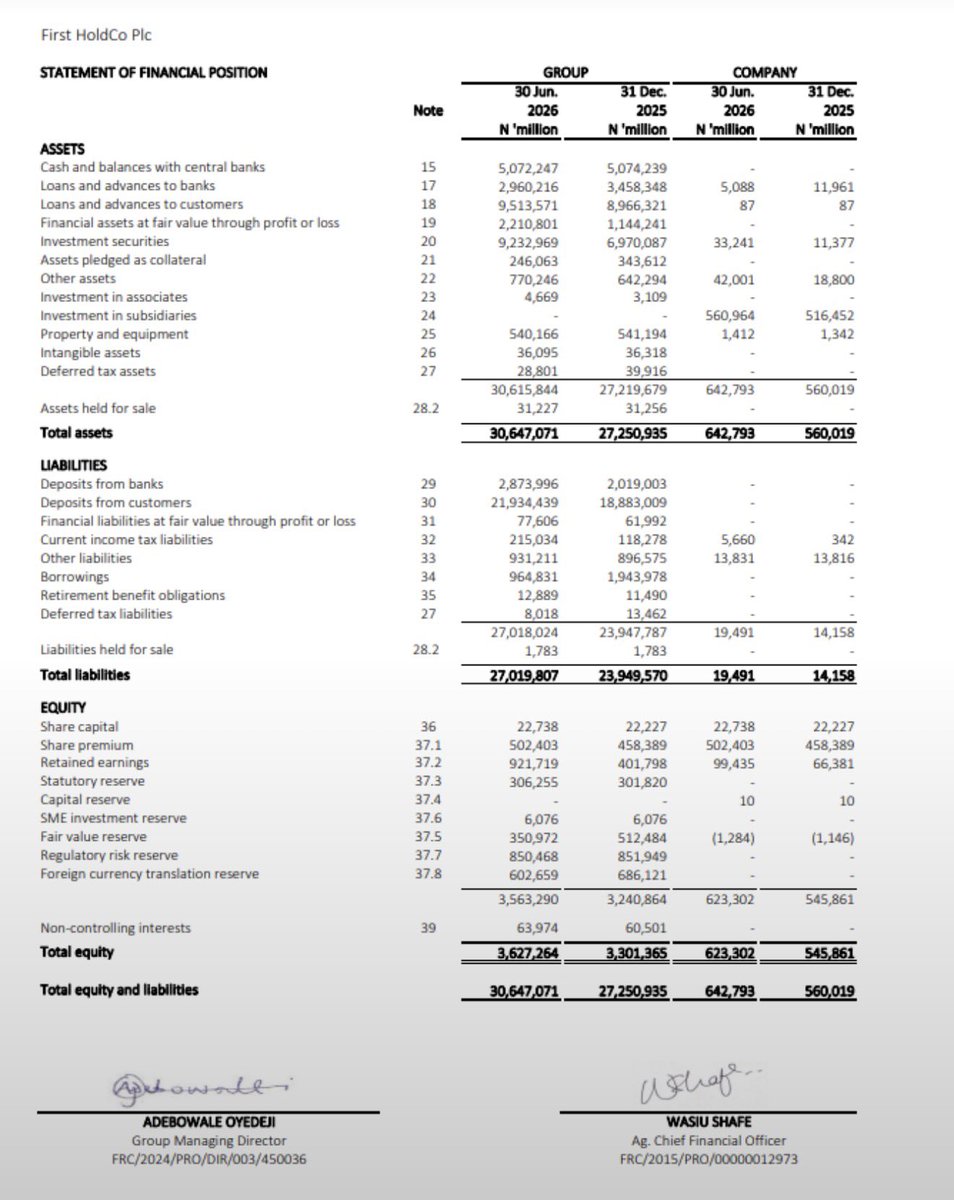
First HoldCo, just delivered one of its best half-year performances in recent memory, and the numbers tell a story worth digging into.
For the first six months of 2026, the company made N526 billion in profit after tax (the money left after paying all its bills and taxes), up 82% from N290 billion the same time last year. Every shareholder felt this too: earnings per share rose to N11.74 from N6.84, even though the company had also issued more shares during the period to raise fresh capital, which normally would have thinned out that gain.
Here's the interesting part: this jump in profit didn't come mainly from the bank doing more of its everyday business, lending money and earning interest on it. In fact, income from lending was slightly lower than last year. The real boost came from two other places. First, the bank clawed back N92 billion from old loans it had basically written off as lost, a huge jump from the N4 billion it recovered a year earlier. Second, it made significantly more money from selling investments and trading activity, helped in part by a weak comparison period the year before. Both are genuine wins worth celebrating, but they're the kind of gains that come and go rather than a steady, repeatable stream of income, so it's worth watching whether the bank's core lending business picks up the pace in the coming quarters.
The balance sheet backs up the sense that this is a company in good health right now. Total assets grew to N30.6 trillion, up 12% since the start of the year. Customers also trusted the bank with more of their money, deposits climbed 16%. Meanwhile, First HoldCo used some of its cash to pay down debt aggressively, cutting what it owed by roughly half, a move that signals financial discipline rather than overreach.
Cash flow tells a similar turnaround story. A year ago, running the bank's day-to-day operations was actually draining cash. This year, operations generated over half a trillion naira in cash instead, a meaningful shift in the right direction. That cash was largely put to work buying investments and clearing debt.
Put simply, First HoldCo had a genuinely strong half year. Profit nearly doubled, the balance sheet grew, and the business looks more disciplined with its debt. The one thing worth keeping an eye on is how much of this growth repeats itself next quarter, since a fair share of it came from one-off recoveries and trading gains rather than the bank's core lending engine.
The only true superpower is never giving up.
Proverbs 24:16
(AMP) For a righteous man falls seven times and rises again, but the wicked are overthrown by calamity.
Happy New week everyone.
Listening to the @Tunde_OD interview on the Afropolitan podcast and this statement he made struck me..
“It is okay to be still and not have to do while the world moves ahead because one day you will move again and the world will stand still for you”
Such a timely word for me.
Pride says “My comfort is more important than another’s progress and wellbeing”
Playing small is pride disguised as humility. God resists the proud and exalts the truly humble.
-FC