As I’ve continue to fight for equitable access to Multiple Sclerosis treatments in British Columbia, I’ve realized something that has become impossible to ignore…
This isn’t just an MS problem.
It’s a healthcare access problem.
Here in British Columbia, we’ve watched Jennifer Beharrell fight for access to pertuzumab, a drug her oncology team recommended before surgery to give her the best possible chance against inflammatory breast cancer. She has shared publicly that without it, her chances of a complete recovery could be dramatically reduced.
Here in British Columbia, we’ve watched little Nathan Hepburn’s family fight to get him to Germany in hopes of accessing treatment for his rare brain disorder that isn’t available here.
Here in British Columbia, we’ve watched toddler Gurmoh Gill’s family plead for access to a life changing therapy for his rare genetic condition, treatment that could help preserve his mobility and give him the best possible future.
Here in British Columbia, we’ve watched Joey Kerr fight for access to luspatercept, a medication that could help manage her myelodysplastic syndrome and improve her quality of life while reducing her dependence on frequent blood transfusion
Here in British Columbia, we’ve watched Lauren Paulsen fight for access to the specialized medical nutrition her physicians say she needs while living with a rare disease, after facing barriers to coverage for the treatment that helps her survive.
And here I am, fighting to preserve my vision from Multiple Sclerosis by advocating for equitable access to the medication that has helped save and preserve my vision for nearly a decade, the very treatment my neurologist believes is the best option to keep my disease under control.
Different diseases.
Different diagnoses.
Different families.
Yet the same heartbreaking reality.
Somewhere along the way, we’ve created a system where patients and families are expected to become fundraisers, advocates, media spokespeople, and policy experts just to access the care their medical teams recommend.
That should never be the expectation.
When families are relying on GoFundMe campaigns, compassionate access programs, or the generosity of pharmaceutical companies simply because our provincial healthcare system won’t provide medically necessary treatments, something is deeply wrong.
When the final decision rests with people who will never meet the patient, never examine them, never witness their disease progressing, and not with the physicians who have spent decades training to diagnose and treat these complex conditions, something is deeply wrong.
Healthcare decisions should be guided by evidence, medical expertise, and the unique needs of each patient. Not by bureaucracy. Not by outdated policies. Not by budgets alone.
My fight may be to save my vision.
Jennifer’s fight is to access the cancer treatment her oncology team believes gives her the best chance of recovery.
Nathan’s family’s fight is to access treatment that offers hope where few options exist.
Gurmoh’s family’s fight is to preserve their little boy’s mobility and future.
Joey’s fight is to access treatment for a serious blood disorder.
Lauren’s fight is to access the support and treatment her body depends on.
But at the heart of every one of these stories is the same question…
Should healthcare decisions be made by the specialists who know these diseases best, or by a system that too often puts bureaucracy ahead of patients?
British Columbians deserve a healthcare system where decisions are led by medical expertise, evidence, and compassion.
Because no one should have to fight their government while they’re already fighting for their life, their health, their vision, or their child’s future.
This is bigger than MS.
This is about the kind of healthcare system we choose to be.
@Dave_Eby@Josie_Osborne@MLABrennanDay@KerryLynneFindl@SteveKooner@HarmanBhanguBC@PeterMilobar@IanPatonDelta@DrKindyMLA
This reality it becoming the forefront of BC healthcare .. Life-saving / Life-Altering therapies should never depend on a postal code or how hard your medical team is able to fight just to gain access to medically necessary care … I may be fighting to save my vision .. But I would give up my temporary compassionate care that my neurologist was able to secure and give it to this women if I could… This needs to change … my heart breaks for her
Having spoken to Jennifer, this situation once again highlights the failure of BC’s Healthcare system to deal with equitable access to drugs.
We are behind all other provinces and G7 countries, and that should be unacceptable to those of us footing the bill.
I saw this yesterday and my heart absolutely broke. We shouldn’t have to depend on compassionate programs or go fund me to gain access or our medical teams begging while time keeps passing..
My situation is so different but highlights the gap along with so many others.. even children facing these horrific gaps while suffering … BC cannot continue to be the only province to lag this far behind when the care is necessary. I pray somehow the compassionate program covers her more than the 60%. My neurologist was able to secure 2 doses for my necessary therapy that’s saved my vision for almost a decade - just had my infusion on Tuesday 2 months late and then my next is in January.. after that? I’m back to square one unless things change.. Clinical judgement must not be placed at the end while decisions are made by a system that has no idea what it’s doing to real people.
Today, Alanah Duffy, Government Relations Manager at MS Canada, presented to the Select Standing Committee on Finance and Government Services, bringing forward the lived realities of people affected by MS across British Columbia.
Having had the opportunity to speak with Alanah in depth, I’m deeply grateful for her support and for the work she continues to do to ensure MS is represented with both evidence and urgency in government spaces.
A key fact raised in today’s presentation is clear, British Columbia remains the only province in Canada without equitable coverage for certain MS treatments. Patients here are facing barriers that do not exist elsewhere in the country.
What stood out in the committee discussion was not disagreement with that reality, but confirmation of it on record, in a budget setting where issues are made visible.
This is what advocacy looks like.
Bringing uncomfortable truths directly into the rooms where change can actually happen.
Thank you, Alanah, for your leadership and persistence on behalf of the MS community.
Please watch and share the presentation. Visibility is not enough but it is where change begins.
British Columbians seeing this - please take a moment to sign the petition on my page.
Help support people living with Multiple Sclerosis gain access that the rest of Canada already has!
@bcndp@BCLegislature@BCConservCaucus@Dave_Eby@Josie_Osborne@HarmanBhanguBC@SteveKooner@PeterMilobar@TrevHal@KerryLynneFindl@ToorJody@McInnis_4MLA@BrendaBaileyBC@MSCanOfficial
#MSCanada #MultipleSclerosis #BCPoli #HealthcareAccess #PatientAdvocacy #BritishColumbia
For World MS Day, the lights at the BC Legislature shone red. The gesture was noticed, appreciated, and meaningful.
For one night, Multiple Sclerosis was visible.
But for the other 30 days of MS Awareness Month, there was silence.
While the red lights were appreciated, awareness is not enough. People living with MS need more than symbolic gestures. We need recognition, representation, and action.
Every day, British Columbians are navigating an incurable, progressive neurological disease that can impact mobility, vision, cognition, employment, mental health, and independence. Yet too often, these realities remain absent from conversations where health-care decisions are made.
British Columbia must catch up to modern MS treatment. We cannot continue to be the only province restricting access in ways that leave patients and physicians with fewer options. Multiple Sclerosis should never be viewed through the lens of cost savings alone on Disease-Modifying therapies - which doesn’t hold true when the healthcare cost of a relapse costs more then the treatment itself…ER visits, emergency care, therapies like PT,OT, more specialists visits, more MRI’s, more neurologist visits… the list goes on..
Treatment decisions should be about protecting patients, preserving quality of life, and preventing irreversible disability.
If every other province can move toward patient-centred access, British Columbia can and should do the same.
This fall, awareness must move from the Legislature’s exterior to where the decisions are taking place inside it.
We have been seen.
Now we need to be heard.
@Dave_Eby@Josie_Osborne
📸 Photo credit: Jason Whittaker
#britishcolumbia #canada #Healthcare #MSAwareness #MultipleSclerosis #WorldMSDay #BCPoli #DisabilityAdvocacy #MSCanada
@bcndp@BCConservCaucus@MLABrennanDay@HarmanBhanguBC@ToorJody@SteveKooner@KerryLynneFindl@TrevHal@MSCanOfficial@McInnis_4MLA@IanPatonDelta
This month is Canada’s Multiple Sclerosis Awareness Month.
Next week on May.30th is
WORLD MS Day 2026.
Yet there has not been a peep from our own B.C. Government leaders to support this Month or UPCOMING day..
Why?
This is about the realities people living with MS in British Columbia are facing every single day. It is about awareness Nationally, Provincially and Globally…
THIS Silence - shows us where our Provincial Government stands when it comes to people fighting incurable, disabling neurological diseases.. We ARE NOT JUST A LINE IN A BUDGET - we are REAL PEOPLE THAT POLICY NEEDS TO CATCH UP WITH!
This week changed me.
Almost 9 years after my MS diagnosis, I attended an MS gathering here in B.C. and listened to people share what life with MS truly looks like beyond what’s visible.
What I heard was heartbreaking.
People being forced to remain on therapies that are no longer the best fit because other options are not covered.
People paying out of pocket for medications because coverage criteria does not reflect the reality of their disease even when deemed medically necessary by their Neurologists.
People depending on pharmaceutical support programs just to stay stable, living with constant uncertainty over whether that support could disappear.
And some people have simply stopped fighting for access altogether because they no longer have the strength left to battle the system itself.
How can British Columbia be the ONLY province in Canada with these barriers??
MS is not a cookie-cutter disease. Policies cannot remain frozen while treatments, research, and patient realities evolve.
In British Columbia, access to care should not depend on how much energy someone has left to appeal, advocate, or fight through paperwork while living with a progressive neurological disease.
Behind every policy is a person trying to protect their mobility, independence, vision, and future.
People living with MS in B.C. deserve better.
I will keep speaking up.
I will keep sharing these stories.
If you believe MS treatment access in British Columbia needs to better reflect today’s realities, my petition is pinned to my page. Please read, sign, and share.
Because too many people are running out of energy before the system runs out of barriers.
@Dave_Eby@Josie_Osborne@MLABrennanDay@HarmanBhanguBC@SteveKooner@Teresa_Wat@PeterMilobar@BCGovNews@IanPatonDelta #WorldMSDay #MSAwareness #MultipleSclerosis #BritishColumbia #Healthcare #bcpoli
‼️ British Columbia , Canada ‼️
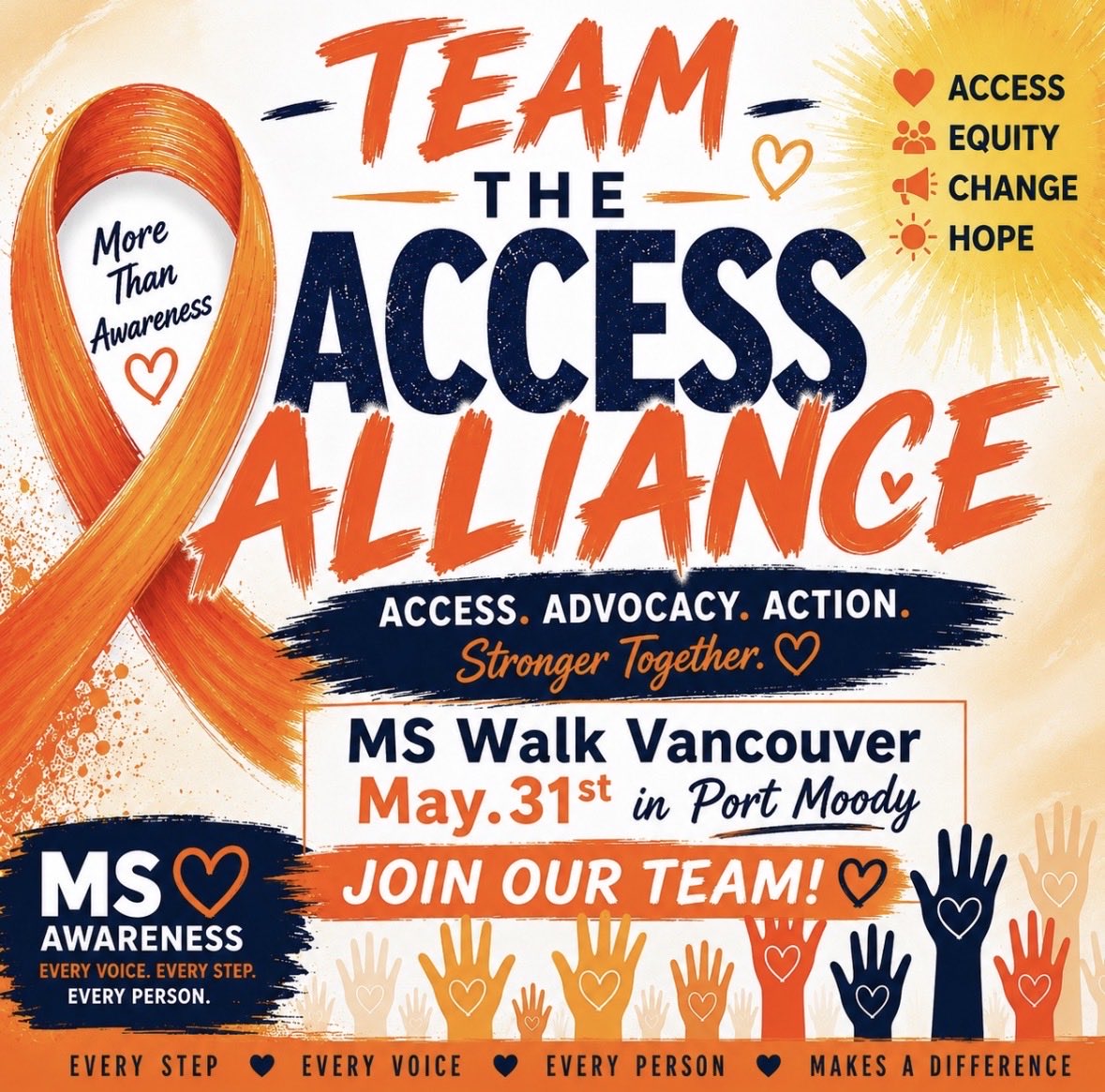
🧡 MS Walk Vancouver 2026 — May 31, 2026
Call out to ANY Government Officials, Media, Supporters and MS Warriors!
Wer inviting you too @Josie_Osborne to hear the stories and impacts behind the policy barriers!
On May 31st, I’ll be walking at the MS Walk Vancouver in Port Moody and this year, this walk means more to me than I can put into words.
You do not need to donate to join the walk and show support! You can even be a virtual walker!!!
Team: The Access Alliance
https://t.co/Xd2nS8OCSp
Petition to help support our cause!
“ Approve Access To Multiple Sclerosis Medications In British Columbia “
https://t.co/j54Y3Kakos
Almost 10 years ago, Multiple Sclerosis began attacking my optic nerves relentlessly.
It was terrifying.
I was a young mother trying to raise children while living through repeated vision loss, pain, fear, uncertainty, and the reality that I could permanently lose parts of my sight. Every new attack carried the fear of what would be taken next.
We fought hard to protect what vision I had left.
It took time, permanent damage, setbacks, fear, and uncertainty before starting a therapy that stabilized my disease, protected my remaining vision, and slowed progression. That stability did not come easily. It came after trauma, loss, and years of learning how devastating MS can truly be.
And now, nearly a decade later, after almost 10 years of stability on the therapy that helped save my sight, I’ve lost access to it.
For the past 7 months, I’ve been fighting again.
Fighting for appeals.
Fighting through policy barriers.
Fighting through uncertainty.
Fighting for the ability to remain on the treatment my medical team believes is the most appropriate for my disease.
And the truth is , no patient should have to live this way.
MS is not just fatigue or “bad days.”
It can mean losing vision.
Losing mobility.
Losing independence.
Losing parts of your future while trying to hold your family together through it all.
That is why this walk matters so deeply to me.
I’m building a team that stands for more than awareness alone.
I’m inviting:
🧡 People living with MS
🧡 Caregivers and families
🧡 Friends and supporters
🧡 Healthcare workers
🧡 Elected officials and community leaders
Because awareness without action is not enough.
This is about advocacy.
This is about dignity.
This is about equitable access to treatment.
This is about making sure patients are seen as human beings , not statistics or cost-saving measures.
I’ll be walking no matter what.
And I hope others will stand beside me and the entire MS community here in British Columbia.
Let’s show the strength behind these stories.
Let’s show the human cost behind these policies.
Let’s make this walk impossible to ignore.
If you want to walk with me, support the team, or stand beside the MS community on May 31st, join us. 🧡
#MSWalk #MultipleSclerosis #MSAdvocacy #BritishColumbia #PortMoody #HealthcareAccess #StrongerTogether #MSCanada #vancouver #healthcare #BCStrong #bcpoli
@GlobalBC@CTVVancouver@VancouverSun@BCConservCaucus@bcndp
🚨 BRITISH COLUMBIA🚨
6 months.
That’s how long I’ve been fighting to keep access to the Multiple Sclerosis treatment that has kept my MS stable and saved my vision.
I did everything right.
Followed every step.
Advocated early, clearly and consistently.
And still …it came down to a submission that didn’t reflect my reality.
No clinical context.
No explanation of risk.
No real picture of what’s at stake.
So when the denial came, it wasn’t just a “no”..
it was based on information that was never fully provided in the first place.
Now I’m left trying to fix something that should have been done properly from the start…
while facing the possibility of losing access to the only therapy that works for me.
And the hardest part?
If this medication was covered under BC PharmaCare…like it is in every other provinces…
NONE of this would be happening.
This isn’t about preference.
It’s about protection.
It’s about not risking irreversible vision loss because of where I live.
I’m still fighting but I shouldn’t have to fight this hard.
If you’ve made it this far, thank you 🧡
⭐️My petition is pinned on my page.⭐️
Please help me protect my vision and help others gain access to the treatments their Neurologist recommends that is deemed medically necessary..
We can not be the ONLY province RESTRICTING access and forcing patients to fight this hard! Access should never depend on your postal code in Canada….
#britishcolumbia #canada #BCHealthCare #healthcare #multiplesclerosis #bcpoli #URGENT #BreakingNews
#vancouverisland #northernbc #vancouver #Richmond #mission #mapleridge #kelowna #princegeorge #bcinterior #abbotsford #surrey
#VictoriaBC
@Dave_Eby@Josie_Osborne@SteveKooner@HarmanBhanguBC@IanPatonDelta@TrevHal@ToorJody@PeterMilobar@GlobalBC@CTVVancouver@CTVNewsVI@VancouverSun@VaughnPalmer@RobShaw_BC
@Josie_Osborne@BCNDPCaucus A great step for the community - But also how about we keep people on the treatments they need, that keep us out of the MRI’s and hospitals ?? @MLABrennanDay
🚨 British Columbia! 🚨
This interview was from January with @GlobalBC and another with @CTVVancouver just before it.. reposting because things have not changed and now it’s even more urgent…
Tomorrow was supposed to be my infusion day.
Instead, my treatment with Ocrevus has been postponed until after June 17th as it stands, while I sit down with my neurologist to figure out what comes next, which should never be the case....
This is not because my medication stopped working. This is not because my doctor wants to change my treatment.
It’s because of access.
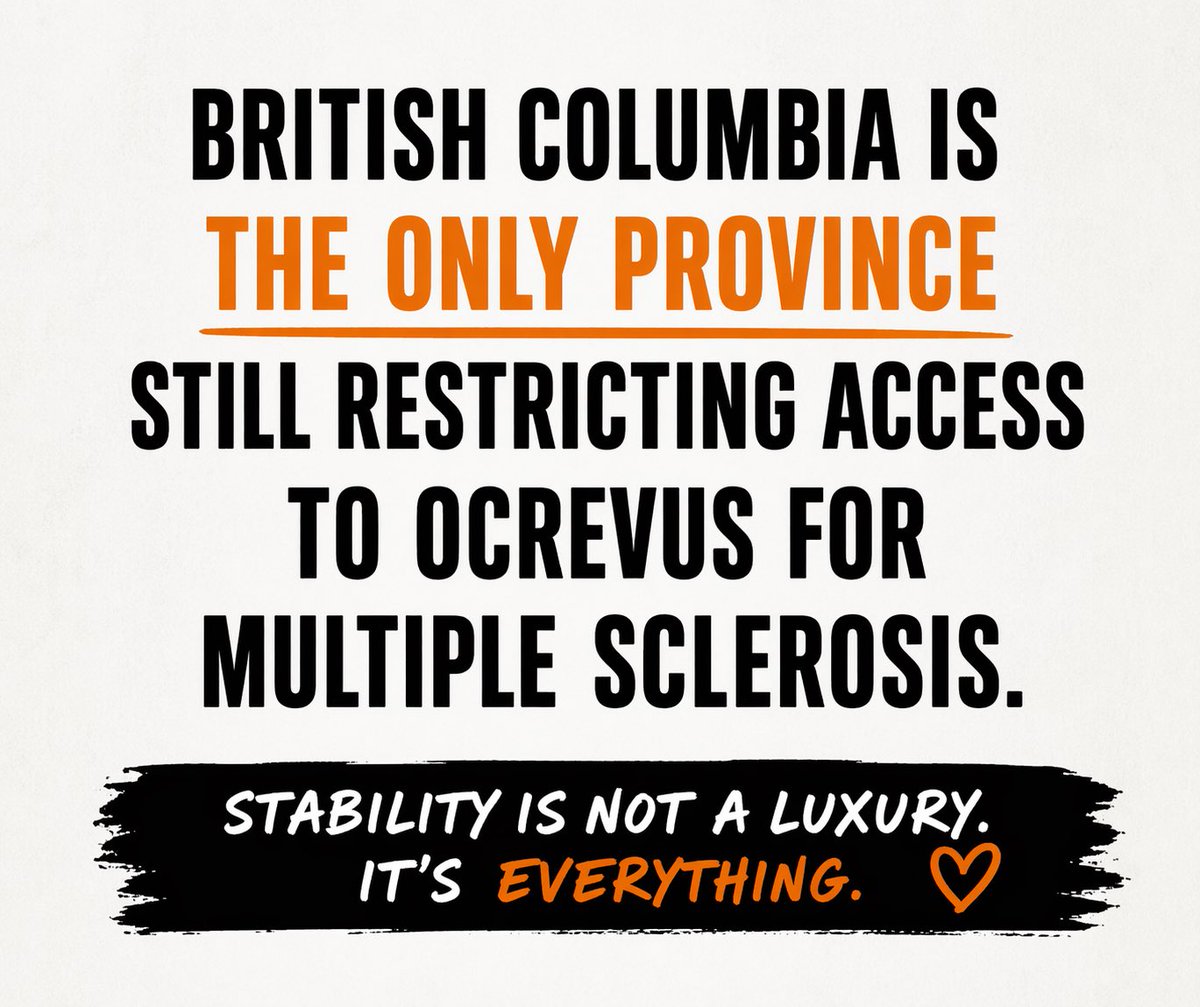
British Columbia is the only province restricting access to this medication - I’m scared - I know what it’s like to not see my children’s faces..
I made the decision to start this therapy back in 2018, believing British Columbia would follow every other province in Canada and that still hasn’t happened. I’ve now been stable for almost a decade…something that is not easy to achieve with all Multiple Sclerosis patients.
And now, that stability is at risk because my insurance changed - being punished for making the right choice back in 2018 to save my sight - most are not that lucky on the first go and have to go through sometimes MANY medications until the right disease-modifying therapy is found that works - I found mine and it saved my vision…
The BC Ministry of Health has stated there are “numerous medications with the same clinical effectiveness.”
But MS is not one-size-fits-all.
And treatment is not interchangeable for many of us, especially when your vision is on the line.
We fought hard to protect what vision I have left. That was never guaranteed. That was years of the right treatment, at the right time.
Now, for the first time in years, there is uncertainty.. being forced to take a risk I should never have to take.
Uncertainty about relapse.
Uncertainty about new damage.
Uncertainty about loosing my vision completely as that damage from before did not fully recover and I still live with gradual retinal thinning every year since.
We are told the system cannot afford this medication “ cost effectiveness”, yet the system continues to absorb the cost of relapses, hospital visits, more MRI’s, more emergency steroid treatments in hospitals and more irreversible disability.
Yet funds other vulnerable groups without question or transparency.
It’s not a who wins what…. Everyone deserves the care they need….
BUT where is the line drawn?
If I am forced to switch medications for non-medical reasons and it goes wrong…
If I lose more of my vision…
Who is held accountable for that outcome?
Patients living with incurable diseases should not be the ones asked to take on that risk.
This should never be happening.
Access to life-altering/saving medications should never depend on your postal code, who can afford what or be punished for using private insurance to save your vision .
⭐️ Please sign my petition pinned on my page or linked in the comments. ⭐️
We need the support of British Columbians.
#britishcolumbia #canada #BCHealthCare #healthcare #multiplesclerosis #bcpoli #URGENT #BreakingNews
@Dave_Eby@Josie_Osborne@MLABrennanDay@TrevHal@SteveKooner@RobShaw_BC@VancouverSun
Today marks the start of Canada’s Multiple Sclerosis (MS) Awareness Month 🇨🇦
Leading up to May 30th - National MS Awareness Day
Multiple sclerosis can affect so much:
• Vision/Blindness
• Ability to walk
• Use of our hands
• Balance
• Memory
• Independence
• And can cause relentless tremors, spasms, and pain
📍 If you’re in British Columbia, we need your voice
People living with MS in BC still don’t have access to medications that are available in every other province across Canada.
📢 Please share and sign our petition to help push the BC government to improve access to MS care and align with the rest of the country.
Link to Change petition - https://t.co/loqH1mVcGC
💬 This is the perfect month to raise Multiple Sclerosis awareness and we need British Columbia’s help.
#BritishColumbia #healthcare #canada #BCPolitics #multiplesclerosis #bcpoli
@Dave_Eby@Josie_Osborne
@MLABrennanDay If senior’s can’t get the care they need - it gives little hope me and others fighting incurable disease we will gain the help we need .. This Healthcare system so broken .. and getting worse by the day ..
I appreciate the empathy,❤️
As the Minister of Health, Josie Osborne is absolutely accountable to the public. It’s the foundation of a publicly funded healthcare system. Ministry decisions directly shape access to care and that includes PharmaCare policies and coverage decisions, which have real, system-wide impacts on everyone across B.C.
This isn’t about preference or convenience. It’s about access to a treatment my neurologist has determined is necessary to keep my disease stable while preserving what vision I have left. When coverage decisions force changes to treatment, the risks and consequences fall on patients, and then increase system wide burden, much larger then what these medications cost.
I’ve already pursued the paths you mentioned. I’ve had media coverage with Global News in November, and again with CTV News and Global in January. I was also invited to speak as a patient panelist at the MedAccessBC Forum just a few weeks ago. There is also a growing petition that is expected to be brought forward to the legislature in the coming weeks/month.
So this isn’t a lack of advocacy or awareness. And it’s not just about me.
This issue goes far beyond my personal situation, it reflects broader gaps in access to necessary medications in this province. Patients shouldn’t have to rely on media attention, public pressure, or crowdfunding to receive appropriate care that’s available across Canada but not here in B.C..
Minister of Health @Josie_Osborne , I am asking you directly…
Why is British Columbia the ONLY province in Canada still restricting access to Ocrevus for Multiple Sclerosis, despite years of mounting, long-term clinical evidence supporting its use?
Why is BC the ONLY jurisdiction not aligned with current MS treatment evidence and evolving standards of care?
Why are stable patients like me, people who made the right treatment decisions with their neurologists, often through private insurance to protect their vision, mobility, and independence ….being forced into switches that introduce unnecessary clinical risk? Being penalized for using that insurance if it changes or ends? Putting my vision that’s left at risk??
What is the clinical justification for overriding stability?
Where is the evidence that supports removing a patient from a therapy that is actively preserving their function?
Because this is not theoretical.
At the American Academy of Neurology Annual Meeting 2026, long-term data confirmed that Ocrevus does more than slow MS.
It preserves function.
The ability to walk.
To use your hands.
To live independently.
In some cases, patients even improved over time.
This is no longer just about slowing disease progression.
This is about protecting function before it is lost.
And that distinction matters.
I was 32 when I was diagnosed. My MS was aggressive and it went after my vision.
It didn’t blur it.
It took it.
It took my career.
It took time from my children.
It took my independence.
Then I started Ocrevus.
And slowly, I got pieces of my life back.
By year four, no relapses.
I still live with permanent damage. My vision, my left hand, my legs …they’re not the same.
But I am stable.
And in MS, stability is everything.
Because when function is preserved, you hold onto your life.
And when it’s lost , you don’t get it back.
So forcing a stable patient off a therapy that is working is not a neutral administrative decision.
It is a clinical risk.
And it is a risk patients are being asked to carry…not because of medical necessity, but because of policy.
And this goes beyond MS.
Across British Columbia, patients living with serious, incurable diseases continue to face restricted or delayed access to medications that are available in every other province …treatments that can slow progression, preserve function, and give people time and quality of life.
So I will ask this again, clearly…..
Why is British Columbia the ONLY province in Canada still out of step on access to treatments that preserve function, people’s lives and vision ?
And why are patients the ones being left to carry the consequences?
Newest Study.. Many others .. that support it .. Yet B.C. continues to deny access..
https://t.co/0i9Q4XBDZ7
@bcndp@BCNDPCaucus@Dave_Eby@TrevHal@MLABrennanDay@IanPatonDelta@elenoresturko@BCConservCaucus@ToorJody@SteveKooner@iainblackbc@BruceBanman@SheldonClareBC@PeterMilobar@ClaireRattee@KerryLynneFindl
AAN 2026: Ocrevus preserves walking, hand function in early RRMS
Study: Some participants experienced improvement over six-year period
https://t.co/htpPJplgZ7