Multisensory Signal Analysis and Enhancement Lab @inrsciences. Using signal processing to provide context for ML/AI algorithms. Applications in HCI, biomed, xR.
Just another data collection day @inrsciences@MuSAELab. In this project, researcher @reza__amini is exploring the combination of brain-computer interface, AI, wearables, and multi-sensory immersive technologies (haptics, smells, audio-visual) to build next-generation HCI tools.
🚨Publication alert @FrontVR: To pre-process or not to pre-process? On the role of EEG enhancement for cybersickness characterization and the importance of amplitude modulation features. (1/3)
In this work, we show that the old saying "one person's trash can be another person's treasure" is also true in EEG-based cybersickness monitoring. Great collaboration with @ThalesCanada and others! (2/3)
#TiagoHFalk, Professor and Director of Multisensory Signal analysis and Enhancement (MuSAE) Lab, Co-director of INRS-UQO Joint Research on Cybersecurity, @inrsciences , University of Quebec.
Read More : https://t.co/LczM18tdHs
Prof. Falk from the MuSAE Lab is running for a spot on the IEEE Systems, Man, and Cybernetics Society's Board of Governors as a Member-at-Large. Voting runs until December 31, 2024 4PM EST. You can cast your ballot at: https://t.co/BursPh9bIi Please vote and help spread the word!
Prof. Falk is on the cover page of the Insight Success Magazine's list of 10 Leaders Leading the xR Metaverse Revolution in 2024, that came out today. Check it out at: https://t.co/EBChPcTDDc
@inrsciences
New work out this week! Collaboration between @MuSAELab, @Lora_Appel's team and @UHN - Stop to smell the virtual roses: a mixed-methods pilot study on the impact of multisensory virtual reality nature experiences on feelings of relaxation. Check it out! https://t.co/eGTBEbZuL6
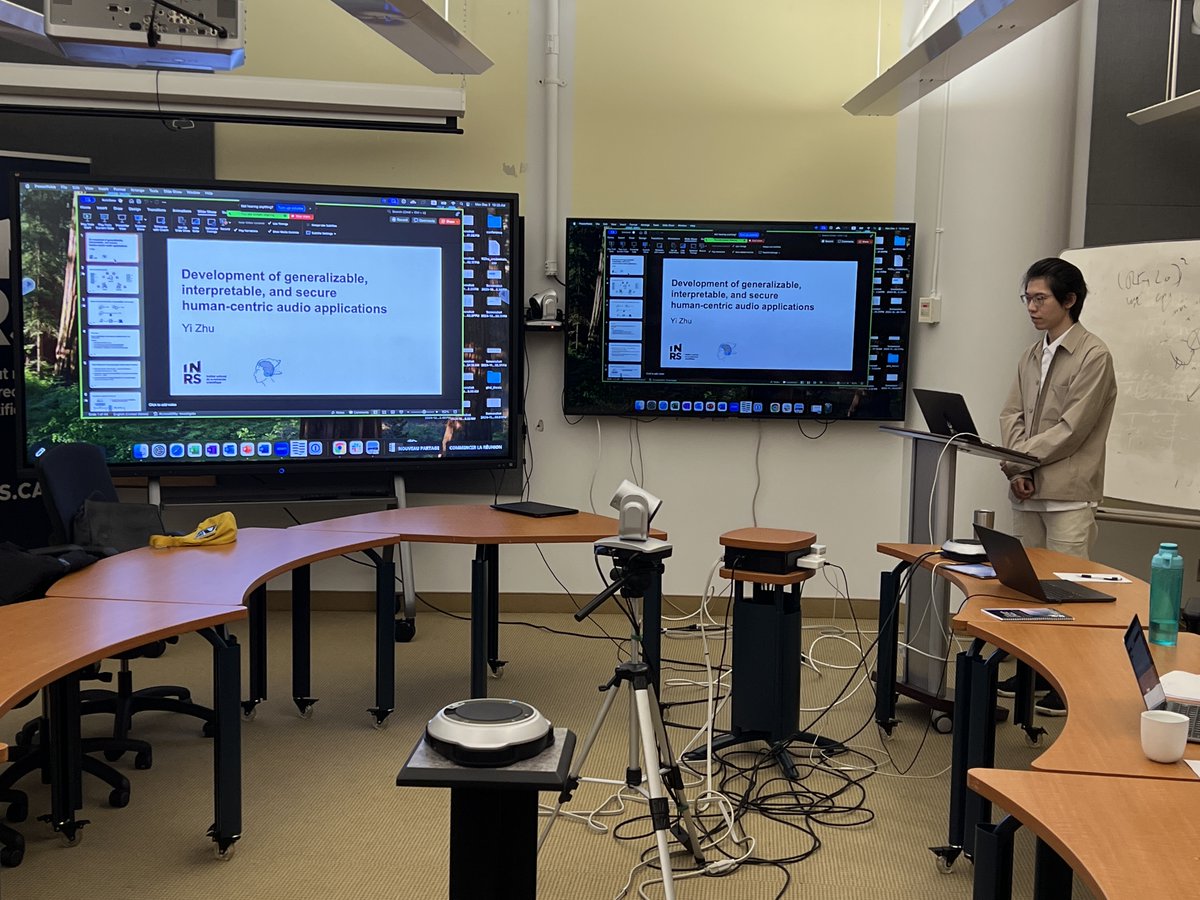
Congratulations to Dr. @Yi_Zhuuu for successfully defending his PhD thesis this week titled "Development of Generalizable, Interpretable, and Secure Human-Centric Audio Applications," which received an excellent mark by the jury. Kudos Dr. Zhu for your excellent work!
Prof. Falk from the MuSAE Lab is running for a spot on the IEEE Systems, Man, and Cybernetics Society's Board of Governors as a Member-at-Large. Voting runs until December 31, 2024 4PM EST. You can cast your ballot at: https://t.co/BursPh9bIi Please vote and help spread the word!
🏆
Tiago Falk @inrsciences et Sébastien Tremblay @universitelaval reçoivent un Prix Synergie pour l’innovation en reconnaissance de leur partenariat avec @ThalesCanada, @ENPQ_Officiel et Centre RISC.
▶️ https://t.co/dWK5NQeewa
Congratulations to MuSAE Lab member Olivier Rosanne on successfully defending his PhD today (with excellence) with a thesis titled “EEG amplitude modulation features for improved BCI performance”. Congrats Dr Rosanne!
Nature walks and forest bathing have shown to reduce stress and anxiety. Does walking in virtual nature have the same effects? If we add smells, does it make the walk more immersive? Does it increase the benefits?
We also show the impact of data augmentation on diagnostic accuracy. Great work done by @Yi_Zhuuu and @inrsciences collaborators and available open access at: https://t.co/G43WYTijzc
Check out our paper titled "On the Impact of Voice Anonymization on Speech Diagnostic Applications: a Case Study on COVID-19 Detection" where we provide a comprehensive evaluation of different speech components used for diagnostics and how they are affected by speech anonymizers
The INRS-UQO Joint Research Unit on Cybersecurity (located in Gatineau, Quebec) has several openings for MSc and PhD students with full scholarships. More details, including instructions on how to apply, can be found at: https://t.co/Ci2CrwXb2X
🌟 Big news for the #opensource#AI community:
🎉 Habemus #SpeechBrain 1.0!
🌐 Website: https://t.co/CkYEluc8Lk
💻 Repo: https://t.co/nmi3N1EkTf
🔍 Discover what's new: https://t.co/s0nmLjIL6L
⭐️ Show support: Star on #GitHub if you appreciate our effort to the community!
https://t.co/XYVthuVWEx
Looking forward to having the MuSASE Lab team contribute to at least two of these areas: deepfake detection and BCIs. Check out our latest developments here: https://t.co/M2GjiODdJd
Nature released yesterday its list of seven technologies to watch for in 2024: Deep learning for protein design, deepfake detection, large-fragment DNA insertion, brain-computer interfaces, "super-duper" resolution, cell atlases, and nanomaterials printed in 3D.