Good article $RIG $NE $SDRL $VAL $ODL.OL
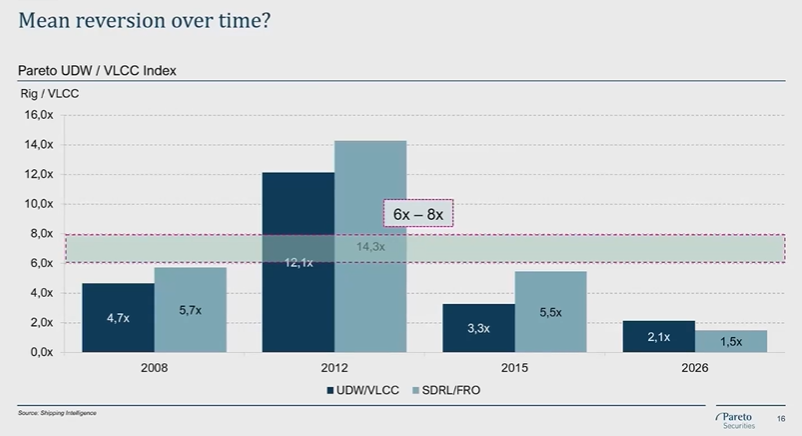
Enjoyed seeing my post there. HHI isn't a topic that does numbers but in honor of this shout out here's another 6 like HHI banger.
Herfindahl-Hirschman Index is a measure of market concentration used to determine market competitiveness
1/4
$OIH $RIG $VAL $NE $SDRL $ODL.OL $NOL.OL
I was DM'd to ask my views on offshore (following a brutal week). Maybe there was too much froth / too many tourists at close last Friday "The Next Big Trade" articles, etc.
But I think the offshore drillers are extremely well placed. People know the $RIG/ $VAL merger is big (but seemed to forget it this week!).
But I still think importance is being heavily underestimated. Partly because the companies are being v cagey about saying how much it will affect industry (for obvious regulatory / competition reasons).
I think this is interesting because normally you have to discount management chat as being too optimistic / bullish. But this is a rare example of where other way around - and I don't think investors 'get it' properly.
I know v well I don't have an analytical edge - but I do have a very good track record of compounding - ~ a decade now - inc outside $$ that prob puts me in top 1-3%. Achieved with virtually no tech exposure.
My edge comes from being willing to endure volatility, staying rational under pressure, being very careful to understand properly what I invest in (e.g. so I can average down safely) and a (genuine vs. BS!) medium-long term timeframe.
I think about incentives, I like to figure out how things work under surface. I often say the only way to outperform over long run is to "get closer to / understand reality better than your legion of invisible competitors".
I'm fairly sure the importance of the $RIG / $VAL merger closing is one of those examples where my understanding is better than most market participants. It is a RADICAL change that will - at some point in future - be recognised as the final catalyst for the future of the industry being definitively different to the past (at least for prob 5-10 years). Feel free to bookmark this.
Some interesting quotes from offshore drilling earnings;
$RIG Roddie Mackenzie, CCO,
“This year, we are seeing the same thing in other places. So a good example is India, for example. There is $9 billion that has been earmarked for funding for basically large-scale exploration and development of their resources, and it is all linked to domestic production… We definitely are observing the NOCs getting after it. We actually would say that in India, ONGC moved very quickly from when they got the bids finalized for that tender to actually making the award, recognizing the scarcity of the rigs available. So we think there is gonna be a lot more of that. We think, basically, those that move quickest are the ones that are gonna secure the assets, and those that do not are going to be disappointed.”
India also came up in our recent conversation with Constellation, who called it a very interesting market on the rise.
“We are not going to reactivate one of those cold-stacked ships speculatively… As we think about cold stack reactivations, we think about the lead time to get them restarted and available to work. That is 12 to 15 months. So… one, it is not going to happen unless there is a contract and we are gonna recover that investment. And two, it is probably not happening in the next 12 months anyhow.”
$ODL Kjetil Gjersdal, CEO, on Norway
“With our recent contract awards, all of our rigs are now fully booked until late 2027, with the Deepsea Bergen booked until early 2031… We do believe that, both with our own contract awards and those of our peers, supply and demand have tightened even further in the harsh-environment segment. The tier 1 harsh-environment market is now almost entirely booked for 2027 and 2028, with very few assets having availability. With limited new supply likely being added in the near future, we believe this to be highly favorable for our business, and we do repeat our previous statement that new builds remain very unlikely at this stage.”
$SDRL Jacob Taylor, VP Commercial
“In Brazil, only the West Auriga currently has a clear availability in late 2027. Between April of 2026 and January of 2027, five drillships have left Petrobras’ fleet, three of which have departed the region altogether. In addition to Petrobras’ decision to release approximately one-fifth of its drillship fleet, they are not expected to award the next wave of drillship contracts until the first half of next year. We believe the West Auriga is well-positioned for regional and international opportunities in the beginning of 2028.”
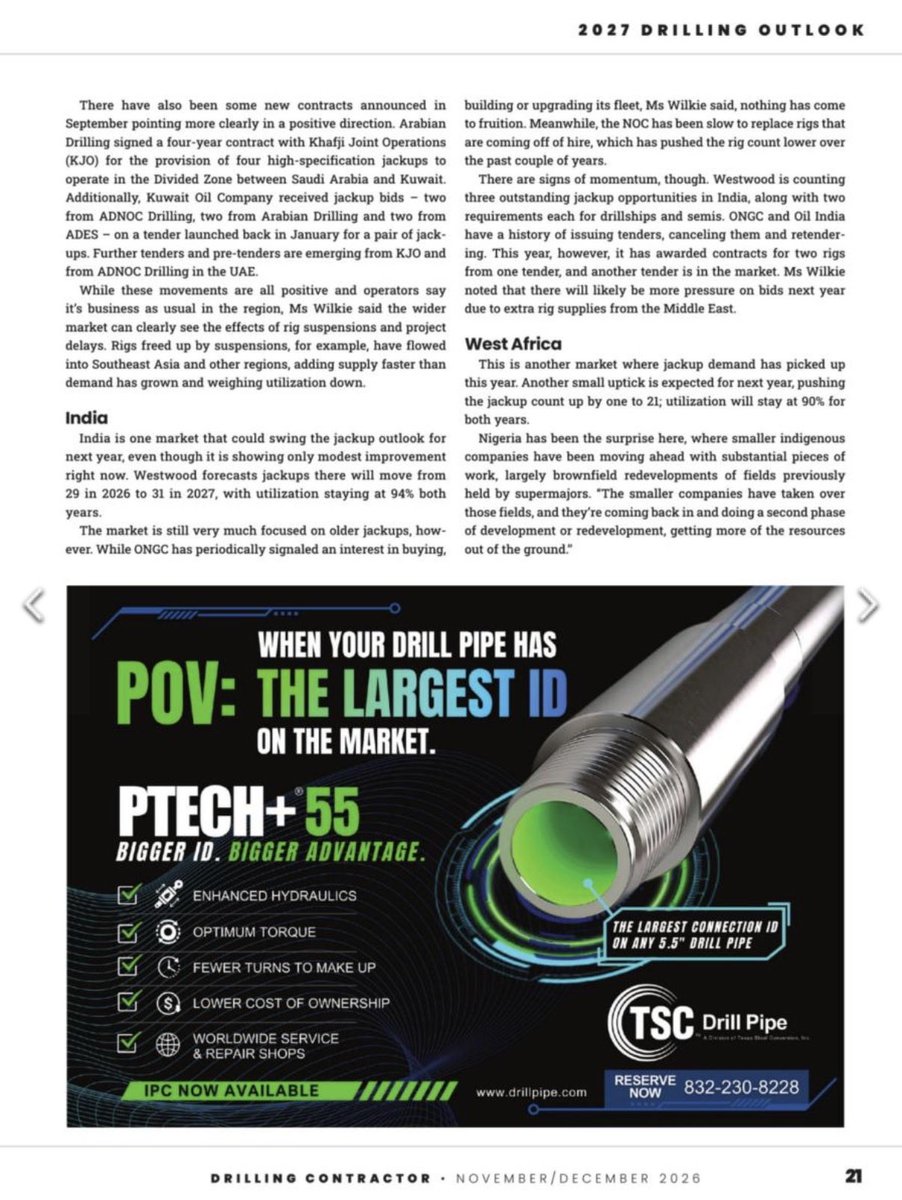
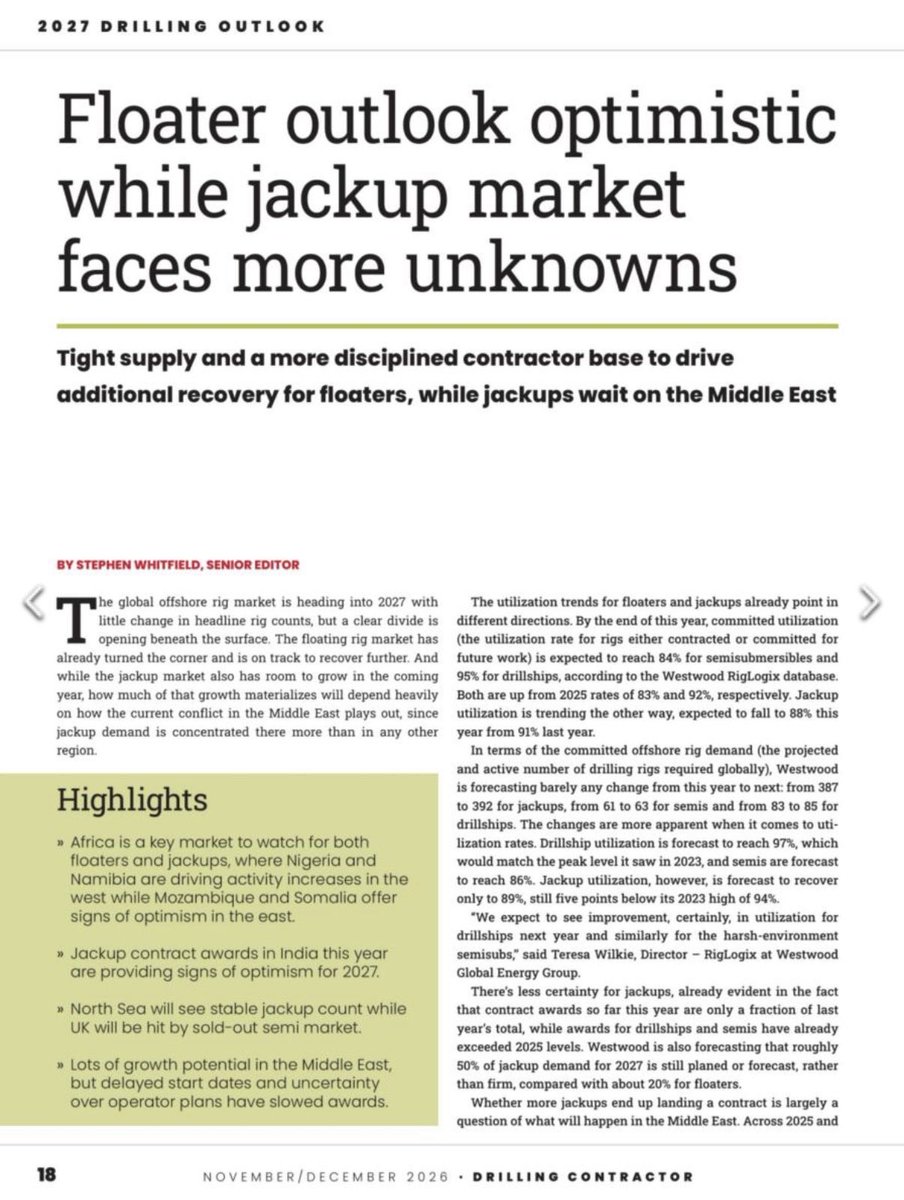
Our barbers are, of course, telling us to get haircuts. The main "point" is that oil at USD 65 or USD 90 doesn’t really matter for the investment cycle. The oil majors plan on very long horizons, and the projects being sanctioned work at much lower prices; Transocean says operators are justifying them on breakevens of USD 50 and below. In my view this is a very durable upcycle. The real question is how fast it moves and when we hit the magical ~96% util level.
The largest question now is whether the slump in Brazil dampens dayrates in 2027. Petrobras has released about a fifth of its drillship fleet and won’t award again before H1'27. Rigs leaving Brazil for West Africa and Asia should help balance the market. What is clearly encouraging is that contracts are getting longer: the average new contract runs ~380 days, up from ~245 last year, and 2–3 year terms are becoming standard. That is usually the first sign of a strong market. Operators commit to longer terms when they start to worry about getting rigs at all, and day rates follow. It also helps lock up more supply, in weak markets rig are on the rollover carousel as they have little pricing power.
Newbuilds are off the table, and Transocean and Seadrill both refuse to reactivate cold-stacked rigs unless a contract pays for it, with a 12–15 month lead time. Any spare capacity comes back slowly, and only at prices that justify it.
Decent video, mate. You speak a bit fast, though. I have a few points of feedback to make. The bear and bull cases for $RIG are far too narrow at -10% and +61%, respectively, over the 2026–2030 period.
Given the highly cyclical nature of the offshore drilling industry, these companies, especially $RIG with its significant debt load, could easily fall 50–75% in a bear scenario or rise 250–1,000% in a bull scenario.
We've seen similarly moves in $SUBC (despite its relatively unlevered balance sheet) and other cyclical companies, both over the past few years and in previous cycles.
Mohnish Pabrai would not buy $RIG if the upside in a bull scenario were just 61% over a 3–4 year period, particularly given the 10% hurdle rate.
This is a highly cyclical industry with substantial operating and financial leverage.
@TommyDeepwater@ICBarrett@ArchiteuthisDx Appreciate you putting out the info as always.
I enjoy being on any list with those 2. Usually it's a list of weirdos but either way Im glad to be on it.
Debt itself didn’t cause the offshore driller bankruptcy cycle of 2016-2021. Debt + a newbuild wave delivering into a downturn did, and it was bad for years
Today, a non-existent orderbook is a better macro backdrop to support modest levels of debt in an optimal cap structure
- Ten years ago, it was hard not to be a huge bear on deepwater rigs. Not only did OPEC crash the market in Nov 2014, but a bloated newbuild orderbook took years of deliveries and supply rationalization to absorb. Meanwhile, E&Ps and IOCs favored short-cycle shale capex, and the Permian was about to add a few million bpd at lower costs than deepwater could match. It resulted in a wave of bankruptcies of deepwater drillers from 2016-2021, although Transocean and Odfjell never filed.
Today, deepwater barrels are far more cost-competitive, thanks to eliminated redundancies and simplified, standardized project designs. Additionally, as more FPSOs come online, deepwater capex increasingly shifts to lower-cost brownfield tiebacks that leverage existing infrastructure. There's also no newbuild orders even contemplated.
- The proposed Transocean-Valaris merger has been cleared by all global regulatory bodies. A shareholder vote in November remains but should be a formality. Once the deal closes, the Transocean debate shifts from merger risk to shareholder returns and the combined company’s optimal capital structure.
- I believe Norwegian harsh environment semisub driller, Odfjell Drilling, sets an ideal example of balancing shareholder returns with an appropriate amount of leverage, which is currently ~1.6x net leverage and a >8% dividend yield.
Once overleveraged, Odfjell deleveraged, then initiated a dividend with room to grow, and its stock has performed strongly in recent years. Transocean is unlikely to initiate a dividend at Odfjell’s current level of >8%, but Odfjell serves as a blueprint for a prospective shareholder returns program.
- Transocean also has an NCS-eligible harsh environment fleet (currently 100% utilized), as well as an industry-leading drillship fleet and after combining with Valaris will also have a diversifying jackup fleet for shallow water markets. Given the combined Transocean-Valaris scale, fleet and regional diversification, and a stronger industry backdrop, Transocean should be able to comfortably sustain 1.5x-2.0x leverage while rewarding shareholders. In my view, a mix of dividends, buybacks, and flexibility for single-rig acquisitions (if/when more accretive than repurchases at prevailing valuations) would create option value for the company and its shareholders.
- Borr Drilling is a different credit story. As a pure-play shallow-water jackup driller, it currently carries more leverage and greater exposure to the Middle East, where the Hormuz crisis is pressuring utilization and global jackup dayrates.
The high yield credit market is saying Borr is overleveraged. Borr’s secured bonds trade actively in the high yield market, with the 8 ¾% 2032s and 9% 2034s both around 89-90, mid-600s OAS, and ~11.5% yields. Borr is rated B/B3, but despite adequate liquidity, sustained net leverage near 6x will lead the agencies to question the capital structure’s sustainability and potentially downgrade it to CCC/Caa. Current bond pricing already reflects that risk.
- The bear case is for Borr to reach ~2x leverage ($1,080mm EBITDA level) requires ~90% utilization at ~$180k dayrates. These levels arguably reflect the 2022-2023 market driven by Aramco’s capacity expansion. Absent a similar Middle East demand surge, those levels may not return. Borr currently generates ~$385mm LTM, reflecting softer conditions.
The bull case is that Middle East demand is depressed because of the Hormuz crisis and if/whenever that normalizes, the region should rebound, lifting jackup utilization and dayrates, all else equal.
-A modest recovery in EBITDA should reduce leverage from ~6x to ~4x, although this is still an elevated level for an offshore driller. Achieving $1,080mm EBITDA (2x leverage) likely requires Aramco to come back in a large way, which is speculative. With yields above 11%, I believe the secured bonds are attractive given Borr’s modern fleet. For risk-seekers, the same leverage amplifies equity upside in a jackup rebound, and Borr has the liquidity to wait for one. The same leverage also magnifies downside in a dilution event.
@ICBarrett I was just talking about something similar. It's very right where I live. But wealthy, white, educated woman are a strange type of left. Sometimes when they complain they will begin to make the right wing point. I think it's an empathy thing. That's laudable but can be foolish.
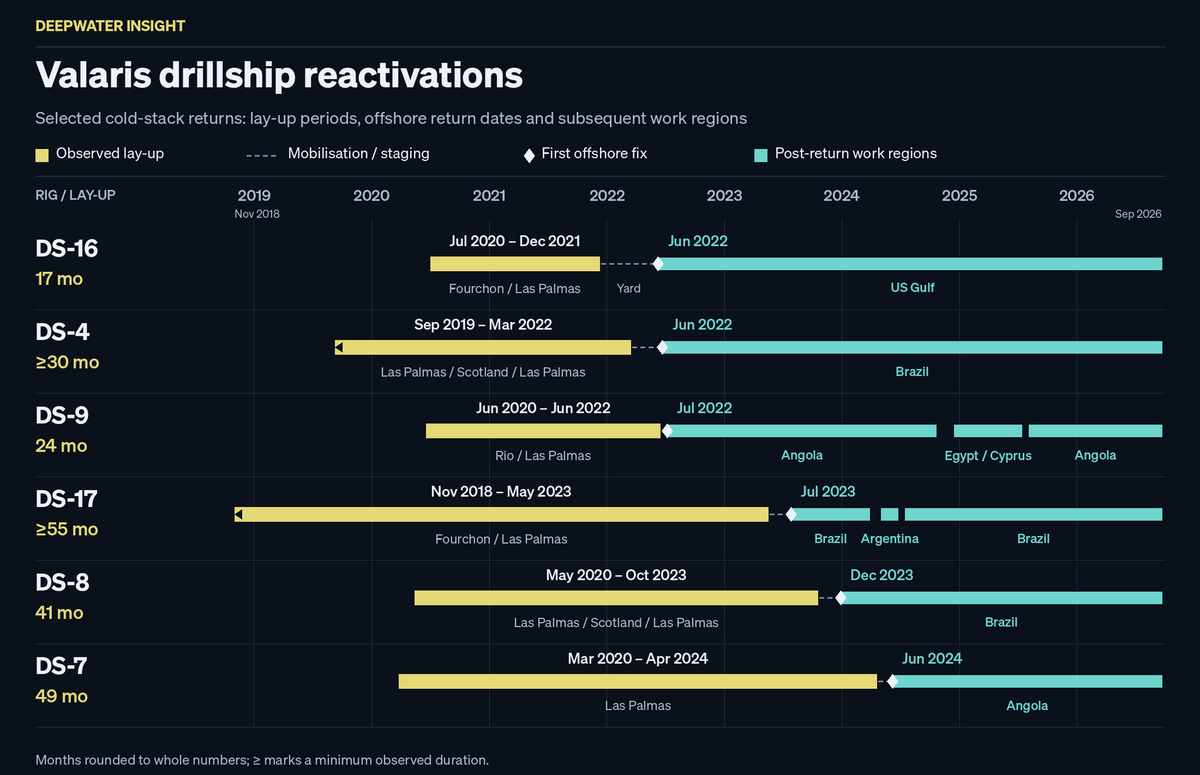
Valaris brought 6 cold-stacked drillships back in 24 months, criticized by some as chasing utilization before the market was truly ready to absorb them.
VAL has another 3 cold drillships on the sidelines. Under Transocean, they likely stay there longer. Supply discipline.
- Valaris' DS-13 and DS-14 are the most relevant as “stranded-newbuild” 7G drillships currently sitting idle in Las Palmas. Atwood originally ordered them >10 years ago. After repeated delivery deferrals, two mergers and a bankruptcy, Valaris exercised purchase options from the shipyard in December 2023 for $337 million combined. They have yet to be activated (~$100mm each).
- With demand improving in Africa and Asia, DS-13 and DS-14 were reasonably expected to be activated eventually. This latent supply may have kept a lid on industry dayrates, all else equal.
- Valaris' third cold-stacked 7G is DS-11. Unlike the stranded newbuilds DS-13 and DS-14, it has previously worked, which likely puts it further back in the reactivation queue.
- A key market structure impact of the proposed RIG-VAL merger is that an independent VAL likely markets these more aggressively, whereas RIG likely waits for more attractive returns before considering potential activation.
- Transocean's 2018 acquisition of Ocean Rig added three cold-stacked 7G drillships, Mylos, Athena and Apollo, all cold for nearly a decade – partly an example of Transocean discipline. Reactivating any of them would be costly and I believe is quite unlikely at this point.
- Activating a cold drillship adds EBITDA and cash flow, net of activation capex. However, the cost is slower to surface as it increases warm supply that weighs on market utilization and dayrates, all else equal. This can be impactful to other warm drillships.
- Industry skeptics argue most of these drillships will never be reactivated, and call that bearish. It's the opposite for the warm fleet: less supply competing for contracts means higher dayrates and lower probability of costly idle time, all else equal.
- A likely outcome of the proposed Transocean-Valaris merger is cold supply stays sidelined longer, some of it permanently. That tightens the market for the warm fleet and moves it closer to the dayrates envisioned when these rigs were ordered for >$750mm each over a dozen years ago.
- Relatedly, in July 2025 Turkey's TPAO bought two stranded-newbuild 7G drillships, since renamed Çağrı Bey and Yıldırım. TPAO uses these for Turkish energy security rather than marketing them internationally as a contract driller would. Paired with a Transocean-Valaris merger, that's a meaningful improvement in high-spec drillship market structure.