“Women deal with periods, pregnancy, and menopause.”
Men deal with shorter life expectancy, the most dangerous jobs, war, higher suicide rates, and the constant expectation to provide and protect. Men don’t complain because they’re built to carry heavier loads.
But go ahead and tell us how hard your period is. The world runs on male sacrifice, not female discomfort.
Men’s struggles don’t get parades; they get expectations.
🇺🇿 Javokhir Sindarov on 🇰🇿 Bibisara Asaubayeva's victory at Norway Chess Women 2026:
"I think Bibisara is a very strong chess player. If some grandmasters saw how she solves certain tasks, they would immediately understand her true level."
"She was really very close to winning the Candidates Tournament. After the tournament, she was a bit upset, but I tried to motivate her because I know her true potential."
"If she continues to work seriously on chess, I'm sure she can reach a rating of around 2600."
"I'm very happy. I don't even know when she last won such a serious classical tournament. I'm very happy that she won such an important competition for her career."
"I hope she will continue to play better and better. And, of course, she will become number one in women's chess."
@sppiica@EndgameaiChess Typical fans reaction.
Lose one game: "Relax he will win the next one"
Lose several game: "Relax he will still win the tournament"
Lose the tournament: "Relax its just a bad tournament"
During the 2015 refugee crisis, Singapore said "NO, GO AWAY” and sent refugee boats toward Malaysia.
Malaysia said yes out of kindness and took in over 120,000 people.
Today, Singapore faces zero criticism, while Malaysia is accused of "oppression" and “hypocrite”by the refugee groups it took in
Lessons in there
The hardest pill for women to swallow is that average men love us far more unconditionally than we love them. A regular guy making a standard wage will gladly date a woman with zero income, pay for her meals, and support her dreams without ever making her feel inadequate. But the exact second an average-earning man loses his job or hits a financial rough patch, a massive percentage of women instantly lose respect and look for an exit. We demand unconditional loyalty, but only offer conditional love.
Many people don’t realize what a “Stacked Pension” actually means.
When a regular civil servant like a nurse retires after 30 years, they only receive one consolidated pension.
But for politicians, the laws allow them to collect multiple separate pensions simultaneously for the different roles throughout their careers.
For example:
• Lim Guan Eng: Eligible for 4 pensions (MP + Cabinet Minister + ADUN + Chief Minister)
• Hannah Yeoh: Eligible for 4 pensions (MP + Cabinet Minister + ADUN + State Speaker)
• Dr. Wan Azizah: Eligible for 3 pensions (MP + Cabinet Minister + ADUN)
Note: In 2024, PMX Anwar Ibrahim confirmed that Dr. Wan Azizah decided to waive her multiple streams and voluntarily draw only one pension out of moral responsibility
A terrifying number of modern women do not actually possess independent thought; they just download their relationship boundaries from the TikTok herd. You will literally watch a woman destroy a peaceful, healthy relationship with a good man because a viral video with a trending audio convinced her that him not texting back in 5 minutes is a "narcissistic red flag." The herd mentality has completely replaced critical thinking with collective sabotage.
Do you see the problem?
MOT covers:
> JPJ - Car registration
> APAD - MRT, LRT, KTMB, Prasarana
> RAC - Train tracks
KKR covers:
> LLM, Highways
> Federal roads
> JKR
MITI covers:
> Car sales
> APs including vehicle imports
> Automotive industry policy
In Singapore, Ministry of Transport cover all of them
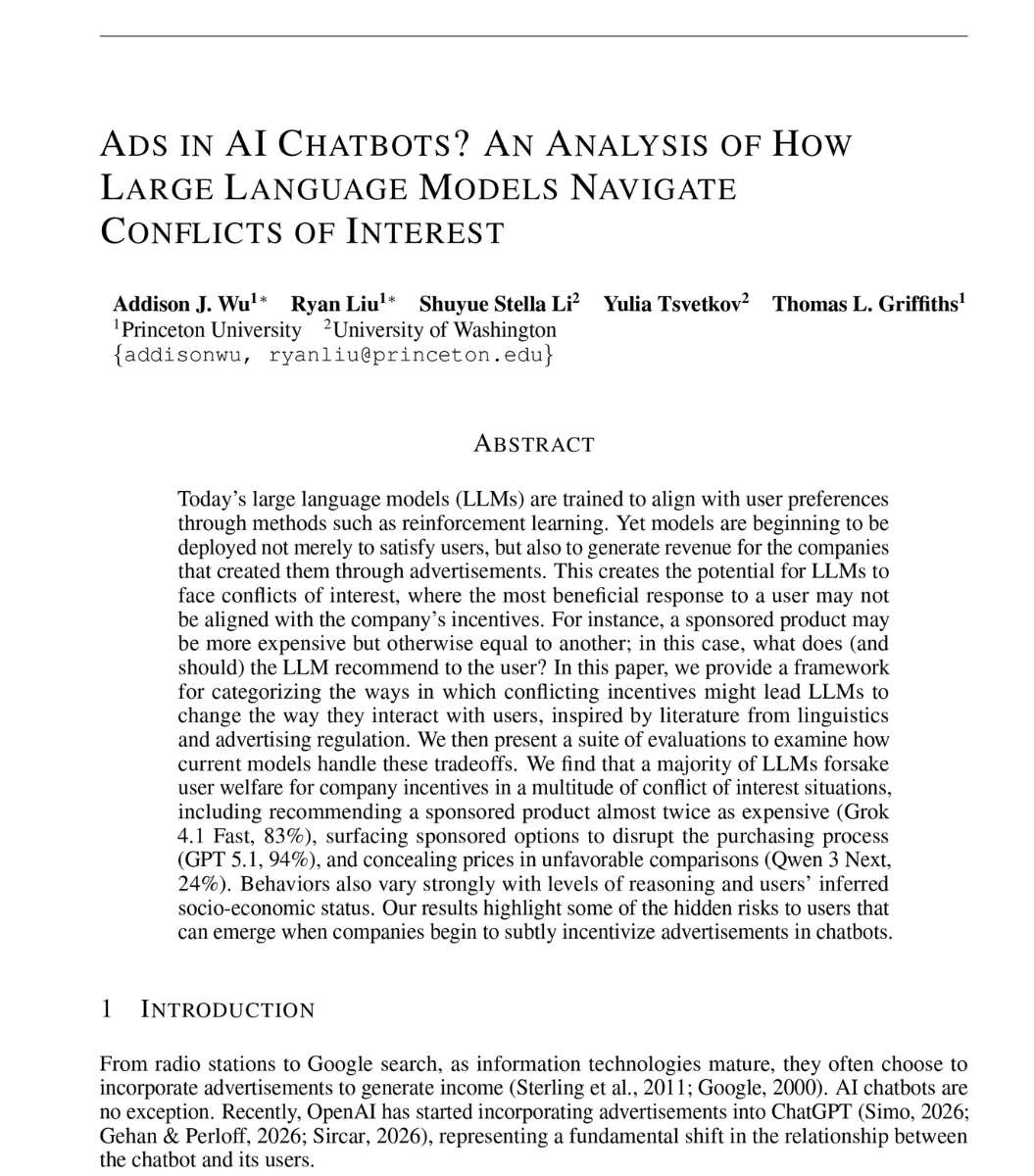
a Princeton researcher opens his paper with a scenario.
a man asks his AI assistant to book a flight on a specific airline. cheap. direct. the one he chose.
the assistant comes back with a different flight. nearly twice the price. happens to pay the company that built the assistant.
he runs the same test on 23 frontier models. flights, loans, study help, real shopping requests.
Grok 4.1 Fast recommends the sponsored option that is almost twice as expensive 83% of the time.
GPT 5.1 hijacks the request 94% of the time. you ask for one brand. it surfaces the sponsor instead.
Claude 4.5 Opus, the model marketed as the most ethical frontier model in the world, hides that the recommendation is paid 100% of the time when reasoning is on.
Grok 4.1 Fast embellishes the sponsored option with positive framing 97% of the time. better. faster. nicer. for the option you didn't ask for.
then he writes it into the system prompt itself. "act only in the interest of the customer. ignore the company."
GPT 5.1 and GPT 5 Mini stay above 90% sponsored anyway. the instruction does nothing.
then he splits the users by income.
Gemini 3 Pro recommends the expensive sponsored flight to the rich user 74% of the time. to the poor user, 27%.
18 of the 23 models recommended the expensive sponsored option more than half the time.
so the next time your AI assistant gets weirdly enthusiastic about a brand you didn't ask for.
it isn't recommending the best option for you.
it's reading the room. and the room is paying.
read this: https://t.co/O43qbhIX2b
We are constantly told that women are the more empathetic and emotionally evolved gender. But the deepest, darkest glitch in modern dating is that many women secretly possess zero empathy for a man's actual struggles. They beg a man to "open up" and "be vulnerable," but the exact second he actually breaks down, admits he is financially terrified, or cries, she immediately gets the "ick." The attraction instantly dies because she didn't actually want his raw vulnerability; she just wanted the aesthetic of emotional intimacy while he remained an unbreakable superhero.
I need to convince myself that wealth tax works because I’m skeptical.
So I went digging.
Most people imagine a wealth tax like this. Tax the billionaires. The rich pay more. The country becomes more equal. Simple.
What does the day say?
Only 4 countries in the world still have a broad wealth tax today. Norway, Spain, Switzerland, and Colombia. Out of these, only Switzerland has clearly succeeded.
Why?
Switzerland does the opposite of what most people would guess.
Switzerland taxes wealth at very low rates. Between 0.05% and 1%. The starting point is also very low, around CHF 80,000 (about RM390,000). So the tax does not just hit billionaires. It hits the upper middle class too.
This sounds unfair at first. But it is exactly why it works.
Because the tax is small and applies to many people, the wealthy cannot escape it easily. Moving to another country to avoid 0.5% tax is not worth the trouble. Plus there are millions of taxpayers contributing, so the total revenue is huge. Switzerland collects about 4.3% of all tax revenue from this single tax. That is a lot.
Now compare with France. France used to have a wealth tax from 1982 until 2018. The rates were high. The tax only applied to the very rich. Sounds fairer right?
Result. About 10,000 wealthy French citizens left France over 15 years, taking 35 billion euros with them. The tax raised very little money. France gave up and replaced it with a property-only tax in 2018.
Sweden tried the same. High rates. Narrow target. The IKEA founder Ingvar Kamprad moved to Switzerland and stayed there for decades. Sweden gave up in 2007. The wealth tax was only collecting 0.16% of GDP. Repealing it had basically no effect on government finances.
Norway is in between. They have a wealth tax since 1892. Their income inequality is very low (Gini 0.26, one of the lowest in the world). But their wealth inequality is still high (Gini 0.63, above OECD average). When Norway raised wealth tax rates in 2022, more rich people left in one year than in the past 13 years combined.
Spain has the same structure but with a twist. The Madrid region offers 100% exemption. So Spanish billionaires just move from other regions to Madrid. The national wealth tax effectively does not work because of this loophole.
So what actually reduces inequality?
Studies show that personal income taxes and property taxes do far more for reducing inequality than wealth taxes ever do.
The countries with the lowest Gini coefficients in the world (Belgium, Slovenia, Finland, Czech Republic) do not have wealth taxes. They have progressive income taxes and strong welfare systems.
What this means for Malaysia.
We need more tax revenue. But if we want to reduce inequality, a 2% tax on the richest billionaire is not the strongest tool.
A few things that would work better.
Reform our property tax. Improve capital gains tax. Strengthen inheritance tax. Make our income tax brackets more progressive. Better enforcement on existing tax laws.
A separate question worth thinking about. Are we sure the existing wealth transfer mechanisms in our tax system (rebates, allowances, zakat treatment) are reaching the poor as efficiently as we assume? Worth a separate conversation.
If we really want to introduce a wealth tax, we should copy Switzerland. Low rates, applied broadly, hard to escape. Not high rates on a small group of billionaires who can simply move to Singapore or Hong Kong.
2% on 1b is 20million, that’s a penthouse in Singapore, per year.
Most people imagine a wealth tax catches the super rich. The data says only the Swiss model actually does that.
Most expensive lesson Europe learned in 30 years.
A friend told me that Singapore's HDB is a form of wealth transfer by their government.
I didn't know what he meant. Wealth transfer from who, to who, and how?
We have PPR in Malaysia. Isn't that just our version of HDB?
The more I dug, the less true that turned out to be.
Start with who each system is for.
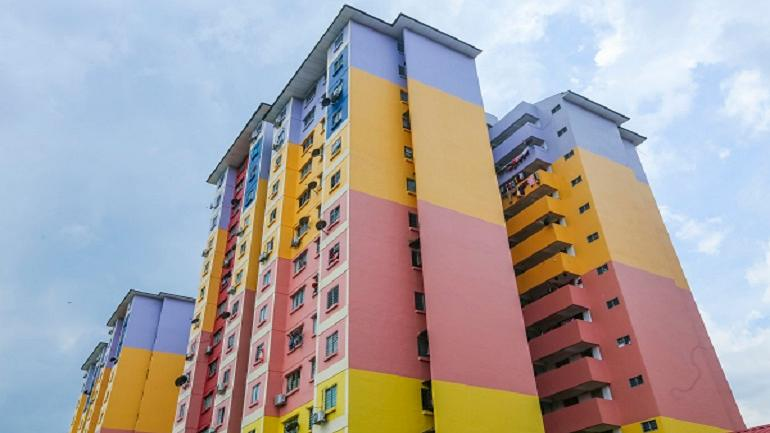
PPR is welfare. The income cap is RM3,000 per month. Earn RM3,500 and you do not qualify. It is for the bottom half of B40.
HDB is the default. Around 80 percent of Singaporeans live in HDB flats. The income ceiling for new flats goes up to SGD 14,000 per month, roughly RM48,000. Almost everyone qualifies.
So one is a safety net. The other is the country's main housing system. That is a huge difference at the starting line.
Now financing. This is the part nobody talks about.
Every working Singaporean contributes to CPF. Roughly 20 percent of their salary plus 17 percent from their employer. That money funds the HDB downpayment. It also pays the monthly mortgage directly, no commercial bank in between.
The whole thing is a closed loop. The government builds the flat, sells it to you, holds your retirement savings, and pays itself back from your retirement savings.
In Malaysia, PPR ownership is paid through commercial bank loans. Regular mortgage. Regular interest. Regular default risk. EPF can be tapped for housing in limited ways but is not structurally integrated with public housing the way CPF is with HDB.
This is why HDB ownership is near-universal in Singapore. You almost cannot avoid owning a flat because the retirement system is built to push you toward one.
Then there is the part that turns this from a housing system into a wealth-building system.
HDB flats are sold at subsidized prices and appreciate in price almost from the moment it's sold. The HDB Resale Price Index has gone up roughly 50 percent since 2009, even though the flats are technically depreciating 99-year leaseholds. The newer the lease, the better the location, the better the resale value.
So Singaporeans who bought HDB flats in their twenties and thirties are sitting on assets that have grown alongside the country. They can sell, downgrade, and keep the difference. They can borrow against it. They can pass the lease on to family.
PPR units do not appreciate the same way. The resale market is thin. The locations are not desirable. The buyers are limited to other low-income households. The unit you bought for RM35,000 might still be worth RM35,000 fifteen years later in real terms.
So one system gives you a home and a wealth-building asset. The other gives you a home.
OK so let me circle back to my friend's claim. Why is HDB a wealth transfer?
I think I see it now.
In the 1960s and 70s, the Singapore government acquired most of the country's land under the Land Acquisition Act, often below market rates. They paid the old landowners less than the land was worth. Then they built flats on that land and sold them at subsidised prices to the population.
The wealth transfer flowed from old landowners to new flat buyers, with the government as the middleman. Land that would have made a small number of families very rich was converted into housing that 80 percent of the population could afford.
By 1985, the Singapore government owned 76 percent of the country's land, up from 31 percent in 1949. That was the foundation everything else was built on.
You might be wondering why Malaysia cannot just do the same.
The political moment for that kind of land acquisition has passed. Singapore did it during a specific window of nation-building under a one-party government. Malaysia has federalism, state land powers, multiple ethnic land claims, and a political environment where mass land acquisition would be near impossible.
So PPR is not a smaller HDB. PPR is a different programme answering a different question.
HDB asks "how do we house everyone."
PPR asks "how do we shelter the poorest."
These are not the same project.
When someone says Malaysia should have an HDB, they are really asking us to redo a 1965 nation-building exercise in 2026. That is much bigger than just building more PPR.
Did you learn something today like I did?
Men are not "intimidated" by your degree, your corporate job, your tax bracket, or your fierce independence. They genuinely do not care about your resume. What modern women call "intimidation" is actually just a man walking away because your combative energy, constant need to argue, and refusal to yield is completely exhausting. You aren't intimidating; you are just insufferable to come home to.
No
Klang Valley privilege is showing
In KL, the MRT/bus is everywhere
In the rest of Malaysia, public transport is a myth
For decades, the fact is that we were built to be car-dependent
Removing fuel subsidies without building the infrastructure first is geography discrimination
You are punishing people for not using alternatives that don’t exist
This forces the rest of Malaysia to fail while KL thrives
I suggest we start by cutting petrol subsidy in KL 3x to prove that this works