If you’re doing empirical monetary macro today, sooner or later you’ll need HFI and related data.
Last semester, I put together a database of the main datasets for measuring and identifying monetary policy for my students in a project course.
A thread (1/10)
MP1/ Monetary Policy Shock Series for 176 Countries by Sangyup Choi, Tim Willems, and Seung Yong Yoo
This database provides monetary policy shock estimates for a large cross-section of countries. It is especially useful for projects on heterogeneous monetary transmission and cross-country comparisons.
Link: https://t.co/pBzmnJGdCm
Link to paper: https://t.co/eQpXQtITd6
Latest data point as of June 2026: December 2019
Super interesting!
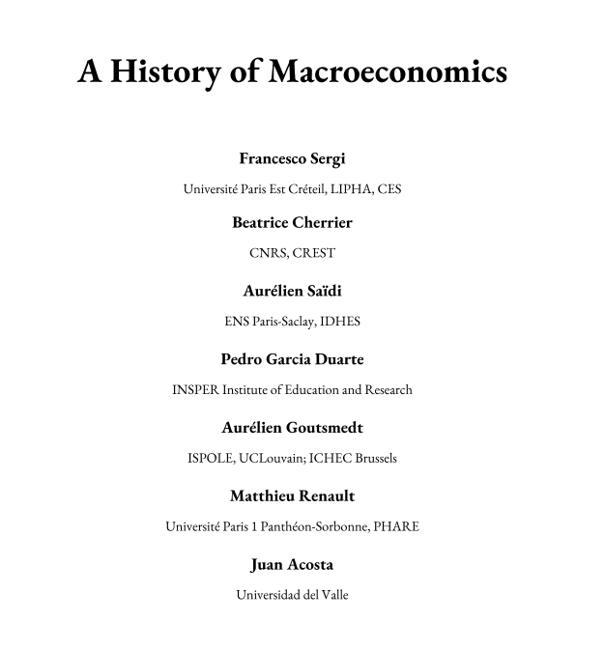
"A History of Macroeconomics" by Francesco Sergi, Beatrice Cherrier, Aurélien Saïdi, Pedro Duarte, Aurélien Goutsmedt, Matthieu Renault, and Juan Acosta.
"The history of macroeconomics outlined in this book is dense and complex. This mirrors both the flourishing historical scholarship and the richness of the subject itself. Yes, macroeconomics is complicated and hard (much more than usually acknowledged in macroeconomics textbook narratives). But this is a good thing, especially as it results from the sheer diversity of topics, of theoretical and methodological patterns, and from the entanglements with other fields as well as policymaking. And yet, the chronology that we offer (birth, bridges, frictions, constellation) helps navigate such a complex story by pointing to our main takeaways. We believe that the different audiences of macroeconomics deserve such an evidence-based, encompassing history, and that our history should, and can, be integrated into macroeconomics textbooks."
https://t.co/ps6Db8cbNp
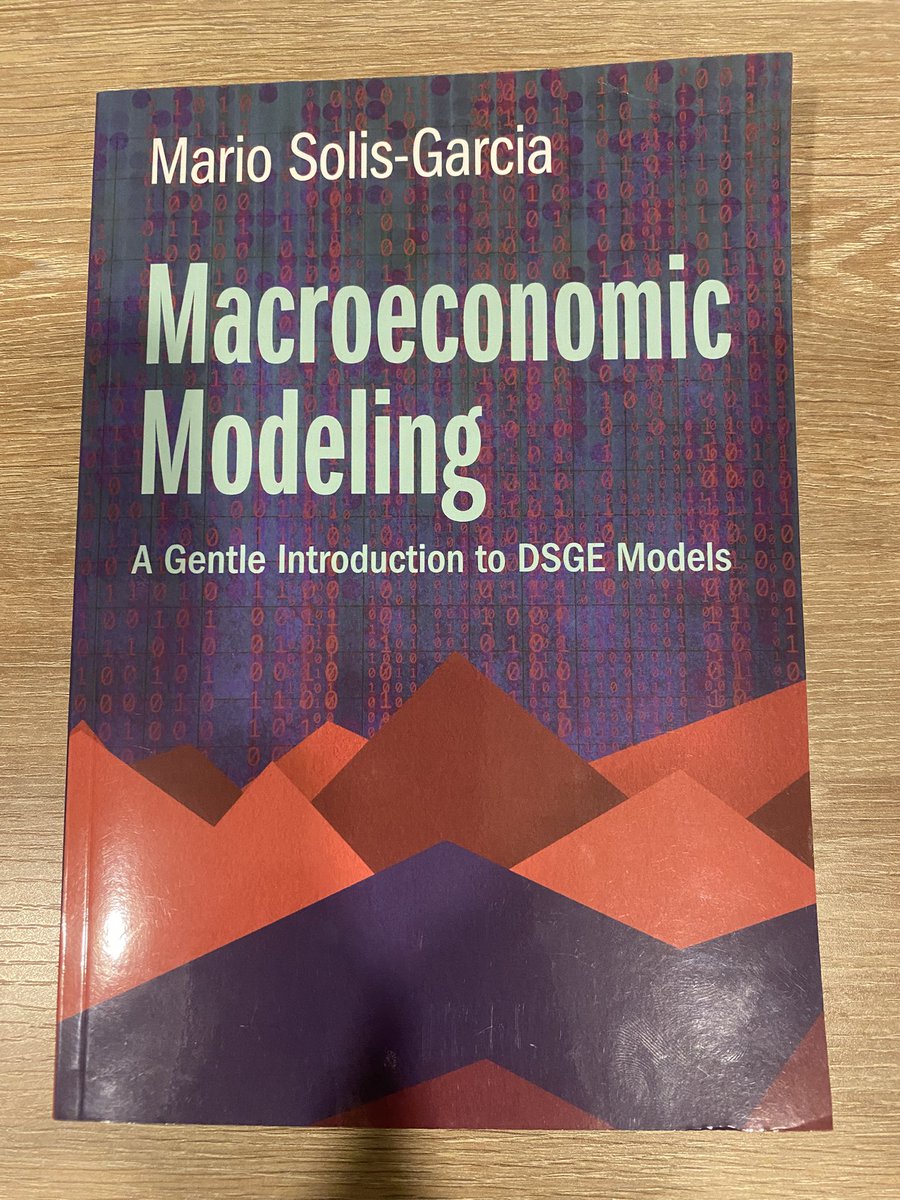
Me acaba de llegar @CambUP_Econ para el curso de Macroeconomía 3 del programa de economía en la Escuela Colombiana de Ingeniería, en donde se hace una introducción a modelos DSGE a nivel pregrado!!!!
Why are aggregate markups rising? Standard decompositions point to reallocation toward high-markup firms, but @HasvanVlokhoven shows that signal reflects mostly firm churning. A new decomposition finds markup-distribution changes are the main driver.
https://t.co/uk1eM4VANg
Oh, I don't know. So many!!!!!!
A few favorite of mines that any student can read and get 95% out of them:
George Akerlof (1970), "The Market for 'Lemons': Quality Uncertainty and the Market Mechanism," QJE
Michael Spence (1973), "Job Market Signaling," QJE
Gary Becker (1973), "A Theory of Marriage: Part I," JPE
Robert Lucas (1978), "On the Size Distribution of Business Firms," Bell Journal of Economics
Sherwin Rosen (1981), "The Economics of Superstars," AER
Douglas Diamond and Philip Dybvig (1983), "Bank Runs, Deposit Insurance, and Liquidity," JPE
Thomas Schelling (1971), "Dynamic Models of Segregation," Journal of Mathematical Sociology
Martin Weitzman (1974), "Prices vs. Quantities," Review of Economic Studies
William Baumol (1967), "Macroeconomics of Unbalanced Growth: The Anatomy of Urban Crisis," AER
Kevin Murphy, Andrei Shleifer and Robert Vishny (1989), "Industrialization and the Big Push," JPE
Michael Kremer (1993), "Population Growth and Technological Change: One Million B.C. to 1990," QJE
@DrAbioye@hazizsegun I have seen a situation (a solo-authored paper) cant recall exactly the title/author but they died while completing the paper. A friends of theirs completed it and submitted/revised through authors comment on their behalf without claiming authorship
This looks like a must-read!
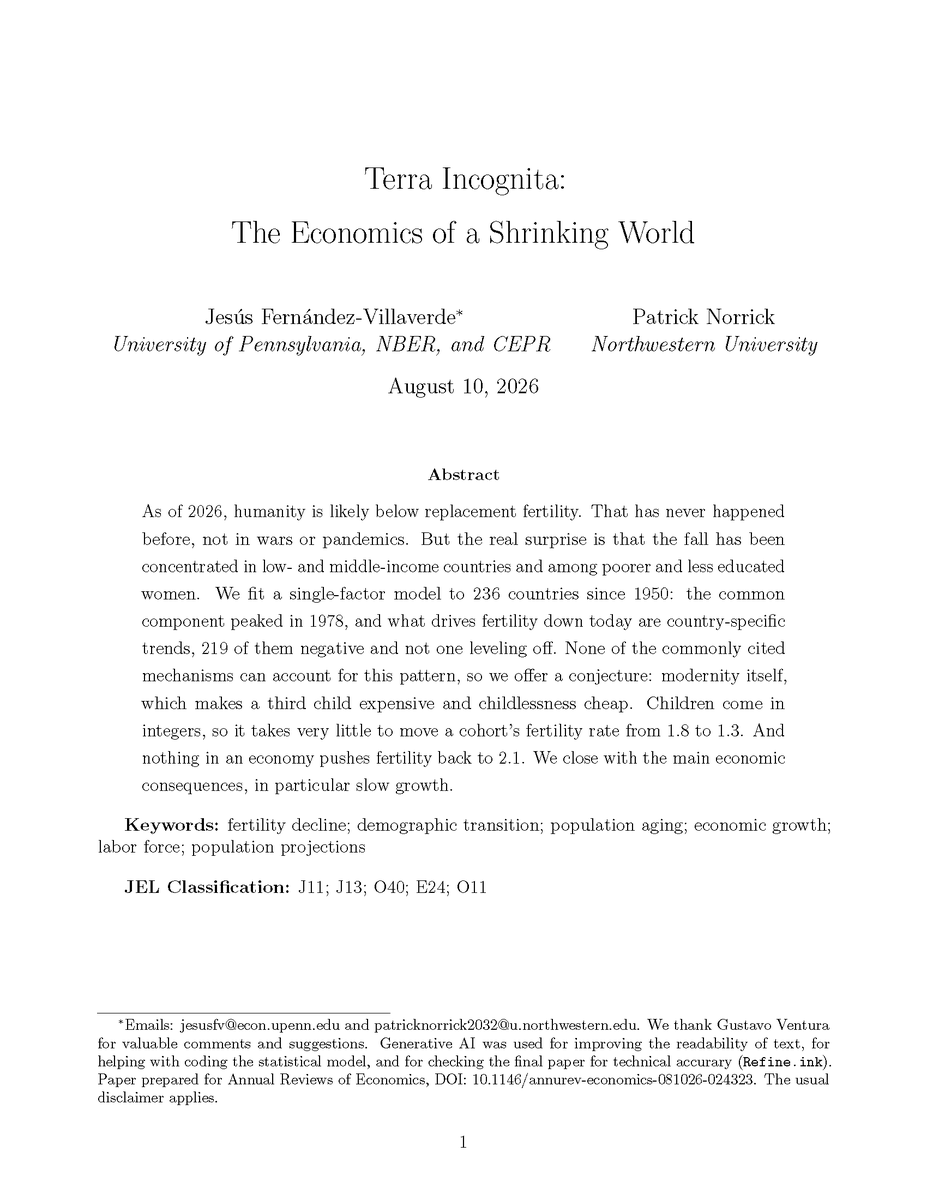
"Terra Incognita: The Economics of a Shrinking World" by Jesús Fernández-Villaverde and Patrick Norrick.
"As of 2026, humanity is likely below replacement fertility. That has never happened before, not in wars or pandemics. But the real surprise is that the fall has been concentrated in low- and middle-income countries and among poorer and less educated women. We fit a single-factor model to 236 countries since 1950: the common component peaked in 1978, and what drives fertility down today are country-specific trends, 219 of them negative and not one leveling off. None of the commonly cited mechanisms can account for this pattern, so we offer a conjecture: modernity itself, which makes a third child expensive and childlessness cheap. Children come in integers, so it takes very little to move a cohort’s fertility rate from 1.8 to 1.3. And nothing in an economy pushes fertility back to 2.1. We close with the main economic consequences, in particular slow growth."
https://t.co/W5lIk4v3tk
Forthcoming in the JEL: "Micro and Macro Perspectives on Production-Based Markups" by John Fernald, Amit Gandhi, Dimitrije Ruzic, and James Traina. https://t.co/KqhydPwK2a
Food for thought!
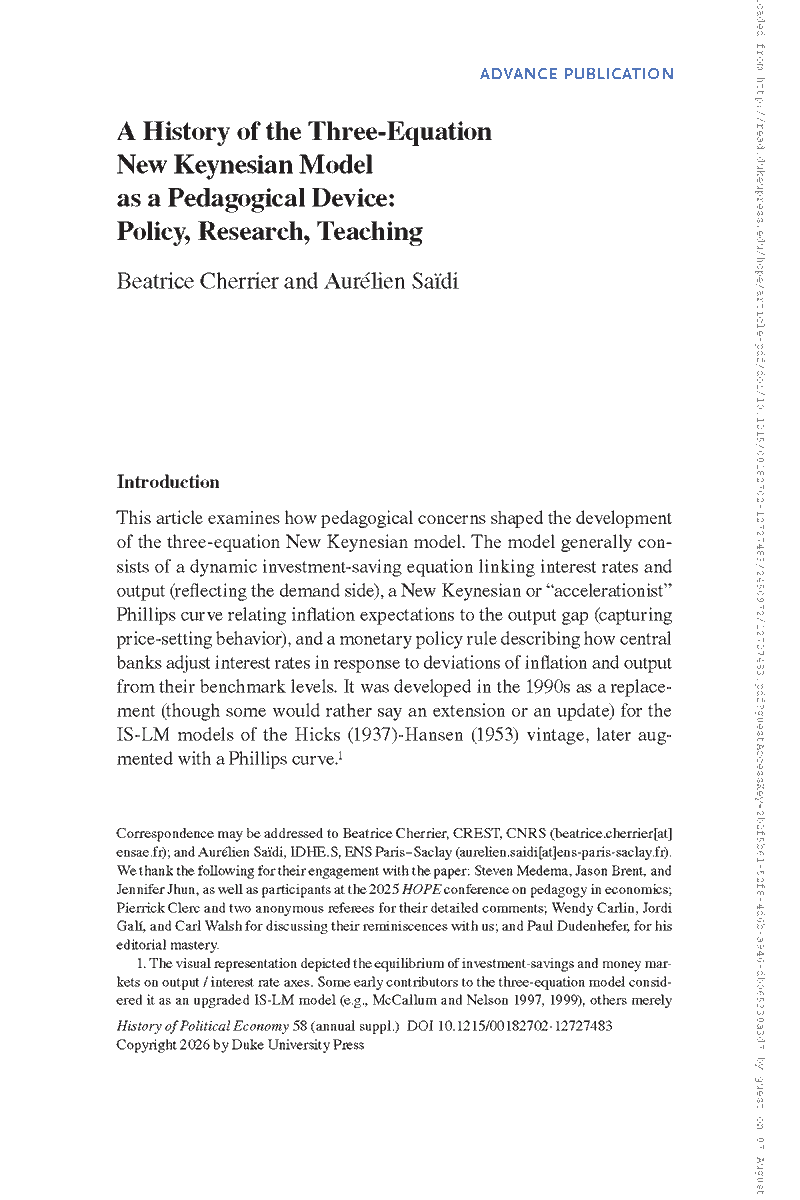
"A History of the Three-Equation New Keynesian Model as a Pedagogical Device: Policy, Research, Teaching" by Beatrice Cherrier and Aurélien Saïdi.
"This article examines how pedagogical concerns shaped the development of the three-equation New Keynesian model, which became the dominant framework for teaching and evaluating monetary policy from the 1990s onward. Contrary to the standard narrative, the model did not originate in classrooms or academic journals but in central bank workshops. We show that the many macroeconomists who proposed small models in the 1990s simultaneously targeted researchers, policymakers, and students, pursuing a common set of epistemic virtues: simplicity, realism, and consistency. They tried to accommodate recent advances in expectations modeling and price-setting modeling, to assess theoretically and empirically worldwide shifts in monetary policymaking, and to equip students with a sense of these mechanisms and dynamics. These virtues were negotiated differently across spheres, particularly in the transition from equation-based policy models to diagrammatic classroom representations, illuminating the porous boundary between education, research, and policymaking in modern macroeconomics."
https://t.co/VoxbdafuvM