@Rick_Ferri@larryswedroe The point I was trying to make is that defining the total market is a decision. You choose the segments that you want exposure to. Once you define your version of total market, and rebalance systematically, you are a passive investor IMO.
@Rick_Ferri@larryswedroe Is 70/30 SPY/GIBIX active? How about 60/30/10 with an alternative asset allocation? What about 50/30/10/10 with precious metals? This dogmatic approach to active/passive is nonsense.
There’s belief among advisers that adding asset classes with low correlation increases return without adding risk. That portfolio benefit is extremely difficult to forecast and can be costly to implement. It’s best not expect a benefit. Great if it happens, but don’t count on it!
@hellspatisserie I have the answer! Introduction to Real Analysis by Bartle and Sherbert. It is completely self contained and will get you learning to THINK mathematically.
@ben_golub This sounds generally like a bad idea if the person is an employee of a public institution. These can be FOIAd. Learned this the hard way, lol.
Couldn’t agree more. One of the beautiful things about academic Econ/finance depts is that every other person can articulate a different nuanced opinion on a range of “hot-button” issues.
@florianederer@billyisapilgrim As a profession we are very good at having very nuanced takes internally, and then when donors come around we hide the nuance in the basement next to the boxes of unopened punch cards and typewriter ribbons
Ground breaking earth shattering discoveries make for good movies - but this isn’t how science is done. Instead, you focus on the frontier of a VERY specific domain and you just pick at it. You try to nudge it forward to get a marginally better understanding of about 1 or 2 questions.
Science progresses by actual answers, not by asking big questions. Asking "how did the universe start" in 1650 would have been a waste of time. But don't confuse real answers to small questions with answers to big questions.
@Rick_Ferri I mean I see your point, and some of their funds are more “active” than others… But they do care quite a bit about tracking error vis a vis the relative benchmark. The selling point is often, “this is a smarter way to track <x>.”
@larryswedroe@MaciejWasek@safimona3@diyreturns@Rick_Ferri I have a lot of respect for DFA but their funds are not active funds. The active management comes from deciding when to own DFA small cap or value or …. Not in the funds themselves. Tilting to a factor is active, but managing a value fund is not.
@MaciejWasek@larryswedroe@Rick_Ferri I hate to miss a spirited debate - but you should look outside of white papers. There has been several advances in ML + factor investing published in top finance journals (RFS, JFE, JF) since 2020.
Wow. I wish I had seen the first 10 or so slides early in my PhD — I did not see the distinction so clearly between the PDEs I had solved in mathematics and those I was facing in economics. Incredible.
I have talked many times on X about overparameterization and the double descent phenomenon. I just finished the first draft of a new paper with @MahdiKahou, “The Blessings of Overparameterization: Applications in Solving Economic Models,” that formalizes part of my thinking.
The punchline is simple. In the context of solving operator equations, such as the ones that appear in economic models (Bellman equations, Euler equations, and so on), overparameterizing the approximating solution, whether it is a neural network or a polynomial, is a blessing. It improves both accuracy and, more importantly, algorithmic stability.
This finding challenges the conventional view, which holds that overparameterizing a solution to an operator equation risks overfitting and poor performance on evaluation points not used in computing the solution (e.g., outside the collocation or grid points).
The practical implication is straightforward: when in doubt, use a wider network. Overparameterization is not a source of risk to be managed but a feature to be exploited.
I will be presenting the paper tomorrow at the Department of Applied Mathematics and Statistics at Johns Hopkins (in case you are around, feel free to join). Since this will be the paper’s first outing, I decided to post the slides here:
https://t.co/ELJQLbLwOq
and see if anyone has suggestions about the best way to make the argument (or if there are doubts the slides do not address). I will post the whole draft in a few days, after I get some feedback.
Also, just for fun, I decided to play with the color palette in Beamer. Curious to hear reactions to the soft grey-bluish theme I am testing.
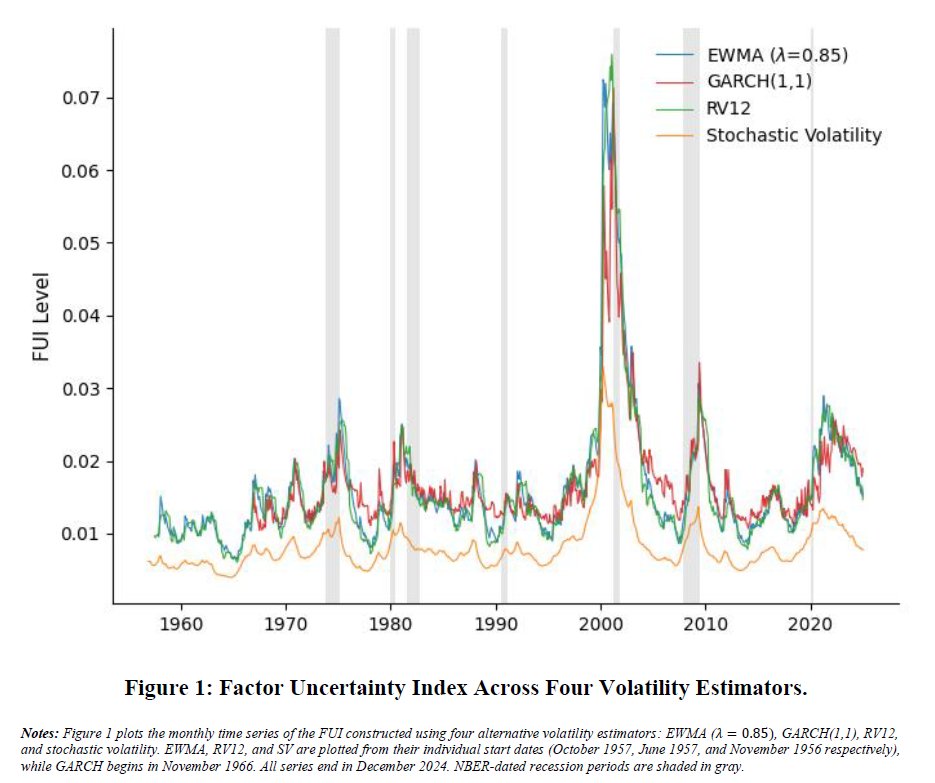
🎯 New Research! Factor uncertainty predicts factor returns. And it's measurable.
The author builds a Factor Uncertainty Index (FUI) from a broad cross-section of equity factors. The insight: aggregate uncertainty across the factor space is itself a signal for future factor returns.
Numbers from the paper:
- Out-of-sample R²: 10–13%
- Predictive power at 12-month horizon: ~30%
- Sharpe with FUI risk scaling: 1.25 → 1.53
This is factor timing with an empirical foundation. The FUI doesn't bet on a single factor; it captures the uncertainty regime affecting the whole cross-section and then adjusts exposure accordingly.
At Noax Capital, we think about factor timing more than most systematic shops are willing to discuss publicly. Indeed, I am actively involved in factor timing research in several dimensions. Papers like this give a cleaner framework for what is otherwise an informal practice. Whether the FUI holds up under live trading conditions remains an open question, but the main intuition is thought-provoking.
📄 Paper: https://t.co/mLAlr1jmLX
→ More research in my newsletter: https://t.co/Xtg63h9wiS