15 things I wish I knew about investing 20 years ago
These tips would change everything for me
Here’s what I wish I knew earlier, so you don’t have to learn the hard way.
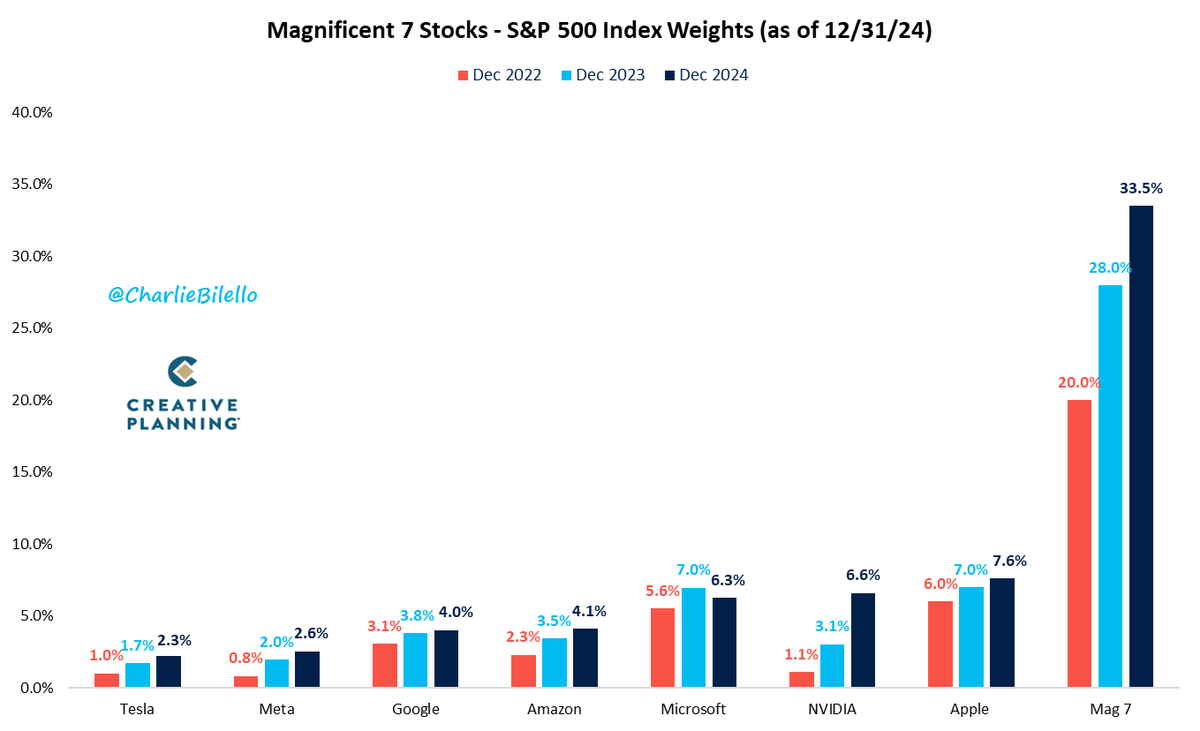
Over a third of the S&P 500 is now concentrated in the "Magnificent Seven" stocks, up from a fifth of the index two years ago.
Video: https://t.co/Sojj2rpHpT
TOP 5 PICKS 2025
“It is not the strongest nor the most intelligent of species that survives, but the one that is most adaptable to change.” – Charles Darwin. This is how I am thinking about 2025.
As a reminder, my Top 5 picks coming into 2024 had a skew of defense and offense. Those were:
$AMZN- Big margin leverage & share gainer in a recession
$META- Reasonable valuation vs growth & AI beneficiary
$TXN- Recovery play in semis & appreciation of fab strategy
$XBI- Valuation tipping point & defensive in a recession
$KWEB- After 3 yrs of punishment by China, tide may be turning
A year ago in my outlook for 2024, I said on CNBC and wrote on January 2nd of 2024: “Looking into 2024, we believe the S&P could gain another 20% (10% from earnings growth and another 10% from multiple expansion) if the Fed does in fact engineer the first soft landing since 1995.” While my forecast was one of the most aggressive at the time following an up 24% year in 2003, the Fed indeed seems to have pulled off a soft landing and the stock market gained 23% in 2024.
My 2025 Top 5 picks also have defense & offense:
Cash - Guaranteed 4% yield in a MMF & dry powder
$CSCO- Networking the data being generated from AI
$KBWB- Deregulation, NIM grows & active capital mkt
$IJJ- New US policies benefit mid (& small) cap value
$ADTN- Optical spend driven by telco carriers & BEAD
Backdrop for 2025
For 2025, I have a combination of more conservative and aggressive options to account for:
1) a solid economy driven by the US consumer
2) but with inflation being the wildcard
3) and AI spending which I predict will go through a period of digestion by mid-2025
My largest concern is about inflation reigniting in late 2025 and the Fed needing to raise rates due to a strong US consumer and pro-growth US fiscal policies which are also inflationary. Therefore my goal is to remain adaptable to the markets reaction to incoming data in 2025. Being patient and waiting for stock market to acknowledge inflection points, both good and bad, in the inflation narrative has served me well over the past four years. Fortunately, I did not believe inflation was transitory in 2021 which had me prepared for the downturn when the market & Fed also finally acknowledged inflation was not transitory in 2022.
S&P Returns Impacted by Mkt views on Inflation
2021 +27%: Fed/mkt ignore CPI rising from 1.4% to 7%
2022 –19%: Fed admits mistake on inflation & hikes
2023 +24%: Fed pause & mkt discounts lower inflation
2024 +23%: Fed cuts & mkt discounts soft landing
I think the odds are almost 50% that the Fed stays on hold or raises rates by late 2025. As a result, much like in 2022, investors may be looking at losses in both stocks and bonds if fears of a 1970s resurgence in inflation arise. As the Fed continued cutting rates, headline PCE bottomed in June with the rest of the headline and core CPI and PCE inflation metrics bottoming in Q3 and started to rise again. But the stock market kept rising & ignored rising inflation much like in 2021. As a reminder in 2021, CPI rose from 1.4% to 7.0% but the S&P rallied 27%. This changed on December 18th when the stock market fell 3% and treasury yields surged after Jerome Powell said the Fed’s inflation forecast has “kind of fallen apart.”
With the S&P trailing PE at 25x versus 19x historically when CPI is between 2.5-3.0% at year end, market multiples are high. A good portion of the multiple premium versus history can be accounted for by 10 year treasury yields at 4.6% versus 5.8% historically when CPI is this high. Having said that, this is why the stock market has been so sensitive ever since the last Fed meeting to any move in rates. It would not surprise me to see 10 year yields go higher as the new administration tries to issue longer dated treasury debt. This would put pressure on stock market multiples.
Q1/2025 guidance could also be disappointing when Q4 results are reported:
1) There will be an ad falloff from the most expensive US election in history in Q1 and no Olympic benefit either for all of 2025.
2) Easter will be on 4/20 this year versus 3/31 last year lowering consumer spending and related ad spending in Q1. Though this should benefit Q2, many companies only give guidance for the following quarter.
3) The US$ ended Q3 at $101 and ended the year at $108. The S&P gets ~30% of revs from international markets which will negatively impact forward guidance when results are reported.
My range of possible outcomes for 2025 of +10% (inflation contained & earnings grow 10%) to down 20% (inflation picking up & market multiples compress) is one of the widest I can remember.
Policies of the incoming administration (& the Fed) have several goals that arguably could produce very different inflationary outcomes for the stock market in 2025 while the economy remains strong:
1. During Trump’s first term, the S&P CAGR was 14%. Extending tax cuts & more deregulation is likely to spur GDP growth but could also be inflationary.
2. Tariffs are likely to help the US economy by driving more domestic manufacturing but could be inflationary to imports.
3. More restrictive immigration policies are likely to reduce government spending over the long-term but increase inflation for lower-end services industries.
4. Central bank rate cuts in 2024 should help drive GDP growth in 2025 but could also risk reigniting inflation.
5. DOGE cutting ~$2 trillion in Federal Government spending by mid-2006 would reduce the federal deficit to GDP back to 3% by 2028 but could also be a ~7% hit to GDP over that time.
6. Producing an additional 3 million barrels of oil a day should help bring down energy costs & inflation but could hurt the oil industry as well through less profitability.
7. AI is deflationary & spending should grow over the next several years but I expect a digestion phase by mid-2025.
Top 5 Picks for 2024 given the wide possible range of outcomes
Cash invested in a money market fund
Cash was also a Top5 Pick of mine for 2022 during which the S&P declined 19%. Money market funds (MMFs) currently offer a guaranteed yield of 4%. Given my concerns about 2025, I believe this is a solid guaranteed return which also leaves dry powder if the market sells off.
$CSCO (Cisco Systems)
Legacy tech company that could re-rate higher as 2025 becomes the year to network the enormous data created by AI infrastructure investment. Over the past two years, there has been an explosion in the volume & density of data created by the AI infrastructure spend. Now the networks will need to be upgraded to catch up and move this data around for enterprises. Cisco’s own internal semiconductor solution called Silicon One is developing into a viable alternative to ASIC solutions while Splunk provides double digit growth in security and data analytics. In Cisco’s October quarter, four different webscalers grew orders over 100% with $300M+ in AI. The PE multiple also has plenty of room to expand at only 16x CY25 for this legacy technology player if it becomes associated more closely with networking the AI infrastructure. Cisco’s nearly 3% dividend yield and relatively low valuation also provides some defense in the event of a stock market downturn.
$KBWB (Bank ETF)
This environment should also specifically benefit bank stocks through less regulation, greater return on loans & more capital markets activity including M&A within the group. The KBWB ETF is a market cap weighted index of companies primarily engaged in US banking activities. The Fund holds large national US money centers, regional banks & thrift institutions. This sector is up just 12% vs 82% for the S&P over the past 5 calendar years after suffering through the banking crisis in 2023 led by the collapse of Silicon Valley Bank, Signature Bank and First Republic Bank in 2023 when treasury yields surged.
While KBWB was up only 9% during the first half of 2024, it rose 22% in the second half with 7% following the election. The potential walking back some of the regulatory proposals of the Basel III Endgame set to be implemented on 7/1/25 should also result in higher dividends and increases in stock buybacks. With the yield curve steepening, I also see net interest margin improving as loan growth improves on pro-growth policies by the new US administration while credit quality remains stable. I almost replaced $KBWB with $WFC (Wells Fargo) given their asset cap imposed by the Fed in 2018 should be finally lifted in 2025. This should enable them to grow again in their higher return businesses but their stock gained 43% in 2024 with some anticipation of this event while KBWB was up 33%. And over the past 2 calendar years, Wells is up 70% while KBWB is up only 27%.
$IJJ (S&P Midcap Value ETF)
Both small and mid-cap value stocks have lagged since the tech spend during Covid & then the AI buildout, but I believe that will change in 2025.
With the world going online during Covid in 2020 and then spending on AI infrastructure starting in 2023, large cap technology stocks have surged over the past five years. As investors rightfully chased these group of large cap momentum stocks, best exemplified by the Magnificent 7. This left the small & mid-cap stocks behind. Over the past five calendar years, the S&P gained 82% while the Nasdaq 100 gained 141% led by the Magnificent 7 that gained 635%. But the S&P midcap index gained just 51% while the S&P small cap index gained just 38%. This performance gap looks even larger over the past 10 years with the S&P up almost 3x, the Nasdaq 100 up 5x but the Midcap & Small Cap Index up under 2x.
But 2025 should see 1) the second Trump administration focused on lower taxes, less regulation and 2) 1% in Fed rate cuts since September helping interest on loans that should benefit small & mid cap stocks. I have been talking about my preference for a more equal weight basket of names since mid-2024. I believe with the recent election that further refining this to the value portion of the small cap and mid cap stocks can enhance returns even more.
Value mid-cap & value small-cap stocks should also be more defensive if 1) inflation does re-ignite like in 2022 and yields rise along with the Fed Funds Rate or 2) if the AI digestion phase I expect is more problematic to the overall market. During the tech bubble collapse, while the S&P was down 44% with the Nasdaq100 down 82%, mid-cap value was up 7% with small cap value down only 1%. The mid-cap S&P and small-cap S&P were down a much greater 23% each during that time. In 2022, they were -14%/-17% respectively but the value segment of each was only -9%/-13%. This was much better than down 19% for the S&P or down 33% for the Nasdaq 100. This outperformance during these two periods of decline (2022 and tech bubble collapse) is why I picked the S&P Midcap Value ETF of $IJJ over the S&P Smallcap Value ETF of $IJS.
$ADTN (Adtran)
Adtran is a small cap (<$1B in market cap), value stock (1.4x EV/Sales vs competitors Calix or Ciena at 2.5-2.8x), that provides networking and comm equipment primarily for telecom carriers. Adtran should benefit from both improving macro conditions & increasing fiber deployment globally:
1) On a macro basis, excess inventory has been depleted at customers after at least a year of oversupply.
2) In Europe, both Deutsche Telekom and British Telecom, where Adtran has 70-100% share, are deploying fiber to the home.
3) In the US, $42.5B in federal BEAD funds for communities with limited broadband access should finally start to flow by mid-year 2025 after being signed into law in 2021. The majority of the funding should be going to optical.
4) ~$100M from sales of buildings with even more from non-core asset sales in 1H:25 should improve Adtran’s balance sheet which has ~$190M in debt at ~8% interest.
5) Adtran’s acquisition of ADVA Optical Networking in mid-2022 has helped add over 10 new customers in 2024 in each of their three product categories with orders improving in all three last quarter.
6) Adtran is also picking up market share following the recent acquisition of Infinera by Nokia & the gradual removal of Huawei from European telecom networks on security concerns.
Originally, I was going to pick the small cap value ETF of $IJS as my 5th Top Pick but $ADTN is a single stock small cap value way to play this same theme with company specific catalysts. Adtran is my riskiest recommendation by far but with the potential in the best case to have the multiple double to be inline with its peers if all events play out as expected.
While these are my best five ideas for 2025 based on the information I have today, my thoughts are constantly evolving based on new information & the reaction of the stock market to that data. In addition, there are always stocks that I expect to struggle that I can use to hedge but that need to be managed even more aggressively given their asymmetric risk to reward. Stocks have infinite upside but can only go to zero.
As always, the key will be to remain intellectually flexible and data dependent. As Charles Darwin said, "It is not the strongest of the species that survives, nor the most intelligent, but the one most adaptable to change."
“The markets only get spooked by an unexpected Fed move when they believe the Fed sees or is sniffing out something that the markets haven’t... https://t.co/oATuFgwFxs
I created a video explaining how the financial system is rigged against us.
It's 90 minutes, in the format of a presentation.
Watching it may be one of the best financial decisions you make 👇
https://t.co/0eJrBBUa8V
Howard Marks is one of the most insightful investors of our time.
Today, he is worth $2 billion and his from Oaktree Capital has over $160 billion in AUM.
Here are 10 lessons I’ve learned from his brilliant writings:
Great explanation from @mjmauboussin on how slight changes in growth rate assumptions can lead to major differences in P/E multiples.
Source: https://t.co/eRi7vd8SZW
The Semiconductor Value Chain
We have created an infographic explaining the complex industry dynamics of semiconductor manufacturing, showing how key players like $TSM, $NVDA, $ASML, $TXN, and $CDNS fit into the ecosystem: