A few takeaways from Warsh's first appearance before the House Financial Services Committee:
1. Warsh repeatedly defended his agenda by pointing to how the Fed had failed to restore price stability after 2022-23. He delivered a particularly pointed critique of the 2020 framework change:
"The Fed changed its academic framework and its operational framework and it led to higher prices, which did more harm to the least well off among us than any policy that I could have imagined. That's why we have to reform it." (He has made this critique before, but it lands differently when it's being made by the chairman before a congressional committee).
2. Warsh suggested that current inflation might be more deeply embedded:
"We cannot have a direct immediate effect on short-term particular prices at the grocery store and agricultural goods. But the job you gave us and the job we are resolute about accomplishing is to make sure that any short-term changes in particular prices don't broaden out. Don't change to a generalized change in the price level. Unfortunately, that's what's happened in the last 63 months.... The longer that prices have been above the inflation target, it's usually a bit harder to dislodge them and get them lower. Our job, my commitment to you is to take sticky prices and to unstick them."
3. Warsh suggested every Fed meeting should be live.
"Over the coming period, I'm going to ask our colleagues and have a good family fight about the extent and timing in which we would need to deploy those" tools.
He dismissed the June CPI as "one data point.... I don't want to overread or cherry-pick data. There might be some that look at this morning's data and say, 'Oh, mission accomplished. Everything is swell.' That is not my view."
DOLLAR WEAKENS AS U.S. INFLATION COOLS
The U.S. dollar fell after June inflation slowed more than expected, reducing expectations for near-term Federal Reserve rate hikes.
However, escalating U.S.-Iran tensions are pushing oil prices higher, potentially reviving inflation concerns.
The euro and pound gained, while the Japanese yen remained near 40-year lows.
About an hour and 40 minutes into this hearing, someone asked Kevin Warsh about the June CPI:
"It’s one data point.... I don’t want to overread or cherry pick data.
"There might be some who look at this morning's data and say, 'Well, mission accomplished, everything is swell.' That is not my view."
Warsh: Fed has “no tolerance for persistently elevated inflation”
“If we get policy right—and we will—the inflation surge of the last five years will be a thing of the past.” https://t.co/RvCRxzdPuS
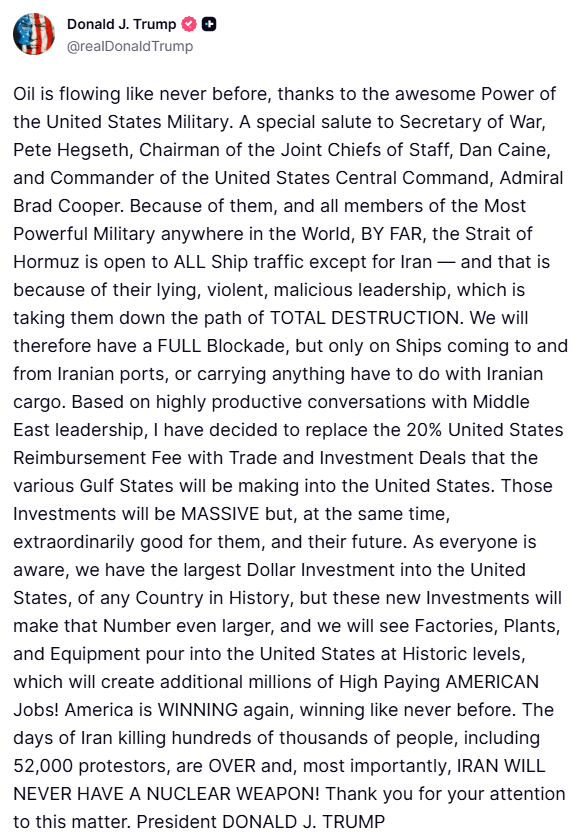
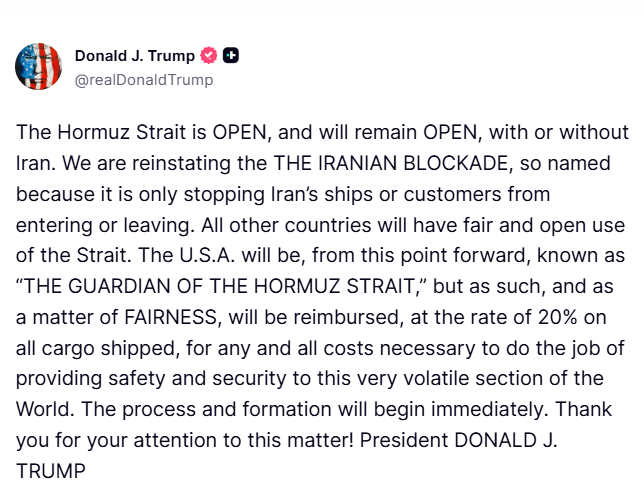
TRUMP TO REPLACE 20% HORMUZ CARGO FEE WITH TRADE DEALS
"I have decided to replace the 20% United States Reimbursement Fee with Trade and Investment Deals that the various Gulf States will be making into the United States"
Economists expect the decline in energy prices last month to pull down the headline CPI for June
But for the Fed, core matters more right now
The core CPI is expected to land close to May's +0.21%, after which, attention will turn to the PPI and what that implies for the PCE
FED AT A CROSSROADS: RATE HIKE BACK ON THE TABLE
Fed Governor Christopher Waller warned that another hot core inflation reading could force policymakers to consider raising interest rates soon.
While the US economy remains resilient, persistent price pressures from tariffs, energy and AI infrastructure are raising concerns.
Tuesday’s inflation data could be decisive.
Fed governor Chris Waller says a rate hike should be on the table if this week's inflation data come in hot, his clearest signal yet he could back a July move.
He lays out what he says is a “credible case” to hold steady if inflation cooperates but pairs it with this warning about talking tough without acting: "Sternly staring at inflation until it melts before our withering gaze is not an option.”
BREAKING: The Aghajari Oil and Gas Airport in Omidiyeh, Iran, has been hit by US airstrikes.
Almost all cities in Khuzestan Province have been struck in the past three hours.
🇮🇷🇺🇸 Iran tells Trump to pull U.S. forces out or they’ll attack.
U.S. official confirmed, saying they expect a bigger wave of strikes on Iran today than the previous days.
Source: NYT, Fox News / Writer: Claudio
The Strait of Hormuz’s southern route remained open to shipping on Sunday despite Iran declaring the waterway closed as tit-for-tat attacks between the US and Tehran escalated, a maritime advisory group said. https://t.co/VDuBFERfkR
US-IRAN CONFLICT ESCALATES AS HORMUZ CLOSES
US forces struck Iran for the third time in a week after Tehran attacked a Cyprus-flagged container ship.
Iran retaliated with missile and drone attacks targeting US-linked sites across the Middle East. Minor damage and several injuries were reported, with no confirmed deaths.
Tehran declared the Strait of Hormuz closed “until further notice,” escalating tensions and threatening global energy supplies.
Despite intensifying attacks, both sides say diplomatic talks remain possible.
For the record.
Kevin Warsh’s Quiet Regime Change at the Fed
Kevin Warsh is not a hawk. He is a pro-growth monetary reformer who wants to restore price stability, reject mission creep, and rebuild a constitutional central bank that uses modern data instead of stale models, Phillips curves, and Keynesian reflexes. Yes, Wall St consensus is wrong again.
Like Scott Bessent, Warsh understands that the Fed’s deepest problem is institutional sprawl. A central bank meant to preserve monetary stability has drifted into credit allocation, financial repression, and de facto debt management. His answer is to narrow the remit, shrink the balance sheet, and scrape away the layers of forward-guidance theater that turned FOMC language into a third policy instrument. The implicit logic of a smaller, quieter Fed balance sheet is more private credit creation, capital formation moves back into markets rather than remaining warehoused on a taxpayer-backed public portfolio.
Warsh also rejects the old Phillips curve intuition that strong growth and tight labor markets are inherently inflationary threats. He is not anti-growth, he is anti-fiscal dominance. In his framework, inflation comes from policy error, too much monetary accommodation for too much fiscal excess, not from prosperity itself. That is why he can be pro-AI, pro-crypto, and broadly supply-side at the same time. He sees productivity growth, technological innovation, and new forms of private capital formation as disinflationary forces when the nominal anchor is credible.
Just as important, Warsh appears to grasp the constitutional arrangement. The Fed is not supposed to moonlight as an all-purpose technocratic state. It is supposed to preserve the currency, provide monetary order, and leave the rest to elected officials and private markets. That requires price stability first, but it also requires better inputs, more modern data, more market signals, less faith in lagging aggregates and broken academic priors.
This is not hawkishness. It is a bid to replace an antiquated Keynesian institution that has come to act as if it were above the constitution with a narrower, pro-growth, market-facing Fed that stabilizes money, scraps pseudo-scientific forward guidance, and gets out of the way.
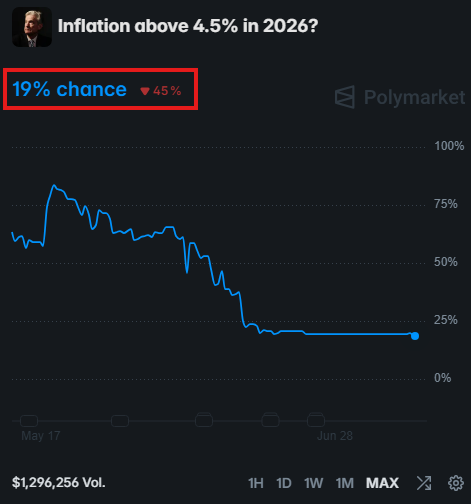
BREAKING: The odds of inflation rising above 4.5% in 2026 fall to a new low of just 19%.
Just 7 weeks ago, there was an 85% chance of inflation rising above 4.5% this year.
Inflation expectations are coming down again.