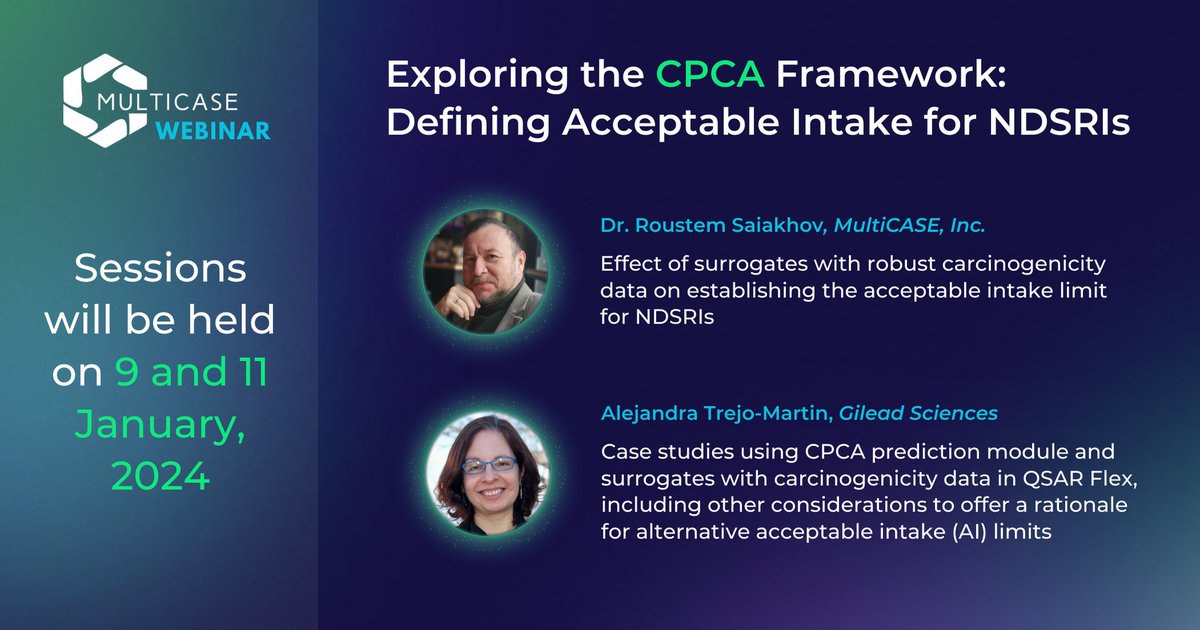
📣 Last chance to sign up for our webinar: Exploring the CPCA Framework: Defining Acceptable Intake for NDSRIs on 9 and 11 January!
🔗 Use this link to register for any of our 3 sessions: https://t.co/5qf16oyBOf
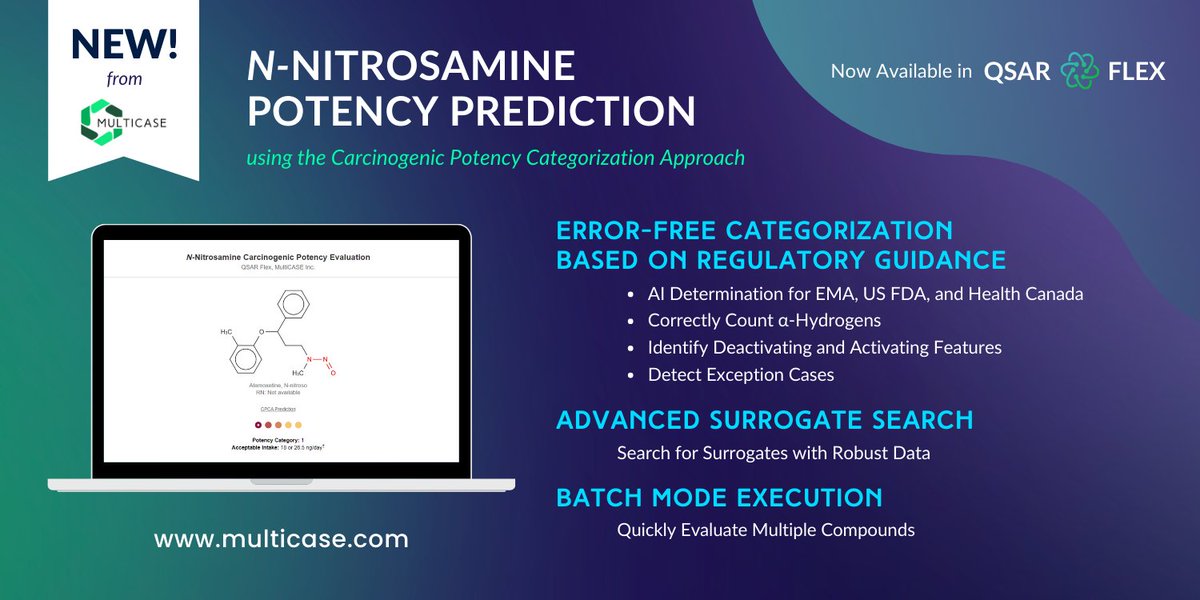
Introducing our new N-Nitrosamine Potency Prediction module for QSAR Flex! 🧪
✅ Aligns with EMA and US FDA AI limit standards
🤖 Predicts potency category via automated CPCA workflow
🔍 Advanced surrogate search & exclusion recognition for streamlined NA assessments
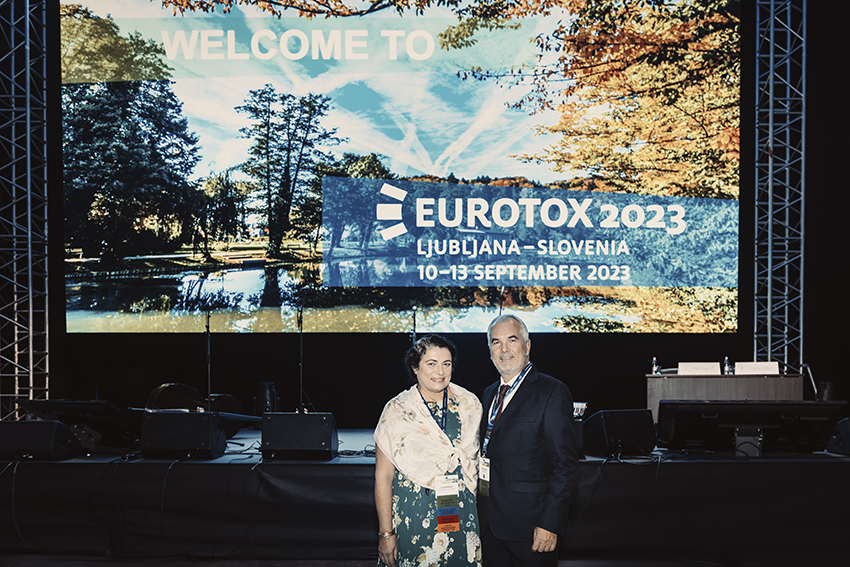
What a great start of #EUROTOX2023!
More than 1,000 delegates already at the registration desk, followed by an atmospheric and dynamic opening ceremony!
So many reasons to look forward to the second day of the congress!
Welcome to #Ljubljana everyone!
#toxicology
Exciting news! 🌍In <1 month, we'll be in beautiful Ljubljana, Slovenia for #EUROTOX. Join us on 11th Sept for an insightful industry session that you won't want to miss! Let's explore cutting-edge toxicology together. See you there! 🇸🇮🔬 #ToxicologyTrends#ScienceConference
Did you get a chance to catch the Safer World By Design webinar with MultiCASE's Mounika Girireddy?! If not, catch the recording here to learn about QSAR models for endocrine disruption 💻 https://t.co/eWmJIEI25k
Chief Scientist S. Chakravarti will discuss challenges in NDSRI evaluations while introducing novel methods to overcome data scarcity at the upcoming GTA meeting. Can't attend the GTA meeting in person? No worries! Presentation slides will be available after the event.
We're pleased to announce that we have completed a part of our research on the N-nitrosamine evaluation, and we're excited to share our findings with the community in the form of a preprint: https://t.co/NzqV5nymtz
At this year's #2023SOT MultiCASE will be presenting a poster on building layered in silico workflows for extractable and leachable risk assessments: https://t.co/vDh5QiEELE #2023SOT
We're looking forward to sharing some of our latest science with the greater tox community!
Our latest book chapter, “Scalable quantitative structure–activity relationship systems for predictive toxicology” recognizes scalability in a broader context which includes an interpretable reporting system as a vital component for distributing results from complex QSAR systems.
Wow, only one more day until the #ACTOX2022 in Denver ✈️✈️✈️
We're looking forward to connecting with everyone at Booth #102. Come say hello to learn more about our computational tools for real world risk assessments
We're looking forward to attending the 43rd Annual @ACToxicology conference in Denver Colorado this month where MultiCASE Chief Scientist Suman Chakravarti will be presenting on applying computational approaches for assessing the carcinogenic potency of #nitrosamines
The ASCCT conference theme 'Shifting the Paradigm to Next-Generation Quantitative Risk Assessment' is a welcome setting for our work on combining in vivo
& in vitro assays to build predictive models for assessing endocrine disruption potential.
MultiCASE will be exhibiting at #ICT2022congress in Maastricht at the end of this week.
Visit Booth #1 to explore the latest in silico solutions available for risk assessments
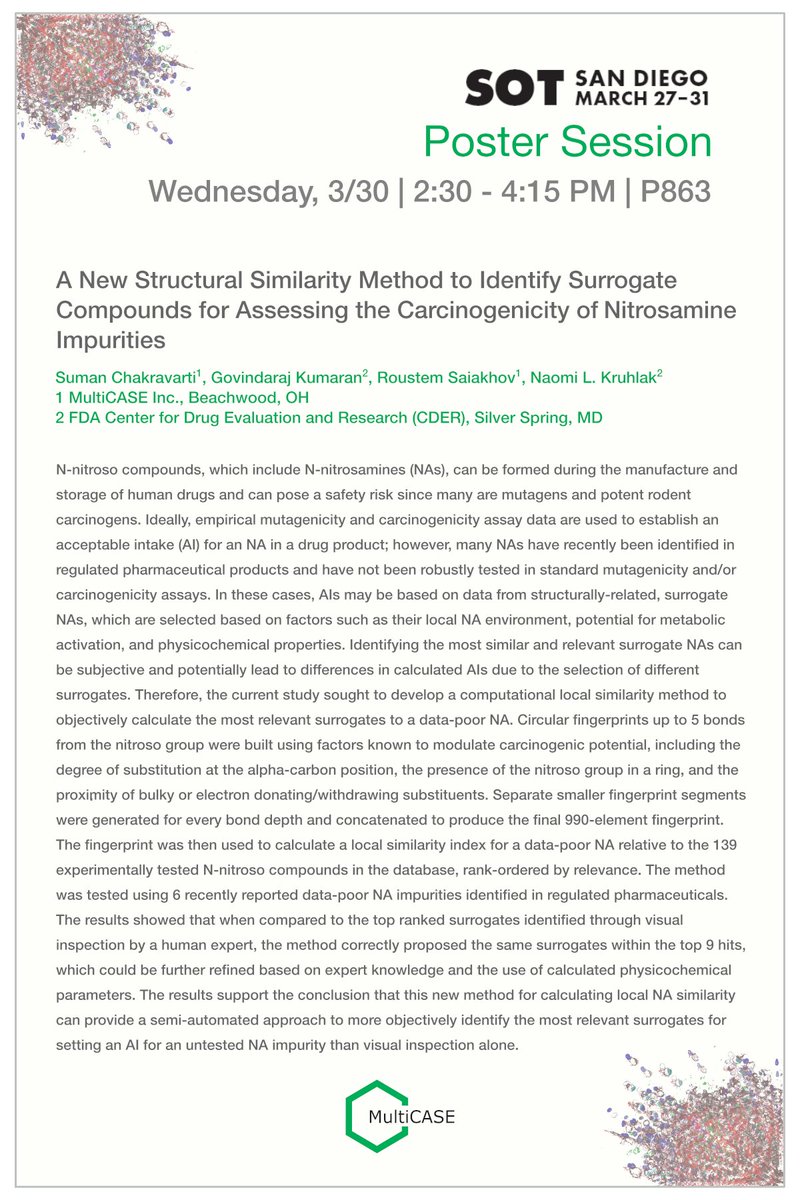
MultiCASE scientists have co-authored a poster on assessing the carcinogenicity of nitrosamine impurities in collaboration with FDA Center for Drug Evaluation and Research (CDER) for the upcoming @SOToxicology 61st Annual Meeting
Come say 👋 at #ToxExpo Booth 1315
#2022SOT
Our latest book chapter in collaboration with Emilio Benfenati on in silico Methods for Predicting Drug Toxicity includes cutting-edge techniques
and key implementation advice from our QSAR experts: MultiCASE Platform for In Silico Toxicology https://t.co/sPVWM3WVPh
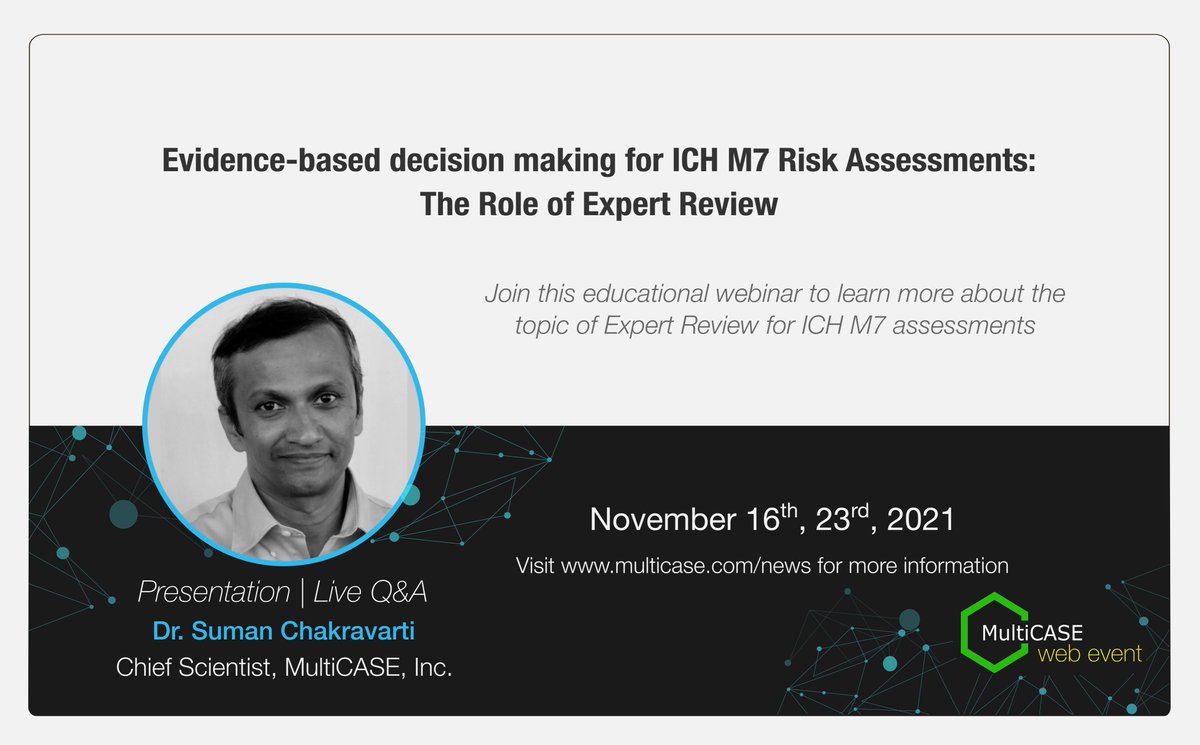
Webinar: Evidence-based decision making for ICH M7 Risk Assessments: The Role of Expert Review
Learn how the MultiCASE Konsolidator tool augments the expert review process to reach an informed decision during ICH M7 classification.
https://t.co/fyhdvG0r48
Join Session 11 at #OpenTox2021 for excellent presentations on using (Q)SAR predictions for Mutagenicity, Metabolism, and Skin Sensitization risk assessment
https://t.co/okp3T7F6tv
The #OpenTox 2021 Virtual Conference begins next week!
Join Session 11 to hear presentations on (Q)SAR predictions for toxicity assessments across multiple endpoints including Mutagenicity, Skin Sensitization, Metabolites, and Human Adverse Effects.
https://t.co/okp3T7nvBX